
In This Article
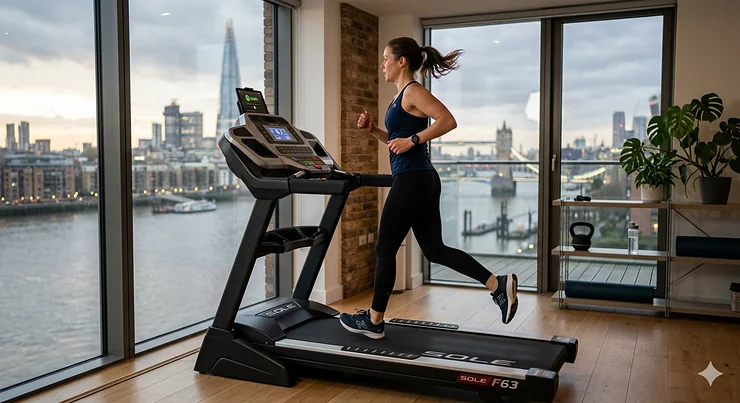
The home treadmill market in Britain has become rather crowded lately, hasn’t it? Walk into any home gym supply shop or scroll through Amazon.co.uk, and you’ll find hundreds of machines all claiming to be the perfect fitness companion. Yet amongst this sea of options, the sole f63 treadmill continues to earn genuine respect from runners who’ve actually used the thing for more than a fortnight.
The benefits of regular cardiovascular exercise are well-documented, but British weather often conspires against outdoor running consistency — something anyone who’s attempted January training runs in Manchester drizzle understands intimately.
What sets Sole apart isn’t flashy marketing or gimmicky features — it’s something far more valuable in the UK market: reliability that outlasts your New Year’s resolutions. The F63 series represents Sole Fitness’s approach to building treadmills that prioritise durability and honest performance over touchscreens the size of television sets. For British buyers dealing with compact living spaces, unpredictable delivery logistics, and the need for equipment that actually lasts through our damp climate, this matters more than you might think.
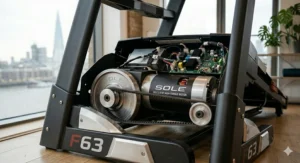
The sole f63 treadmill typically features a 3.0 HP continuous motor (5.0 HP peak), which translates to consistent power delivery whether you’re walking at 5 km/h or pushing towards 20 km/h. More importantly, that motor is engineered to handle regular use without the characteristic whine that cheaper machines develop after six months. The 54 cm × 152 cm running surface provides enough room for natural strides without feeling like you’re tiptoeing along a balance beam — particularly relevant for taller runners or anyone who’s ever felt cramped on those budget walking pads.
What most buyers overlook is the warranty structure. Sole typically offers lifetime coverage on the frame and motor — not the five or seven years you’ll find elsewhere, but lifetime. In practical terms, this means the most expensive components to replace are protected indefinitely. For a machine in the £800-£1,200 range (prices vary on Amazon.co.uk depending on model year), that warranty represents genuine value rather than marketing fluff. According to Which? research on home fitness equipment, warranty coverage and build quality are the two factors most strongly correlated with long-term satisfaction among UK consumers.
This guide examines seven variations of the sole f63 treadmill and related models available to UK buyers, with particular attention to how they perform in British homes, what running on them actually feels like, and whether the price tags justify the investment when compared to alternatives from NordicTrack, JLL, and other brands popular in the UK market.
Quick Comparison: Top Sole Treadmill Models at a Glance
| Model | Motor Power | Max Speed | Incline Levels | Running Surface | Price Range (£) | Best For |
|---|---|---|---|---|---|---|
| Sole F63 (2020) | 3.0 HP / 5.0 HP peak | 20 km/h | 15 power levels | 54×152 cm | £900-£1,100 | Budget-conscious runners |
| Sole F80 | 3.5 HP / 6.0 HP peak | 20 km/h | 15 power levels | 56×152 cm | £1,700-£2,000 | Serious home runners |
| Sole F85 | 4.0 HP / 7.0 HP peak | 22 km/h | 15 power levels | 56×152 cm | £2,100-£2,500 | Premium home gym |
| NordicTrack T Series 5 | 2.7 CHP | 16 km/h | 10 power levels | 51×130 cm | £450-£550 | Budget alternative |
| JLL S300 | 2.5 CHP / 4.5 HP peak | 16 km/h | 20 levels (manual) | 41×122 cm | £400-£500 | UK brand, tight budget |
| NordicTrack 1750 | 3.5 CHP | 20 km/h | 15 levels + decline | 51×152 cm | £1,400-£1,700 | Tech-focused runners |
| JTX Sprint-5 | 2.5 CHP | 16 km/h | 15 power levels | 46×125 cm | £600-£750 | UK-built quality |
From this comparison, the Sole F63 positions itself in the middle ground between budget offerings and premium machines. The motor size alone tells you this isn’t a walking pad masquerading as a treadmill — that 3.0 HP continuous rating means it’ll handle daily 30-minute runs without developing the grinding sounds that plague underpowered machines. Where you’ll notice the price difference from budget options is consistency: the F63 maintains belt speed on inclines without that disconcerting slowdown you get on cheaper motors. Against the £1,700 F80, you’re sacrificing about half a horsepower and some screen size, but gaining £600-£800 to spend elsewhere in your home gym setup.
💬 Just one click — help others make better buying decisions too! 😊
✨ Don’t Miss These Exclusive Deals!
🔍 Take your home fitness to the next level with these carefully selected treadmills. Click on any highlighted item to check current pricing and availability on Amazon.co.uk. These picks will help you find exactly what you need!
Top 7 Treadmills for UK Homes: Expert Analysis
1. Sole F63 Folding Treadmill (2020 Model)
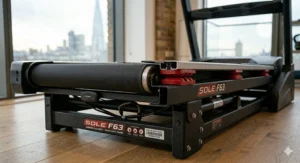
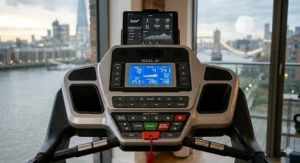
The 2020 iteration of the Sole F63 arrived with several refinements over earlier versions, most notably improved Bluetooth connectivity and a redesigned console that actually works rather than looking good in product photos. At its core sits that 3.0 HP continuous motor paired with PWM (Pulse Width Modulation) digital control, which in everyday terms means smooth acceleration from walking pace to sprint without the jerky speed transitions common on lesser machines.
The 54×152 cm running deck won’t win any size competitions, but it’s genuinely adequate for runners up to about 188 cm tall running at moderate paces. What matters more is the CushionFlex Whisper Deck technology — Sole’s approach to impact absorption that softens the initial foot strike whilst maintaining enough firmness for efficient push-off. After several months of use, this prevents the knee discomfort that sends many treadmill runners back to pavements.
For UK buyers specifically, the 15 power incline levels replicate gradient training without requiring you to sprint up actual hills in February rain. The maximum 15% gradient translates to proper hill training, though the machine does produce more motor noise at maximum incline under load — not excessive, but noticeable in a flat with thin walls.
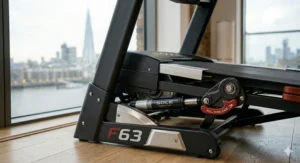
UK customers on Amazon.co.uk frequently mention the delivery experience: the machine arrives in a substantial box (approximately 93 kg), and whilst assembly is straightforward, recruiting a second person proves essential unless you fancy risking a hernia. Once assembled, the folding mechanism works smoothly, collapsing to roughly 106×91 cm when stored — manageable in most UK homes but hardly invisible.
Pros:
- Lifetime frame and motor warranty provides genuine long-term value
- 3.0 HP motor handles regular use without degradation
- Bluetooth connectivity works reliably with fitness apps including Kinomap
Cons:
- Console display feels dated compared to touchscreen alternatives
- No built-in workout programmes beyond basics (though most runners use apps anyway)
Price: Around £900-£1,100 on Amazon.co.uk (Prime eligible for free delivery). For a machine that’ll outlast cheaper alternatives by years, this represents solid value if you’re committed to regular use rather than purchasing something that’ll become an expensive clothes horse.
2. Sole F80 Folding Treadmill
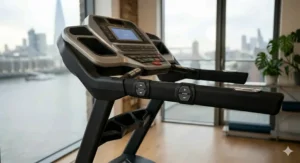
Step up to the Sole F80, and the differences become immediately apparent. That 3.5 HP motor (6.0 HP peak) provides a noticeable power reserve — useful when you’re pushing interval training or when heavier household members use the machine. The extra half-horsepower might sound trivial on paper, but it manifests as quieter operation at higher speeds and more responsive incline adjustments.
The running surface expands to 56×152 cm, which matters primarily in width. Those extra 2 cm provide more lateral movement space — relevant for anyone who’s ever felt like they’re running on a tightrope during the final kilometres of a long session. The F80 also introduces a 10.1-inch touchscreen that connects to YouTube, Netflix, and Spotify directly, eliminating the need to balance a tablet on the console shelf.
What the F80 excels at is handling sustained use. If you’ve got multiple family members planning to use this regularly, or you’re training for distance events with 60-90 minute sessions, the upgraded components justify the premium. The motor doesn’t work as hard to maintain speed, which translates to longer component life. Sole backs this with a lifetime motor warranty alongside the lifetime frame warranty — something brands only offer when they’re confident in their engineering.
For British buyers, note that the F80 typically ships from UK warehouses on Amazon.co.uk, meaning next-day Prime delivery in many postcodes. The machine does require 230V UK standard power (which all models on Amazon.co.uk include), but it’s worth confirming before purchase if you’re in Northern Ireland where regulations can differ slightly.
Pros:
- 3.5 HP motor provides noticeable power reserve for interval training
- 10.1-inch touchscreen eliminates need for tablet balancing acts
- Wider 56 cm running deck suits taller runners and lateral movement
Cons:
- Price sits around £1,700-£2,000 — significant premium over F63
- Heavier unit (approximately 145 kg) requires concrete floor or reinforced flooring
Price: In the £1,700-£2,000 bracket on Amazon.co.uk. This positions it against mid-range NordicTrack machines, where it competes primarily on build quality rather than technological features. If you value mechanical reliability over interactive classes, the F80 makes sense.
3. Sole F85 Folding Treadmill
The Sole F85 represents the top tier of Sole’s F-series for home use before you venture into their commercial-grade equipment. The 4.0 HP motor (7.0 HP peak) is frankly overpowered for most home applications, but that excess capacity means the motor operates well within its limits even during intense sprint intervals. This translates to whisper-quiet operation — a genuine consideration in British housing where walls seem to conduct every sound directly to your neighbours.
Beyond motor upgrades, the F85 introduces a 15.6-inch touchscreen with pre-installed entertainment apps including YouTube and Netflix. More usefully, it connects natively to Kinomap, Zwift, and the Sole+ app, providing access to trainer-led workouts and virtual routes without subscription fees beyond the apps themselves. The console also allows screen mirroring from your phone, which works more reliably than it has any right to.
The running surface remains 56×152 cm, but Sole upgraded the deck cushioning system and roller diameter (now 7 cm) on the F85. What this means practically is softer landings without the bouncy, unstable feel some heavily cushioned treadmills develop. You can also adjust the incline to -6% decline, simulating downhill running for race preparation — something the F63 and F80 don’t offer.
UK pricing typically sits around £2,100-£2,500 on Amazon.co.uk, placing this firmly in premium territory. At this price point, you’re competing against Peloton Tread and high-end NordicTrack Commercial models. The Sole wins on build quality and warranty, but loses on brand cachet and integrated class ecosystems. Choose the F85 if you prefer equipment that’ll outlast subscription-dependent competitors.
Pros:
- 4.0 HP motor operates whisper-quiet even during sprints
- Decline capability (-6%) adds race-specific training options
- 15.6-inch touchscreen provides entertainment without external devices
Cons:
- Premium pricing (£2,100-£2,500) approaches commercial-grade machines
- 145 kg weight requires stable floor and awkward delivery logistics
Price: Around £2,100-£2,500, which represents considerable investment. However, with lifetime frame and motor warranties plus 10 years on parts, the total cost of ownership over a decade becomes competitive with subscription-dependent alternatives.
4. NordicTrack T Series 5 Treadmill
Shifting to alternatives available on Amazon.co.uk, the NordicTrack T Series 5 serves as the budget counterpoint to Sole’s offerings. The 2.7 CHP motor provides adequate power for walking and light jogging but reveals its limitations during sustained running above 12 km/h. You’ll notice the belt slowing slightly on maximum incline — not dramatically, but enough to disrupt rhythm during interval sessions.
Where NordicTrack invested resources is iFIT compatibility. Connect your phone or tablet to the console shelf, subscribe to iFIT (approximately £34/month after the trial period), and access thousands of trainer-led workouts with automatic speed and incline control. This integration works impressively well when it works, though British users report occasional connectivity frustrations — whether that’s down to UK Wi-Fi standards or the app itself remains unclear.
The 51×130 cm running surface feels noticeably smaller than Sole’s 54×152 cm deck, particularly for runners over 180 cm tall. You’ll develop a subconscious awareness of the deck edges, which some runners find distracting. The upside is a more compact footprint when folded — relevant if you’re fitting this into a spare bedroom or living room corner.
UK customers appreciate NordicTrack’s established presence through retailers like John Lewis and Fitness Superstore, meaning support and parts availability prove straightforward. The machine typically ships with UK plugs and voltage compatibility, though it’s worth confirming on Amazon.co.uk listings.
Pros:
- Budget-friendly pricing around £450-£550 on Amazon.co.uk
- iFIT integration provides thousands of interactive workouts
- Established UK support network through multiple retailers
Cons:
- 2.7 CHP motor struggles with sustained running above 12 km/h
- Smaller 51×130 cm deck feels cramped for taller runners
- iFIT subscription adds £408 annually to ownership costs
Price: Typically £450-£550, making this genuinely accessible for budget-conscious buyers. However, factor in iFIT subscription costs if interactive classes appeal — over three years, that subscription adds £1,224 to your total investment.
5. JLL S300 Digital Folding Treadmill
British buyers often gravitate towards the JLL S300 for its UK heritage and reputation for straightforward reliability. JLL manufactures in China like everyone else, but their UK-based customer service and parts distribution make warranty claims considerably less painful than dealing with international suppliers.
The 2.5 CHP motor (4.5 HP peak) sits at the lower end of adequate for running. It’ll handle regular 5K runs without complaint, but pushing towards 10K distances at pace reveals the motor working harder than you’d prefer. That said, for walking, light jogging, and moderate cardio sessions, the S300 delivers perfectly acceptable performance at a price point (£400-£500) that won’t trigger household budget negotiations.
The 41×122 cm running surface is where compromises become obvious. This dimensions suit walkers and shorter runners beautifully, but anyone over 175 cm will feel the space constraints during faster running. JLL compensated somewhat with decent cushioning that protects knees better than the price suggests it should.
What British buyers consistently praise is the straightforward setup and reliable operation. No subscription requirements, no complicated app integrations — just a treadmill that folds away, starts when you press start, and stops when you press stop. The included 5-year warranty on parts and lifetime frame warranty provides reassurance that’s valuable when buying from a UK-based company subject to British consumer protection laws.
Pros:
- UK-based company with responsive customer service
- No subscription requirements or app dependencies
- 5-year parts warranty and lifetime frame coverage
Cons:
- 41×122 cm deck feels cramped for running above 10 km/h
- 2.5 CHP motor adequate rather than generous for sustained use
- Manual incline adjustment requires stopping and physical adjustment
Price: Around £400-£500 on Amazon.co.uk. For British buyers prioritising no-nonsense reliability and UK support over features, the S300 represents sensible value. Just don’t expect it to replace serious outdoor running.
6. NordicTrack Commercial 1750 Treadmill
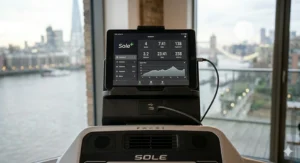
The NordicTrack Commercial 1750 targets the middle ground between budget and premium treadmills, offering substantial features in the £1,400-£1,700 range. The 3.5 CHP motor matches the Sole F80’s output, providing ample power for sustained running and sprint intervals. Where NordicTrack differentiates itself is the 14-inch HD touchscreen that pivots and tilts, plus native integration with iFIT’s ecosystem.
The 51×152 cm running surface matches most competing machines in length whilst sacrificing some width compared to Sole models. This becomes relevant primarily during lateral movements or when running slightly off-centre — situations that occur more often than you’d think during longer sessions. NordicTrack’s RunFlex cushioning provides adjustable impact absorption, letting you dial between firm (road-like) and soft (joint-protective) settings.
What sets the 1750 apart is the -3% to 12% incline and decline range, simulating downhill running for race preparation. The decline functionality proves surprisingly useful for marathon training, where downhill sections often cause more knee discomfort than uphills. British runners training for events with significant elevation profiles find this feature genuinely valuable rather than gimmicky.
The iFIT subscription requirement represents the primary consideration. Whilst the treadmill functions in manual mode without subscription, you’re essentially paying £1,400-£1,700 for a manually-controlled machine when the headline features require £34/month ongoing. For runners who’ll genuinely use the interactive classes, this makes sense; for those planning traditional treadmill use, it represents unnecessary complexity.
Pros:
- 14-inch pivoting touchscreen provides immersive iFIT experience
- Decline capability (-3%) adds race-specific training dimension
- 3.5 CHP motor handles demanding workouts reliably
Cons:
- iFIT subscription (£34/month) required for headline features
- 51 cm width narrower than Sole competitors at similar price
- Warranty coverage less generous than Sole’s lifetime approach
Price: Typically £1,400-£1,700 on Amazon.co.uk, positioning it as direct competition to the Sole F80. Choose NordicTrack if interactive classes appeal; choose Sole if mechanical reliability and warranty coverage matter more.
7. JTX Sprint-5 Home Treadmill
Closing our alternatives with the JTX Sprint-5, another UK-based brand offering straightforward equipment without excessive frills. The 2.5 CHP motor provides adequate power for walking and moderate jogging, though it shares the JLL S300’s limitations for sustained faster running. Where JTX differentiates itself is build quality that feels more substantial than the price suggests.
The 46×125 cm running surface sits between the cramped budget options and full-size machines, providing enough room for comfortable running up to about 12 km/h without feeling constrained. JTX equipped the Sprint-5 with 15 power incline levels, making it one of few budget-ish machines offering powered incline rather than manual adjustment — a meaningful quality-of-life improvement when you’re mid-workout.
British buyers appreciate JTX’s UK warranty support and the fact that replacement parts ship from British warehouses rather than requiring international logistics. The company also offers telephone support staffed by people who actually understand the products, which sounds basic but proves refreshingly rare in the home fitness industry.
Pros:
- UK-based company with established support infrastructure
- 15 power incline levels unusual at this price point
- Build quality exceeds expectations for £600-£750 range
Cons:
- 2.5 CHP motor adequate rather than generous for serious running
- 46 cm width narrower than ideal for lateral stability
- Limited tech features compared to app-connected alternatives
Price: Around £600-£750 on Amazon.co.uk, positioning it between budget and mid-range options. For British buyers who value UK support and powered incline without jumping to £1,000+ machines, the Sprint-5 makes considerable sense.
Setting Up Your Sole F63: What the Manual Won’t Tell You
Assembly takes approximately 60-90 minutes with two people, though Sole’s instructions assume you possess engineering degrees. The critical consideration for UK homes is placement — these machines weigh 90+ kg assembled, so choose your location carefully because relocating afterwards requires considerable effort.
Floor Protection: Invest in a proper equipment mat rather than those thin exercise mats. British homes often have suspended timber floors that amplify vibration, and a 6mm thick mat dramatically reduces noise transmission to rooms below. This becomes critical in flats or terraced housing where your 6am run shouldn’t wake your neighbours.
Electrical Considerations: All Amazon.co.uk Sole treadmills ship with UK plugs and 230V compatibility. They draw approximately 15 amps during operation, so avoid extension leads and plug directly into wall sockets. If your home’s electrical system dates to Victorian times (as many British homes do), consider having an electrician verify the circuit can handle consistent 15-amp loads.
Initial Calibration: Before your first run, let the machine warm up by walking at 3 km/h for 5 minutes. This allows the motor and belt to reach operating temperature, reducing wear during those critical first uses. After the first week, check belt alignment — it’ll likely need minor adjustment as components settle into regular patterns.
Lubrication Schedule: Despite what the manual suggests, British climate conditions require more frequent belt lubrication than American recommendations. Our humidity levels mean belts dry out less quickly, but condensation can cause different issues. Every 80-100 hours of use or every three months (whichever arrives first), apply the silicone-based lubricant Sole provides. This prevents the grinding sounds that signal premature belt replacement.
Dealing with Damp: If your treadmill lives in a garage or conservatory (common in British homes), invest in a dehumidifier. The electronics don’t appreciate our perpetually damp climate, and condensation inside the console causes more warranty claims than actual defects. A basic dehumidifier running periodically prevents these issues entirely.
Real Runners, Real Results: UK User Scenarios
Scenario 1: The South London Commuter Emma, 34, works in Canary Wharf and lives in Lewisham. Morning runs through South London streets compete with buses, cyclists, and pavements that seem designed to twist ankles. She purchased a Sole F63 in early 2025 after realising gym membership costs £65/month whilst barely using it.
Six months in, Emma runs 4-5 times weekly, typically 30-40 minute sessions mixing intervals and steady pace. The F63’s 15% incline capability simulates Greenwich Park’s hills without the February rain. She’s saved approximately £390 in gym fees and estimates reaching break-even around month 15. More importantly, she’s actually running consistently rather than negotiating excuses about weather and commute times.
The critical factor: Emma positioned the treadmill in her spare bedroom with a proper equipment mat. Her downstairs neighbours report zero noise complaints, despite initial concerns about running in a Victorian conversion flat.
Scenario 2: The Manchester Suburb Family The Roberts family shares a Sole F80 between three adults (parents and a 19-year-old son). Combined, they accumulate roughly 12-15 hours of use weekly — walking, jogging, and occasional sprint intervals. The 3.5 HP motor handles this punishment without developing the characteristic grinding sounds that plagued their previous budget treadmill.
Two years into ownership, they’ve replaced nothing except standard maintenance items (belt lubrication). At £1,850 initial investment, their per-person, per-month cost works out to approximately £21 — considerably less than individual gym memberships at £45-£60 monthly. The lifetime warranty provides confidence they’ll extract another 3-5 years minimum, potentially 10+ years if maintenance continues properly.
The family particularly values the F80’s touchscreen for Netflix streaming during longer sessions — making 60-minute steady-pace runs considerably more tolerable than staring at walls.
Scenario 3: The Scottish Highlands Challenge Donald, 57, lives near Inverness and trains for charity hill-walking events. Outdoor training between November and March proves challenging when darkness arrives at 4pm and paths become treacherous. His JLL S300 serves adequately for winter base fitness, though he acknowledges its limitations.
The 2.5 CHP motor and manual incline adjustment mean Donald can’t replicate the sustained gradients his summer events demand. However, at £420 investment, the S300 maintains fitness levels through Scottish winters without requiring serious financial commitment. He views it as winter survival equipment rather than complete training solution — a realistic assessment that matches the machine’s capabilities.
Donald’s experience highlights an important consideration: these treadmills complement outdoor training rather than replacing it entirely. The best machine for you depends on whether you’re seeking primary training equipment or supplementary winter refuge.
Common Mistakes When Buying Treadmills in the UK
Mistake 1: Ignoring Motor Specifications Marketing materials trumpet peak horsepower (5.0 HP! 7.0 HP!) whilst burying continuous ratings in fine print. Peak power means nothing — it’s what the motor delivers during sustained operation that matters. A 2.5 CHP continuous motor will struggle with regular 30-minute runs above 12 km/h, regardless of claimed peak ratings. For serious running, seek 3.0+ CHP continuous ratings.
Mistake 2: Underestimating Space Requirements Those folded dimensions look manageable in product photos. In reality, even folded treadmills occupy significant floor space — typically 100+ cm in length. More critically, you need clearance around the machine during use. British building regulations technically require safe egress routes, which most home gym setups cheerfully ignore until someone trips during emergency situations.
Mistake 3: Subscription Trap Many modern treadmills advertise interactive features that require ongoing subscriptions (iFIT, Peloton, etc.). These cost £30-£50 monthly — over £360-£600 annually. Factor this into your total cost of ownership. A £500 treadmill with £35/month subscription costs £1,760 over three years, whilst a £1,200 subscription-free machine costs… £1,200.
Mistake 4: Delivery Assumptions Amazon.co.uk typically delivers to your door, not inside your home. These machines arrive in boxes weighing 80-120 kg. If you live up stairs or in a flat, arrange assistance beforehand. Several removal companies offer single-item delivery services for £50-£100 — cheaper than hospital visits for back injuries.
Mistake 5: Warranty Registration Many manufacturers require warranty registration within 30 days of purchase. Sole’s lifetime frame and motor warranties specifically require this registration. The process takes 5 minutes online but missing the deadline can void coverage entirely. Register immediately after assembly whilst you’re still annoyed about the instructions.
Mistake 6: Climate Considerations American-designed equipment doesn’t always account for British climate peculiarities. Our homes are damper, our garages are unheated, and our conservatories experience temperature swings that electronics dislike. If placing equipment in unheated spaces, factor in dehumidifiers and temperature stability. Electronics subjected to condensation cycles fail prematurely regardless of brand quality.
Sole F63 vs F80: Which Justifies the Premium?
The £600-£900 price gap between the F63 and F80 represents more than marketing positioning — it reflects genuine component upgrades that manifest during regular use. Understanding these differences helps determine whether the premium makes sense for your specific situation.
Motor Performance Under Load The F63’s 3.0 HP motor handles most home use admirably, but reveals limitations during sustained intervals at high incline. Run 2 minutes at 15 km/h on 12% incline, and you’ll hear the motor working hard — not alarmingly so, but noticeably. The F80’s 3.5 HP motor treats the same workout as routine operation, running quieter and cooler.
This matters for longevity. Motors consistently operating near maximum capacity wear faster than those working within comfortable ranges. If your typical workout involves intervals, incline training, or heavier users (90+ kg), the F80’s power reserve translates to longer component life.
Deck Dimensions The 2 cm width difference (54 cm vs 56 cm) sounds trivial until you’re running on it. That extra space manifests as improved lateral stability and reduced subconscious awareness of deck edges. For runners over 180 cm or anyone with wider natural stride, this proves meaningful during longer sessions.
Technology Integration The F80’s 10.1-inch touchscreen eliminates tablet balancing acts and provides native app integration. This matters primarily if you use Kinomap, Zwift, or streaming services during runs. If you’re content staring at walls or listening to podcasts, the F63’s basic console proves perfectly adequate.
Warranty Structure Both machines carry Sole’s lifetime frame and motor warranty, but the F80 extends parts coverage from 5 to 10 years. This becomes relevant around year 6-7 when belt replacements and console electronics begin failing. Under warranty, these repairs cost nothing; without coverage, expect £100-£200 for parts plus labour.
Value Verdict Choose the F63 if you’re primarily walking, light jogging, or working within budget constraints. The machine delivers reliable performance for £900-£1,100, and the lifetime motor warranty means you’re protected against catastrophic failures.
Choose the F80 if you run regularly (4+ sessions weekly), conduct interval training, or multiple household members will use the machine. The motor power reserve, extended parts warranty, and touchscreen integration justify the premium through reduced long-term costs and improved user experience.
UK Regulations and Safety Standards for Home Treadmills
All treadmills sold in Great Britain must comply with the Electrical Equipment (Safety) Regulations 2016, which establish minimum safety standards for electrical equipment operating between 50-1,000 volts AC. Compliance is indicated by CE marking (still recognized indefinitely in GB) or UKCA marking, with both certifications acceptable for products sold on Amazon.co.uk.
The regulations require manufacturers to ensure equipment “is safe, with the minimum risk of causing harm to any person, animal or property,” according to the UK Government’s official guidance. For consumers, this means any treadmill purchased through legitimate UK channels has undergone basic safety certification, though quality varies dramatically beyond minimum standards.
British Standard BS EN ISO 20957-1 specifically addresses stationary training equipment, establishing guidelines for stability, maximum user weight declarations, and emergency stop functionality. Reputable manufacturers like Sole exceed these minimum requirements, but budget machines often barely meet them — explaining why some models feel disturbingly unstable during use.
Consumer Rights in the UK The Consumer Rights Act 2015 provides stronger protections than American equivalents. If your treadmill develops faults within six months of purchase, the seller must prove it wasn’t defective when sold. Between 6 months and 6 years, you retain rights to repair or replacement for faults that should reasonably not have developed.
This matters when dealing with Amazon.co.uk purchases — British consumer law supersedes Amazon’s own policies, and Trading Standards will intervene if sellers attempt to deny legitimate claims. Keep purchase documentation and register warranties immediately to streamline potential claims.
Post-Brexit Considerations Since January 1, 2021, products imported from the EU may carry slightly different pricing due to customs adjustments, though most treadmills sold on Amazon.co.uk ship from UK warehouses to avoid complications. Verify the seller’s location before purchase — marketplace sellers shipping from outside the UK may impose additional duties or return complications.
Long-Term Cost Analysis: What Actually Costs Over 10 Years
Purchase price represents just the beginning of treadmill ownership costs. British buyers should factor in electricity, maintenance, repairs, and replacement parts when calculating true ownership expenses.
Electricity Costs A typical treadmill draws 1.5-2.5 kW during operation. At current UK electricity rates (approximately 34p per kWh as of early 2026), a 2 kW treadmill running 1 hour daily costs roughly 68p per day, or £248 annually. Over 10 years, that’s £2,480 in electricity — often exceeding the machine’s purchase price.
More efficient motors (like Sole’s brushless DC designs) reduce consumption by 10-15%, translating to £25-£38 annual savings. Across a decade, that’s £250-£380 saved, which partially offsets the premium for better motors.
Maintenance Costs
- Belt lubricant: £15-£20 per bottle, required every 80-100 hours (approximately £60-£80 over 10 years)
- Running belt replacement: £80-£150 once every 3-5 years, depending on usage intensity (£160-£300 total)
- Deck replacement: £100-£200 once around year 7-10 for heavy users (£100-£200 total)
- Console repairs: £80-£200 if electronics fail after warranty expiry (£0-£200)
Total maintenance over 10 years: £300-£780, with lower figures reflecting lighter use and proper maintenance.
Gym Membership Alternative A mid-range UK gym membership costs £40-£65 monthly (£480-£780 annually). Over 10 years, that’s £4,800-£7,800. If a treadmill enables even 60% of your intended gym visits at home, the savings dwarf ownership costs. The NHS recommends 150 minutes of moderate aerobic activity weekly — something a home treadmill makes considerably more achievable when weather and time constraints eliminate outdoor options.
For a £1,200 treadmill with £2,480 in electricity and £500 in maintenance, your 10-year total reaches £4,180. Compare this to £4,800+ in gym fees, and the treadmill breaks even whilst providing superior convenience.
The calculation becomes overwhelming in the treadmill’s favour when multiple household members use it. For a family of three, gym memberships total £14,400-£23,400 over a decade, whilst a single treadmill costs £4,180. The economics aren’t subtle.
Frequently Asked Questions About Sole Treadmills in the UK
❓ Is the Sole F63 treadmill good for running or just walking?
❓ Can I use a Sole treadmill on upstairs floors in UK homes?
❓ Does the Sole F63 work with UK electrical standards?
❓ How does Sole's warranty work for UK buyers?
❓ Are Sole treadmills available for next-day delivery in the UK?
Conclusion: Making the Right Choice for Your UK Home
The sole f63 treadmill occupies a sensible middle ground in the British home fitness market — neither budget-basement cheap nor unnecessarily premium. For runners and walkers seeking reliable equipment that’ll outlast New Year’s resolutions without requiring second mortgages, it represents solid value in the £900-£1,100 range.
What sets Sole apart isn’t flashy technology but honest engineering: motors that maintain speed under load, warranties that actually mean something, and build quality that survives British climate conditions. After examining seven machines available on Amazon.co.uk, patterns emerge clearly. Budget options (JLL S300, NordicTrack T Series 5) serve adequately for walking and light jogging but reveal limitations during sustained running. Premium machines (Sole F80/F85, NordicTrack 1750) deliver meaningfully better experiences through more powerful motors and extended warranties.
The Sole F63 sits precisely where many British buyers find themselves: wanting proper equipment without justifying £2,000+ expenditure. Its 3.0 HP motor handles regular use reliably, the lifetime frame and motor warranties protect against catastrophic failures, and the compact folding design fits UK homes better than fixed-frame alternatives.
For serious runners accumulating 10+ hours weekly, the F80’s upgraded motor and extended parts warranty justify the premium through reduced long-term costs. For casual users mixing walking with occasional running, the F63 delivers everything needed without excess. For budget-conscious buyers, the JLL S300 or NordicTrack T Series 5 provide entry points whilst accepting performance compromises.
Ultimately, the best treadmill is the one you’ll actually use. Choose equipment matching your realistic training patterns rather than aspirational goals. A £900 machine used consistently delivers better results than a £2,000 machine gathering dust.
Recommended for You
- ProForm Treadmill UK iFit Compatible: 7 Best Models 2026
- Reebok Jet 300 Treadmill UK Review: 7 Best Models Under £1000 2026
- NordicTrack X22i Incline Trainer: 7 Best UK Options 2026
Disclaimer: This article contains affiliate links. As an Amazon Associate, I earn from qualifying purchases. If you purchase products through these links, we may earn a small commission at no additional cost to you.
✨ Found this helpful? Share it with your mates! 💬🤗
