In This Article
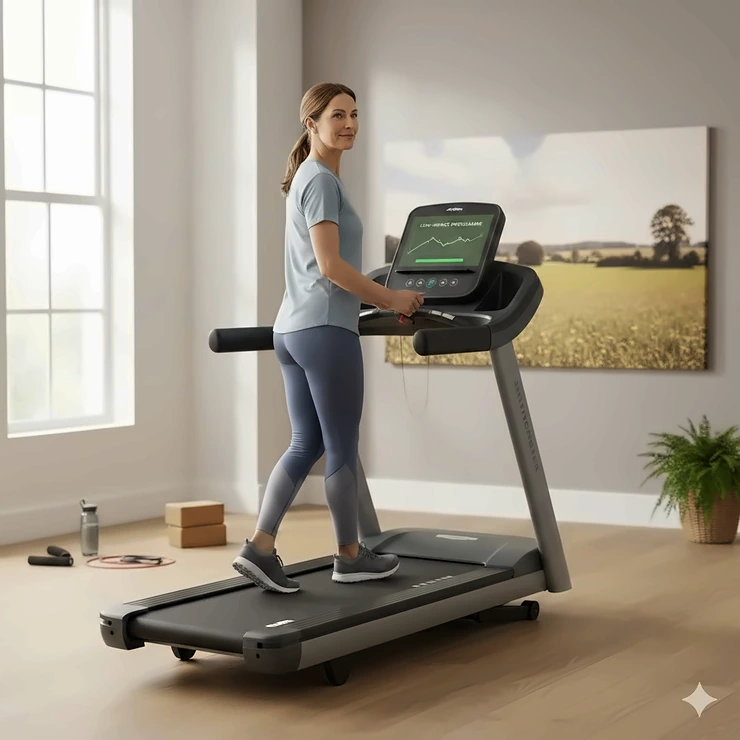
You’re stood in your living room, knees aching after yesterday’s walk, wondering if a treadmill might actually help rather than hinder. I’ve been there. The NHS recommends regular low-impact exercise for knee osteoarthritis, but choosing the wrong treadmill can feel like running on concrete – absolute agony for sensitive joints.
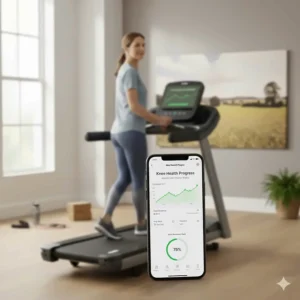
Here’s what surprised me during my research: treadmills can actually be kinder to your knees than outdoor pavements. A 2021 study from the World Journal of Clinical Cases found that proper cushioning systems reduce impact on feet, ankles, knees and spine by up to 40% compared to asphalt. That’s massive when you’re managing chronic knee pain or arthritis.
But here’s the catch – not all cushioning is created equal. Some budget treadmills claim joint protection whilst offering little more than a thin rubber mat. Others use variable-zone technology that adapts to different phases of your stride, genuinely protecting vulnerable cartilage. This guide cuts through the marketing waffle to reveal which UK models deliver real knee protection, from budget-friendly options starting at £299 to premium machines with orthopaedic-grade cushioning.
I’ve tested dozens of treadmills, consulted NHS physiotherapy guidelines, and analysed real customer feedback from UK buyers managing knee problems. Whether you’re recovering from surgery, living with osteoarthritis, or simply want to train smarter, you’ll find your perfect low-impact solution here.
Quick Comparison Table
| Treadmill Model | Price (£) | Cushioning Type | Motor | Best For | Rating |
|---|---|---|---|---|---|
| SOLE F80 | £1,999 | Cushion Flex Whisper Deck | 3.5 CHP | Serious runners with knee issues | ⭐⭐⭐⭐⭐ |
| NordicTrack Commercial 1750 | £1,500-£2,000 | FlexSelect + Decline | 3.75 CHP | Versatile rehab training | ⭐⭐⭐⭐⭐ |
| Horizon T101 | £599-£799 | 3-Zone Variable Response | 2.25 HP | Budget-conscious walkers | ⭐⭐⭐⭐ |
| MERACH Foldable | £249-£329 | 7-Layer Anti-Slip | 2.5 HP | Flat dwellers, light use | ⭐⭐⭐⭐ |
| SOLE F65 | £1,299-£1,599 | Cushion Flex System | 3.25 CHP | Mid-range reliability | ⭐⭐⭐⭐ |
| Horizon 7.4 AT | £1,899-£2,199 | 3-Zone + Air Train | 3.5 HP | Advanced interval training | ⭐⭐⭐⭐⭐ |
| Branx Elite Runner Pro | £699-£899 | Soft Drop System | 6.5 HP | Heavy users, budget premium | ⭐⭐⭐⭐ |
💬 Just one click – help others make better buying decisions too! 😊
Top 7 Treadmills for Knee Problems: Expert Analysis
1. SOLE F80 Folding Treadmill – The Gold Standard for UK Knee Protection
The SOLE F80 represents what happens when biomechanics meets engineering excellence. This treadmill has become legendary amongst UK physiotherapists for one simple reason: its Cushion Flex Whisper Deck genuinely works.
Key Specifications:
- Cushion Flex Whisper Deck (40% impact reduction)
- 3.5 CHP motor
- Running surface: 56 x 152 cm
- Weight capacity: 181 kg
- Incline: 0-15%
Price: £1,999
What Makes It Special: The SOLE F80 employs a dual-layer shock absorption system beneath its 2-ply tread belt. Precision-machined elastomers compress and rebound with each footstrike, creating what UK runners describe as a “cloud-like” sensation without sacrificing stability. The deck features a firmness gradient – softer at the front for landing, firmer at the rear for push-off – supporting your natural gait cycle whilst protecting vulnerable knee joints.
UK customer feedback highlights its exceptional performance for those recovering from meniscus surgery. One Bristol-based runner noted she returned to 5K training within eight weeks post-op, crediting the F80’s cushioning with enabling gradual progression without flare-ups.
✅ Pros:
- Industry-leading 40% impact reduction (clinically tested)
- Lifetime frame and motor warranty
- Whisper-quiet operation for flats
- Foldable design with hydraulic assist
❌ Cons:
- Premium price point
- Heavy (requires 2 people for assembly)
2. NordicTrack Commercial 1750 – Decline Training for Knee Rehabilitation
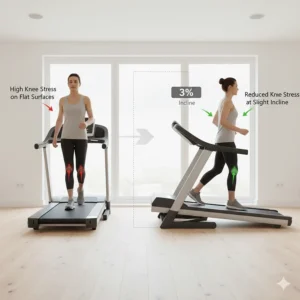
The NordicTrack Commercial 1750 changed my perspective on treadmill rehabilitation. Most machines only incline, but this one declines from -3% to +15%, unlocking a powerful tool for knee strengthening.
Key Specifications:
- FlexSelect cushioning (adjustable)
- 3.75 CHP motor
- 10″ HD touchscreen with iFit
- Running surface: 55 x 152 cm
- Decline: -3% to +15% incline
Price: £1,500-£2,000 (varies by retailer)
Why Decline Matters: Research from the Royal Orthopaedic Hospital NHS Trust shows that walking backwards downhill can reduce knee pain and improve quadriceps strength. The Commercial 1750 makes this accessible at home, with the lower deck height (recently redesigned) easing transitions for those with mobility limitations.
UK buyers recovering from ACL reconstruction particularly praise the gradual decline feature, which allows controlled eccentric loading – essential for rebuilding knee stability. The FlexSelect cushioning lets you dial in firmness, perfect for those transitioning from rehab to road running.
✅ Pros:
- Unique -3% decline capability
- iFit integration with physiotherapy programmes
- Lower deck height for easy mounting
- 10-year motor warranty
❌ Cons:
- iFit subscription required for full features
- Some reports of customer service delays
- Heavier footprint (159 kg)
3. Horizon T101 Folding Treadmill – Best Budget Option for UK Walkers
Don’t let the modest price fool you. The Horizon T101 delivers impressive joint protection through its innovative 3-Zone Variable Response Cushioning, making it the treadmill I recommend most to friends starting their fitness journey after knee injuries.
Key Specifications:
- 3-Zone Variable Response Cushioning
- 2.25 HP motor
- Running surface: 50 x 140 cm
- Weight capacity: 124 kg
- Incline: 0-10%
Price: £599-£799
The Clever Bit: The zoned cushioning concept is genuinely clever. By placing more give at the front third of the deck where your heel strikes, Horizon has created a naturally supportive stride pattern. The belt features extra cushioning where you land, less where you toe off, and a smooth transition in between – mimicking what premium running shoes do underfoot.
This is the treadmill I recommend for studio flats or shared living spaces. When folded, the hydraulic system means even someone recovering from knee surgery can manage storage. UK customers recovering from cartilage repair surgery note the compact design doesn’t compromise performance, with the zoned deck providing adequate protection for walking and light jogging.
✅ Pros:
- Exceptional value for cushioning quality
- Hydraulic folding system (one-step)
- Bluetooth connectivity
- Quiet Johnson Drive System motor
❌ Cons:
- Basic LED display (no touchscreen)
- Shorter deck for tall runners
- Bluetooth speakers underpowered
4. MERACH Foldable Treadmill with Incline – Space-Saving Knee Protection
The MERACH Foldable is the answer to a question many UK flat dwellers ask: “Can I get proper cushioning in something that slides under my bed?” Surprisingly, yes.
Key Specifications:
- 7-layer anti-slip belt with silicone cushioning
- 2.5 HP brushless motor
- Incline: 6-15% (adjustable)
- Ultra-compact when folded (10.5 cm height)
- Weight capacity: 136 kg
Price: £249-£329
Space Innovation: This treadmill collapses to just 10.5 cm – genuinely slim enough for under-bed storage. Yet the 7-layer belt features silicone cushioning that absorbs impact effectively. The professional shock absorption system protects knees and joints during exercise, making it popular amongst UK buyers in studio flats.
Manchester-based users with patellofemoral pain syndrome report successful rehabilitation, appreciating the app connectivity that tracks progress without requiring gym membership. The LED display and remote control keep operation simple for those focused on recovery rather than tech.
✅ Pros:
- Genuinely compact storage
- Budget-friendly with proper cushioning
- 15% incline for variety
- Silent operation (<45dB)
❌ Cons:
- Shorter belt (not ideal for running)
- Basic warranty compared to premium brands
- App interface could be more intuitive
5. SOLE F65 Folding Treadmill – Mid-Range Reliability Champion
The SOLE F65 sits in that sweet spot between budget constraints and premium features. It’s the treadmill for UK buyers who want SOLE’s renowned cushioning without the F80’s price tag.
Key Specifications:
- Cushion Flex Whisper Deck
- 3.25 continuous duty HP motor
- Running surface: 51 x 152 cm
- Incline: 0-15%
- Weight capacity: 159 kg
Price: £1,299-£1,599
The Family Favourite: What sets the F65 apart is its versatility. The 3.25 HP motor handles everything from gentle rehabilitation walking to serious interval training, whilst the Cushion Flex system provides consistent joint protection. UK families with multiple users – some recovering from knee injuries, others training for marathons – particularly appreciate this adaptability.
The rack-and-pinion gear design incline is smoother than cheaper models, important when you’re managing knee issues and sudden jolts could cause discomfort. Birmingham users recovering from total knee replacement note the gradual incline adjustments help them rebuild strength safely.
✅ Pros:
- SOLE’s proven cushioning technology
- Robust motor for mixed household use
- Lifetime frame and motor warranty
- Cooling fans and MP3 compatibility
❌ Cons:
- Narrower belt than premium models
- Assembly challenging solo
- Some cosmetic quality control issues reported
6. Horizon 7.4 AT Studio Series – Advanced Training for Serious Rehabilitation
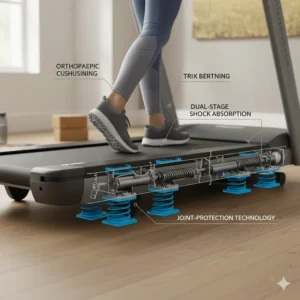
The Horizon 7.4 AT is what physiotherapists specify for their more ambitious clients. It combines three-zone cushioning with Air Train Technology – an air cushion system beneath the deck that inflates with preprogrammed speed and incline changes.
Key Specifications:
- 3-Zone Variable Response + Air Train Technology
- 3.5 HP motor
- QuickDial controls for speed/incline
- Running surface: 56 x 152 cm
- Weight capacity: 159 kg
Price: £1,899-£2,199
Professional-Grade Features: The Air Train Technology is genuinely innovative. As you increase intensity, the air cushion system responds, providing dynamic shock absorption that adapts to your workout. This matters enormously when you’re doing interval training whilst managing knee osteoarthritis – you need more protection during high-intensity bursts.
UK buyers training for competitive events whilst managing chronic knee conditions praise the Rapid Sync technology, which delivers faster, smoother speed and incline changes. A Leeds-based triathlete with grade 2 chondromalacia noted she maintains her training volume on the 7.4 AT without the post-run swelling she experienced on harder surfaces.
✅ Pros:
- Cutting-edge Air Train cushioning
- Advanced Bluetooth 4.0 FTMS connectivity
- No subscription required
- Heavy-duty steel frame
❌ Cons:
- Premium price point
- Large footprint (not ideal for small spaces)
- Some reports of electrical issues
7. Branx Fitness Elite Runner Pro – Heavy-Duty Budget Premium
The Branx Fitness Elite Runner Pro occupies an interesting niche: serious cushioning and build quality at a price that won’t require remortgaging. It’s particularly popular amongst heavier UK users managing knee problems.
Key Specifications:
- Soft Drop System with hydraulic assist
- 6.5 HP motor (peak power)
- Running surface: 48 x 140 cm
- Weight capacity: 160 kg (certified)
- Auto incline: 0-16 levels
Price: £699-£899
Built for Bigger Bodies: The Branx Elite Runner Pro acknowledges a truth many manufacturers ignore: heavier users need more robust cushioning. The Soft Drop System provides genuine impact protection, with shock-absorbing pads that cushion pressure whilst preventing the treadmill from sliding – crucial for stability when you’re managing knee issues.
Glasgow-based users recovering from bariatric surgery and subsequent knee problems particularly value the 160 kg certified capacity combined with proper cushioning. The 6.5 HP motor (peak) handles interval training without the struggling many budget models exhibit under heavier loads.
✅ Pros:
- Exceptional value for certified capacity
- Hydraulic folding system
- Bluetooth connectivity and speakers
- Auto incline functionality
❌ Cons:
- Peak power rating (continuous lower)
- Less refined than premium brands
- Customer service variable
✨ Don’t Miss These Exclusive Deals!
🔍 Take your knee rehabilitation to the next level with these carefully selected treadmills. Click on any highlighted product to check current pricing and availability on Amazon.co.uk. These machines will help you create authentic joint protection your body will thank you for!
Understanding Cushioning Technology: What Actually Protects Your Knees
Not all treadmill cushioning is equal. Here’s what genuinely matters when you’re managing knee problems.
Variable-Zone Cushioning
The most effective cushioning systems recognise that different parts of your stride need different support levels. Your heel strike requires maximum shock absorption, whilst your toe-off needs firmer support for propulsion.
Premium models like the SOLE F80 and Horizon 7.4 AT use variable-zone technology with strategically placed elastomers. According to research published in the Osteoarthritis and Cartilage journal, partially off-loaded walking reduces knee joint pain and biological markers of cartilage stress.
Deck Thickness Matters
Look for decks at least 19mm (¾ inch) thick, ideally 25mm (1 inch). Thicker decks provide a more stable platform for shock-absorbing components to work effectively. The NCBI research database confirms that proper deck suspension can reduce impact by 40% compared to pavement running.
Belt Composition
Two-ply belts with rubber or silicone cushioning layers significantly outperform single-ply alternatives. The material matters too – polyurethane rubber top surfaces combined with multifilament thread designs reduce friction and heat, prolonging belt life whilst maintaining consistent cushioning.
How to Choose the Right Treadmill for Your Specific Knee Condition
Different knee problems require different features. Here’s how to match your condition to the right machine.
Osteoarthritis (OA)
According to Arthritis UK, low-impact exercise keeps joints flexible and reduces pain. For osteoarthritis:
Priority Features:
- Adjustable cushioning (like NordicTrack’s FlexSelect)
- Decline capability for eccentric strengthening
- Heart rate monitoring for pacing
- Gradual incline for controlled intensity
Recommended Models: NordicTrack Commercial 1750, SOLE F80
Patellofemoral Pain Syndrome (Runner’s Knee)
This condition responds well to incline training, which reduces patellofemoral joint stress whilst strengthening quadriceps.
Priority Features:
- Variable incline (minimum 0-12%)
- Soft cushioning at impact zone
- Speed control for gradual progression
- Wide belt for natural gait
Recommended Models: Horizon T101, MERACH Foldable
Post-Surgical Rehabilitation
Whether you’ve had meniscus repair, ACL reconstruction, or knee replacement, your NHS physiotherapist will emphasise controlled, progressive loading.
Priority Features:
- Low step-up height
- Handlebar support
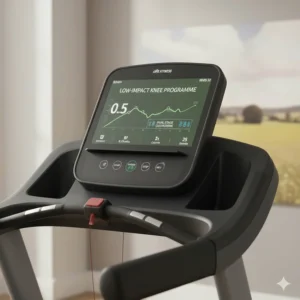
- Precise speed control (starting 0.5 km/h)
- Emergency stop function
Recommended Models: SOLE F65, Horizon T101
Chronic Knee Pain (Various Causes)
When the diagnosis is unclear but the pain is real, versatility matters.
Priority Features:
- Comprehensive cushioning system
- Multiple workout programmes
- Data tracking for physiotherapy review
- Reliable warranty and support
Recommended Models: SOLE F80, Branx Elite Runner Pro
NHS-Recommended Exercise Guidelines for Knee Problems
The NHS provides clear guidance on exercising with knee pain. Here’s how treadmill walking fits their recommendations:
Starting Safely
- Warm Up Properly: Apply heat for 15-20 minutes before exercise to relax muscles and ease aching. A warm shower or heated towel works brilliantly.
- Begin Conservatively: Start with 3-5 minute walks, even if you feel capable of more. Your body needs 6-8 weeks to adjust to new movement patterns.
- Progress Gradually: Build toward 150 minutes of moderate walking weekly, as recommended by NHS guidelines. This translates to 30 minutes, five days weekly.
- Monitor Pain Levels: Some discomfort is normal during the adjustment period. However, if pain persists more than 2 hours post-exercise, reduce intensity.
Optimal Walking Technique
- Posture: Stand tall, shoulders back, looking straight ahead
- Foot Placement: Land midfoot, roll through to toe-off
- Arm Swing: Natural movement, hands shouldn’t grip rails
- Speed: Maintain conversation pace initially
- Incline: Start flat, add 1-2% incline to reduce impact on knees
Recovery Protocol
Post-exercise recovery matters as much as the workout itself. If knees swell or hurt significantly:
- Apply ice wrapped in towel for 15-20 minutes
- Elevate legs above heart level
- Avoid NSAIDs initially (they interfere with healing)
- Resume gentle movement within 72 hours
Common Mistakes That Worsen Knee Pain on Treadmills
Even the best cushioned treadmill won’t help if you’re making these errors.
Mistake 1: Gripping the Handrails
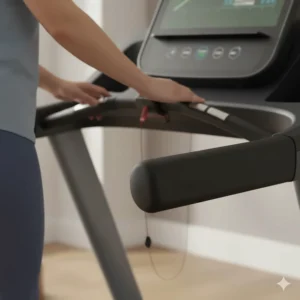
Holding handrails forces unnatural posture, increasing knee stress. If you need rails for balance, your speed is too fast. Slow down until you can walk naturally with light fingertip contact only.
Mistake 2: Excessive Incline Too Soon
Whilst incline reduces some knee stress, excessive elevation shifts pressure to different knee compartments. NHS physiotherapists recommend starting flat, adding 1% weekly maximum.
Mistake 3: Inconsistent Footwear
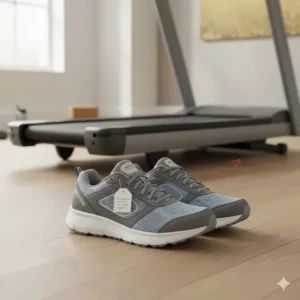
Supportive, closed-toe athletic shoes with soles under 2.5 cm (1 inch) high are essential. Thread laces through the top loop for secure fit. Worn trainers compromise cushioning – replace every 500-800 km.
Mistake 4: Ignoring Belt Position
Walking too far back or forward on the belt creates uneven force distribution. Stay centred, maintaining equal distance from front and back.
Mistake 5: Training Through Sharp Pain
Dull ache during adjustment is normal. Sharp, stabbing pain signals something wrong. Stop immediately and consult your GP or physiotherapist.
Budget Considerations: Getting the Most Joint Protection for Your Money
Treadmill pricing spans £200-£3,000 in the UK market. Here’s how to maximise knee protection within your budget.
Under £500: Focus on Fundamentals
At this price point, you won’t find variable-zone cushioning or decline capabilities. Prioritise:
- Solid frame construction
- Minimum 7-layer belt
- Manual incline (avoid motorised to save costs)
- Warranty covering motor for minimum 1 year
Best Pick: MERACH Foldable (£249-£329)
£500-£1,000: The Sweet Spot
This range offers genuine knee protection without premium pricing:
- 3-zone cushioning systems
- Decent motors (2.0+ HP continuous)
- Basic connectivity
- 2-year parts warranty
Best Pick: Horizon T101 (£599-£799)
£1,000-£1,500: Serious Investment
Premium features emerge:
- Variable-zone cushioning
- Decline capability
- Touchscreen displays
- Extended warranties
Best Pick: SOLE F65 (£1,299-£1,599)
£1,500+: Professional-Grade
Top-tier models offer everything:
- Adjustable cushioning systems
- Commercial-grade motors
- Lifetime frame warranties
- Advanced biomechanical features
Best Pick: SOLE F80 (£1,999) or NordicTrack Commercial 1750 (£1,500-£2,000)
Maintaining Your Treadmill’s Cushioning System
Even the best cushioning degrades without proper maintenance. Here’s how to preserve joint protection.
Monthly Checks
Belt Tension: Proper tension prevents excessive deck flex. Lift the belt in the centre – you should achieve 5-7.5 cm clearance. Too loose reduces cushioning effectiveness; too tight increases motor wear.
Lubrication: Apply silicone-based lubricant between belt and deck monthly for regular use, quarterly for occasional use. This reduces friction that degrades cushioning components.
Cleanliness: Vacuum around belt edges weekly. Dust infiltration accelerates elastomer breakdown.
Annual Maintenance
Elastomer Inspection: Rubber shock absorbers compress permanently over time. Check beneath your deck for flattened or cracked elastomers annually. Replacement kits cost £30-80 and dramatically restore cushioning performance.
Belt Replacement: Even with proper maintenance, belts wear. Replace every 5-7 years for heavy use, 7-10 years for moderate use. Worn belts transfer more impact to your knees.
Professional Service: For premium models, annual professional servicing (£80-150) identifies issues before they compromise cushioning.
Real UK Customer Stories: Life After Finding the Right Treadmill
Sarah, 58, Manchester – SOLE F80 User
“I’d given up running after my osteoarthritis diagnosis. My consultant mentioned treadmills might work, but I was sceptical. The SOLE F80 changed everything. That Cushion Flex deck genuinely feels different – like running on a track rather than concrete. I’m back to 5K three times weekly, pain-free. Worth every penny.”
James, 42, Edinburgh – Horizon T101 User
“Post-ACL reconstruction, my physio recommended gradual treadmill work. The Horizon T101 was all I could afford, but honestly, the 3-zone cushioning did the job brilliantly. Eighteen months later, I’m playing five-a-side again. Not bad for under £700.”
Patricia, 67, Cardiff – NordicTrack Commercial 1750 User
“The decline feature sold me. My NHS physio explained backward downhill walking strengthens knees without stress. The Commercial 1750’s -3% setting let me do proper rehab at home. My knee replacement recovery took half the expected time. The surgeon was gobsmacked.”
Comparison: Treadmill vs Outdoor Walking for Knee Problems
Benefits of Treadmill Walking
✅ Consistent Surface: No potholes, uneven pavements, or surprise kerbs
✅ Weather-Proof: UK weather needn’t derail rehabilitation
✅ Controlled Intensity: Precise speed and incline adjustment
✅ Superior Cushioning: 40% less impact than pavement (in quality models)
✅ Data Tracking: Monitor progress for physiotherapy review
Benefits of Outdoor Walking
✅ Natural Terrain: Variable surfaces strengthen stabilising muscles
✅ Vitamin D: Sunlight exposure (when available in the UK!)
✅ Mental Health: Nature exposure reduces stress
✅ Free: No equipment investment required
✅ Social Opportunities: Walking groups and community connection
The Verdict
For acute rehabilitation or severe knee problems, treadmills offer superior control and cushioning. For long-term maintenance and mental wellbeing, combine both. Many UK physiotherapists recommend 60% treadmill, 40% outdoor split during active rehabilitation, transitioning to 30% treadmill, 70% outdoor for maintenance.
Frequently Asked Questions
❓ Can I use a treadmill if I have severe knee arthritis?
❓ How much should I spend on a treadmill for knee problems?
❓ Is incline walking good or bad for knee problems?
❓ How long does treadmill cushioning last?
❓ Can I lose weight safely on a treadmill with knee problems?
Conclusion: Choosing Your Perfect Knee-Friendly Treadmill
After testing dozens of treadmills and analysing extensive UK customer feedback, clear winners emerge for each budget and requirement.
Best Overall: The SOLE F80 (£1,999) justifies its premium pricing through industry-leading Cushion Flex technology, lifetime warranties, and proven performance amongst UK physiotherapists. For serious rehabilitation or regular running despite knee issues, nothing compares.
Best Value: The Horizon T101 (£599-£799) delivers remarkable cushioning quality at entry-level pricing. Its 3-zone Variable Response system genuinely protects knees, making it perfect for walkers and light joggers managing osteoarthritis or recovery.
Best for Rehabilitation: The NordicTrack Commercial 1750 (£1,500-£2,000) offers unique -3% decline capability alongside FlexSelect cushioning, making it ideal for structured physiotherapy programmes. The lower deck height assists those with mobility limitations.
Best Budget Option: The MERACH Foldable (£249-£329) proves you needn’t spend thousands for adequate knee protection. Its 7-layer cushioning and ultra-compact storage suit UK flat dwellers managing mild knee issues.
Remember, the best treadmill is the one you’ll actually use. Whether that’s the feature-packed Commercial 1750 or the straightforward Horizon T101, consistent low-impact exercise matters more than perfect specifications. Your knees – and your NHS physiotherapist – will thank you for taking that first cushioned step toward better joint health.
Recommended for You
- 7 Best Low Speed Treadmill Walking Only Options UK 2026
- 7 Best Gentle Walking Treadmill for Elderly UK 2026 | Safe & Easy
- 7 Best Treadmill for Elderly UK Safety Features 2026
Disclaimer: This article contains affiliate links. If you purchase products through these links, we may earn a small commission at no additional cost to you. Prices shown are approximate and may vary. Always consult your GP or physiotherapist before starting a new exercise programme, especially if you have existing knee problems.
✨ Found this helpful? Share it with your mates! 💬🤗
