
In This Article
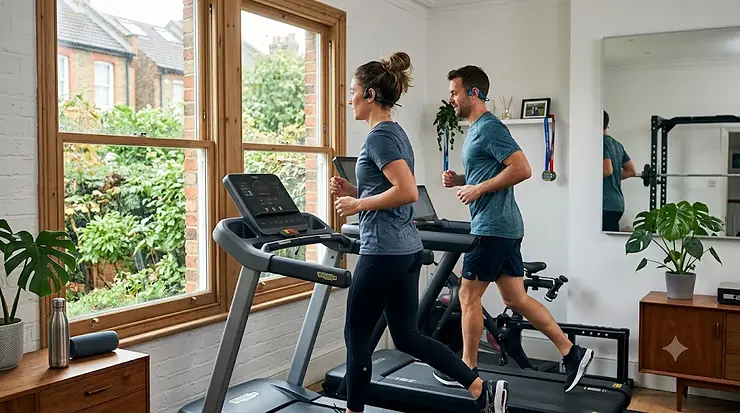
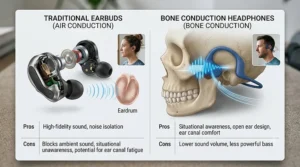
Here’s a confession: the first time someone told me bone conduction headphones would let me hear my own footsteps thumping on the belt, I assumed they were exaggerating for effect. They weren’t. That’s rather the whole point of the technology. Bone conduction headphones treadmill sessions have become one of the fastest-growing corners of the fitness audio market, and once you understand the mechanics, it’s obvious why. Rather than piping sound down your ear canal, these headphones sit just in front of your ears and send vibrations through your cheekbones straight to your inner ear — leaving your ear canals completely open. What is a bone conduction headphone, in the simplest possible terms? It’s a headset that skips the eardrum’s usual entry point entirely, using bone as the conduit for sound so you can still hear a trainer shouting your name, a treadmill’s safety beep, or the gym’s fire alarm.
That open-ear design matters more indoors than most people expect. On a crowded gym floor, you need to hear someone asking to work in on your machine, catch an instructor’s cue, or notice when the person next to you is about to topple sideways off their own treadmill. Outdoors, the same open-ear principle protects you from traffic and cyclists. The core bone conduction mechanism itself has been understood by scientists for well over a century; consumer headphones simply repurposed it for fitness use in the last decade. This guide walks through seven genuinely useful bone conduction headphones treadmill options, spanning budget to premium, backed by real specifications and aggregated reviewer sentiment rather than guesswork. We’ll also dig into how this category compares with sealed earbuds, what actually matters when you’re shopping, and where the physical activity side of things fits in — because 150 minutes of moderate activity a week only helps if your gear doesn’t get in the way.
Quick Comparison Table
| Product | Best For | Battery Life | Water Resistance | Price Range |
|---|---|---|---|---|
| Shokz OpenRun Pro 2 | Best overall sound on the belt | Up to 12 hrs | IP55 | £150-£180 |
| Shokz OpenRun | Dependable all-rounder | Up to 8 hrs | IP55 | £110-£140 |
| Shokz OpenMove | Budget entry into Shokz build quality | Up to 6 hrs | IP55 | Under £80 |
| Suunto Wing 2 | LED visibility for dawn treadmill-to-street runs | 12 hrs + 24 hrs powerbank | IP66 | £170-£200 |
| H2O Audio Tri 2 Pro | Swim-run cross-training | Around 8 hrs | IPX8 | £180-£220 |
| Nank Runner Diver2 Pro | Onboard music storage | Around 10 hrs | Swim-rated | £70-£100 |
| YouthWhisper Lite | Lowest genuine entry price | Around 6 hrs | Splashproof | Under £40 |
Looking at the table, it’s clear the spread isn’t just about price — it’s about what each pair is actually optimised for. The Shokz OpenRun Pro 2 earns its premium position through sound quality and battery stamina rather than gimmicks, while the Suunto Wing 2 justifies its cost with genuine safety hardware most rivals skip entirely. Budget buyers shouldn’t assume they’re settling, either: the YouthWhisper Lite and Nank Runner Diver2 Pro both punch well above their price tags for straightforward treadmill use.
💬 Just one click — help others make better buying decisions too!😊
Top 7 Bone Conduction Headphones Treadmill: Expert Analysis
1. Shokz OpenRun Pro 2 — best overall sound quality for indoor runs
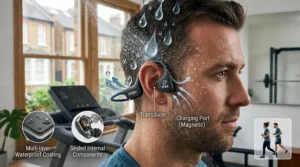
The standout here is DualPitch technology, Shokz’s tenth-generation bone conduction transducer paired with a small air-conduction driver — essentially an admission that pure bone conduction has always struggled with bass, and a genuine fix for it. On paper this means noticeably fuller low-end than older single-driver bone conduction sets, without sealing your ear canal shut. The IP55 rating handles sweat comfortably, and the titanium band is springy enough to fold into a gym bag without complaint; Bluetooth 5.3 also keeps the connection stable if your phone lives in an armband a few feet away on the machine. Based on the spec comparison with cheaper Shokz models, this is the pair built for people who want treadmill audio that doesn’t sound like a compromise, especially anyone who also uses their headphones for calls, commuting or general listening outside the gym. Reviewers at outlets including Tom’s Guide and SoundGuys consistently rank the OpenRun Pro 2 as the best-sounding bone conduction headphones they’ve tested, with praise for the secure ear-hook fit during long sessions and a mild caveat that battery life dips to around 10-11 hours if you consistently run at maximum volume. What most buyers overlook is that it ships in two sizes, standard and mini, and the shorter headband genuinely changes comfort for smaller heads.
Pros:
- ✅ Fullest bass of any bone conduction pair on this list
- ✅ Two headband sizes for a genuinely tailored fit
- ✅ Fast charging tops up hours of playtime in minutes
Cons:
- ❌ Not swim-rated despite the sweat-proof coating
- ❌ Premium pricing versus the standard OpenRun
Typically priced in the £150-£180 range, this is a “spend once, stop shopping” pick for serious treadmill regulars, and the value case holds up well against pricier multi-sport rivals later in this list.
2. Shokz OpenRun — most dependable mid-range all-rounder
The standout feature is PremiumPitch 2.0+ technology, a single-driver system that’s one generation behind the Pro 2 but still noticeably clearer than the sub-£80 alternatives further down this list. In practice this means solid mids and vocals with less low-end punch, which suits podcasts and audiobooks just as well as music. The lighter, slimmer housing means less cheekbone vibration at higher volumes — a common early complaint about bone conduction generally — and the IP55 rating shrugs off a hard treadmill sweat session without issue. Here’s what to weigh: the OpenRun sacrifices some of the Pro 2’s bass depth and battery stamina, but for most casual-to-regular runners that trade-off is barely noticeable day to day. GearJunkie’s testing team describes the standard OpenRun as a dependable standby that still impresses even as newer Shokz models launch around it, which tracks with why it remains the brand’s best-selling mid-tier option. Reviewers frequently flag the button controls as intuitive enough to operate blind mid-run, without needing to glance down at your wrist or the console.
Pros:
- ✅ Noticeably lighter than the Pro 2 for all-day wear
- ✅ Reliable button controls usable without looking
- ✅ Four colourways including a dual-tone finish
Cons:
- ❌ Thinner bass than the DualPitch-equipped Pro 2
- ❌ Shorter battery life than premium siblings
Sitting in the £110-£140 range, this is the sensible default for anyone who wants proven Shokz reliability without paying for features they won’t use.
3. Shokz OpenMove — budget entry into genuine Shokz build quality
The standout advantage is that this is the cheapest current-generation Shokz model that still uses the same titanium band and companion app as its pricier siblings, rather than a stripped-down imitation. What that means practically: you’re getting proven ergonomics and Shokz’s tuning philosophy, just with a single-driver design and a shorter rated battery life around six hours. The USB-C charging port is a welcome modern touch that some older budget bone conduction models still lack. Reviewers consistently note that fit stability is fine for steady treadmill pacing and walking but less locked-in during sprint intervals or quick head turns, and that mic quality, while usable for casual calls, sounds thinner than Shokz’s call-focused OpenComm line. What most buyers overlook is that bass and maximum volume noticeably trail the DualPitch-equipped Pro 2, so if you like your workout playlist loud, this isn’t the pair for you.
Pros:
- ✅ Genuine Shokz titanium build at a lower price
- ✅ USB-C charging instead of proprietary cables
- ✅ Companion app support matching pricier models
Cons:
- ❌ Fit loosens slightly during high-intensity sprints
- ❌ Noticeably lower max volume than DualPitch models
Usually found under £80, this is the honest starter pick for treadmill beginners who want to try the category without committing to premium pricing.
4. Suunto Wing 2 — LED visibility for dawn treadmill-to-street runs
The headline feature is genuinely clever: intelligent LED lights built into the frame that pulse in time with your running cadence or flash when you check for traffic, giving you visibility that ordinary bone conduction headphones simply don’t offer. Paired with an IP66 rating against dust and water jets, and a titanium-and-silicone build weighing just 35 grams, the Wing 2 is engineered for runners who start on the treadmill and finish outdoors as the sun comes up. Head Movement Control lets you skip tracks or answer calls with a simple nod, which matters more than it sounds once your hands are full of a water bottle and a towel. Based on hands-on reviews from outlets like Gadgets & Wearables, sound quality is decent for the category — clear vocals, a bit more punch than average bone conduction — though the review notes fit needs to sit snug against the head or volume and clarity drop noticeably, a quirk of how bone conduction physically works. Reviewers also highlight a neck-fatigue alert feature, aimed at people who spend long stretches on a treadmill console in one fixed head position.
Pros:
- ✅ Cadence-syncing LED lights for genuine visibility
- ✅ Nod-based hands-free control for calls and tracks
- ✅ Pairs with Suunto watches for live workout feedback
Cons:
- ❌ Heavier than standard Shokz models at 35g
- ❌ Fit sensitivity affects volume if not snug
Retailing in the £170-£200 range, this is the pick for treadmill users who regularly transition to early-morning or late-evening outdoor sessions.
5. H2O Audio Tri 2 Pro Multi-Sport — built for swim-run cross-training
The standout feature is an IPX8 waterproof rating, a genuine step up from the sweat-resistance most treadmill headphones offer, plus 8GB of onboard storage so you can load a playlist and leave your phone in a locker entirely. What this means in practice: triathletes and swim-run hybrid trainers get one headset that survives the pool, the treadmill, and everything in between, rather than juggling two separate pairs. TechRadar’s testing team calls it an exceptional option for both runners and swimmers, going as far as ranking it above Shokz in outright audio quality for this specific use case — though they and Tom’s Guide both flag that the price sits uncomfortably close to Shokz’s own dedicated swim model, the OpenSwim Pro, which several reviewers consider the stronger all-round buy. Here’s what to weigh: if swimming genuinely features in your weekly routine alongside treadmill sessions, the fully submersible rating earns its premium. If you never swim, you’re paying for waterproofing you’ll never test.
Pros:
- ✅ Genuinely swim-safe IPX8 waterproof rating
- ✅ 8GB onboard storage removes phone dependency
- ✅ Multipoint connectivity between phone and laptop
Cons:
- ❌ Premium price rivals Shokz’s dedicated swim model
- ❌ Overkill if you never swim alongside running
Priced around £180-£220, this is a specialist buy that only makes financial sense for genuine cross-trainers.
6. Nank Runner Diver2 Pro — most onboard storage for phone-free sessions
The headline number is 32GB of onboard storage, a genuinely unusual amount for this category and enough to hold a sizeable personal music library without ever touching Bluetooth. The standout practical benefit is multiple included earplugs and pliable arms, letting you fine-tune both fit and perceived sound quality rather than accepting one generic shape. TechRadar’s buying guide specifically recommends it to runners who go long distance, citing roughly 12 hours of battery life and fast charging that delivers over two hours of playback from a five-minute top-up — handy if you forgot to charge before an early treadmill session. Reviewers consistently note this isn’t the pair for casual joggers who just want background noise for a 5K; the feature set, and the price that comes with it, is built for people training multiple times a day. Aggregated sentiment also flags that call quality can sound slightly crackly, a common trade-off on headphones in this price bracket.
Pros:
- ✅ Enormous 32GB onboard storage for phone-free runs
- ✅ Swappable earplugs let you customise sound
- ✅ Fast-charging delivers two hours from five minutes
Cons:
- ❌ Call quality trails premium Shokz models
- ❌ More headset than casual joggers really need
Found in the £70-£100 range, this is the best pick for treadmill regulars who train often and hate carrying a phone.
7. YouthWhisper Lite — lowest price point that still feels legitimate
The standout claim to fame is price-to-performance: GearJunkie’s testing team named it the best value pair they tried, at a genuinely low cost point that undercuts even Shokz’s cheapest model. What that means day to day is Bluetooth 5.0 connectivity with a stable 29-foot range, a two-hour charge time delivering roughly six hours of playback, and a fit reviewers describe as somewhat firm compared with premium Shokz models but not uncomfortable enough to want to remove. On paper the audio quality won’t compete with DualPitch technology, but for treadmill sessions where you mainly want podcasts or a steady playlist rather than audiophile bass, that’s a reasonable trade. Reviewers consistently frame this as the honest entry point into the category — good enough to prove whether bone conduction suits you before you spend three or four times as much on a flagship pair.
Pros:
- ✅ Lowest genuine entry price in this round-up
- ✅ Stable 29-foot Bluetooth range in testing
- ✅ Quick two-hour charge for six hours of use
Cons:
- ❌ Noticeably firmer fit than premium alternatives
- ❌ Bass-light sound compared with DualPitch models
Typically under £40, this is the risk-free way to trial bone conduction headphones treadmill listening before committing to a bigger spend.
Practical Usage Guide: Setting Up Your Bone Conduction Headphones Treadmill Routine
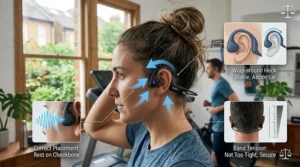
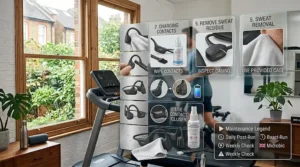
Getting the most from any bone conduction pair starts before your first run. Position matters enormously: the transducers should sit directly in front of your ears, against the cheekbone, not pressed into the ear itself — a common first-week mistake that makes audio sound thin and tinny. Pair the headphones to your phone or watch before you’re on the machine, since fumbling with Bluetooth settings mid-stride is a reliable way to lose your rhythm entirely. In the first 30 days, resist the urge to crank the volume to compensate for gym noise; instead, position yourself near a quieter part of the floor or invest in a treadmill with better sound insulation around the motor. Clean the contact pads weekly with a damp microfibre cloth, since sweat buildup both degrades comfort and can dull audio clarity over months of use. Most models also include an EQ within their companion app: nudging the bass slider up two or three notches genuinely improves the classic “thin bone conduction sound” that puts newcomers off during the adjustment period.
Situational Awareness Running: Real-World Scenarios
Situational awareness running is arguably the single biggest reason people switch to this category in the first place, and it plays out differently depending on where you train. Picture a college student squeezing in an 8-mile daily commute-run partly on a gym treadmill, partly on busy city pavements — for them, hearing traffic and pedestrians isn’t optional, and a pair like the Suunto Wing 2 with its cadence-synced LEDs adds a genuine safety layer once daylight fades. Compare that with a parent doing 5K treadmill sessions at the gym crèche hours, where the priority shifts to hearing a staff member call their name over the tannoy rather than traffic awareness. A third scenario: a marathon-in-training runner alternating treadmill long runs with outdoor tempo sessions, who values the Shokz OpenRun Pro 2‘s battery stamina across a two-hour effort more than any lighting feature. In every case, the open-ear principle is doing the same underlying job — keeping you plugged into your surroundings without sacrificing your workout soundtrack entirely.
Problem → Solution: Common Treadmill Headphone Issues
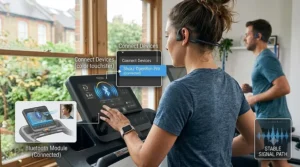
Sweat interference tops the list of first-month frustrations, and the fix is straightforward: choose an IP55-rated pair minimum, and wipe contact points after every session rather than letting salt residue build up. A second common complaint is sound leakage annoying nearby gym-goers at higher volumes — a known trade-off of open-ear design that’s largely solved by keeping playback under roughly 70% of maximum and letting the transducers, rather than raw volume, do the work. Third, some users report the headphones slipping during sprint intervals; a pair with a proper ear hook, like the Shokz OpenRun Pro 2 or Suunto Wing 2, solves this far better than lighter open-fit alternatives. Fourth, thin-sounding bass is a frequent early disappointment, addressed either by upgrading to a DualPitch model or simply adjusting the companion app’s EQ settings. Finally, Bluetooth dropouts near treadmill electronics are occasionally reported; moving your phone from a pocket to an armband closer to head height usually resolves this instantly.
Best Bone Conduction Headphones Running: How to Choose
- Decide your primary environment first — indoor-only treadmill use prioritises comfort and battery life over waterproofing.
- Check the water resistance rating against your actual sweat levels; IP55 covers most gym sessions, IPX8 only matters if you also swim.
- Weigh battery life against your longest realistic session, adding a buffer for max-volume listening, which drains cells faster.
- Try before committing if possible, since fit against your specific jaw and cheekbone shape affects sound quality more than spec sheets suggest.
- Consider onboard storage if you dislike running with your phone, as models like the Nank Runner Diver2 Pro remove that dependency entirely.
- Factor in companion app support, since EQ adjustment meaningfully improves bone conduction’s naturally lighter bass response.
- Set a genuine budget band rather than chasing the flagship by default — the YouthWhisper Lite proves entry-level bone conduction headphones running can still be a sound investment.
Shokz vs Bone Conduction Headphones: How the Category Leader Compares
It’s a slightly odd question on the surface, since Shokz itself makes bone conduction headphones — but it’s really asking how Shokz stacks up against the wider field of alternative brands chasing the same open-ear idea. The honest answer is that Shokz still sets the price ceiling and the technical benchmark that most competitors are measured against, largely thanks to DualPitch technology addressing the category’s historic bass weakness better than most rivals have managed. That said, Shokz doesn’t win every category outright: the Suunto Wing 2 offers safety lighting Shokz doesn’t build into any current model, and the H2O Audio Tri 2 Pro edges ahead on pure waterproofing for swimmers. What most buyers overlook is that Shokz’s real advantage isn’t any single spec, but consistency — its app support, fit engineering and customer service track record are more mature than most challenger brands, which matters over a two- or three-year ownership period rather than a single purchase decision.
Open Ear Running Headphones vs Bone Conduction: What’s the Difference
This distinction trips people up constantly, so it’s worth being precise. Open ear running headphones is actually the broader category umbrella, covering any design that leaves your ear canal unobstructed — that includes bone conduction models but also air-conduction “open-ear” earbuds that sit just outside the ear and beam sound toward it, similar to clip-on designs from brands like Anker. The practical difference: bone conduction skips vibrating the air near your eardrum entirely, using your skull instead, while open-ear air-conduction buds still rely on traditional sound waves, just without sealing the canal. In practice, air-conduction open-ear buds typically deliver richer, more natural-sounding bass, since they’re not fighting the physical limitations of transmitting sound through bone. Bone conduction wins on comfort for glasses-wearers and anyone prone to ear irritation, plus it’s the only style currently permitted under UK Athletics competition rules for road races, according to reporting from Expert Reviews UK. For pure treadmill use where race rules are irrelevant, the choice really comes down to whether you prioritise absolute audio fidelity or maximum ear-canal awareness.
Bone Conduction Headphones Safe Running: What the Science Says
Bone conduction headphones are widely considered a safer choice for situational awareness during running because they leave the ear canal open to ambient traffic and voice cues, rather than because the bone conduction mechanism itself is inherently gentler on hearing. That’s an important distinction: the vibrations still eventually stimulate the same inner-ear structures as conventional sound, meaning volume and duration still matter for long-term hearing health. According to guidance from the World Health Organization, listening at above roughly 80 decibels for extended periods still carries a real risk of noise-induced damage regardless of delivery method, and the charity RNID similarly notes that hair cells can begin sustaining damage from noise exposure around 85 decibels and above. The practical upshot for treadmill users: bone conduction genuinely improves situational safety versus sealed earbuds, but it doesn’t grant immunity from turning the volume up too high for too long, so the same 60/60-style listening habits still apply.
AfterShokz Review: What Happened to the Old Name?
If you’ve spent any time researching this category, you’ve likely noticed older reviews and product listings referencing AfterShokz rather than Shokz — they’re the same company. The brand rebranded from AfterShokz to Shokz globally in 2021, streamlining its identity as bone conduction moved from niche curiosity to mainstream fitness accessory. Functionally, nothing about the underlying technology changed overnight; models simply carried the new branding forward, with the once-popular AfterShokz Aeropex effectively becoming the direct ancestor of today’s Shokz OpenRun line. What most buyers overlook when they stumble on an AfterShokz review from several years back is that it’s still broadly relevant context for understanding Shokz’s design philosophy, even though you won’t find AfterShokz-branded stock on current amazon.co.uk listings. If a review specifically mentions the AfterShokz name, treat it as reliable historical context on fit and durability rather than a live buying guide for 2026 hardware.
Common Mistakes When Buying Bone Conduction Headphones Treadmill
The most frequent misstep is buying based on brand name alone rather than matching features to actual training habits — paying premium pricing for waterproofing you’ll never need is a classic example. A second mistake is ignoring fit sizing; several models, including the Shokz OpenRun Pro 2, offer a mini headband option specifically because a loose fit tanks both comfort and sound quality. Third, buyers often overlook battery life relative to their real session lengths, then find themselves recharging mid-week more often than expected. Fourth, skipping the companion app entirely means missing out on EQ adjustments that meaningfully improve bone conduction’s naturally lighter bass. Finally, some shoppers assume all bone conduction headphones sound roughly the same, when in reality the gap between single-driver budget models and DualPitch flagship technology is significant enough to notice within the first few minutes of listening.
Long-Term Cost & Maintenance
Bone conduction headphones generally require less day-to-day maintenance than sealed earbuds, since there are no ear tips to replace or wax buildup to manage inside a canal — though the external contact pads still need regular cleaning to prevent sweat-related skin irritation and audio dulling over time. Total cost of ownership favours mid-range picks like the Shokz OpenRun over multiple budget replacements: independent testing from Which? has previously flagged real gaps in durability and sound leakage between the cheapest off-brand models and established names, which lines up with the general pattern that a £120 pair lasting three years can work out cheaper per year than replacing a £35 pair annually. Battery degradation is the main long-term cost factor across the category; expect meaningful capacity loss after roughly 300-500 charge cycles, which for daily treadmill use translates to somewhere between 18 months and three years depending on how consistently you run the battery flat before recharging.
Features That Actually Matter (And Those That Don’t)
Battery life, fit security and IP rating genuinely matter for treadmill use, since these directly affect whether you’ll actually enjoy using the headphones session after session. Companion app EQ support matters more than most marketing copy suggests, given how much it can correct bone conduction’s characteristic thin bass. On the other hand, some heavily marketed features add little real-world value for pure treadmill training: onboard GPS-adjacent “training metrics” mean far less indoors than outdoors, and multipoint Bluetooth connectivity, while handy for office use, rarely gets used mid-workout. LED safety lighting, as featured on the Suunto Wing 2, is a genuinely useful feature — but only if you actually run outdoors before or after your treadmill session; if your training stays entirely indoors, it’s paying for a feature you’ll never switch on.
✨ Don’t Miss These Exclusive Deals!
🔍 Take your treadmill training to the next level with these carefully selected bone conduction headphones treadmill picks. Click through to check current pricing and availability on amazon.co.uk, and find the pair that keeps you both entertained and aware on every run! 🏃♀️
FAQ
❓ Are bone conduction headphones good for treadmill running?
❓ Do bone conduction headphones work with glasses?
❓ How long do Shokz batteries last?
❓ Can I swim in bone conduction headphones?
❓ Is bone conduction sound quality as good as normal headphones?
Conclusion
Choosing between these seven bone conduction headphones treadmill options really comes down to matching features to how and where you actually train. If you want the best all-round listening experience with no real weaknesses, the Shokz OpenRun Pro 2 remains the safest recommendation on this list. Runners who split time between treadmill sessions and dawn or dusk outdoor miles should look seriously at the Suunto Wing 2 for its LED visibility, while anyone training for a triathlon needs the genuine waterproofing of the H2O Audio Tri 2 Pro. Budget-conscious buyers shouldn’t feel like they’re settling either — both the Nank Runner Diver2 Pro and YouthWhisper Lite deliver real value at a fraction of flagship pricing. Whichever pair you choose, remember that situational awareness is only half the safety equation; sensible listening volumes still protect your long-term hearing, treadmill or not.
✨ Ready to Find Your Perfect Pair?
🔍 Compare current prices on all seven bone conduction headphones treadmill picks above and pick the one that matches your training routine, your budget, and your ears! 🎧
Recommended for You
- Wireless Earbuds For Treadmill Workout: 7 Top 2026 Picks
- Fitness Tracker for Treadmill Workouts: 7 Best Picks for 2026
- 7 Best Running Watch for Treadmill Picks Tested in 2026 (UK)
Disclaimer: This article contains affiliate links. As an Amazon Associate, I earn from qualifying purchases. If you purchase products through these links, we may earn a small commission at no additional cost to you.
✨ Found this helpful? Share it with your friends! 💬🤗
