
In This Article
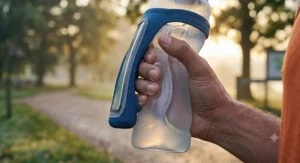
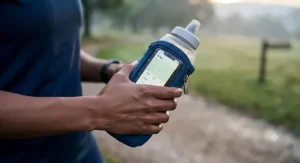
Somewhere around mile three, every runner without a proper carry system has the same argument with themselves. Do I really need my phone right now? What if something happens? What if I need to change the music? And so the phone gets crammed into a waistband, or gripped white-knuckled for four more miles, or — worst of all — left at home, which feels sensible until you’re standing on a closed footpath with no map and no way to call anyone. A handheld running bottle with phone holder solves this specific, oddly stressful problem by combining hydration and phone storage into one strap that sits on your hand rather than bouncing on your hip or squeezing your arm.
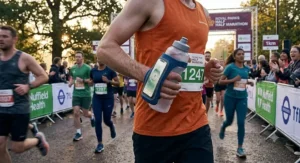
This guide is built for runners in the UK who want a genuinely useful carry solution rather than another gadget gathering dust in a drawer. We’ve researched seven real, currently available products spanning budget, mid-range and premium price points, and we’ve dug into what actual reviewers say about strap comfort, phone compatibility and long-term durability — not just what the marketing copy promises. What is a handheld running bottle with phone holder? In short, it’s a bottle with an adjustable hand strap and an attached zippered pocket, letting you carry water, your phone, keys and a card without a belt, vest or armband digging into your skin. Alongside product reviews, you’ll find comparison tables, a buyer’s decision framework, and honest analysis of where a handheld bottle beats — and loses to — belts and vests.
Whether you’re commuting on foot through city streets, training for your first 10K, or just tired of your phone slipping out of your leggings pocket, there’s a genuine case for trying one of these. Let’s get into the detail.
Quick Comparison Table
| Product | Capacity | Phone Fit | Strap Type | Price Range | Best For |
|---|---|---|---|---|---|
| Nathan SpeedDraw Plus Insulated | 18oz / 532ml | Most phones | Adjustable, thumbhole | £25-£35 | All-round training |
| Nathan SpeedDraw 2 Insulated | 18oz / 532ml | Larger phones | Adjustable ergonomic | £30-£40 | Hot-weather runners |
| AONIJIE Handheld with Phone Holder | 15oz / 450ml | Up to 6.8″ | Elasticated + drawcord | Under £20 | Budget city running |
| Amphipod Hydraform Thermal-Lite | 20oz / 591ml | Compact phones | Quick-adjust strap | £20-£30 | Longer training runs |
| Amphipod Hydraform Ergo-Lite Ultra | 20oz / 591ml | Larger phones | Thumb-Lock strap | £25-£35 | Marathon & ultra training |
| HydraPak SkyFlask Speed | 500ml (collapsible) | Small-mid phones | Adjustable strap | £20-£30 | Lightweight racers |
| Gear Beast Running Water Bottle | 23oz / 680ml | Most phones | Ergonomic cinch strap | Under £20 | First-timers & walkers |
Even at a glance, the spread here tells its own story. Budget-friendly options like the AONIJIE Handheld with Phone Holder and Gear Beast Running Water Bottle prioritise phone storage and value over insulation, while the two Amphipod models lean into ergonomic strap design for people logging serious weekly mileage. The Nathan pair sits in the middle, balancing insulation with genuinely adjustable straps, and the HydraPak SkyFlask Speed is the outlier — a collapsible flask built for people who care more about shedding grams than maximising capacity.
💬 Just one click — help others make better buying decisions too!😊
Top 7 Handheld Running Bottles With Phone Holder: Expert Analysis
1. Nathan SpeedDraw Plus Insulated — best all-rounder for regular training
The standout here is the double-wall insulation, which keeps water noticeably cooler on a warm club run than the single-wall bottles further down this list. Specs worth knowing: 18oz (532ml) capacity, a Race Cap designed for quick bursts of fluid rather than a slow sip, and a fully adjustable hand strap with a thumbhole that lets your fingers stay relaxed instead of gripping. In practice, that thumbhole design is the difference between a bottle that disappears into your stride and one you’re constantly readjusting.
Based on the spec comparison with cheaper handhelds, the insulation and the expandable zippered pocket justify the mid-range price for anyone doing more than two or three runs a week. This is a bottle for the regular trainer rather than the occasional walker — someone who wants one piece of kit that works in January frost and July heat alike. Reviewers consistently report that the pocket comfortably swallows a phone, key fob and a gel, though several note it takes a squeeze to fit larger phones without a case. A common complaint in user reviews is that the strap can loosen gradually over longer runs and need retightening.
Pros:
- ✅ Genuine double-wall insulation keeps drinks cooler for longer
- ✅ Thumbhole strap design reduces hand fatigue on long runs
- ✅ Expandable pocket fits phone, keys, ID and a gel
Cons:
- ❌ Strap can loosen and need mid-run adjustment
- ❌ Larger phones with bulky cases are a tight squeeze
Prices for the Nathan SpeedDraw Plus Insulated typically sit in the £25-£35 range at the time of research, and given the insulation and pocket capacity on offer, it represents solid value for anyone training three-plus times a week rather than an occasional jogger.
2. Nathan SpeedDraw 2 Insulated — best for hot-weather and larger phones
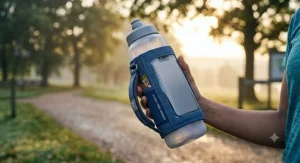
What most buyers overlook about this model is that it’s a genuine refinement of the original SpeedDraw rather than a cosmetic refresh — the blast-valve cap and reworked ergonomic grip are built specifically around reducing hand strain on longer efforts. The 18oz insulated flask keeps the same double-wall construction as its predecessor, but the storage pocket has been widened, making it noticeably more accommodating for today’s larger smartphones.
On paper this means fewer compromises for anyone carrying a phone in a protective case, and reviewers back that up: aggregated feedback highlights the roomier phone pocket as the single biggest improvement over the original SpeedDraw. Here’s what to weigh, though — the wider pocket adds a touch of bulk to the bottle’s profile, so if you value a minimalist feel in your hand, this may sit slightly heavier than sleeker alternatives. The reflective detailing is genuinely useful for anyone running early mornings or dark evenings on British roads through autumn and winter.
Pros:
- ✅ Wider pocket comfortably fits larger modern phones
- ✅ 360-degree reflective design for low-light visibility
- ✅ Blast-valve cap delivers fluid quickly without fumbling
Cons:
- ❌ Slightly bulkier profile than the original SpeedDraw Plus
- ❌ Premium end of the price bracket for a handheld bottle
Expect to pay in the £30-£40 range for the Nathan SpeedDraw 2 Insulated, at the time of research, making it a worthwhile upgrade if phone size was ever a frustration with older handheld designs.
3. AONIJIE Handheld with Phone Holder — best budget pick for phone storage
The immediate standout is the sheer size of the phone pocket: a 6.8-inch zippered compartment that swallows even today’s largest phones, something several pricier bottles on this list can’t match. The 15oz (450ml) BPA-free flask uses a 30-degree angled silicone bite valve, which sounds like a gimmick until you’re mid-stride and realise you don’t have to tip your wrist awkwardly to drink.
What the spec sheet won’t tell you, but reviewers note, is that the CORDURA fabric construction feels notably more durable than the price suggests — this isn’t a flimsy budget knockoff, it’s a genuinely well-built piece of kit at a fraction of the cost of the premium brands. This is the pick for beginners or anyone unsure whether a handheld bottle suits their running style; the low entry price removes the risk of an expensive experiment. Aggregated review sentiment is positive on the phone fit and the reflective trim for low-light safety, though a recurring theme is that the elastic drawcord securing the bottle itself can loosen slightly over hundreds of uses.
Pros:
- ✅ Enormous 6.8-inch phone pocket fits nearly any device
- ✅ Genuinely low price point for first-time buyers
- ✅ Reflective trim adds visibility on unlit routes
Cons:
- ❌ Elastic bottle cord can loosen with heavy long-term use
- ❌ Smaller 450ml capacity than most rivals here
At under £20 at the time of research, the AONIJIE Handheld with Phone Holder is arguably the best value entry point on this entire list, especially for anyone whose main frustration is simply finding somewhere secure to put a large phone.
4. Amphipod Hydraform Thermal-Lite — best for longer training runs
The perforated neoprene sleeve is the feature that separates this from a basic bottle-and-strap combo — Amphipod’s own testing claims it keeps hydration cooler for around 30% longer than an uninsulated equivalent, and the breathable design also reduces the sweaty-palm feeling you get from non-perforated sleeves on a humid run. At 20oz (591ml), it holds more than either Nathan model, which matters once your long run creeps past 90 minutes.
Based on the spec comparison, the wide-mouth Jett Lock cap is a genuinely practical touch: it accepts ice cubes, which the narrower openings on some rivals simply can’t. Reviewers consistently note the ergonomic shape as one of the most comfortable handheld designs available, with several long-distance runners specifically praising how little hand fatigue they experience compared with rigid bottles. The zippered utility pocket is sized for gels, keys, cash and ID rather than being purpose-built for a phone, so anyone carrying a large handset should measure their device against the compact pocket dimensions before buying.
Pros:
- ✅ Wide-mouth cap accepts ice cubes for hot-weather runs
- ✅ 20oz capacity suits runs over 90 minutes
- ✅ Breathable neoprene sleeve reduces palm sweat
Cons:
- ❌ Storage pocket is compact for larger modern phones
- ❌ Heavier in hand than slimline soft-flask alternatives
The Amphipod Hydraform Thermal-Lite typically retails in the £20-£30 range at the time of research, putting it firmly in mid-range territory for what is a genuinely well-engineered long-run companion.
5. Amphipod Hydraform Ergo-Lite Ultra — best for marathon and ultra training
This is Amphipod’s answer to the question “what if the pocket needs to hold a proper phone, not just a key and a tenner?” The Ergo-Lite Ultra’s zippered storage includes an internal divider and a dedicated key fob loop, and it’s explicitly built to accommodate large phones alongside ID, cards and nutrition — a genuine departure from the more minimalist Thermal-Lite above.
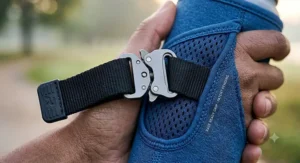
Here’s what to weigh: the Thumb-Lock strap system is engineered specifically to eliminate the low-grade hand cramping that ultra runners report after several hours of carrying a rigid bottle, and aggregated reviewer sentiment consistently praises the strap’s comfort over long durations, which is precisely the demographic this bottle targets. A common theme in feedback is that buyers switching from basic bottles are surprised by how little they notice the strap after the first few kilometres — a meaningful claim for anyone training for a marathon or beyond, where hours in hand matters more than headline capacity. It isn’t the cheapest option here, and the outer gel slot, while handy, does add a small amount of extra bulk to the overall profile.
Pros:
- ✅ Purpose-built pocket fits large phones plus cards and cash
- ✅ Thumb-Lock strap minimises hand cramp on long efforts
- ✅ Outer gel slot for quick-access nutrition
Cons:
- ❌ Higher price point than Amphipod’s simpler models
- ❌ Slightly bulkier profile due to the added storage
Prices for the Amphipod Hydraform Ergo-Lite Ultra generally sit in the £25-£35 range at the time of research — a reasonable ask for anyone logging serious weekly long-run mileage.
6. HydraPak SkyFlask Speed — lightest option for racing
The defining feature is right there in the name: this is a collapsible soft flask, not a rigid bottle, and it genuinely shrinks as you drink, which matters more than it sounds on race day when every gram in your hand adds up over 26.2 miles. Available in 350ml and 500ml sizes (with an insulated 500ml variant), the SkyFlask Speed pairs a spill-proof cap with an adjustable strap that’s noticeably slimmer than the bulkier hand-straps on this list.
What most buyers overlook about soft flasks generally is that the collapsing action isn’t just about weight — it also stops the sloshing sensation that rigid bottles create as they empty, something distance runners often cite as a genuine annoyance mid-race. This is a minimalist’s pick rather than a phone-storage specialist: the strap system is built around holding the flask securely rather than carrying a full loadout of essentials, so anyone prioritising phone capacity over pure lightweight performance should look toward the AONIJIE or Amphipod options instead. Reviewers who use it for racing rather than daily training consistently rate it highly for exactly this reason.
Pros:
- ✅ Collapses as you drink, shedding bulk and weight
- ✅ Slim, race-day-focused strap design
- ✅ Available in multiple sizes including an insulated option
Cons:
- ❌ Storage is minimal compared with pocket-focused rivals
- ❌ Less structured feel than a rigid bottle for some runners
Expect to pay in the £20-£30 range for the HydraPak SkyFlask Speed at the time of research, which is competitive for a flask built by a brand with a strong reputation among trail and ultra communities.
7. Gear Beast Running Water Bottle — best for beginners and city walking
The Gear Beast’s biggest selling point is straightforward generosity: a 23oz (680ml) capacity, the largest on this list, paired with a zippered phone holder roomy enough for water, phone, keys, cards, cash and ID all at once. The neoprene construction is sweat-proof and water-resistant, and the ergonomically designed hand strap is specifically engineered to make dropping either the bottle or the phone “virtually impossible,” according to the brand’s own product testing claims.
Based on the spec comparison, the universal-fit adjustable cinch strap is a genuinely thoughtful touch for households where more than one person might use the same bottle — it tightens down for smaller hands or loosens for larger ones without needing a different size entirely. Reviewers consistently frame this as a strong entry point for people newer to structured carrying systems, whether that’s runners just starting out or walkers and hikers who want one product that covers multiple activities. It won’t win any prizes for insulation or premium materials, but for the price, the sheer capacity and phone-storage flexibility are hard to beat.
Pros:
- ✅ Largest capacity on this list at 23oz
- ✅ Universal-fit strap suits multiple hand sizes
- ✅ Roomy enough for phone, cards, cash and keys together
Cons:
- ❌ Lacks the insulation of the Nathan and Amphipod models
- ❌ Bulkier feel than slimline racing-focused options
At under £20 at the time of research, the Gear Beast Running Water Bottle is one of the most accessible entry points into handheld carrying, particularly for anyone who values capacity and simplicity over premium materials.
Practical Usage Guide: Getting the Most From Your Handheld Bottle
Setting a new handheld bottle up correctly on day one saves weeks of minor frustration. Start by adjusting the hand strap while the bottle is empty — most straps, including those on the Nathan SpeedDraw Plus Insulated and Amphipod Hydraform Thermal-Lite, are designed to be tightened around your relaxed hand rather than a clenched fist, so grip it the way you would mid-stride, not the way you’d grip a dumbbell. A strap that feels snug standing still will usually loosen slightly once your hand warms up and swells during a run, so err on the side of slightly tight rather than loose.
For the first thirty days, resist the urge to overfill insulated models like the Nathan SpeedDraw 2 Insulated with ice right to the brim — leave a little headroom, since the double-wall construction needs space to actually chill the water rather than just holding solid ice. Rinse the bottle and pocket lining after every run in humid weather; sweat and residual sports drink are the two biggest causes of the musty smell that ruins an otherwise great bit of kit within a few months. Most handheld bottles, including the Gear Beast Running Water Bottle, are hand-wash only for the fabric sleeve, so check the label before it goes anywhere near a washing machine.
A common early mistake is treating the phone pocket as a permanent home for anything you own — overstuffing the AONIJIE Handheld with Phone Holder‘s 6.8-inch pocket with a phone, cards, keys and a gel simultaneously puts unnecessary strain on the zip over time. Rotate what you carry based on the run: short local loops need less than a long training run where you might genuinely need cash for a mid-run coffee stop.
Real-World Scenarios: Which Bottle Suits Your Running Life
Picture three very different runners tackling the same question. First, a college student commuting three miles across a UK city to lectures, running rather than taking the bus to save money and fit in exercise. Budget matters, and so does phone size, since most of her essentials — student ID, bank card, headphones — live on her phone. The AONIJIE Handheld with Phone Holder suits this profile well: the low price removes financial risk, and the oversized 6.8-inch pocket comfortably swallows a large-screen phone alongside a card.
Second, consider a 45-year-old training for their first half marathon, running four times a week including one long run that’s crept past ninety minutes. Insulation and capacity both matter here, and hand comfort over an extended period matters more than it did during shorter 5K training. The Amphipod Hydraform Thermal-Lite or the Nathan SpeedDraw Plus Insulated both fit this scenario, offering genuine temperature control and an ergonomic strap built for sustained carrying rather than short bursts.
Finally, picture an experienced club runner chasing a marathon PB, racing in warm conditions and obsessing over every gram. Weight and minimalism outrank storage capacity entirely. The HydraPak SkyFlask Speed is the obvious fit — a flask that shrinks as it empties, with a slim strap that won’t feel like extra baggage in the closing miles when everything starts to feel heavier than it is.
Common Problems Runners Face — And How to Solve Them
Problem: the phone pocket won’t zip closed with a large phone in a case. Solution: check listed compatibility before buying — models like the Nathan SpeedDraw 2 Insulated and AONIJIE Handheld with Phone Holder are specifically built with wider pockets for today’s larger devices, while older or more minimalist designs may struggle.
Problem: the strap loosens mid-run. Solution: this is a common theme across nearly every brand, including feedback on the Nathan SpeedDraw Plus Insulated. Tighten the strap slightly more than feels necessary at rest, since hands typically swell during exercise, and check the strap at each water stop rather than waiting until it’s uncomfortably loose.
Problem: the bottle sloshes and feels unbalanced as it empties. Solution: this is inherent to rigid bottles rather than a fault — collapsible flasks like the HydraPak SkyFlask Speed solve it structurally by shrinking with volume, so if sloshing genuinely bothers you, a soft flask is the better long-term fix rather than a different rigid bottle.
Problem: musty odour developing after a few weeks of use. Solution: rinse both the bottle and the fabric sleeve or pocket after every run, and let it air dry fully rather than storing it in a closed bag while still damp — this is the single biggest cause of lingering smell on any neoprene-sleeved product, including the Gear Beast Running Water Bottle.
Problem: hand fatigue on long runs. Solution: look specifically for a thumbhole or Thumb-Lock strap design, which distributes weight across the hand rather than relying on a clenched grip — both the Amphipod Hydraform Ergo-Lite Ultra and the Nathan range are built around this principle.
Buyer’s Decision Framework
If you run under 5K distances mostly for fitness and want the lowest financial risk, choose a budget pocket-focused model like the AONIJIE Handheld with Phone Holder, because you’ll get large phone storage without paying for insulation you may not need on short runs.
If you’re training for a half marathon or marathon with long runs regularly exceeding 90 minutes, choose an insulated option such as the Nathan SpeedDraw Plus Insulated or Amphipod Hydraform Thermal-Lite, because temperature retention becomes genuinely important once you’re out for well over an hour in variable UK weather.
If you’re racing competitively and grams matter, choose a collapsible flask like the HydraPak SkyFlask Speed, because shedding weight and eliminating slosh outweighs any storage convenience in a race scenario.
If you want one product to cover running, walking and hiking without buying multiple carry systems, choose the highest-capacity generalist option, the Gear Beast Running Water Bottle, because its universal strap fit and large pocket suit varied, less specialised use.
How to Choose a Handheld Running Bottle With Phone Holder
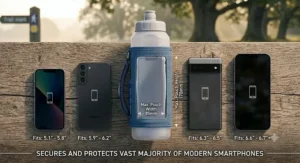
- Measure your phone against the pocket dimensions. Manufacturer listings usually state a maximum phone size in inches — check this against your actual device with its case on, since a snug fit without a case can become impossible once the case is added.
- Decide whether insulation matters for your runs. If most of your training happens in under an hour, insulation is a nice-to-have rather than essential; for anything longer, or for summer running, it becomes genuinely useful.
- Check the strap adjustment mechanism. Thumbhole and Thumb-Lock designs, as used across the Nathan and Amphipod ranges, generally reduce hand fatigue better than simple Velcro straps.
- Consider your typical carry load. If you regularly need cash, cards, keys and a gel alongside your phone, prioritise pocket size and dividers over minimalism.
- Think about visibility. Reflective detailing matters far more than most buyers initially assume, particularly given UK daylight hours shrink dramatically through autumn and winter.
- Weigh up capacity against comfort. A larger bottle holds more water but adds weight to your hand for the entire run — match capacity to your actual typical distance, not your longest ever run.
- Factor in ease of cleaning. Hand-wash-only fabric sleeves need more maintenance discipline than simpler rigid bottles, so be honest about your own laundry habits before committing.
Handheld Bottles vs Traditional Alternatives
| Carry Method | Comfort Over Distance | Phone Access | Bounce | Best For |
|---|---|---|---|---|
| Handheld Bottle (e.g. Nathan SpeedDraw Plus Insulated) | High with proper strap | Immediate | Minimal | Regular training runs |
| Running Belt/Waist Pack | Moderate, can chafe | Requires unzipping pouch | Noticeable on uneven terrain | Multi-item carrying |
| Arm Band | Low over long distance | Awkward to view screen | Low | Short runs, music control |
| Hydration Vest | High for long distances | Buried in pack | Very low | Ultra distance, trail |
Looking at the comparison above, a handheld bottle like the Amphipod Hydraform Ergo-Lite Ultra genuinely outperforms belts on immediate phone access — there’s no unzipping a waist pouch mid-stride — but it does mean one hand is permanently occupied, which some runners find limiting for arm swing on faster efforts. Belts and vests distribute weight across the body rather than concentrating it in one hand, which matters more as distance and total carried weight increase, but they trade that comfort for slower access to your phone. For anyone doing 5-10K runs where quick phone access genuinely matters — city commuters checking navigation, parents wanting instant call access — the handheld format wins outright.
Handheld Running Bottles for City Runners
Running through UK city streets brings a different set of priorities than trail or park running. Traffic awareness matters more, navigation apps get checked more frequently, and the ability to quickly access a card or contactless payment for an emergency bus fare or coffee stop is genuinely useful in a way it simply isn’t on a closed trail loop. The best handheld bottle for city running tends to prioritise fast phone access and visibility over raw capacity — you’re rarely more than a few minutes from a tap or shop, so the largest bottles on this list offer less practical benefit in an urban setting than they do on a rural long run.
The AONIJIE Handheld with Phone Holder and Nathan SpeedDraw 2 Insulated both suit city running particularly well, since their pockets are sized around modern phones rather than minimalist racing setups, and their reflective detailing helps with visibility crossing busy junctions in low light. According to the government’s official Highway Code guidance for pedestrians, wearing something reflective makes it considerably easier for drivers to see you at night, which is a genuinely practical reason to favour a handheld bottle with reflective trim over a plain option if most of your running happens on unlit streets during autumn and winter months.
Long-Term Cost & Maintenance
A handheld bottle isn’t a one-and-done purchase in the way a plain water bottle might be — the fabric sleeve, zip and strap are all wear items that determine how long the product genuinely lasts. Based on the spec comparison across this list, products with reinforced YKK zippers, seen on the AONIJIE Handheld with Phone Holder, tend to outlast cheaper unbranded zip mechanisms by a meaningful margin, since the zip is usually the first component to fail on budget carrying gear.
Total cost of ownership should factor in more than the upfront price. A £15 budget bottle that needs replacing after eight months of regular use isn’t necessarily cheaper over two years than a £35 Nathan model that lasts three or four times as long with proper care. Neoprene sleeves, used across most of this list including the Amphipod Hydraform Thermal-Lite, benefit from air drying rather than tumble drying, and avoiding direct sunlight for extended storage periods slows the fabric degradation that eventually causes fraying at the seams. Replacement soft flasks for collapsible systems like the HydraPak SkyFlask Speed are also worth checking — buying a spare flask is usually far cheaper than replacing the entire strap-and-flask unit if only the bladder fails.
Features That Actually Matter (And Those That Don’t)
Marketing copy on handheld bottles leans heavily on buzzwords, so it’s worth separating genuine performance features from padding. Adjustable strap mechanisms matter enormously — this is the single feature most likely to determine whether you actually enjoy using the product, which is exactly why the thumbhole design on the Nathan SpeedDraw Plus Insulated and the Thumb-Lock system on the Amphipod Hydraform Ergo-Lite Ultra get so much attention in this guide. Phone pocket dimensions matter just as much, particularly given how large modern phones have become.
What matters considerably less: exact bottle colour, decorative branding, and marginal capacity differences of an ounce or two between similar models. A bite valve angle, championed heavily by AONIJIE’s marketing, is a genuine minor convenience but not a dealbreaker either way — plenty of runners are perfectly happy with a standard push-pull cap. Insulation claims are worth scrutinising too: double-wall insulation on the Nathan models is a real, measurable feature, whereas a simple neoprene sleeve, while helpful, offers noticeably less temperature retention than genuine double-wall construction, despite sometimes being marketed with similarly confident language.
Safety and Visibility Guide for Running With a Handheld Bottle
Visibility deserves more attention than most runners give it, particularly given how much of the year the UK spends in low light. The British Heart Foundation’s guidance on hydration for sporting events reinforces that consistent daily fluid intake — not just drinking during the run itself — supports overall training performance, which is a good reminder that a handheld bottle is one part of a broader hydration habit rather than a complete solution on its own.
On the visibility side, reflective elements built into bottles like the Nathan SpeedDraw 2 Insulated genuinely help, but they work best as one layer of a broader visibility strategy rather than a sole solution — pairing a reflective bottle with a high-vis top or a small clip-on light covers the gaps a bottle’s reflective trim alone can’t. If your usual routes cross roads without dedicated crossings, it’s worth remembering that reflective clothing specifically helps oncoming traffic spot you sooner in the dark, giving drivers meaningfully more reaction time than non-reflective kit.
✨ Ready to Upgrade Your Runs?
🔍 Take your handheld running bottle with phone holder search to the next level with the picks above — click through to check current pricing and availability on any of these seven options. Comfortable, secure phone storage might be the single easiest upgrade to your running kit this year!
Handheld Bottles for Different Types of Runners
Beginners generally benefit most from generous, forgiving designs rather than minimalist race-focused gear — the Gear Beast Running Water Bottle‘s large capacity and universal strap fit make it a genuinely low-risk starting point, since it won’t feel restrictive while you’re still working out your preferred running style and distance.
Experienced marathon and ultra runners tend to prioritise strap comfort above almost everything else, since hours of carrying time makes even small design flaws noticeable — this is exactly the audience the Amphipod Hydraform Ergo-Lite Ultra‘s Thumb-Lock system is engineered for. Meanwhile, competitive racers chasing personal bests are usually best served by minimalist, low-weight options like the HydraPak SkyFlask Speed, where every gram genuinely does matter over 13.1 or 26.2 miles.
Parents running with young children nearby, or anyone who values instant phone access for safety reasons, should lean toward models with the largest, most accessible phone pockets — both the AONIJIE Handheld with Phone Holder and Nathan SpeedDraw 2 Insulated fit this need well, since their pockets are specifically sized around today’s larger smartphones rather than older, smaller handset dimensions.
Common Mistakes When Buying a Handheld Running Bottle
The single most frequent mistake is buying based on brand reputation alone without checking phone pocket dimensions against your actual device — a well-reviewed bottle can still be the wrong choice if your phone simply doesn’t fit its pocket comfortably. Another common error is prioritising the largest available capacity regardless of typical run distance; carrying an unnecessarily heavy, full 23oz bottle on a routine 5K adds fatigue without any real benefit.
Buyers also frequently underestimate how much straps loosen once hands warm up during exercise, leading to disappointment with a product that actually performs perfectly well once properly adjusted. Finally, skipping the maintenance instructions is a recurring issue — treating a hand-wash-only neoprene sleeve like a machine-washable item is one of the fastest ways to shorten the lifespan of an otherwise well-built product.
Frequently Asked Questions
❓ Can I fit a large phone in a handheld running bottle pocket?
❓ Is a handheld bottle better than a running belt for phone storage?
❓ How do I stop my handheld bottle strap from loosening while running?
❓ Do insulated handheld bottles actually keep water cooler for longer?
❓ What size handheld bottle do I need for a 10K run?
Conclusion
Choosing between these seven handheld running bottles with phone holders really comes down to matching the product to your actual running life rather than chasing the highest spec sheet. Budget-conscious beginners and city commuters are well served by the AONIJIE Handheld with Phone Holder or Gear Beast Running Water Bottle, both offering generous phone storage without a big financial commitment. Regular trainers logging consistent weekly mileage should look toward the insulated comfort of the Nathan SpeedDraw Plus Insulated or Amphipod Hydraform Thermal-Lite, while marathon and ultra runners will likely appreciate the strap engineering built into the Amphipod Hydraform Ergo-Lite Ultra. Competitive racers chasing a PB have a clear winner in the featherweight HydraPak SkyFlask Speed.
None of these are perfect for every runner — that’s genuinely the point of comparing seven real options rather than pushing a single “best” product. What matters is being honest with yourself about your typical distance, your phone size, and how much you value insulation versus minimalism. Get that match right, and a handheld bottle stops being another piece of unused kit and becomes something you genuinely reach for before every run.
Recommended for You
- Bone Conduction vs Earbuds for Treadmill Running: 7 Tested Picks (2026)
- Bone Conduction Headphones Treadmill: 7 Best Picks (2026)
- Wireless Earbuds For Treadmill Workout: 7 Top 2026 Picks
Disclaimer: This article contains affiliate links. As an Amazon Associate, I earn from qualifying purchases. If you purchase products through these links, we may earn a small commission at no additional cost to you.
✨ Found this helpful? Share it with your friends! 💬🤗
