

In This Article
Somewhere around mile four of a Sunday long run, your phone starts doing that thing. You know the thing — the little rhythmic thump-thump-thump against your hip, in perfect (and infuriating) time with your cadence. A good running waist belt is the difference between that and simply forgetting your kit exists. It’s not a glamorous purchase. Nobody’s ever bragged about their belt at a pub quiz. But get the wrong one and it will chafe, bounce, or slowly work its way south until you’re hoiking it back up at every lamppost between here and the finish line.

Here’s what most buyers overlook: the belt itself matters less than the fit, and the fit depends entirely on what you’re actually carrying. A minimalist strip of Lycra holding nothing but a key and a gel is a very different product to a hydration belt loaded with two soft flasks and a race number. Get that match wrong and even the best-reviewed belt on Amazon UK will feel like a saddlebag. This guide walks through seven genuinely well-regarded options — from budget tubular belts to hydration-ready marathon kit — plus the comparisons, the common mistakes, and the practical fitting advice that Amazon listings tend to skip entirely. Fluid needs rise noticeably once you’re out for longer than 45 minutes, which is roughly where the NHS guidance on daily fluid intake becomes genuinely relevant to your kit choices, not just your diet.
What Is a Running Waist Belt?
A running waist belt is a lightweight strap or pouch worn around the midsection to carry a phone, keys, gels, a race number, or a small water flask hands-free while running, without the bounce and bulk of a backpack-style vest.
That’s the dictionary version. In practice, “running waist belt” covers a surprisingly wide family of products. At one end sits the tubular, zip-free FlipBelt-style band — basically a stretchy sleeve you step into. At the other end sits a fully-loaded hydration belt with two 500ml flasks and a zipped pocket big enough for a folded jacket. Somewhere in the middle are race-day belts designed purely to hold your bib number without sixteen safety pin holes in your favourite vest. Understanding which category you actually need — before you look at brand names — saves a lot of returned parcels.
Quick Comparison Table
| Belt | Best For | Bounce Control | Hydration | Price Range |
|---|---|---|---|---|
| FlipBelt Classic Edition | Everyday runners, minimalists | Excellent | No | Around £20–£25 |
| VeloChampion Reflective Race Number Belt | Race day, night visibility | Good | No | Under £15 |
| SPIbelt Dual Pocket Pro | Larger phones, expandable storage | Very good | No | £25–£30 range |
| Fitletic Ultimate II | Marathon training, gels + bib | Excellent | No | £30–£35 range |
| Nathan Trail Mix Plus 3.0 | Long runs needing fluid | Very good | Yes (soft flask) | £30–£40 range |
| CamelBak Ultra Belt | Ultras, hot weather, heavy load | Excellent | Yes (17oz flask) | £40–£50 range |
| Salomon Pulse Belt | Speed sessions, low-profile carry | Very good | No | £30–£40 range |
Looking at the spread here, the pattern is fairly clear: the belts that carry the least bounce the least, because there’s simply less mass to move. Add hydration and you add stability engineering — which is exactly why the Nathan Trail Mix Plus 3.0 and CamelBak Ultra Belt cost more than a basic phone-only band. If your longest run this year tops out at 10K, you’re very likely overpaying by chasing a hydration belt you’ll never fill.
💬 Just one click — help others make better buying decisions too!😊
Top 7 Running Waist Belts: Expert Analysis
Seven belts, spanning budget tubular bands through to marathon-ready hydration systems. Each one below has real specs, honest analysis, and — where verifiable — genuine aggregated review sentiment, not invented quotes. Prices shown are ranges only; always check the current listing for exact pricing.
1. FlipBelt Classic Edition — near-zero bounce from a £20 band
The FlipBelt skips buckles and zips entirely, using a tubular loop of stretch fabric you step into like a wide waistband, and that simplicity is precisely why it doesn’t bounce. Made from a Lycra-nylon-spandex blend, it comes in three sizes covering roughly 24 to 45 inches at the waist, with multiple horizontal slots rather than one big pocket — so weight distributes evenly instead of sagging on one hip. Because there’s no rigid pouch or clasp, the whole thing behaves like a second skin once it’s positioned correctly, which is precisely why FlipBelt-style belts keep topping “no bounce” round-ups across running publications.
Who is this for? Runners doing 5K to half-marathon distances who want to carry a phone, key, and maybe a card, and who find zippered pouches fiddly mid-stride. It’s less suited to anyone wanting to carry an actual water bottle — there’s nowhere rigid to put one. Aggregated reviewer sentiment across retailers consistently flags the fabric as breathable and genuinely bounce-free, though a recurring complaint is that retrieving a phone mid-run from the tighter slots takes a bit of practice.
Pros:
- ✅ Zero hardware means nothing to rattle or dig in
- ✅ Multiple slots spread weight evenly around the waist
- ✅ Fits under a jacket without printing through fabric
Cons:
- ❌ No dedicated water bottle holster
- ❌ Smaller phones can shift inside looser slots
Priced around £20–£25, the FlipBelt Classic Edition is one of the cheapest ways to solve the bounce problem outright — genuinely good value if hydration isn’t part of your kit list.

2. VeloChampion Reflective Race Number Belt — best budget race-bib specialist
VeloChampion’s belt strips things back to the essentials: an elastic adjustable strap with clip fastening, a small storage pouch, and reflective detailing for early-morning or evening starts. It’s built specifically around the “no safety pins” use case — clipping your race bib to the front rather than pinning it through your running top, which matters more than it sounds once you’ve torn a favourite vest at parkrun. The elastic construction adjusts to most adult waist sizes without needing to pick between S/M/L.
Where this belt earns its keep is race mornings and dark-weather training runs, where the reflective strip adds a genuine visibility margin — an easy win given how often runners underestimate how invisible they are to drivers before sunrise. Reviewers on UK retail sites consistently note the reflective panel and the fact it holds a bib flat rather than folded, which matters for chip-timed events with barcode scanning. The trade-off is storage: the small pouch fits a key or gel, not much else.
Pros:
- ✅ Reflective panel adds real low-light visibility
- ✅ No safety pins needed for bib attachment
- ✅ One-size elastic fit suits most adult waists
Cons:
- ❌ Storage pouch is genuinely tiny
- ❌ Not built to carry a phone comfortably
At under £15, the VeloChampion Reflective Race Number Belt is the obvious pick if your only real need is a bib holder for race day rather than daily training carry.
3. SPIbelt Dual Pocket Pro — best expandable pocket for bigger phones
SPIbelt built its reputation on one clever idea: an expandable pocket that lies flat when empty and stretches to swallow a large phone, keys, and a couple of gels when loaded, all while staying pinned close to the body via a wide elastic waistband. The Dual Pocket Pro version adds a second zippered compartment, useful for separating a card or key from a phone so you’re not fishing around for either mid-stride. It’s rated to expand comfortably around phones the size of a Samsung Galaxy S20+ or iPhone Pro Max, which many slimmer belts simply can’t accommodate.
The appeal here is versatility without hydration bulk — this is a belt for runners who want one pocket that does everything, rather than several small compartments. Aggregated review sentiment is broadly positive on the no-bounce claim, though a recurring theme in customer feedback is that very stretchy fabric means some buyers size down from their usual measurement to get a snug rather than loose fit.
Pros:
- ✅ Expands to fit large modern phones
- ✅ Dual pockets separate valuables from phone
- ✅ Wide elastic band resists riding up
Cons:
- ❌ Runs stretchy — sizing down is often recommended
- ❌ No dedicated hydration option
At around £25–£30, the SPIbelt Dual Pocket Pro sits firmly in the mid-range and earns it through sheer flexibility of what it can carry.
4. Fitletic Ultimate II — best all-rounder for marathon training
This is the belt built for people who are actually training for something. The Fitletic Ultimate II pairs an 8x4x0.5 inch main pouch — sized for phones up to an iPhone 15 Pro Max — with four external gel loops and dedicated bib toggles, so you can carry fuel, your race number, and your phone on the same adjustable band without stacking pockets on top of each other. An inner pocket separates ID, cards, and keys from the phone compartment, a small design choice that stops your key scratching your screen over a 20-mile long run.
What most buyers overlook about a belt like this is that marathon training isn’t one run — it’s months of long runs that gradually demand more carrying capacity as mileage builds. A belt bought in January for 5K runs often needs replacing by March once gel loops and bib holders become non-negotiable. Buying ahead for where your training is heading, rather than where it is now, avoids that. The adjustable band covers roughly a 24 to 42 inch waist, and aggregated reviews consistently praise the patented no-bounce design and the bib toggles specifically, with occasional comments that the inner ID pocket is a little snug for bulkier wallets.
Pros:
- ✅ Four gel loops plus bib toggles built in
- ✅ Separate inner pocket for cards and keys
- ✅ Fits current large-format phones comfortably
Cons:
- ❌ Bulkier profile than minimalist belts
- ❌ Inner ID pocket is tight for thick wallets
Around £30–£35, the Fitletic Ultimate II offers strong value for anyone training seriously for a spring or autumn marathon, since it removes the need to buy a separate bib holder and gel carrier.
5. Nathan Trail Mix Plus 3.0 — best entry point into hydration belts
Once training runs stretch past an hour, water access stops being optional, and this is where the Nathan Trail Mix Plus 3.0 earns its place. It pairs a soft-flask holster on the back — using an updated no-bounce technology that keeps the flask from sloshing side to side — with a large expandable front zippered pocket and an exterior mesh pouch, all on a belt that weighs around 8oz empty and 10oz loaded. Total storage capacity sits at roughly 0.5 litres, which is enough for a phone, gels, and a lightweight layer alongside the flask.
The honest trade-off with any hydration belt is weight versus dryness: carrying water means carrying more mass around your midsection, and even good engineering can’t make a full flask weigh nothing. What Nathan’s holster design does solve is the specific complaint most hydration belts attract — flask movement — by angling the holder so the flask sits close and locked rather than swinging loose. Reviewers consistently rate the no-bounce holster highly, with the more common criticism being that half a litre of total storage feels tight once a jacket gets added on colder mornings.
Pros:
- ✅ Angled holster genuinely reduces flask bounce
- ✅ Expandable front pocket fits most phones
- ✅ Lightweight even when fully loaded
Cons:
- ❌ 0.5L total storage is snug with layers
- ❌ One flask only — not built for very long runs
At around £30–£40, the Nathan Trail Mix Plus 3.0 is the sensible middle ground between a phone-only belt and a full ultra-running hydration system.

6. CamelBak Ultra Belt — best for heavy-load, no-bounce hydration
This is the premium pick, and the spec sheet explains why. The CamelBak Ultra Belt carries a 17oz collapsible soft flask in a back pocket that tightens down as the flask empties, meaning it doesn’t bounce whether it’s full or nearly finished — a detail many cheaper hydration belts get badly wrong. A zippered front pouch plus additional drop-in side pockets add real capacity for a phone, gels, and small essentials, and the belt is compatible with trekking pole attachment loops on some versions, useful if trail running or hiking crosses into your training.
Where this belt genuinely shines is under real load. Reviewers across outdoor gear publications consistently describe it as staying stable even “fully packed” — language that shows up repeatedly across independent test write-ups rather than in a single isolated review, which is a reasonably strong signal for a claim this specific. The honest downside is price and profile: at £45-plus, and with a wider chassis than a minimalist belt, this is overkill for a casual 5K but genuinely well-matched to long training runs or half-day trail sessions.
Pros:
- ✅ Tightening flask pocket prevents bounce as it empties
- ✅ Multiple pocket types for varied kit
- ✅ Stable even when fully loaded
Cons:
- ❌ Premium price point for a belt
- ❌ Bulkier than minimalist alternatives
In the £45–£55 range, the CamelBak Ultra Belt justifies its cost for anyone regularly running 90 minutes or longer, but it’s genuinely more belt than most weekday 5K runners need.
7. Salomon Pulse Belt — best low-profile pick for faster sessions
Where the CamelBak leans into capacity, the Salomon Pulse Belt leans into speed. Its v-shaped strap design stabilises the pack when properly adjusted, and the narrow straps improve airflow, especially when positioned lower on the hips rather than higher on the waist — a small fit adjustment that makes a noticeable difference to how much you notice it’s there. Independent testers have reported minimal bounce even when the pack was nearly full, and the discreet profile means it tucks comfortably under a jacket for winter training, unlike bulkier hydration belts.
This is the belt for interval sessions, tempo runs, and race day itself — situations where you want your kit to disappear rather than announce itself. It doesn’t carry water, so it’s not the pick for long runs in summer heat, but for anyone whose main gripe with running belts is feeling weighed down during faster efforts, the narrow, low-profile build directly addresses that. One notable bonus flagged by testers: the low profile made it comfortable enough to wear cycling too, useful if you’re cross-training.
Pros:
- ✅ V-shaped straps stabilise the pack when full
- ✅ Narrow build improves airflow at speed
- ✅ Discreet enough to wear under a jacket
Cons:
- ❌ No hydration capacity
- ❌ Less storage than pouch-style belts
Sitting around £30–£40, the Salomon Pulse Belt is the pick for runners who prioritise disappearing comfort over maximum carrying capacity.
How to Wear and Fit Your Running Waist Belt for Zero Bounce
Buying the right belt solves half the bounce problem. The other half is fit, and this is the part Amazon listings never explain. Position matters more than most people assume: a belt worn high, near the natural waist, tends to shift and ride up with every stride, while one worn slightly lower, resting on the hip bones, has a stabler anchor point and moves far less. It sounds like a small distinction. On a 10-mile run it’s the difference between forgetting it exists and adjusting it every half mile.
Tension is the second variable. Most runners under-tighten on the first wear, assuming a looser fit will feel more comfortable, and then spend the whole run readjusting a belt that’s slipping. A properly fitted belt should feel snug enough that you can’t easily slide two fingers underneath it while standing still — it will still feel comfortable once you’re moving, because running compresses the torso slightly and a belt fitted “just right” standing still often loosens by the time you’re a mile in. Load distribution matters too: a phone and keys both crammed into one pocket on one hip will pull unevenly, so where a belt has multiple compartments, spreading weight across them evens out the pull and cuts down on that side-to-side sway that reads as “bounce” even when the belt itself is behaving.
First 30 days: expect a short break-in period as the fabric — especially on stretch-fabric belts like FlipBelt or SPIbelt styles — settles to your shape. Wash according to the label rather than leaving sweat and salt to dry into the elastic, since that residue is what degrades stretch fabric fastest and is the single most avoidable cause of belts losing their snug fit within a season.
Real Runners, Real Belts: Matching Your Kit to Your Training
The 5K parkrun regular. Running three times a week, mostly under 40 minutes, phone and key only. A minimalist option like the FlipBelt Classic Edition or VeloChampion Reflective Race Number Belt covers this comfortably — there’s no need to pay for hydration capacity that will sit empty every single run.
The half-marathon-to-marathon trainer. Long runs now regularly exceed 90 minutes, gels are part of the plan, and race day means an actual bib number to carry. This is the profile the Fitletic Ultimate II was built around — gel loops and bib toggles solve two problems most runners at this stage are juggling separately, often with safety pins and a pocket that doesn’t quite fit.
The trail or ultra-curious runner. Sessions stretch past two hours, terrain is uneven, and self-sufficiency matters because there’s no water station every mile. Here, the CamelBak Ultra Belt or Nathan Trail Mix Plus 3.0 earns its higher price tag — dehydration risk climbs sharply on longer efforts, and reliable, bounce-free flask access becomes a genuine safety consideration rather than a nice-to-have.

Running Waist Belt vs Bum Bag for Running: What’s Actually Different
“Bum bag” and “running belt” get used almost interchangeably by non-runners, but the two products are engineered for entirely different jobs, and conflating them is a common reason people end up disappointed with a purchase.
| Feature | Running Waist Belt | Standard Bum Bag |
|---|---|---|
| Fabric | Stretch, moisture-wicking Lycra blends | Often rigid nylon or canvas |
| Fit | Snug, close to body, anti-bounce design | Looser, designed for walking-pace carry |
| Weight distribution | Multiple pockets or tubular slots | Usually one central pouch |
| Best For | FlipBelt Classic Edition, Salomon Pulse Belt | Festivals, travel, dog walking |
A general-purpose bum bag isn’t designed to withstand repeated impact at running cadence — the fabric doesn’t wick sweat the same way, the strap tends to sit higher and looser, and a single central pouch concentrates weight in one spot rather than spreading it, which is precisely the setup that causes noticeable bounce. Running-specific belts solve for cadence and moisture in a way general fashion accessories simply weren’t built to. If you’ve ever tried running in a festival bum bag and found it slapping against your hip within the first kilometre, that’s the fabric and fit gap showing itself immediately.
No-Bounce Running Belt: What Actually Stops the Bounce
Every product in this category claims to be “no-bounce,” which makes the phrase almost meaningless as a marketing term — so it’s worth unpacking what genuinely reduces movement versus what’s just a label.
- Snugness over looseness. A belt that’s technically the right size but worn loose will bounce regardless of design. Fit is doing most of the work here, more than any single material choice.
- Weight distribution across multiple compartments. Tubular slot belts (FlipBelt-style) and multi-pocket belts spread load, which is why they consistently outperform single-pouch designs at matched weight.
- Rigid or angled holsters for liquids. Hydration belts that bounce are almost always ones where the flask sits loose in a soft pouch; belts like the CamelBak Ultra and Nathan Trail Mix Plus solve this with tightening or angled holster mechanisms specifically.
- Waistband width. Wider bands anchor against more surface area and resist twisting, which is part of why the Salomon Pulse Belt’s v-shaped strap design was singled out by testers for stability.
- Position on the body. As covered above, hip position beats natural-waist position for stability on nearly every belt style.
The takeaway: “no-bounce” isn’t a single feature, it’s the sum of fit, distribution, and holster design working together, and a £15 belt fitted correctly will often out-perform a £40 belt worn loose.
Running Belt for Marathon Training: Building Your Race Kit
Marathon training changes what a belt needs to do over the course of a plan, not just on race day itself. Early in a training block, when long runs sit under an hour, a minimalist phone-and-key belt is genuinely sufficient. By the midpoint, once long runs stretch past 90 minutes and gel strategy becomes part of the plan, most runners find they need dedicated gel storage — which is exactly the gap the Fitletic Ultimate II fills with its four external loops.
Race week introduces a separate consideration entirely: your bib number. Most major UK marathons, including the TCS London Marathon, require the bib number to be worn and visible throughout the event as part of standard entry conditions, and it’s collected in your event pack rather than posted out. A dedicated bib-toggle belt or a simple clip-style option like the VeloChampion Reflective Race Number Belt avoids the safety-pin-through-vest routine that damages race-day kit you might actually want to wear again. It’s a small detail, but on a morning already loaded with nerves, not having to hunt for safety pins is worth more than it sounds.
Running Waist Belt Problems — And How to Actually Fix Them
Problem: the belt keeps riding up. This is almost always a tension or position issue rather than a product fault — reposition lower on the hips and tighten one notch more than feels necessary standing still; it will settle once moving.
Problem: the phone bounces even in a “no-bounce” belt. Check whether the phone is loose inside an oversized pocket. A SPIbelt Dual Pocket Pro-style expandable pocket needs the excess fabric folded and secured, not left slack, or the phone will still shift inside a technically snug belt.
Problem: chafing along the belt line. Moisture and repeated rubbing are the two drivers of skin irritation during long runs, and belts sitting against sweaty skin for hours are a common culprit; this is well documented in general skin friction guidance, including the clinical description of chafing from friction and moisture. A thin, breathable layer under the belt, or switching to a wider, softer band, usually resolves it within a run or two.
Problem: the flask sloshes audibly. This is a holster design issue rather than user error — angled, tightening holsters like those on the Nathan and CamelBak options are specifically engineered to solve it, whereas basic elastic loops rarely do.
Problem: the belt smells no matter how often it’s washed. Sweat salt builds up in stretch fabric over a season; hand-washing with a mild detergent and air-drying (never tumble-drying elastic fabrics) extends belt life and keeps odour in check considerably longer than machine washing on a hot cycle.
✨ Don’t Miss These Exclusive Deals!
🔍 Take your running comfort to the next level with these carefully selected picks. Click on any highlighted item to check current pricing and availability. The right belt turns “carrying stuff while running” from a hassle into something you genuinely stop noticing by mile two.
Hydration Bottles and Running Belts: Do You Need to Carry Water?
Not every run needs water. For anything under about 45 minutes in mild conditions, most runners are adequately hydrated by drinking normally through the day, in line with general NHS fluid guidance around 6 to 8 glasses daily. Once a run pushes past the hour mark, particularly in warm weather, the calculation shifts — sweat losses accumulate, and access to fluid without stopping becomes genuinely useful rather than a nice extra.
This is where hydration bottles built into belt systems earn their keep over a handheld bottle. A handheld requires one hand permanently occupied, which affects arm swing and, over long distances, changes running form subtly. A belt-mounted flask, like the ones on the Nathan Trail Mix Plus 3.0 or CamelBak Ultra Belt, keeps both hands free while placing the weight close to the body’s centre of gravity rather than swinging at arm’s length. The trade-off is the bounce-engineering discussion covered earlier — a poorly designed flask holster genuinely can make a run less comfortable, not more, which is exactly why holster design (not just capacity) should be the deciding factor when comparing hydration belts.
For context on planning fluid intake around exercise more broadly, the fluid volumes runners lose through sweat can vary enormously by individual and conditions, so a fixed rule rarely applies to everyone equally — pairing a hydration belt with attention to thirst and urine colour remains a more reliable guide than a rigid drinking schedule.
Race Number Belt Explained: Bibs Without Safety Pins
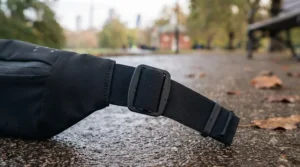
A race number belt exists to solve one specific, mildly annoying problem: attaching a paper or card race bib to your body without four safety pin holes through a running top you’d rather not ruin. Most work via elastic toggles or a clip system that holds the bib flat against the belt — flat matters for events using barcode or chip scanning at the bib, since a folded or crumpled number can fail to scan.
Two very different approaches sit within this category. Purpose-built options like the VeloChampion Reflective Race Number Belt do essentially nothing else — no phone pocket, no gel storage — which keeps them cheap and genuinely minimal for race morning. Multi-function options like the Fitletic Ultimate II fold bib toggles into a belt that also carries gels and a phone, useful if you’d rather not swap kit between training and race day. Either approach is legitimate; the choice really comes down to whether you want one belt for everything or a dedicated race-only accessory that lives in your kit bag between events.
Common Mistakes When Buying a Running Waist Belt
Most buying mistakes with running belts trace back to skipping the fit-before-features step. Sizing by “usual” clothing size rather than actual waist measurement is the single most common error — stretch fabrics in particular need measuring, not guessing, because a belt that reads “one size” often has a genuinely narrow effective range.
Buying for current mileage rather than planned mileage is the second common trap; a runner starting a Couch to 5K plan who’s eyeing a spring half marathon will likely outgrow a bare-bones belt’s storage within a couple of months, making a slightly more capable option like the Fitletic Ultimate II the better long-term buy even if it feels like overkill on day one. Ignoring phone size is the third: modern phones, especially in protective cases, are considerably larger than the pouches on many older or cheaper belt designs, so checking listed phone compatibility against your actual phone-in-case measurements avoids a frustrating return. Finally, chasing the cheapest option in a hydration belt specifically tends to backfire — this is the one category where holster engineering genuinely differs by price point, and a bargain hydration belt with a basic elastic flask loop will very likely bounce no matter how well it’s fitted.
Running Comfort: Long-Term Cost, Fit, and Skin Health
Comfort over a full training cycle is really a cost-of-ownership question in disguise. A cheap belt bought for £10 that needs replacing every eight weeks because the elastic loses its snap works out more expensive over a year than a £30 belt that holds its shape for two or three seasons of regular washing and wear.
| Consideration | Budget Belt (£10–£20) | Mid-Range Belt (£25–£35) | Premium/Hydration (£40+) |
|---|---|---|---|
| Typical lifespan | 3–6 months regular use | 8–14 months | 12–24 months |
| Best For | Occasional runners, race day only | Fitletic Ultimate II, regular training | CamelBak Ultra Belt, long-distance regulars |
| Skin comfort | Variable, depends on fabric quality | Generally good, wider bands common | Best-in-class holster and band engineering |
The pattern in this table matters for anyone training toward a specific race: paying more upfront on a belt that will see genuinely heavy use, like a marathon block’s worth of long runs, tends to work out cheaper per wear than repeat budget purchases. Skin comfort compounds this further — a belt that chafes gets shoved in a drawer after two uses regardless of its original price, which is arguably the most expensive kind of “saving” a runner can make.
Features That Actually Matter (And Those That Don’t)
Marketing copy on running belts leans hard on certain buzzwords, and it’s worth separating genuine functional differences from filler. Actually matters: band width and material (directly affects bounce and chafing), pocket type matched to what you’re carrying (expandable versus fixed-size versus tubular slots), and hydration holster design specifically, not just flask capacity. Doesn’t matter much: the number of “extra” pockets beyond what you’ll realistically use — a six-pocket belt sounds generous until you realise you’re only ever filling two of them — and colour-coded reflective trim beyond a single visible strip, which mostly affects aesthetics rather than actual visibility once one reflective element is present.
The genuinely useful features worth prioritising, in order, are: correct sizing for your waist, pocket design matched to your actual kit list, and — only if runs regularly exceed an hour — hydration holster quality. Everything else is largely personal preference dressed up as a spec sheet.

Frequently Asked Questions
❓ What is the best running waist belt for beginners?
❓ Do running belts actually stop bouncing completely?
❓ Can I fit a large phone in a running waist belt?
❓ Is a hydration belt worth it for shorter runs?
❓ How do I stop a running belt from causing chafing?
Conclusion
There’s no single “best” running waist belt, and honestly, anyone claiming otherwise hasn’t looked closely enough at how differently people actually run. What suits a twice-weekly parkrun habit will feel like unnecessary bulk on a marathon long run, and what a trail runner needs to survive two hours without a water station would be comically over-specced for a quick 5K before work. The FlipBelt Classic Edition and VeloChampion Reflective Race Number Belt cover the minimalist end well; the Fitletic Ultimate II earns its place for anyone deep into marathon training; and the Nathan Trail Mix Plus 3.0 or CamelBak Ultra Belt make sense once hydration genuinely becomes part of the plan.
What matters more than any individual product is matching the belt to where your training actually sits right now — and being honest about where it’s heading over the next few months. Get the fit right, get the pocket layout right, and a belt genuinely does disappear from your attention within the first mile, which is really all anyone’s asking of it.
Recommended for You
- Best Running Belt for Phone UK (2026): 7 Picks Compared
- 7 Best Running Bum Bag Under £30 UK
- Recovery Drink for Runners: 7 Best Picks
Disclaimer: This article contains affiliate links. As an Amazon Associate, I earn from qualifying purchases. If you purchase products through these links, we may earn a small commission at no additional cost to you.
✨ Found this helpful? Share it with your friends! 💬🤗
