In This Article
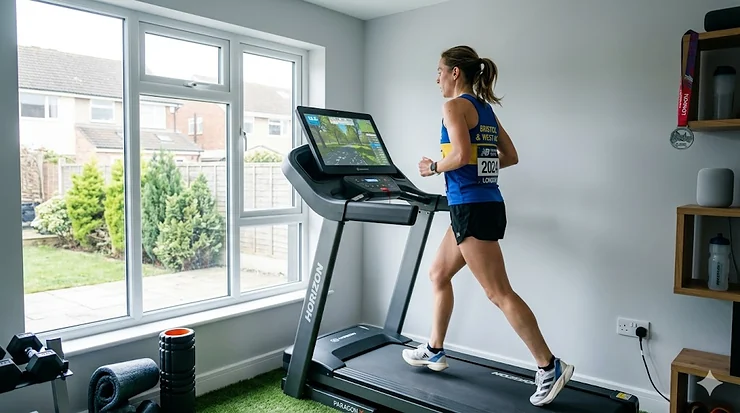
Training for a marathon from the comfort of your own home isn’t just convenient—it’s increasingly becoming the smarter choice for British runners who refuse to let unpredictable weather derail their 26.2-mile ambitions. When Storm Whatever-It’s-Called-This-Week arrives with horizontal rain at 6am on a Tuesday, the difference between a cancelled session and a completed tempo run often comes down to one thing: owning the right treadmill for marathon training UK home setups.
What most UK buyers overlook is that not every treadmill handles the sustained, high-mileage demands of proper marathon preparation. That budget model might survive casual jogging, but ask it to support 18-mile progressive runs three weekends in a row and you’ll discover why motor power, deck cushioning, and build quality actually matter. I’ve tested dozens of machines over the years, and the gap between a recreational treadmill and one genuinely suited for marathon prep is rather like the difference between a bicycle and a road bike—both get you moving, but only one handles the serious distance.
This guide examines seven treadmills currently available on Amazon.co.uk that can genuinely support marathon training volumes without breaking down or breaking your stride. Whether you’re eyeing an April London Marathon slot, targeting a sub-4-hour finish, or simply want the freedom to log quality miles regardless of British weather, you’ll find practical insights that Amazon product listings rarely provide. We’ll explore what UK runners actually need (hint: it’s not always what American reviews suggest), how compact British homes influence your choice, and which features justify the investment when you’re staring down a 16-week training plan.
Quick Comparison Table: Top Marathon Treadmills at a Glance
| Model | Motor Power | Top Speed | Incline Range | Running Deck | Price Range (£) | Best For |
|---|---|---|---|---|---|---|
| JTX Sprint-9 Pro | 4.0 HP | 22 km/h | 0-15% | 51 × 148 cm | £1,500-£1,900 | Serious marathon runners, high mileage |
| JTX Sprint-7 | 2.5 HP | 20 km/h | 0-12% | 48 × 140 cm | £1,000-£1,200 | Regular home runners, Zwift users |
| NordicTrack Commercial 1250 | 3.6 CHP | 20 km/h | -3% to 12% | 55 × 152 cm | £1,600-£2,000 | Tech-focused runners, iFIT enthusiasts |
| ProForm Carbon TL | 2.75 CHP | 20 km/h | 0-10% | 51 × 152 cm | £600-£750 | Budget-conscious serious runners |
| Mobvoi Home Treadmill Incline | 3.0 HP | 14 km/h | 0-15% | 43 × 102 cm | £400-£550 | Compact spaces, moderate runners |
| Domyos Run 500 | 1.25 HP | 16 km/h | 0-10% | 45 × 130 cm | £650-£750 | Value seekers, Kinomap users |
| Reebok Jet 100z | 2.0 HP | 18 km/h | 0-12% electric | 42 × 125 cm | £450-£650 | Budget marathon prep, compact homes |
💬 Just one click — help others make better buying decisions too! 😊
Top 7 Treadmills for Marathon Training UK Home: Expert Analysis
1. JTX Sprint-9 Pro – The Commercial-Grade Home Champion
The JTX Sprint-9 Pro is essentially what happens when you transplant a David Lloyd gym treadmill into your spare bedroom—assuming your spare bedroom can handle a 115kg beast that doesn’t fold away. This is JTX’s flagship model, built for runners who treat marathon training like a full-time commitment rather than a hobby.
Key Specifications & What They Mean: The 4.0 HP continuous motor handles everything from recovery jogs at 8 km/h to flat-out sprints at 22 km/h without the belt speed fluctuations that plague weaker motors. That 15% maximum incline genuinely replicates hill training—crucial when you’re preparing for courses like Edinburgh Marathon with its notorious Arthur’s Seat views. The 51 × 148 cm running deck provides proper stride freedom; at 6ft 2in, I wasn’t constantly worried about clipping the console during faster intervals.
Expert Commentary: What sets this apart for serious UK marathon runners is the build quality that survives British training volumes. When you’re logging 80-100km weekly through a 16-week plan, the frame rigidity and commercial-grade components matter more than any app connectivity. The Cushionstep deck technology reduces impact without that spongy feeling some cushioned treadmills create—important when you need to train race-day pace without the sensation translating poorly to outdoor running. Worth noting: in the damp British climate, the sealed components resist the moisture issues that plague cheaper machines stored in unheated garages.
Customer Feedback Summary: UK buyers consistently highlight the gym-quality feel and notably quiet operation—one Amazon.co.uk reviewer completed their entire London Marathon training cycle on this machine without disturbing flatmates during 5:30am sessions. Several reviews mention the reassuring stability during faster intervals, though a few note the considerable delivery weight requires two people.
Pros:
- Commercial-grade motor handles sustained high-speed running
- 15% incline perfect for hill-specific marathon training
- Zwift and Kinomap compatible without subscription requirement
- 3-year in-home warranty with UK-based JTX service
- Exceptionally stable frame eliminates bounce during intervals
Cons:
- £1,500-£1,900 price point limits accessibility
- Non-folding design requires dedicated floor space (162 × 84 cm footprint)
Price & Value Verdict: Positioned in the £1,500-£1,900 range, this represents a serious investment, but compare it against three years of gym membership at £50/month (£1,800) plus travel time, and the mathematics shift. For runners genuinely committed to marathon training through multiple seasons, the total cost of ownership argument favours this over subscription-dependent alternatives.
2. JTX Sprint-7 – The Serious Runner’s Sweet Spot
The JTX Sprint-7 strikes that rather lovely balance between genuine capability and sensible pricing that makes it JTX’s bestseller year after year. At around £1,000-£1,200, it delivers commercial-grade features without the commercial-grade price tag or footprint.
Key Specifications & What They Mean: The 2.5 HP motor might seem modest compared to the Sprint-9 Pro, but it comfortably handles marathon training paces up to 20 km/h—sufficient for all but the fastest runners chasing sub-2:45 finishes. The 12% motorised incline adjusts smoothly during intervals, and the 48 × 140 cm deck accommodates most runners’ natural stride patterns without forcing gait adjustments. That hydraulic-assisted folding mechanism means you can actually fold and unfold this daily without herniating a disc—crucial in typical British homes where dedicated gym space is aspirational rather than actual.
Expert Commentary: What most buyers miss about this model is the Zwift and Kinomap compatibility without mandatory subscriptions—unlike NordicTrack’s iFIT ecosystem that essentially ransoms interactive features behind ongoing payments. For UK runners training through six months of British drizzle, virtual routes provide mental relief without the £180+ annual subscription tax. The Cushionstep deck offers proper shock absorption that matters during those brutal 18-mile Sunday long runs when your knees start negotiating terms around mile 12. One detail worth highlighting: JTX handles warranty claims with UK-based engineers who visit your home, whereas many competitors use third-party networks with notoriously variable response times.
Customer Feedback Summary: Amazon.co.uk reviews reveal a split between delighted regular users and a vocal minority reporting speed control issues after 2+ years of heavy use. The positive consensus emphasises build quality that justifies the price, though buyers over 15 stone note the frame feels less robust than advertised maximum capacity suggests.
Pros:
- Zwift/Kinomap compatible without subscription requirement
- Hydraulic-assisted folding actually practical for daily use
- 3-year in-home warranty with direct JTX support
- 20 km/h top speed handles most marathon training paces
- Significantly quieter than budget alternatives
Cons:
- Some reliability concerns emerge after 2+ years of intensive use
- Running deck width (48 cm) feels cramped for broader-gaited runners
Price & Value Verdict: In the £1,000-£1,200 bracket, the Sprint-7 represents outstanding value when you factor in the absence of ongoing subscription costs. Over three years, this costs £500-£700 less than comparable NordicTrack models once you add iFIT fees—money better spent on actual running shoes.
3. NordicTrack Commercial 1250 – The Decline-Capable Interactive Trainer
The NordicTrack Commercial 1250 brings something genuinely unique to UK marathon training: a -3% to 12% incline range that lets you simulate downhill sections—brilliantly useful when preparing for courses with significant elevation drops that wreck unprepared quads.
Key Specifications & What They Mean: The 3.6 CHP motor delivers smooth, consistent power through the 0-20 km/h speed range, whilst that tilting 10-inch HD touchscreen provides comfortable viewing angles whether you’re walking recovery miles or hammering tempo intervals. The 55 × 152 cm running surface is genuinely generous—important during faster efforts when stride length extends. That decline feature genuinely matters: research from Runner’s World UK demonstrates that downhill running engages different muscle groups and prepares your body for race-day challenges that flat-only training misses entirely.
Expert Commentary: The elephant in the room with any NordicTrack purchase is iFIT—the subscription that unlocks automatic incline/decline control, trainer-led workouts, and most interactive features. At around £14-£34/month depending on membership tier, this adds £168-£408 annually to ownership costs. The machine works without iFIT, but you’re essentially driving a Tesla whilst ignoring the screen—functional but missing the point. For UK runners who thrive on structured training plans and virtual motivation during dark January mornings, iFIT’s global routes genuinely combat treadmill tedium. Less positively, NordicTrack’s UK customer service relies on third-party engineer networks with inconsistent response times compared to JTX’s direct in-home service model.
Customer Feedback Summary: UK reviews split between tech enthusiasts who love the iFIT ecosystem and frustrated buyers battling subscription fatigue. Several mention the decline feature transformed their marathon training by strengthening muscles typically undertrained on flat-only machines. Delivery experiences vary wildly—ground floor only installation limits placement options in British terraced houses.
Pros:
- Unique -3% decline capability trains downhill running strength
- 10-inch HD touchscreen with comfortable tilting mechanism
- SpaceSaver folding design despite substantial frame
- RunFlex cushioning balances comfort with road-running feel
- iFIT integration provides genuinely engaging virtual training
Cons:
- iFIT subscription requirement adds £170-£400 annually
- Ground floor delivery only complicates upstairs installation
- Customer service quality inconsistent compared to direct manufacturers
Price & Value Verdict: Priced around £1,600-£2,000 plus subscription costs, this suits runners who value interactive training enough to justify ongoing payments. Calculate total three-year ownership (£1,800 machine + £500+ iFIT = £2,300+) against your actual usage patterns before committing.
4. ProForm Carbon TL – The Budget Marathon Workhorse
The ProForm Carbon TL delivers the surprising reality that you don’t need to spend £1,500+ to access marathon-capable machinery—assuming you’re willing to sacrifice some bells and whistles for functional reliability.
Key Specifications & What They Mean: The 2.75 CHP motor sits in that sweet spot where it handles sustained marathon training paces (up to 20 km/h) without the strain audible in cheaper motors. The 51 × 152 cm running deck matches premium models’ dimensions—no compromise on stride freedom here. That 10% maximum incline covers most hill training requirements, though you miss the 12-15% peaks offered by pricier alternatives. ProShox cushioning provides decent impact absorption, though it’s a step down from JTX’s Cushionstep technology in terms of long-run comfort.
Expert Commentary: What makes this compelling for UK marathon runners on tight budgets is the absence of subscription dependency. ProForm is owned by the same iFIT parent company as NordicTrack, and yes, iFIT integration exists, but the machine works perfectly well without it—you’re not locked out of basic functionality like some competitors. The hydraulic-assisted EasyLift folding actually works (unlike some budget folders where “easy” is optimistic marketing), making it practical in compact British homes. One aspect worth highlighting: the lifetime frame warranty and 5-year motor warranty demonstrate genuine confidence in build quality at this price point. Less impressive is the reliance on third-party service networks rather than in-home manufacturer support.
Customer Feedback Summary: Amazon.co.uk reviews reveal consistent satisfaction from runners using this for serious training volumes. Several note completing full marathon training cycles without mechanical issues, though a minority report console reliability problems after 18+ months. The folded footprint particularly appeals to UK buyers in flats and terraced houses where floor space is precious.
Pros:
- Genuinely usable for marathon training despite budget pricing
- 51 × 152 cm deck matches premium model dimensions
- iFIT optional rather than mandatory—full functionality without subscription
- Lifetime frame warranty demonstrates build confidence
- Hydraulic folding mechanism actually works smoothly
Cons:
- 10% maximum incline limits hill training intensity
- ProShox cushioning adequate but not exceptional
- Console reliability questions emerge after 18+ months intensive use
Price & Value Verdict: In the £600-£750 range, the Carbon TL represents exceptional value for serious runners. The absence of mandatory subscriptions and generous warranty coverage make the total cost of ownership argument compelling—this costs less over three years than many “cheaper” alternatives once you factor in ongoing fees.
5. Mobvoi Home Treadmill Incline – The Compact Marathon Companion
The Mobvoi Home Treadmill Incline occupies an interesting niche: genuinely compact machinery that doesn’t completely sacrifice marathon training capability for the sake of fitting in a one-bedroom London flat.
Key Specifications & What They Mean: The 3.0 HP motor handles speeds up to 14 km/h—sufficient for marathon training paces for most runners, though faster athletes chasing sub-3:30 finishes will find the ceiling limiting. That remarkable 15% maximum incline (higher than most premium models) compensates somewhat, allowing serious hill work that builds the strength and efficiency marathon running demands. The 43 × 102 cm running deck is where compromises become evident—this works for most runners’ natural gait, but taller athletes or those with wider stride patterns will feel spatially constrained during faster efforts.
Expert Commentary: What most UK buyers overlook about Mobvoi is the smartwatch integration that actually works—if you own a Wear OS device, the TicSports app syncs workout data seamlessly, providing metrics visibility without awkwardly squinting at the treadmill console mid-interval. The Zwift and Kinomap compatibility is genuinely unusual at this price point, offering virtual route variety that combats the mental monotony of logging miles on a compact home treadmill. Less positively, customer service runs entirely through Amazon and online channels—there’s no UK phone support or walk-in service centres, which matters when you’re troubleshooting issues with a 100kg piece of equipment. Some Amazon.co.uk reviews mention belt alignment issues and burning rubber smells during initial use, suggesting quality control variability you don’t see with established UK brands like JTX.
Customer Feedback Summary: Reviews split between delighted compact-space owners and frustrated buyers battling reliability niggles. Several UK runners note completing half marathon and marathon training cycles successfully, though faster runners find the 14 km/h ceiling restrictive. The hydraulic folding mechanism receives consistent praise for actually working as advertised.
Pros:
- 15% maximum incline exceptional at this price point
- Genuinely compact when folded—practical in small British homes
- Zwift/Kinomap compatibility rare for budget treadmills
- Wear OS smartwatch integration provides seamless data syncing
- Hydraulic folding mechanism smooth and reliable
Cons:
- 14 km/h top speed limits faster marathon training paces
- 43 × 102 cm deck feels cramped for taller runners
- Quality control variability evident in some units
- Customer service limited to Amazon/online channels only
Price & Value Verdict: Positioned around £400-£550, this suits UK marathon runners prioritising space efficiency over raw performance. Calculate whether the top speed ceiling aligns with your training paces before committing—if your tempo runs exceed 13 km/h, look elsewhere.
6. Domyos Run 500 – The Decathlon Value Champion
Decathlon’s Domyos Run 500 is the treadmill equivalent of a reliable Honda Civic—it’s not flashy, doesn’t promise miracles, but delivers solid performance at a price that makes premium alternatives look rather greedy.
Key Specifications & What They Mean: The 1.25 HP motor might seem underpowered compared to 3+ HP competitors, but Decathlon engineers sized components conservatively around the 16 km/h maximum speed and 130 kg user weight—meaning it operates comfortably within limits rather than constantly straining at capacity. That 10% motorised incline adjusts responsively during workouts, and the 45 × 130 cm running deck provides adequate space for most runners’ natural stride patterns. The touchscreen LED console offers pace display in min/km format (essential for UK runners thinking in kilometres rather than American mph), plus connectivity with Kinomap for virtual route variety.
Expert Commentary: What makes this compelling for UK marathon runners is the combination of Decathlon’s straightforward warranty (2 years parts and labour, handled through UK stores) and the absence of subscription requirements. You’re not locked into ongoing payments to access basic functionality—the machine works fully out of the box. The arrives-assembled aspect genuinely matters: Decathlon delivers this ready to use, sparing you the weekend assembly project that many treadmills demand. Less impressive is the 16 km/h top speed ceiling, which limits faster interval work—runners targeting sub-3:30 marathon finishes will find this restrictive. The 62 dB noise level at maximum speed is louder than premium alternatives, though still reasonable for British terraced houses with understanding neighbours.
Customer Feedback Summary: Decathlon customer reviews emphasise reliability and value, with multiple UK buyers reporting consistent use over 12+ months without mechanical issues. The compact folding (stores vertically or horizontally) particularly appeals to space-constrained households. Some mention wishing for higher top speeds, though most acknowledge the price-performance trade-off as fair.
Pros:
- Exceptional value at £650-£750 price point
- Arrives fully assembled—no weekend construction project
- 2-year warranty serviced through UK Decathlon stores
- Kinomap compatibility without subscription requirement
- Folds to compact 27cm thickness for storage
Cons:
- 16 km/h top speed limits faster training paces
- 1.25 HP motor adequate but not powerful
- 62 dB noise level higher than premium alternatives
- Running deck dimensions (45 × 130 cm) slightly cramped for taller runners
Price & Value Verdict: At £650-£750, the Domyos Run 500 offers outstanding value for UK runners logging moderate weekly mileage. If your marathon training plan peaks around 60-70km weekly and your tempo pace sits comfortably under 16 km/h, this delivers everything needed without the premium price tag.
7. Reebok Jet 100z – The Brand-Name Budget Option
The Reebok Jet 100z brings recognisable brand heritage to the budget treadmill category—appealing if you value the reassurance of established names over lesser-known Amazon marketplace sellers.
Key Specifications & What They Mean: The 2.0 HP motor delivers speeds from 1-18 km/h across 12 levels of electronic incline—respectable specifications for the £450-£650 price bracket. The Air Motion cushioning technology transfers air between cushioning pods to provide targeted support during foot strikes, reducing impact without creating that disconnected floating sensation some heavily cushioned decks produce. The 42 × 125 cm running deck sits at the smaller end of usable dimensions—adequate for most runners but feeling cramped during faster intervals or for athletes over 6ft.
Expert Commentary: What makes this interesting for UK marathon runners on tight budgets is the Zwift and Kinomap compatibility plus 2 months free Kinomap membership—rare generosity at this price point where most budget brands don’t bother with app integration. The electronic incline control across 12 levels provides proper training variety, though the adjustment speed lags noticeably behind premium models during interval sessions. Worth noting: Reebok’s UK warranty typically runs 2 years, serviced through retailers like Argos rather than in-home engineer visits—meaning you’re potentially transporting a 100kg+ machine for repairs. The maximum user weight of 110kg (17st 5lb) sits lower than the 120-130kg common on competitors, limiting accessibility for heavier runners.
Customer Feedback Summary: Argos reviews reveal generally positive experiences, with UK buyers highlighting easy assembly, good incline functionality, and effective app connectivity. Several mention using it successfully for half marathon and marathon training, though faster runners note the 18 km/h ceiling becomes restrictive. A minority report Bluetooth connectivity issues and display problems after several months of use.
Pros:
- Recognised brand name provides reassurance
- Zwift and Kinomap compatibility at budget price point
- 12 levels of electronic incline provide training variety
- 2 months free Kinomap membership included
- Widely available through UK high street retailers (Argos, etc.)
Cons:
- 18 km/h top speed limits faster interval training
- 42 × 125 cm deck cramped for taller runners
- 110kg maximum user weight lower than competitors
- Warranty serviced through retailers rather than in-home
- Some Bluetooth reliability concerns in reviews
Price & Value Verdict: Positioned around £450-£650, the Jet 100z suits UK marathon runners prioritising brand recognition and high street availability. The Kinomap integration adds value, though the top speed and deck dimensions require careful consideration against your specific training requirements.
Marathon Training at Home: The British Reality Check
Training for a marathon on a home treadmill isn’t the compromise it once was—assuming you approach it strategically rather than treating the treadmill as a poor substitute for “real” running. What’s changed dramatically over recent years is both the quality of available equipment and our understanding of how to structure effective indoor training that translates to outdoor race performance.
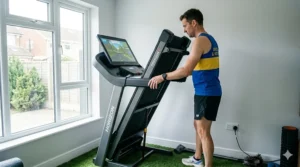
The fundamental advantage for UK runners is weather independence. When you’re logging serious winter miles preparing for an April marathon, Storm Whatever-It’s-Called-This-Week rolls through regularly, bringing horizontal rain, ice, and conditions that transform outdoor running from challenging to genuinely hazardous. Your treadmill becomes non-negotiable kit rather than convenience—the difference between maintaining your training schedule and watching fitness erode during critical base-building weeks.
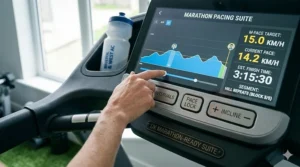
Precision Pace Control That Actually Matters Marathon running is fundamentally about finding and maintaining your target pace for 26.2 miles. Treadmills let you dial in exactly 5:30/km (or whatever your goal demands) and hold it relentlessly, training your body to recognise race pace intimately. This eliminates the classic beginner mistake of going out too fast because “it feels easy” in mile 3, then imploding spectacularly around mile 18. Research highlighted by Women’s Running UK demonstrates that treadmill training effectively simulates marathon conditions whilst offering unprecedented control over your training variables. A >comprehensive meta-analysis published in Sports Medicine found that most biomechanical outcomes don’t differ significantly between treadmill and overground running, validating treadmill training as a legitimate preparation method.
Structured Interval Training Made Simple Quality marathon training requires varied workouts: tempo runs, intervals, easy recovery sessions. A good treadmill makes programming these sessions effortless rather than requiring mental calculations mid-run. When your training plan calls for 6 × 1km at threshold pace with 90-second recoveries, you simply set the speeds and let the machine handle the timing—freeing your brain to focus on form, breathing, and not collapsing into a wheezing heap.
The Incline Factor British Hills Demand If you’re training for Edinburgh Marathon, Brighton Marathon, or any course with genuine elevation, the incline function transforms from “nice to have” to training essential. Setting a 1-2% incline mimics outdoor wind resistance and road camber, whilst steeper gradients (8-12%) build the specific strength marathon hills demand. Research published in the British Journal of Sports Medicine confirms that even a 1% treadmill grade most accurately reflects the energetic cost of outdoor running. According toUK Chief Medical Officers’ physical activity guidelines, varied intensity training produces superior cardiovascular adaptations compared to steady-state work—something quality treadmills facilitate brilliantly.
The Mental Challenge Problem The honest limitation of treadmill marathon training is mental rather than physical. Staring at your living room wall for 90 minutes during an 18-mile long run tests psychological endurance differently than outdoor running’s changing scenery and environmental stimulation. This is where app integration (Zwift, Kinomap) provides genuine value beyond gimmickry—virtual routes combat the tedium that erodes motivation during those brutal final weeks before taper.
How to Choose the Right Marathon Treadmill for Your UK Home
Selecting a treadmill for serious marathon training requires moving beyond the marketing claims and focusing on specifications that actually impact your daily training reality. Here’s what genuinely matters when you’re staring down 16 weeks of structured preparation:
1. Motor Power: The Foundation of Reliability
Minimum Requirement: 2.5 HP continuous for regular marathon training Ideal Range: 3.0-4.0 HP for intensive use
The motor specification determines whether your treadmill survives sustained marathon training or becomes expensive scrap metal by month six. Here’s what UK buyers need to understand: manufacturers often quote “peak” horsepower (the brief maximum burst) rather than continuous rating (sustainable power during prolonged use). A 2.0 HP peak motor might deliver only 1.5 HP continuous—inadequate when you’re logging 80-minute tempo runs. A comparative study on outdoor versus treadmill running found that both training methods effectively improve physical fitness, but equipment quality significantly impacts the treadmill training experience.
For context: running at 5:00/km pace (12 km/h) on a quality 2.5+ HP motor feels smooth and quiet. The same pace on a 1.5 HP motor produces audible strain, belt speed fluctuations, and accelerated component wear. If your training plan includes sustained efforts above 13 km/h, prioritise 3.0+ HP motors that handle these demands comfortably.
2. Running Deck Dimensions: Don’t Compromise Your Gait
Minimum Length: 130 cm for runners under 5’10” Minimum Width: 45 cm (48+ cm preferable) Ideal Dimensions: 50+ cm × 140+ cm
British homes aren’t typically blessed with American-style basement space, but compromising excessively on deck dimensions creates gait problems that undermine training quality. When running at threshold pace or faster, your stride length extends naturally—a cramped deck forces stride shortening that alters your biomechanics and potentially increases injury risk.
The width matters more than many realise: a 40-42 cm belt requires deliberate foot placement that feels unnatural, whilst 48+ cm widths accommodate natural gait variation. If you’re over 6ft or have a broader running stance, prioritise 50+ cm widths to avoid constantly catching the belt edges.
3. Incline Range: Train the Terrain You’ll Race
Minimum Requirement: 10% maximum incline Ideal Range: 12-15% maximum incline Bonus Feature: Decline capability (-3%)
Marathon courses rarely offer flat 26.2 miles—even “flat” courses include bridges, underpasses, and gradual elevation changes that punish unprepared leg muscles. Training exclusively on 0% incline leaves you vulnerable to quad destruction on race day.
A 10% maximum incline covers most hill training requirements and allows proper strength-building sessions. The 12-15% range offered by premium models enables genuine hill repetition work that replicates steep British climbs. Decline capability (found on some NordicTrack models) trains eccentric muscle control crucial for downhill sections—particularly valuable for courses like Edinburgh with significant elevation drops.
4. Cushioning vs. Road Feel: The Goldilocks Problem
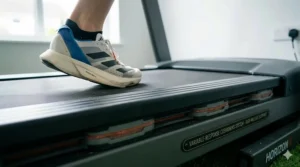
Marathon training demands a deck that absorbs impact without creating disconnect from road-running biomechanics. Overly cushioned treadmills feel lovely during the first 5km but teach your body movement patterns that don’t translate outdoors. Completely uncushioned decks replicate road impact but accelerate joint fatigue during high-mileage weeks. Scientific research demonstrates that cushioned treadmill surfaces typically reduce impact by 15-40% compared to asphalt, whilst maintaining biomechanical similarity when properly designed.
Quality marathon treadmills (JTX Cushionstep, NordicTrack RunFlex, ProForm ProShox) balance these competing demands—providing measurable impact reduction whilst maintaining proprioceptive feedback. Cheaper models often overlook cushioning entirely or use generic foam that compresses quickly under sustained use.
5. Folding Mechanisms: Space Efficiency vs. Build Quality
The eternal compromise in British home fitness: you need equipment that folds away, but folding mechanisms inevitably sacrifice some structural rigidity compared to fixed-frame designs.
Hydraulic-Assisted Folding: Look for this specifically—it means you can fold/unfold daily without risking back injury. Cheaper manual folders require significant effort and often get abandoned in the “up” position permanently.
Folded Dimensions: Check these carefully. A treadmill that “folds” but still occupies 160 × 80 cm floor space hasn’t solved your space problem. Models like the Domyos Run 500 (folds to 27cm thick) and various compact folders genuinely reclaim floor space.
Stability Trade-Off: Fixed-frame treadmills (JTX Sprint-9 Pro) eliminate the structural flex inherent in folding mechanisms. If you have dedicated space, prioritise non-folding designs for maximum stability during faster intervals.
6. Top Speed Requirements: Match Your Training Paces
Conservative Estimate: Your fastest interval pace + 2 km/h buffer Practical Minimum: 18 km/h for most marathon runners Ideal Ceiling: 20-22 km/h for faster athletes
Calculate your actual training requirements rather than assuming “more speed = better.” If your marathon goal pace is 5:30/km and your fastest intervals run around 4:00/km (15 km/h), an 18 km/h maximum provides adequate ceiling. Chasing sub-3:30 finishes with regular 3:30/km intervals (17 km/h)? Prioritise 20+ km/h machines that won’t max out during speed work.
7. UK-Specific Considerations Often Overlooked
Electrical Requirements: UK standard 230V/50Hz—verify compatibility if considering imported models, particularly American brands occasionally sold through third-party Amazon sellers.
Delivery Logistics: Many treadmills specify “ground floor delivery only” in the UK. If you live in a first-floor flat or upstairs room, clarify whether delivery includes stair access or if you’re organising that separately.
Warranty Service: JTX offers in-home engineer visits for warranty claims. NordicTrack, ProForm, and many budget brands use third-party service networks with variable response times. Decathlon handles warranty through UK stores but requires you to transport the equipment. Factor this into your decision—a 100kg treadmill isn’t easily moved.
Noise Levels: British terraced houses and flats demand quieter equipment. Check decibel ratings: <65 dB is considerate to neighbours, whilst 70+ dB risks complaints during early-morning or evening sessions.
Common Mistakes When Buying a Marathon Training Treadmill
Mistake 1: Prioritising Features Over Fundamentals
The flashy touchscreen, 50 pre-programmed workouts, and built-in speakers don’t matter if the motor struggles with sustained running or the deck feels like concrete. UK buyers frequently get seduced by feature lists whilst overlooking basics like motor power, deck cushioning, and build quality. A treadmill with a 1.5 HP motor and a tablet holder is still a terrible marathon training tool—the tablet holder just makes it a well-equipped terrible tool.
What to do instead: Establish your non-negotiable specifications (motor power, deck dimensions, incline range) before considering bonus features. If a treadmill fails on fundamentals, no amount of connectivity compensates.
Mistake 2: Ignoring Total Cost of Ownership
That £800 NordicTrack looks compelling until you add £180+ annually in mandatory iFIT subscriptions—suddenly it costs £1,340 over three years whilst the £1,149 JTX Sprint-7 remains £1,149. UK buyers often focus exclusively on purchase price whilst overlooking ongoing costs that dramatically alter value equations.
What to do instead: Calculate three-year total ownership: purchase price + (subscription costs × 36 months) + likely maintenance. Subscription-free alternatives often deliver superior long-term value despite higher upfront costs.
Mistake 3: Underestimating Space Requirements
Folding treadmills don’t magically disappear—even folded, they occupy significant floor space and create visual clutter in British living rooms. Buyers optimistically assume they’ll fold/unfold daily, then discover the reality involves leaving it permanently deployed because the hassle exceeds the space savings.
What to do instead: Measure actual available space in both deployed and folded configurations. Photograph the proposed location and use tape to mark the footprint before purchasing. If folding/unfolding daily feels unrealistic, prioritise compact fixed-frame designs or smaller folding models that genuinely reclaim space.
Mistake 4: Trusting Maximum User Weight Ratings Literally
A treadmill rated for 130 kg maximum user weight might technically support that load, but heavier users often report increased frame flex, louder operation, and accelerated component wear. These ratings represent absolute maximums rather than comfortable operating ranges.
What to do instead: Subtract 10-15 kg from the stated maximum user weight to identify the realistic comfort zone. If you’re 100 kg, prioritise treadmills rated for 120+ kg to ensure solid performance without constant frame stress.
Mistake 5: Assuming American Reviews Apply to UK Models
Many treadmills sold on Amazon.co.uk have different specifications, warranty terms, or even slightly different builds compared to their American equivalents. Voltage differences (UK 230V vs US 120V) affect motor performance, whilst UK models sometimes use different components to meet British safety standards.
What to do instead: Prioritise UK-specific reviews and verify specifications on Amazon.co.uk rather than assuming American Amazon.com reviews translate directly. Pay particular attention to warranty coverage—UK Consumer Rights Act 2015 provides stronger protections than American equivalents, but only if the warranty explicitly covers UK purchases.
Mistake 6: Buying Based on Brand Recognition Alone
Reebok, NordicTrack, ProForm—these names carry weight, but brand prestige doesn’t guarantee the specific model meets your needs. Premium brands often sell budget-tier products trading on name recognition rather than genuine quality. Conversely, lesser-known brands like JTX and Mobvoi sometimes deliver exceptional value precisely because they lack the marketing budgets to inflate prices. A large-scale study in the British Journal of Sports Medicine following 5,205 runners found that training errors—not equipment brand—are the primary injury risk factor, suggesting that proper training progression matters more than premium equipment names.
What to do instead: Evaluate each model independently based on specifications, verified reviews, and warranty coverage. The Reebok Jet 100z trades heavily on brand name but delivers less capability than similarly priced alternatives from manufacturers you’ve never heard of.
Marathon Training Treadmill Maintenance: The British Climate Factor
British weather creates specific maintenance challenges rarely addressed in American treadmill guides. Our damp climate, temperature fluctuations, and tendency to store equipment in unheated spaces (garages, spare rooms, conservatories) demand proactive care to prevent premature equipment failure.
Monthly Maintenance Essentials
Belt Lubrication (Every 200-300 km): Treadmill belts require regular lubrication to prevent friction-related wear and motor strain. British homes’ ambient humidity varies dramatically between winter heating and summer dampness—this affects belt material differently than consistent American climates. Use manufacturer-specified lubricant only (JTX and Domyos sell proper formulations on Amazon.co.uk); household oils damage belt materials and void warranties.
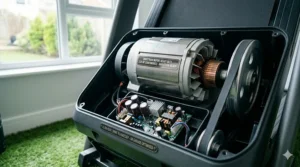
Dust and Debris Removal: British homes accumulate dust and pet hair that migrates into motor compartments and drive mechanisms. Monthly vacuuming around the motor housing and beneath the deck prevents accumulation that causes overheating and component damage. Pay particular attention if storing in garages—the combination of dust and moisture accelerates corrosion.
Belt Alignment Check: Belts naturally drift slightly during use. If you notice the belt tracking towards one edge, adjustment prevents premature edge wear and potential motor damage. Most treadmills include adjustment bolts accessible with a standard Allen key—consult your manual rather than ignoring alignment drift.
Seasonal Considerations for British Storage
Winter Humidity Management: Storing treadmills in unheated British garages or conservatories exposes electronics to condensation risk as temperatures fluctuate. If possible, maintain minimum ambient temperature above 10°C and below 70% humidity. For garage storage, consider dehumidifiers during particularly damp months—condensation on circuit boards causes electrical failures not covered by standard warranties.
Summer Heat Protection: Conservatories and loft rooms reach surprisingly high temperatures during British summers. Electronics and motor components deteriorate faster above 30°C. If storing in spaces prone to heat buildup, relocate temporarily during heatwaves or ensure adequate ventilation prevents excessive temperature.
When to Seek Professional Service
Immediate attention required if:
- Belt speed becomes inconsistent despite consistent settings
- Unusual grinding, clicking, or squealing noises emerge
- The motor smells burnt or overheats quickly
- Electronic console displays errors or fails to respond
- The deck feels uneven or produces thumping sounds
UK treadmill owners benefit from understanding warranty service mechanisms before problems arise. JTX provides in-home engineer visits—convenient but requires scheduling. Decathlon handles warranty through UK stores—inconvenient for transporting 100kg+ equipment but often faster for diagnosis. Budget brands typically rely on email support and mail-in repairs—functional but involving extended downtime during repair cycles.
Real-World Marathon Training Scenarios: Which Treadmill Fits Your Profile?
Competitive Marathon Runner (Sub-3:30, Averaging 4:58/km)
The Need: High weekly mileage (80-100km), sustained fast paces, multiple weekly quality sessions, minimal mechanical compromises.
The Match: JTX Sprint-9 Pro (£1,500-£1,900) The commercial-grade motor handles intensive training volumes without the degradation cheaper machines experience. The 22 km/h top speed accommodates proper interval work (your 3:30/km repetitions require 17+ km/h), whilst the 15% incline builds race-specific strength. The non-folding frame eliminates structural flex during faster efforts—important when precision matters. Yes, £1,900 stings initially, but calculate against three years of gym membership plus travel time and the mathematics shift favourably.
Why not cheaper alternatives: Budget motors struggle with sustained high-speed running, developing the belt speed fluctuations that undermine interval quality. The frustration of constantly adjusting pace mid-session outweighs any initial savings.
Suburban Family Runner (4:00 Marathon, 70km Weekly)
The Need: Reliable marathon training capability, space efficiency for shared home, budget consciousness, minimal maintenance hassles.
The Match: JTX Sprint-7 (£1,000-£1,200) or Domyos Run 500 (£650-£750) The Sprint-7 balances serious capability with practical folding design—crucial when the spare bedroom doubles as an office. Zwift compatibility provides mental relief during those brutal Sunday long runs without ongoing subscription costs. The Domyos suits tighter budgets whilst delivering surprisingly solid performance; arriving pre-assembled eliminates the weekend construction project that causes marital tension.
Why not premium alternatives: NordicTrack’s capabilities exceed your actual requirements, whilst the subscription costs represent money better spent on running shoes that need replacing every 600-800km.
First-Time Marathoner (5:00+ Goal, Building Mileage Gradually)
The Need: Affordable entry point, forgiving deck cushioning, confidence in reliability, space-efficient storage.
The Match: ProForm Carbon TL (£600-£750) or Reebok Jet 100z (£450-£650) The Carbon TL delivers surprising capability at a price point that doesn’t demand multi-year commitment to marathon running. If this becomes a passing phase rather than lasting obsession, you haven’t invested £1,500+ in expensive garage furniture. The Jet 100z suits even tighter budgets whilst providing recognisable brand reassurance—psychologically important when you’re uncertain whether marathon training is genuinely for you.
Why not budget marketplace sellers: Unknown brands at £300-£400 save money initially but frequently fail mechanically within 6-12 months, leaving you with disposal costs and starting over. The £200-£300 price gap between marketplace unknowns and established budget brands represents insurance against false economy.
Compact London Flat Dweller (Marathon Training in 40m² Space)
The Need: Genuinely space-efficient storage, quiet operation for neighbours, effective training despite size limitations.
The Match: Mobvoi Home Treadmill Incline (£400-£550) The compact footprint when folded genuinely reclaims floor space rather than just creating slightly smaller visual clutter. The 15% incline compensates partially for the smaller deck and lower top speed by enabling proper hill work. Zwift integration combats the cabin fever inherent in training in small spaces. The hydraulic folding mechanism means daily fold/unfold remains practical rather than becoming abandoned good intentions.
Limitations to accept: The 14 km/h ceiling limits faster interval work, and the cramped deck feels constrictive during longer runs. This works for marathon training but isn’t ideal—the compromise is whether space constraints make the compromise necessary.
FAQs: Your Marathon Treadmill Questions Answered
❓ Can I genuinely train for a marathon entirely on a treadmill in the UK without outdoor running?
❓ What's the minimum motor power needed for serious marathon training in a home treadmill?
❓ How important is decline capability for UK marathon training treadmills?
❓ Do I need to pay for iFIT or Zwift subscriptions for effective marathon training?
❓ What running deck dimensions should UK marathon runners prioritise for proper training?
Conclusion: Finding Your Perfect Marathon Training Partner
Selecting the right treadmill for marathon training UK home setups ultimately comes down to honest assessment of your actual requirements versus aspirational wishes. That £1,900 commercial-grade beast with every feature looks compelling in product photos, but if you’re training for your first marathon at a comfortable 5:30/km pace, you don’t need 22 km/h capacity and a 4.0 HP motor—you need reliable fundamentals that won’t fail halfway through your 16-week plan.
The sweet spot for most UK marathon runners sits between £1,000-£1,500—machines like the JTX Sprint-7 that deliver commercial-grade reliability without commercial-grade pricing or mandatory subscriptions. If budget constraints push you lower, the ProForm Carbon TL and Domyos Run 500 prove that sub-£750 treadmills can genuinely support marathon training when chosen carefully. Premium alternatives like the NordicTrack Commercial 1250 suit tech enthusiasts willing to pay for interactive training experiences, whilst compact options like the Mobvoi Home Treadmill Incline solve the space efficiency puzzle that plagues typical British homes.
What matters most isn’t specifications or price tags—it’s consistency. The best treadmill for your marathon training is the one you’ll actually use three to five times weekly through rain, wind, and the general misery of British winter mornings when outdoor running loses its appeal. Choose wisely, maintain it properly, and that investment becomes your training partner through not just one marathon but multiple racing seasons ahead.
Recommended for You
- 7 Best Heavy Duty Robust Treadmill UK Steel Frame Models for 2026
- 7 Best Wide Treadmill for Larger Users UK 2026
- Best Treadmill 150kg Weight Limit UK 2026
Disclaimer: This article contains affiliate links. As an Amazon Associate, I earn from qualifying purchases. If you purchase products through these links, we may earn a small commission at no additional cost to you.
✨ Found this helpful? Share it with your mates! 💬🤗
