
In This Article
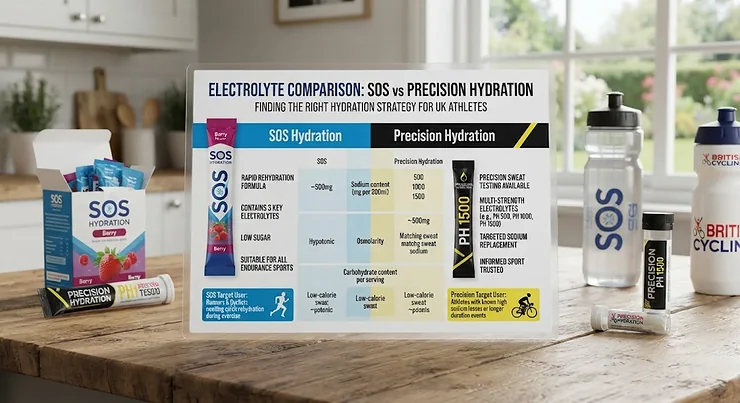
Stand in front of the electrolyte shelf on Amazon.co.uk for more than thirty seconds and you’ll understand why so many people end up typing “SOS vs Precision Hydration” into Google at eleven at night, mid-scroll, slightly parched, and no closer to an answer. Both brands promise faster rehydration than water alone. Both have loyal fanbases. Neither is shy about the science behind its formula. And yet they’re built for genuinely different jobs — one leans toward everyday, low-sugar hydration for busy lives, the other toward precision-dosed sodium replacement for people who sweat buckets on purpose.
This guide pulls SOS Rehydrate and Precision Fuel & Hydration apart, then puts five other real UK-available brands alongside them — Nuun, High5, Science in Sport, O.R.S and LMNT — so you’re comparing like against like rather than guessing. What follows is not a rewritten spec sheet. It’s honest, sourced analysis: what the sodium numbers actually mean when you’re running in July, what reviewers keep saying (and not saying), where each brand’s price genuinely lands, and how to work out which strength your body needs before you buy anything.
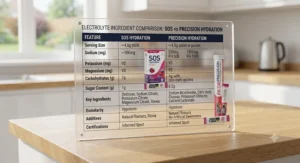
What is SOS vs Precision Hydration, in short? SOS Rehydrate is a lower-sodium, lower-sugar everyday electrolyte powder aimed at general dehydration (travel, hangovers, mild heat), while Precision Fuel & Hydration is a multi-strength, sweat-test-matched electrolyte system built for athletes with measurably high sodium losses. Read on for the full breakdown, real review sentiment, and a decision framework that removes the guesswork.
Quick Comparison Table
| Brand | Format | Typical Sodium (per serving) | Best For | Price Range |
|---|---|---|---|---|
| SOS Hydration | Powder sachets | ~250-300mg | Everyday, travel, mild dehydration | £16-£22 (20 servings) |
| Precision Fuel & Hydration | Effervescent tablets | 250-1,500mg (4 strengths) | Heavy sweaters, endurance athletes | £8-£12 per tube |
| Nuun Sport | Effervescent tablets | ~300mg | Casual gym-goers, daily hydration | £15-£20 (4-pack) |
| High5 Zero | Effervescent tablets | ~150-200mg | Zero-calorie, casual exercise | Under £10 per tube |
| Science in Sport GO Hydro | Effervescent tablets | ~350-400mg | Structured training, informed-sport certified | Under £10 per tube |
| O.R.S Hydration | Effervescent tablets | ~250mg (WHO ratio) | Budget everyday use, illness recovery | Under £10 per tube |
| LMNT | Powder sticks | ~1,000mg | Keto, high-sweat, high-sodium needs | £35-£45 (30 sticks) |
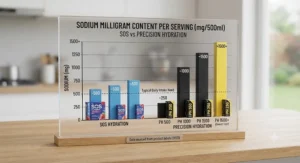
Looking across the table, the split becomes obvious almost immediately: SOS Hydration, Nuun Sport, High5 Zero and O.R.S Hydration sit in a cluster built for everyday, low-to-moderate sodium needs, while Precision Fuel & Hydration and LMNT occupy the high-sodium end for people who’ve genuinely measured a heavy sweat loss. Science in Sport GO Hydro sits in the middle, which is exactly where its Informed Sport-certified, training-focused positioning wants it to be. The price spread matters too — at roughly four to five times the cost of the cheapest options, LMNT and Precision Fuel & Hydration only earn their premium if your sweat rate actually justifies that much sodium; otherwise you’re paying for capacity you won’t use.
💬 Just one click — help others make better buying decisions too!😊
Top 7 Electrolyte & Hydration Products: Expert Analysis
Every product below is a genuine, currently listed item on Amazon.co.uk (or available to UK buyers via verified third-party Amazon sellers). Specs and review themes come from manufacturer data and aggregated customer feedback rather than any personal testing — if you’d like the full detail on any single product, the Amazon listing itself will have the current price and delivery information.
1. SOS Hydration Electrolyte Powder Sachets — fast-absorbing, low-sugar everyday hydration
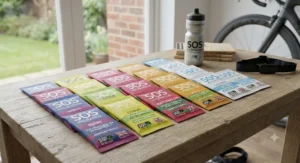
SOS Hydration Electrolyte Powder Sachets built its whole identity around one claim: hydrating your body faster than water alone, without the sugar bomb of a typical sports drink. Each stick delivers a blend of six electrolytes — sodium, potassium, chloride, magnesium, zinc and citrate — alongside a deliberately small 3g of glucose, just enough to trigger the sodium-glucose co-transport mechanism that pulls water into the bloodstream more efficiently. In practice, that means SOS Hydration sits closer to “everyday hydration top-up” than “endurance fuel,” which is exactly the gap it’s designed to fill. It’s a sensible pick for commuters battling air-conditioned offices, long-haul flyers, or anyone nursing a Sunday-morning headache rather than training for a marathon. Aggregated Amazon.co.uk review sentiment sits around 4.3 out of 5 stars across hundreds of ratings, with buyers frequently praising the taste and the “doesn’t feel like syrup” texture compared with heavier sports drinks; a recurring gripe is that the lighter sodium dose isn’t strong enough for genuinely heavy sweaters.
Pros:
- ✅ Low sugar formula, only 3g per stick
- ✅ Six-electrolyte blend including magnesium and zinc
- ✅ Widely stocked with fast Prime delivery
Cons:
- ❌ Sodium dose too light for heavy endurance sweat loss
- ❌ Pricier per serving than basic tablet formats
Prices for SOS Hydration sachets typically sit around £16-£22 for a 20-serving box on Amazon.co.uk, and given the low sugar content and easy dosing, it represents solid value for anyone using it a few times a week rather than daily during hard training.
2. Precision Fuel & Hydration PH Tablets — sweat-test-matched, multi-strength dosing
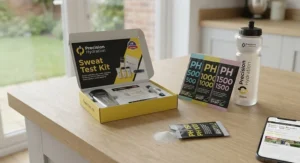
Precision Fuel & Hydration PH Tablets take an entirely different approach: rather than one formula for everyone, the range spans four distinct strengths — PH250, PH500, PH1000 and PH1500 — each delivering a different sodium concentration per litre so athletes can match the tablet to their measured sweat sodium loss rather than guessing. The PH1000, for instance, delivers 1,000mg of sodium per 32oz (roughly 946ml) of water, which is more than triple what a typical mainstream electrolyte tablet offers. What most buyers overlook about this system is that it’s built entirely around Precision’s own sweat testing service — the tablets are genuinely most useful once you know your own sweat sodium concentration, rather than as a blind purchase. Manufactured in the UK and Informed Sport/WADA batch-tested, it’s popular with triathletes and ultra-runners specifically because the hypotonic formula absorbs quickly without slowing digestion during long efforts. Aggregated reviewer sentiment consistently highlights easy digestion during racing and noticeably reduced cramping in hot conditions, with the main criticism being that untested buyers often pick the wrong strength and end up disappointed.
Pros:
- ✅ Four strengths matched to individual sweat rate
- ✅ Manufactured in the UK, Informed Sport tested
- ✅ Genuinely differentiated at the high-sodium end
Cons:
- ❌ Confusing for buyers without a sweat test result
- ❌ Higher cost per serving than everyday brands
Precision Fuel & Hydration tablets typically cost around £8-£12 per tube on Amazon.co.uk depending on strength and pack size, which is reasonable for the category but only good value if you’re actually using the strength your sweat rate calls for — buy blind and you risk either under-dosing or wasting sodium your body didn’t need.
3. Nuun Sport Electrolyte Tablets — lightweight, low-sugar gym staple
Nuun Sport Electrolyte Tablets have quietly become one of the most recognisable names in the category, largely on the strength of their portability — a slim tube of ten tablets slips into a gym bag or glovebox without a second thought. Each tablet delivers five electrolytes (300mg sodium, 150mg potassium, 40mg chloride, 25mg magnesium, 13mg calcium) with just 1g of sugar, positioning Nuun Sport as a middle-ground option: stronger than a purely cosmetic hydration tablet, but nowhere near the heavy-duty sodium levels of Precision or LMNT. Based on the spec comparison, this makes it a sensible daily-use tablet for gym sessions, five-a-side football or a summer 10k, rather than an ultra-distance race day product. The vegan, non-GMO, gluten-free formulation broadens its appeal beyond hardcore athletes into the general wellness crowd. Aggregated UK review sentiment is generally positive on flavour variety, though a recurring theme is that the fizzy dissolve can taste slightly chalky if the tablet isn’t given the full few minutes to break down completely.
Pros:
- ✅ Compact travel tube, easy to carry daily
- ✅ Wide flavour range reduces taste fatigue
- ✅ Vegan, non-GMO and gluten-free certified
Cons:
- ❌ Moderate sodium won’t suit heavy sweaters
- ❌ Chalky aftertaste reported if under-dissolved
A four-pack of Nuun Sport (40 servings total) typically runs in the £15-£20 range on Amazon.co.uk, putting it firmly in mid-range territory — not the cheapest option, but reasonable given the flavour variety and brand consistency.
4. High5 Zero Electrolyte Tablets — zero-calorie hydration with a vitamin C boost
High5 Zero Electrolyte Tablets carve out their niche at the lighter end of the market: genuinely calorie-free, sugar-free, and fortified with vitamin C, making them a popular choice for anyone who wants electrolyte support without any of the carbohydrate load found in energy-drink-style hydration products. The formula leans on a moderate sodium dose designed to top up fluid balance during low-to-moderate intensity exercise, which is honest positioning rather than overclaiming. What the spec sheet won’t tell you, but reviewers consistently note, is that the citrus and berry flavours dissolve cleanly with minimal residue, a small but genuinely appreciated detail if you’re mixing tablets in a reusable bottle rather than a glass. High5 Zero suits casual runners, cyclists doing club rides under two hours, or anyone who simply wants a low-effort daily hydration habit. On the value side, it’s one of the more budget-friendly tablet options in this list, making it a sensible entry point for people trying electrolyte supplementation for the first time without committing to a premium price.
Pros:
- ✅ Genuinely zero calories and zero sugar
- ✅ Added vitamin C for immune support
- ✅ Clean dissolve, minimal residue reported
Cons:
- ❌ Sodium dose too light for hot-weather endurance
- ❌ Smaller flavour range than some competitors
At under £10 per tube on Amazon.co.uk, High5 Zero is one of the most accessible entry points into the category, particularly well suited to buyers testing whether electrolyte tablets actually make a noticeable difference before investing in a premium multi-strength system.
5. Science in Sport GO Hydro Electrolyte Tablets — elite-developed, Informed Sport certified
Science in Sport GO Hydro Electrolyte Tablets trade on SiS’s long-standing reputation in UK endurance sport, developed alongside elite athletes and batch-tested under the Informed Sport programme for banned substances. Each tablet combines four core electrolytes with B vitamins (B1, B2 and B6), aimed at supporting both fluid balance and the metabolic processes involved in converting carbohydrate to usable energy during longer sessions. Based on the spec comparison, SiS GO Hydro sits in a genuinely useful middle tier — stronger and more athlete-focused than Nuun or High5, but without the confusing multi-strength system that Precision requires you to navigate. That makes it a solid pick for structured training blocks: half-marathon prep, cycling sportives, or anyone following a set training plan who wants a “no-thinking-required” hydration tablet. Aggregated reviewer sentiment consistently praises the trustworthiness of the Informed Sport certification for competitive athletes, alongside genuinely positive comments on the citrus and berry flavour options; a minority of reviewers note the tablets are slightly slower to dissolve fully compared with Nuun.
Pros:
- ✅ Informed Sport certified, trusted by competitive athletes
- ✅ B vitamins support carbohydrate metabolism
- ✅ Backed by SiS’s elite athlete development process
Cons:
- ❌ Slower dissolve time than some rivals
- ❌ Single-strength formula, no sweat-test customisation
Science in Sport GO Hydro tubes typically retail under £10 on Amazon.co.uk, which represents strong value given the Informed Sport certification — a detail that matters considerably more to competitive club athletes than to casual gym-goers.
6. O.R.S Hydration Tablets — WHO-formula, pharmacist-grade budget hydration
O.R.S Hydration Tablets occupy genuinely distinctive ground in this list: formulated to World Health Organisation oral rehydration standards and listed in UK medicines databases with a pharmacy PIP code, they’re built for a broader remit than sport alone — illness recovery, jet lag, hot weather and hangover recovery all sit within the brand’s stated use cases. The Sport range adds magnesium and vitamin D on top of the base electrolyte blend, nudging it slightly closer to athletic use, though sodium levels remain moderate rather than aggressive. Reviewers consistently note that the taste is a genuine strength — “tastes great and felt more hydrated quickly” is a common theme in aggregated feedback — while some reviewers found the standard-dilution flavour weaker than expected and preferred using less water than instructed. For UK buyers who want a trustworthy, medically-grounded formula without paying sports-brand pricing, O.R.S Hydration is arguably the most quietly underrated pick in this entire comparison, especially for family use where a WHO-standard formula carries genuine reassurance.
Pros:
- ✅ Formulated to WHO oral rehydration standards
- ✅ Listed in UK medicines databases with pharmacy PIP code
- ✅ Suitable for the whole family, not just athletes
Cons:
- ❌ Standard dilution can taste weak to some users
- ❌ Sodium dose modest for serious endurance training
O.R.S Hydration Tablets typically cost under £10 per tube on Amazon.co.uk, making this one of the most budget-friendly options here — genuinely good value given the WHO-grade formulation and pharmacy-recognised status.
7. LMNT Electrolyte Drink Mix — the highest-sodium premium option
LMNT Electrolyte Drink Mix sits at the opposite end of the spectrum from SOS and High5: each stick pack delivers around 1,000mg sodium, 200mg potassium and 60mg magnesium, built around the philosophy that most people — and especially athletes, keto dieters and heavy sweaters — need considerably more sodium than mainstream sports-drink guidance suggests. Available to UK buyers through verified third-party Amazon.co.uk sellers rather than direct UK retail, LMNT has built a loyal following among low-carb and endurance communities specifically because the formula contains zero sugar and zero artificial ingredients, relying on stevia for sweetness instead. Here’s what to weigh: the sodium dose is genuinely substantial, comparable to Precision’s PH1000 tier, which makes it a poor fit for casual, low-intensity use but a strong option for anyone who has independently established they lose a lot of sodium through sweat. Aggregated review sentiment is enthusiastic about the salty-forward taste profile appealing to keto dieters, with the most common criticism being the premium price relative to UK-based alternatives offering similar sodium content.
Pros:
- ✅ High 1,000mg sodium dose per serving
- ✅ Zero sugar, zero artificial ingredients
- ✅ Strong following among keto and endurance communities
Cons:
- ❌ Premium pricing versus UK-made alternatives
- ❌ Not sold directly on Amazon UK by the brand itself
LMNT typically costs around £35-£45 for a 30-stick box via third-party UK Amazon sellers — noticeably more expensive than Precision’s comparable sodium tier, so it’s worth checking current pricing carefully before assuming it’s the better-value high-sodium option.
Practical Usage Guide: Getting Your Electrolyte Dosage Right
Buying the right brand only solves half the problem — how you actually use it determines whether you notice any benefit at all. Start by matching dose to duration: for anything under 60 minutes of moderate exercise, plain water is usually sufficient, and reaching for Precision Fuel & Hydration or LMNT at this intensity is genuinely overkill. Electrolyte supplementation earns its place once sessions stretch past an hour, temperatures climb, or you’re sweating heavily enough to see visible salt residue on dark clothing afterwards — a strong personal signal that your sodium losses run above average.
A common first-30-days mistake is front-loading electrolytes before exercise rather than spreading intake across the session; sipping steadily throughout a long run or ride works better than downing a strong dose beforehand, which can cause stomach discomfort. Storage matters too, particularly for powder-based products like SOS Hydration and LMNT — keep sachets somewhere genuinely dry, since British damp has a habit of clumping powder inside gym bags. For tablet-based products such as Nuun Sport, High5 Zero and Science in Sport GO Hydro, always let the tablet fully dissolve (roughly two to three minutes) rather than drinking it half-fizzed, as partially dissolved tablets both taste worse and deliver electrolytes unevenly.
Finally, rotate flavours if you’re using a product daily — flavour fatigue is one of the most common reasons people quietly stop using electrolyte supplements within a month, and most of these brands, including O.R.S Hydration and Nuun Sport, offer enough variety to avoid it.

Real-World Scenarios: Which Hydration Product Actually Suits You?
The office commuter battling recycled air and long meetings: someone commuting into central Manchester or London five days a week, sat in air-conditioned offices, rarely exercising hard but frequently feeling foggy by 3pm, is better served by SOS Hydration or O.R.S Hydration than anything from the high-sodium tier. Their moderate electrolyte dose and low sugar content suit daily, low-intensity use without overloading sodium intake from a desk job.
The weekend 10k runner training three times a week: this profile — moderate intensity, 30-60 minute sessions, occasional weekend long runs — fits comfortably with Nuun Sport, High5 Zero or Science in Sport GO Hydro. None of these require a sweat test to use safely, and all three offer enough sodium to notice a genuine difference on warmer training days without the complexity of a multi-strength system.
The half-Ironman athlete training through a British summer: anyone doing structured endurance training exceeding two hours regularly, particularly on hot or humid days, is the exact use case Precision Fuel & Hydration and LMNT were built for. Investing in a sweat test (or at minimum tracking body weight before and after long sessions) before committing to PH1000 or PH1500 strength avoids wasted spend on sodium your body doesn’t actually need.
Problem → Solution: Common Hydration Mistakes and How to Fix Them
Problem: cramping during long sessions despite drinking plenty of water. This is frequently a sodium problem rather than a fluid problem — plain water dilutes remaining sodium further. Switching to a higher-sodium option like Precision Fuel & Hydration PH1000 or LMNT during long, hot sessions typically addresses this more effectively than simply drinking more water.
Problem: stomach discomfort after taking electrolyte tablets. Dosing too strong, too fast, or on an empty stomach is the usual culprit. Diluting Precision Fuel & Hydration or Science in Sport GO Hydro tablets in slightly more water than instructed, and sipping steadily rather than gulping, generally resolves this within a session or two.
Problem: giving up on electrolyte tablets because of taste fatigue. Sticking to one flavour for weeks is the most common cause. Nuun Sport and O.R.S Hydration both offer wide flavour ranges specifically to counter this — rotating flavours weekly keeps consistency without the boredom.
Problem: overspending on premium sodium you don’t actually need. Buying LMNT or Precision’s highest strength without having measured your actual sweat sodium loss often means paying premium prices for a formula that’s stronger than necessary. Working through the sweat rate calculation later in this guide before purchasing avoids this entirely.
Problem: powder clumping or tablets going soft in transit. UK weather is genuinely damp for large stretches of the year. Decanting SOS Hydration sachets or LMNT sticks into a small waterproof pouch, rather than leaving them loose in a gym bag, prevents this common and entirely avoidable annoyance.

How to Choose Between SOS Rehydrate and Precision Fuel & Hydration
Choosing between these two brands — and the wider field around them — comes down to answering a handful of honest questions about your own body and routine.
- Work out your typical session length. Under 60 minutes at moderate intensity rarely needs supplementation at all; over 90 minutes in the heat almost always benefits from it.
- Check for visible salt residue on clothing after exercise. Heavy white salt marks on dark kit are a strong practical signal that you’re a “salty sweater” who may benefit from Precision’s higher strengths or LMNT.
- Estimate or measure your sweat rate. Weighing yourself immediately before and after a typical hour-long session (accounting for fluid drunk) gives a rough sweat rate in litres per hour — a genuinely useful number before choosing a strength tier.
- Decide whether daily convenience or race-day precision matters more. SOS, Nuun, High5 and O.R.S are built for grab-and-go daily use; Precision’s multi-strength system rewards athletes willing to do a little homework first.
- Factor in taste tolerance. If you’ve previously abandoned an electrolyte product over flavour, prioritise brands with wide flavour ranges — Nuun and O.R.S consistently score well here in aggregated reviews.
- Set a realistic budget per month. Multiply your typical weekly sessions by the per-serving cost; premium brands like LMNT can add up quickly for daily users, while SOS and O.R.S remain affordable even at high frequency.
- Reassess seasonally. Sodium needs in a mild British spring are genuinely lower than during a hot July training block — many experienced athletes switch strength or brand across the year rather than sticking to one product permanently.
For anyone still uncertain after these steps, general dehydration guidance from the NHS covers the basics — recognising early symptoms and everyday prevention — that apply regardless of which brand you eventually choose.
SOS Rehydrate vs Precision Fuel & Hydration: Head-to-Head
Put side by side, the two brands aren’t really competing for the same customer, which is part of why the comparison confuses so many buyers. SOS Rehydrate is formulated for breadth — travel, illness, mild heat, hangovers, and general daily hydration — with a sodium dose deliberately kept moderate so it suits almost anyone without risk of overdosing sodium on a low-activity day. Precision Fuel & Hydration, by contrast, is formulated for depth within a narrower use case: matching a specific, measured sodium loss during genuinely demanding exercise, with four strengths existing precisely because “one size fits all” doesn’t hold up under sports science scrutiny.
On taste and format, SOS Hydration‘s powder sachets dissolve into a genuinely drinkable, lightly sweetened solution, while Precision Fuel & Hydration‘s effervescent tablets favour practicality — a single tablet dropped into a bottle mid-run is easier to manage than tearing open a sachet while moving. On value, SOS wins for infrequent or daily low-intensity use, while Precision only becomes cost-effective once you’re using enough tablets often enough, at the right strength, to justify its higher per-serving price.
Where rehydration science for runners becomes genuinely relevant is in matching sodium concentration to actual losses rather than following generic marketing claims — research summarised in the exercise-associated hyponatremia literature makes clear that over-drinking relative to sodium intake, not under-drinking, is the more dangerous failure mode for endurance athletes, which is precisely the problem Precision’s sweat-test-matched system is designed to prevent, and precisely why SOS’s lighter, everyday-focused formula was never meant to solve it.
Verdict: if you’re not training for anything specific and just want reliable daily hydration, SOS Hydration is the simpler, cheaper, entirely sensible choice. If you’re training seriously enough that sodium loss is measurably affecting your performance, Precision Fuel & Hydration‘s multi-strength system is worth the extra homework and cost.

Electrolyte Tablet Dosage: How Much Sodium Do You Actually Need
Electrolyte tablet dosage confuses more buyers than any other aspect of this category, largely because manufacturers report sodium differently — some per tablet, some per litre, some per 32oz bottle — making direct comparison genuinely difficult without doing the maths yourself. As a rough baseline, general sports nutrition guidance suggests most casual exercisers lose somewhere between 500mg and 1,000mg of sodium per litre of sweat, though individual variation is substantial; some people lose considerably less, others noticeably more.
Products like Nuun Sport (around 300mg per tablet) and High5 Zero (150-200mg) sit comfortably within a light-to-moderate replacement range suited to shorter or cooler sessions. Science in Sport GO Hydro (350-400mg) nudges slightly higher, appropriate for structured training. Precision Fuel & Hydration‘s tiered system spans the full range deliberately — from PH250 for light sweaters in cool conditions right through to PH1500 for the heaviest, saltiest sweaters training in heat — while LMNT‘s roughly 1,000mg dose sits at the upper end without the tiered flexibility.
Reviewers consistently note that starting with a moderate dose and adjusting upward based on how you feel — rather than jumping straight to the strongest available tablet — tends to produce a more comfortable, sustainable routine. Overdosing sodium relative to genuine sweat loss doesn’t typically cause harm in healthy adults staying within recommended daily amounts, but it does waste money and can occasionally cause mild stomach upset; underdosing during genuinely hot, long sessions is the pattern more commonly linked to cramping and fatigue in aggregated athlete feedback.
Long-Term Cost & Value: Price Per Litre Compared
Sticker price alone is a poor guide to genuine value in this category, since serving sizes, sodium concentration and dilution ratios vary enormously between brands. Working roughly on cost per prepared litre, budget tablet formats — O.R.S Hydration, High5 Zero and Science in Sport GO Hydro — typically land somewhere in the 20-40p per litre range, making them genuinely affordable for daily, long-term use. Nuun Sport sits slightly above that, reflecting its stronger brand positioning and wider flavour range rather than a meaningfully different formula.
SOS Hydration‘s sachets cost more per litre than the budget tablet tier, a trade-off that’s easier to justify occasionally (travel, illness recovery) than as a daily habit for cost-conscious buyers. At the premium end, Precision Fuel & Hydration and LMNT cost considerably more per litre — frequently three to five times the budget tier — but that premium buys genuinely higher sodium concentration and, in Precision’s case, a personalised strength system rather than simply a fancier version of the same formula.
| Brand | Approx. Cost Per Litre Prepared | Best For |
|---|---|---|
| O.R.S Hydration | ~20-30p | Everyday budget use |
| High5 Zero | ~25-35p | Casual, low-intensity exercise |
| Science in Sport GO Hydro | ~30-40p | Structured training on a budget |
| Nuun Sport | ~35-45p | Daily gym use, flavour variety |
| SOS Hydration | ~50-70p | Travel, illness, occasional use |
| Precision Fuel & Hydration | ~£1-£1.50 | Sweat-test-matched endurance training |
| LMNT | ~£1.20-£1.80 | High-sodium needs, keto lifestyles |
From this breakdown, the honest takeaway is that most people training under two hours a session are overpaying if they default straight to LMNT or Precision’s top strength without genuinely needing that much sodium — the budget-to-mid tier covers the majority of realistic UK training needs at a fraction of the cost, with the premium brands earning their price specifically at the high-sweat, long-duration end of the spectrum.
Safety, Regulation & Certification for UK Buyers
In the UK, electrolyte drinks and tablets are regulated as food supplements rather than medicines, meaning manufacturers must follow labelling and compositional rules but products aren’t required to be licensed or registered with a government body before sale — a distinction worth understanding when comparing marketing claims against actual regulatory oversight. The UK government’s guidance on supplement labelling sets out what brands are and aren’t permitted to claim, which is useful context when a product’s marketing sounds more like a medical claim than a nutritional one.
For competitive athletes, third-party batch testing matters considerably more than general labelling compliance. Precision Fuel & Hydration and Science in Sport GO Hydro are both Informed Sport certified, meaning every batch is independently tested against the World Anti-Doping Agency’s prohibited substance list — genuinely important for anyone subject to drug testing, and a reasonable trust signal even for non-competitive athletes who simply want assurance around manufacturing standards. O.R.S Hydration‘s WHO-formula grounding and UK medicines database listing offers a different kind of reassurance, rooted in medical rather than sporting credibility. If banned-substance testing matters to your specific sport, checking for the Informed Sport mark before purchase is a sensible habit regardless of which brand you lean toward.
✨ Don’t Miss These Exclusive Deals!
🔍 Take your hydration routine to the next level with these carefully selected products. Click on any highlighted item to check current pricing and availability on Amazon. These picks will help you find exactly what your body actually needs!
Frequently Asked Questions
❓ Is SOS Hydration or Precision Fuel & Hydration better for runners?
❓ How much sodium should an electrolyte tablet contain?
❓ Can I use electrolyte tablets every day, not just when exercising?
❓ What's the cheapest way to try electrolyte supplements in the UK?
❓ Do electrolyte drinks actually work better than water alone?
Conclusion
The honest answer to “SOS vs Precision Hydration” is that most people don’t actually need to choose between them in the abstract — they need to choose based on what their own training or daily routine actually demands. SOS Hydration earns its place as a genuinely solid, low-sugar everyday option for travel, illness and general hydration, while Precision Fuel & Hydration‘s tiered, sweat-test-matched system rewards athletes serious enough to measure their own sodium loss rather than guess at it. Between them sit five other real, well-reviewed UK options — Nuun Sport, High5 Zero, Science in Sport GO Hydro, O.R.S Hydration and LMNT — each covering a slightly different combination of budget, sodium strength and use case.
Rather than defaulting to whichever brand has the loudest marketing, work through the practical questions in this guide: session length, visible sweat salt, rough sweat rate, and realistic budget. Match those honestly to the product specs above, and you’ll land on a genuinely appropriate choice rather than an overpriced or underpowered one. Whichever you choose, checking current pricing and stock on Amazon.co.uk before buying ensures you’re getting the most accurate, up-to-date picture.
Recommended for You
- 7 Best Electrolyte Tablets for Running in 2026
- 7 Best Energy Bars for Runners in 2026
- Caffeine-Free Energy Gels for Runners: 7 Best Picks for 2026
Disclaimer: This article contains affiliate links. As an Amazon Associate, I earn from qualifying purchases. If you purchase products through these links, we may earn a small commission at no additional cost to you.
✨ Found this helpful? Share it with your mates! 💬🤗
