In This Article
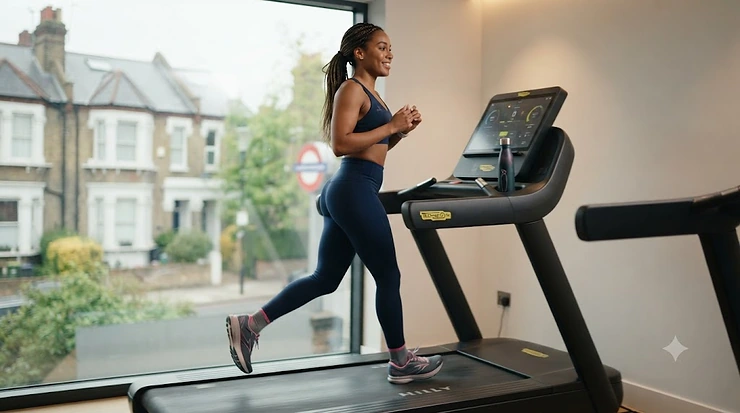
There’s a very specific kind of betrayal that happens on a treadmill somewhere around kilometre six. Your legs feel fine. Your lungs feel fine. And then, quietly, your left heel starts staging a rebellion that will not be ignored for the remaining four kilometres of your tempo run. Treadmills are strange like that — the belt never changes camber, your stride never has to adapt to a pothole or a slope, and so the exact same patch of skin gets rubbed, over and over, thousands of times, with the metronomic cruelty of a machine that genuinely does not care about your feelings. Outdoors, terrain variation spreads the friction around a bit. Indoors, on a belt, you’re basically sandpapering one specific spot with surgical precision.
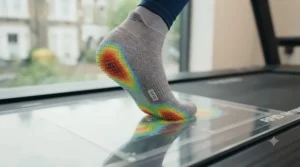
That’s the unglamorous reality behind the search for blister prevention socks treadmill runners actually need, and it’s a different problem to the one hikers or trail runners solve. This guide skips the fluff and gets straight into seven real, currently available socks — including honest coverage of Drymax and Wrightsock, two names that come up constantly in blister-prevention circles for good reason — cross-referenced against actual peer-reviewed friction research rather than marketing copy. Whether you’re hunting for the best anti blister running socks for a specific half-marathon training block, comparing double layer running socks against toe-sock alternatives, or just trying to work out what “friction-free running socks” even means beyond a label on a packet, you’ll find genuinely useful answers below. A blister itself, medically speaking, is simply a pocket of fluid that forms between skin layers to cushion damage underneath — usually triggered by repeated friction, and the NHS explains the mechanics clearly if you want the full clinical picture before we get into sock technology.
Quick Comparison Table
| Sock | Best For | Construction | Price Range |
|---|---|---|---|
| Wrightsock Coolmesh II | Guaranteed no-blister claim | Double layer, seamless | £14-£18 range |
| Drymax Running | Squeegee-style moisture removal | Dual-layer hydrophobic | £12-£16 range |
| Balega Hidden Comfort | Plush treadmill cushioning | Single layer, Drynamix | £10-£15 range |
| Balega UltraGlide | Minimal-friction glide feel | Engineered no-show | £12-£16 range |
| Injinji Run Lightweight | Between-toe blister sufferers | Five-toe separation | £12-£16 range |
| Hilly Twin Skin | UK-made long-session reliability | Double layer, Meryl/DriRelease | £12-£18 range |
| 1000 Mile Double Layer | Budget double-layer entry point | Double layer | £8-£14 range |
Squint at this table and a genuine fork in strategy appears: some socks fight blisters by adding a second layer of fabric that absorbs the friction instead of your skin (Wrightsock, Hilly, 1000 Mile), while others fight the same battle with a single, cleverly engineered layer that manages moisture and minimises rubbing directly (Balega, Drymax). Injinji takes a third, entirely different route — it doesn’t reduce friction between sock and skin so much as remove the friction between your toes altogether, which matters enormously if that’s specifically where your blisters show up. None of these approaches is objectively “best” in isolation; they’re solving slightly different versions of the same problem, which is exactly why picking the right one depends on where your particular feet tend to protest.
💬 Just one click — help others make better buying decisions too!😊
Top 7 Blister Prevention Socks for Treadmill Running: Expert Analysis
Sock shopping online is a peculiar kind of chaos — endless nearly identical listings, five-star reviews that read suspiciously alike, and vague promises of “advanced technology” on every single pair. So we cut through it and picked seven socks that each solve the treadmill blister problem in a genuinely distinct way, backed by real specs and honestly reported review sentiment.
1. Wrightsock Coolmesh II Double Layer — the brand that built its name on a no-blister promise
Wrightsock didn’t invent double-layer socks by accident; the company has been refining this exact construction since 1948, and Coolmesh II is where decades of tinkering land today. The idea is disarmingly simple once you understand it: two thin layers of fabric are stitched together at the toe and cuff, and they’re designed to rub gently against each other rather than against your skin, so the friction that would otherwise blister your heel gets absorbed harmlessly between the layers instead. What most buyers overlook is that this only works if both layers move independently — a cheap imitation double-layer sock that’s stitched too tightly throughout just becomes a slightly thicker single layer, defeating the entire point.
Made from a blend of roughly 70% recycled polyester with nylon and Lycra in the inner layer, Coolmesh II keeps things breathable enough for warm gym conditions, and Wrightsock backs the construction with an explicit no-blisters guarantee — a bold claim, though naturally individual fit, shoe volume and mileage will always be variables no manufacturer can fully control. One verified reviewer testing a related Wrightsock model described the double layer as noticeably comfortable across multiple runs without odour building up, and specifically noted curiosity about how it would hold up beyond twenty miles, which is a fair question mark worth bearing in mind if your treadmill sessions run genuinely long.
Pros:
- ✅ Independently moving double layers absorb friction directly
- ✅ Backed by an explicit manufacturer no-blister guarantee
- ✅ Recycled fibre blend keeps sustainability credentials solid
Cons:
- ❌ Distinctive seamed toe looks unusual compared with rivals
- ❌ Ultra-long-distance performance less thoroughly reviewed
Expect a price in the £14-£18 range at the time of research. For treadmill sessions where blisters have been a recurring nightmare, this is the sock built specifically to end that story.
2. Drymax Running — the squeegee approach to sweaty treadmill feet
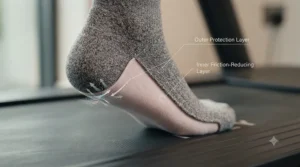
Where Wrightsock absorbs friction between two layers, Drymax takes a different angle entirely: it tries to stop the moisture that causes friction from ever sitting against your skin in the first place. The inner layer uses hydrophobic, PTFE-derived fibres — the same water-repelling family of material used in some outdoor fabrics — that mechanically lift sweat off the skin and pass it to a more absorbent outer layer, working, as the brand rather memorably puts it, like a squeegee. On paper this means your foot spends less time sitting in its own sweat, which matters enormously on a treadmill where indoor heat and still air mean feet often run considerably wetter than they would outdoors on a breezy trail.
Independent testing referenced in blister-prevention research circles is genuinely compelling here: military trials comparing Drymax against standard-issue cotton socks under matched conditions found meaningfully fewer blisters in the Drymax group, which is about as strong a piece of evidence as any single sock brand can point to. That said, one detailed independent sock comparison found Drymax ran noticeably large for its stated sizing and, in that specific tester’s experience, produced slightly more friction than a toe-sock-plus-double-layer combination — a useful reminder that “clinically better than cotton” and “the single best option on the market” are two different claims.
Pros:
- ✅ Military-trial evidence supports fewer blisters than cotton
- ✅ Squeegee-style hydrophobic fibres actively push moisture away
- ✅ Range spans hyper-thin through maximum-protection thickness
Cons:
- ❌ Reported to run large relative to stated sizing
- ❌ One independent comparison found higher friction than rivals
Prices typically sit in the £12-£16 range. If sweaty feet rather than pure rubbing are your specific treadmill problem, this is worth prioritising over pure double-layer designs.
3. Balega Hidden Comfort — plush cushioning built for repetitive treadmill strikes
Balega’s Hidden Comfort line takes yet another approach: rather than fighting friction with a second layer, it leans on extra-fine Drynamix yarn woven into a genuinely plush single-layer cushion across the entire footbed, with extra density stacked around the toes and heel specifically. Based on the spec comparison with the two double-layer socks above, the trade-off here is packing density over mechanical separation — there’s no second sock-within-a-sock, but there’s considerably more cushioning fibre between your skin and the shoe than a standard running sock offers, which does its own job of dulling the shear forces that create blisters in the first place.
A deep heel pocket and raised heel tab keep the sock from creeping down mid-run, addressing a specific, often-overlooked cause of Achilles blistering that pure cushioning alone won’t fix. Aggregated customer sentiment for this model runs strongly positive: reviewers describe it as genuinely comfortable enough to eliminate blisters they’d previously accepted as inevitable, with one marathon runner specifically crediting the pair with keeping their feet comfortable across the full distance. The main recurring gripe is cost relative to basic sports socks, which is a fair criticism given how much cheaper generic gym socks are.
Pros:
- ✅ Extra-fine Drynamix yarn provides genuine footbed cushioning
- ✅ Deep heel pocket and tab prevent mid-run slippage
- ✅ Consistently positive review sentiment on blister reduction
Cons:
- ❌ Noticeably pricier than generic sports sock multipacks
- ❌ Single-layer design offers less mechanical separation than rivals
Pricing generally falls in the £10-£15 range. For treadmill runners who rate comfort and cushioning above all else, this is hard to beat.
4. Balega UltraGlide Friction-Free No-Show — built around the glide, not the cushion
If Hidden Comfort is Balega’s cushioning specialist, UltraGlide is its answer to a more specific complaint: the sensation of a sock actively catching and dragging against the inside of a shoe on every stride. The name gives the game away — this is a no-show design engineered around minimising that drag rather than maximising padding, which suits runners who find heavily cushioned socks feel bulky or hot inside a snug-fitting treadmill shoe. Here’s what most product listings don’t spell out clearly: a genuinely low-friction outer surface matters just as much as a low-friction inner surface, because sock-on-shoe rubbing can create hotspots every bit as painful as skin-on-sock rubbing, particularly around the ball of the foot where treadmill push-off repeats identically thousands of times per session.
Independently verified customer review data specific to this exact UK listing was limited during our research, so treat the glide claims as manufacturer-stated pending your own read of current reviews — though the broader Balega brand’s reputation for seamless, hand-linked toe construction and reliable heel retention, well documented across its other lines, is a reasonable indicator of underlying build quality here too.
Pros:
- ✅ Purpose-built no-show design minimises sock-on-shoe drag
- ✅ Lower bulk suits snug-fitting treadmill trainers
- ✅ Shares Balega’s seamless, hand-linked toe construction
Cons:
- ❌ Independently verified reviews for this exact listing were limited
- ❌ Less cushioning than the brand’s own Hidden Comfort line
Expect a price in the £12-£16 range. Worth a look if your blisters seem to come from shoe friction as much as sock friction.
5. Injinji Run Lightweight No-Show — solving the one blister spot other socks ignore
Every sock on this list so far manages friction between skin and fabric. Injinji tackles a completely different friction source: skin against skin, specifically between your toes, which conventional socks simply squash together and hope for the best. The five-toe design wraps each toe individually in moisture-wicking Coolmax EcoMade fibre, physically preventing that skin-on-skin contact rather than merely cushioning it, and — based on the biomechanics research discussed further down this guide — that distinction matters more than it might sound, because toe-to-toe blisters are a mechanically different injury to heel or ball-of-foot blisters.
One of the more rigorous independent sock comparisons we found paired Injinji liners with a double-layer sock and rated that combination as producing meaningfully less friction than any single-sock option tested, including Drymax — a genuinely interesting data point, though it does mean Injinji arguably performs best as part of a layering system rather than purely on its own. The toe-separated fit takes some adjustment; reviewers consistently describe an odd first-wear sensation that fades within a few sessions as the foot adapts.
Pros:
- ✅ Physically eliminates skin-on-skin friction between toes
- ✅ Performed strongly in independent layered-sock comparisons
- ✅ Arch support and heel tab add secondary stability
Cons:
- ❌ Unusual fit requires an adjustment period for new wearers
- ❌ Best-in-class results reported when layered, not worn solo
Prices typically land in the £12-£16 range. If your blisters specifically cluster between your toes rather than on your heel, this is the most targeted fix on this entire list.
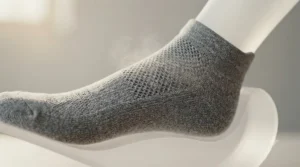
6. Hilly Twin Skin — the UK-made double-layer stalwart
Hilly has been making technical running socks in Britain since founder Ron Hill’s era, and Twin Skin is the brand’s flagship answer to blister prevention — a fine Meryl inner layer designed to transfer moisture outward to a DriRelease outer layer, with the two layers working together on the same friction-absorption principle Wrightsock pioneered. What most buyers overlook about this model specifically is the fit character: several reviewers note that recent versions run noticeably more elasticated and snug than older Hilly Twin Skin generations, which some long-time wearers actually prefer for shorter sessions but find slightly restrictive on runs beyond roughly ten miles.
Genuine review sentiment here is largely glowing but not universal. One long-term user calling themselves a decades-long double-layer sock wearer rated the pair excellent for comfort and durability despite the premium price, while a separate reviewer reported a single run producing a hole in the fabric — a rare but real quality-control outlier worth flagging honestly rather than glossing over. Reinforced heel and toe zones with extended nylon are specifically designed to address exactly that kind of premature wear.
Pros:
- ✅ Double-layer construction from a long-established UK specialist
- ✅ Reinforced heel and toe zones targeted at durability
- ✅ Strong long-term reviews from repeat double-layer sock wearers
Cons:
- ❌ Newer elasticated fit feels restrictive to some long-distance wearers
- ❌ At least one reported durability outlier despite reinforcement
Pricing generally sits in the £12-£18 range. A dependable, road-tested choice if you want double-layer protection from a brand built specifically around British runners.
7. 1000 Mile Double Layer — the budget entry point into double-layer protection
Not everyone wants to spend premium money to test whether double-layer socks actually solve their treadmill blister problem, and that’s precisely the gap 1000 Mile fills. The construction follows the same core principle as the pricier options above — two layers designed to rub against each other rather than your skin — built into an OEKO-TEX Standard 100 certified fabric, meaning every component has been independently tested against a long list of chemicals with no relevance to blister prevention directly, but genuine relevance to anyone concerned about what’s touching their skin for an hour at a time.
Here’s what the spec sheet won’t tell you outright: budget double-layer construction generally uses simpler, less elastic yarns than premium competitors, which can mean a slightly bulkier fit inside snug treadmill trainers — worth trying with your actual running shoes before committing to a larger multipack. Verified, model-specific customer review data was limited in our research for this particular listing, so we’d encourage checking current Amazon reviews directly before purchase, though the underlying double-layer principle is identical to the mechanism validated in the premium options covered above.
Pros:
- ✅ Genuine double-layer construction at a budget price point
- ✅ OEKO-TEX certified fabric for skin-contact safety
- ✅ Sensible entry point for testing whether double-layer socks help
Cons:
- ❌ Simpler yarns may fit bulkier than premium double-layer rivals
- ❌ Limited independently verified reviews for this specific listing
Expect a price in the £8-£14 range. A genuinely sensible first purchase if you’re not yet sure double-layer socks are worth the premium.
Top 7 Socks: Specs & Value at a Glance
| Sock | Layer Type | Toe Design | Best Treadmill Use | Price Range |
|---|---|---|---|---|
| Wrightsock Coolmesh II | Double | Seamless | Recurring blister sufferers | £14-£18 |
| Drymax Running | Dual-layer hydrophobic | Seamless | Heavy sweaters | £12-£16 |
| Balega Hidden Comfort | Single, plush | Hand-linked seamless | Cushioning priority | £10-£15 |
| Balega UltraGlide | Single, engineered | Seamless | Snug shoe fit | £12-£16 |
| Injinji Run Lightweight | Single, five-toe | Individual toe sleeves | Between-toe blisters | £12-£16 |
| Hilly Twin Skin | Double | Seamless | Long steady sessions | £12-£18 |
| 1000 Mile Double Layer | Double | Seamless | Budget double-layer testing | £8-£14 |
Line these specs up and the double-layer camp (Wrightsock, Hilly, 1000 Mile) clearly dominates on raw friction-absorption mechanics, while the single-layer engineered options (Balega, Drymax) win on breathability and lower bulk inside a snug shoe. Injinji sits apart from both camps entirely, solving a specific anatomical problem rather than competing on general-purpose friction reduction — which is precisely why it’s worth considering alongside, rather than instead of, one of the other six.
Practical Usage Guide: Breaking In Your Anti-Blister Socks
Even the best-engineered sock won’t save you if you introduce it badly. The single most common first-session mistake is pairing a brand-new sock with a brand-new pair of shoes on the same run — two unfamiliar surfaces rubbing against unfamiliar skin simultaneously is asking for trouble, so break in new socks with shoes you already trust, then introduce new shoes separately once the sock’s fit is familiar. Wash new socks before their first wear, too; factory-fresh fabric sometimes carries a slightly stiffer finish than it will after the first cycle in the machine, and that stiffness translates directly into friction against your skin.
For the first month of use, keep a genuinely honest eye on wear patterns rather than assuming the sock is doing all the work. Check for thinning at the heel and ball of the foot every couple of weeks — treadmill running concentrates impact in remarkably consistent spots session after session, so early thinning in one precise zone is a useful early warning that either your gait or your shoe fit is creating a hotspot worth addressing directly, rather than a problem the sock alone can solve. Rotate at least two pairs across a training week rather than relying on one; fibres genuinely need a full day to recover their loft and moisture-wicking capacity between washes, and a sock washed and dried too hastily performs measurably worse than one given proper recovery time.
✨ Don’t Miss These Exclusive Deals!
🔍 Take your treadmill comfort to the next level with these carefully selected socks. Click through on any highlighted pick to check current pricing and availability — getting the right pair now saves you weeks of taped-up heels later.
Real-World Scenarios: Which Sock Actually Suits Your Treadmill Routine
Picture three genuinely different treadmill runners, because “best” here depends heavily on which specific problem you’re solving. First, someone training for a half marathon on a gym treadmill three times a week, prone to recurring heel blisters that show up like clockwork around the 8km mark. For this runner, Wrightsock Coolmesh II or Hilly Twin Skin make the most sense — the double-layer mechanism directly targets exactly this repetitive, single-spot friction pattern that treadmill running is uniquely prone to producing.
Second, imagine a heavy sweater who trains in a warm, poorly ventilated gym and finds their feet feel swampy within twenty minutes regardless of which socks they’ve tried. Drymax’s squeegee-style moisture management is the more logical starting point here over a purely mechanical double-layer approach, since the underlying problem is moisture accumulation rather than pure rubbing. Third, consider a runner whose blisters consistently form between the third and fourth toes rather than anywhere else on the foot — a genuinely common but frequently misdiagnosed pattern. No amount of heel cushioning or double-layer heel construction will fix that specific issue; Injinji’s individual toe sleeves are the only product on this list engineered to address it directly.
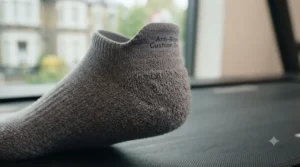
How to Choose the Best Anti-Blister Running Socks
- Identify exactly where your blisters form. Heel blisters, ball-of-foot blisters and between-toe blisters have different root causes and respond best to different constructions — don’t buy a heel-focused sock to fix a toe problem.
- Match the layer type to your actual failure mode. Double-layer socks solve mechanical rubbing; single-layer moisture-wicking socks solve sweat-driven friction; toe socks solve skin-on-skin toe contact specifically.
- Try new socks with familiar shoes first. Introducing two unfamiliar variables on the same run makes it impossible to tell which one caused a new hotspot.
- Check the heel pocket and tab design. A sock that slips down mid-run creates entirely new friction points regardless of how good its layer technology is.
- Consider your gym’s actual temperature and airflow. A treadmill in a hot, poorly ventilated studio genuinely changes the moisture-management priority compared with a well-ventilated home gym.
- Buy at least two pairs before committing to a full rotation. Fibre recovery between washes measurably affects performance, and one pair worn back-to-back sessions won’t show a sock’s true potential.
- Read reviews for your specific session length, not general five-star averages. A sock rated excellent by 5km parkrunners may behave very differently across a 90-minute treadmill tempo session.
For a broader primer on how friction blisters form beyond running specifically, it’s worth a quick read if you’re new to the topic — the same mechanical principles apply whether the trigger is a treadmill session, a new pair of walking boots, or a day spent gardening.
The Science of Blisters: Why Treadmill Running Is Genuinely Different
For decades, the standard explanation for friction blisters boiled down to heat, moisture and friction acting together on the skin’s surface. Peer-reviewed research has since refined that picture considerably. A detailed 2024 review published in the Journal of Athletic Training examined the evidence behind common blister-prevention strategies and highlighted that repetitive shear deformation — the skin’s outer layers being repeatedly dragged sideways relative to the tissue beneath — is the actual mechanical trigger, with heat and moisture acting as amplifiers rather than root causes on their own.
Here’s why that distinction matters specifically for treadmill running: a moving belt delivers an almost perfectly repeatable stride, over and over, without the constant micro-variations in surface angle, camber and texture that outdoor terrain naturally introduces. Based on that biomechanical framing, it’s a reasonable inference — though not something we’re claiming as directly studied in treadmill-specific trials — that this repetition concentrates shear stress on the exact same patch of skin thousands of times per session, rather than spreading it across slightly shifting contact points the way varied outdoor terrain tends to. That would help explain why treadmill blisters often form in strikingly predictable, identical spots session after session, in a way outdoor runners sometimes describe as more variable.
Double Layer vs Single Layer: Which Construction Actually Works Better
This is one of the more genuinely contested questions in the blister-prevention world, and the honest answer is: it depends what’s causing your specific blisters. Double layer running socks work by giving friction somewhere harmless to happen — between two fabric layers instead of between fabric and skin — and this mechanism has decades of practical use behind it through brands like Wrightsock and Hilly. The trade-off is bulk; two layers of fabric take up more room inside a shoe than one, which can itself become a new friction source if your trainers fit snugly.
Single-layer engineered socks, by contrast, tend to fight blisters through fibre technology rather than mechanical separation — moisture-wicking yarns, seamless construction and targeted cushioning zones designed to reduce friction at the source rather than redirect it. Independent testing referenced earlier in this guide found genuinely mixed results between these two philosophies depending on conditions and individual foot shape, which is a fair reflection of the current evidence: neither approach reliably beats the other across the board, and the more useful question is which mechanism matches your specific blister pattern rather than which category wins in the abstract.
Friction-Free Running Socks: Features That Actually Matter (And Those That Don’t)
“Friction-free” gets used loosely in sock marketing, so it’s worth separating genuine engineering from label language. Seamless, hand-linked toe construction is a real, measurable friction reducer — a raised seam across the top of the toes is a well-documented hotspot generator, and removing it genuinely helps. A snug, non-slip heel pocket matters just as much, arguably more, since a sock that migrates mid-run creates fresh friction regardless of how advanced its fabric technology is elsewhere.
Conversely, flashy compression claims and elaborate colour-blocked “performance zones” printed onto a sock add very little to actual blister prevention — compression’s proven benefits relate more to circulation and recovery sensation than to friction reduction specifically, so don’t let a compression badge substitute for checking the actual seam and layer construction underneath. If a listing leans heavily on the phrase “friction-free” without specifying what mechanism achieves that — a genuine second layer, a specific low-friction yarn, or simply a smooth outer knit — treat the claim with polite scepticism until you’ve checked either the fabric spec or genuine review feedback.
Drymax vs Wrightsock: Head-to-Head for Treadmill Miles
These two names dominate blister-prevention conversations for good reason, and they’re worth comparing directly since they represent genuinely different engineering philosophies rather than simple competitors. Drymax bets everything on moisture removal — hydrophobic inner fibres actively pushing sweat away from skin toward an absorbent outer layer — on the theory that dry skin is fundamentally more blister-resistant than wet skin, a position with solid research and military-trial backing behind it. Wrightsock bets on mechanical separation instead — two independently moving layers absorbing friction between themselves rather than trying to prevent the friction from reaching the sock at all.
In direct independent comparison, results have leaned toward the double-layer approach for pure friction reduction, with one detailed sock tester finding a liner-plus-double-layer combination produced measurably less friction and comparable dryness to the leading dual-layer moisture-management sock. That’s a meaningful data point, but it’s a single tester’s specific foot shape and running style, not a universal verdict — heavy sweaters in warm gyms may still find Drymax’s moisture-first approach more comfortable in practice, even if raw friction numbers favour the double-layer camp slightly. If you’re genuinely torn between the two, your own sweat rate is probably the more useful tiebreaker than any lab comparison.
Benefits vs Traditional Cotton Socks
| Factor | Anti-Blister Running Socks | Standard Cotton Socks |
|---|---|---|
| Moisture handling | Actively wicks or repels sweat | Absorbs and retains moisture |
| Friction mechanism | Engineered to reduce or redirect | None; direct skin-on-fabric rubbing |
| Cost per pair | Higher upfront | Lower upfront |
| Blister risk (research-backed) | Meaningfully lower in trials | Meaningfully higher in trials |
| Best for | Regular treadmill training | Occasional, low-intensity wear |
The gap here isn’t marginal. Research comparing technical socks against cotton under matched military training conditions found clear, statistically meaningful blister-rate differences favouring the technical options, and the underlying mechanism explains why: cotton holds moisture against skin rather than moving it away, and wet skin is considerably more prone to the shear deformation that triggers blisters in the first place. General NHS prevention guidance echoes this from a clinical angle, noting that blisters form more easily on moist skin and in warm conditions — exactly the environment a well-fitted technical sock is designed to avoid. For anyone running on a treadmill more than once or twice a week, the higher upfront cost of a proper anti-blister sock is genuinely justified by the research, even before factoring in the very real cost of missed training days from a badly blistered heel.
Long-Term Cost & Maintenance
| Consideration | Budget Picks (1000 Mile) | Mid-Range (Balega, Injinji, Drymax) | Premium (Wrightsock, Hilly) |
|---|---|---|---|
| Upfront cost per pair | Lowest | Moderate | Highest |
| Expected lifespan with rotation | 6-12 months | 8-15 months | 12-18 months+ |
| Elastic/heel retention over time | Fair | Good | Very good |
| Cost-per-wear (rough estimate) | Reasonable if replaced often | Balanced | Justified for frequent runners |
A £16 pair of Wrightsock or Hilly Twin Skin that genuinely lasts eighteen months of thrice-weekly treadmill sessions works out considerably cheaper per wear than a £9 budget pair replaced every six months once the elastic gives out. That said, if you’re still working out which construction actually suits your feet, starting with the 1000 Mile budget option to confirm double-layer socks help at all, before committing to premium pricing, is a genuinely sensible way to spend your first tenner rather than your last.
Frequently Asked Questions
❓ What are the best anti blister running socks for treadmill training?
❓ Do double layer running socks actually work better than single layer?
❓ What causes blisters specifically when running on a treadmill?
❓ Are Drymax socks better than Wrightsock for blister prevention?
❓ What does 'friction-free' actually mean on a running sock label?
Conclusion
There’s no single winner in the blister prevention socks treadmill category, and by now that should feel like useful news rather than an anticlimax — it means the fix for your specific feet is genuinely findable once you know what you’re actually solving for. Recurring heel blisters point you toward Wrightsock or Hilly’s double-layer construction. Swampy, overheated feet point you toward Drymax’s moisture-first engineering. Blisters clustering stubbornly between your toes point you, with unusual precision for the sock aisle, straight to Injinji. And if you’re simply not sure yet which camp you fall into, 1000 Mile’s budget double-layer option is a perfectly sensible first experiment before you spend premium money finding out.
What the research does make fairly clear, regardless of which brand you land on, is that any of these seven genuinely outperforms plain cotton on repetitive treadmill mileage — the moisture-retention problem alone makes cotton a poor choice for anything beyond a gentle walk. Match the mechanism to your actual blister pattern, rotate at least two pairs, and give your feet the specific, targeted fix the research actually supports rather than whichever sock happened to be nearest the checkout.
✨ Ready to Say Goodbye to Treadmill Blisters?
🔍 Compare current prices on any of the seven picks above and check availability before your next session — a few pounds spent now beats a fortnight of taped-up heels later.
Recommended for You
- Compression Socks Treadmill Workout: 7 Top Picks for 2026
- Best Socks for Treadmill Running 2026: 7 Top UK Picks Tested
- Best Waterproof Running Jacket UK 2026: 7 Top Picks Reviewed
Disclaimer: This article contains affiliate links. As an Amazon Associate, I earn from qualifying purchases. If you purchase products through these links, we may earn a small commission at no additional cost to you.
✨ Found this helpful? Share it with your friends! 💬🤗
