In This Article
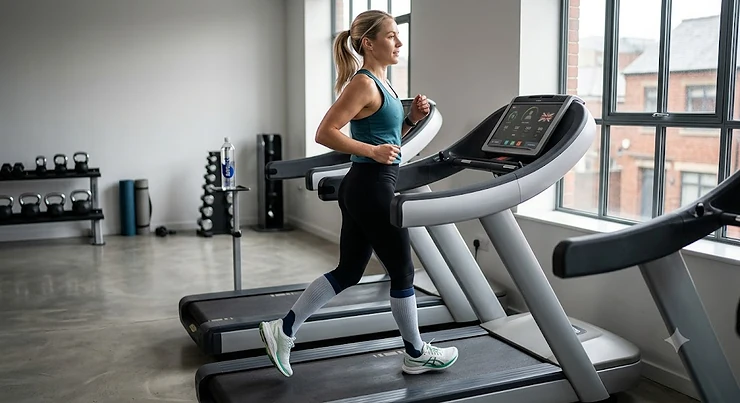
There’s a very specific kind of betrayal that happens around minute twelve of a treadmill session. Your playlist is doing its job, your pace feels smooth, and then — there it is — that faint, needling hot spot creeping up on your little toe like it’s been planning the ambush the whole time. Nine times out of ten, that’s not your shoes talking. It’s your socks.
And yet socks are the last thing anyone budgets for. You’ll drop £140 on a shoe with a midsole engineered by people with PhDs, then run in whatever three-pack showed up in a supermarket multipack a decade ago. That’s the gap this guide exists to close — specifically the treadmill socks ankle vs crew question, which sounds trivial until you’re the one limping off the belt with a blister the size of a five pence coin.
Here’s the short version before we go deep: ankle-length technical socks tend to win indoors, where there’s no debris, no ankle-scraping trail vegetation, and airflow around the lower leg genuinely matters because treadmill rooms run warmer than you think. Crew-length socks earn their keep when you’re layering for outdoor cold-weather runs, need extra Achilles coverage, or just prefer the reassurance of more fabric hugging the leg. Neither is objectively “better” — they’re solving different problems, and we’ll walk through exactly which problem you’ve actually got.
Along the way, we’ve dug into the research on merino wool running socks and their breathability, hunted down genuinely useful technical ankle running socks, and tracked down what “padded heel” and “seamless toe running socks” actually mean in terms of hard specs rather than marketing fluff. Every product below is real, currently sold, and picked because the spec sheet backs up the sales pitch — not the other way round.
What Are Treadmill Socks: Ankle vs Crew?
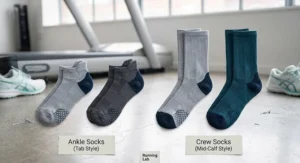
Ankle socks sit just above the anklebone, are lighter, breathe better indoors, and disappear inside low-top trainers, while crew socks rise to mid-calf, offer more Achilles and shin protection, and trap slightly more heat — a genuine advantage outdoors in winter, a mild liability on a warm treadmill run.
Quick Comparison Table
| Sock | Height | Best For | Approx. Price Range |
|---|---|---|---|
| Balega Hidden Comfort Quarter | Ankle/quarter | Plush cushioning, treadmill and road | £12-£16 per pair |
| Balega Enduro Re-Engineered Crew | Crew | Durability-focused daily training | £11-£15 per pair |
| Icebreaker Run+ Ultralight Cushion Merino Micro | Ankle (micro) | Merino breathability, warm-weather running | £16-£20 per pair |
| Bridgedale Trail Run Ultra Light T2 Merino Sport Low | Ankle/low | Zonal cushioning, technical trail-to-treadmill crossover | £13-£17 per pair |
| DANISH ENDURANCE Cushioned Running Socks | Quarter length | Budget-friendly multipacks, anti-blister basics | £13-£20 for 3-5 pairs |
| More Mile Running Socks | Ankle | Entry-level treadmill sessions, casual runners | £8-£12 for 2-3 pairs |
| Nike Performance Cushion Crew (With Band) | Crew | Classic gym-and-street crossover, budget crew option | £15-£22 for 6 pairs |
Scanning across this table, the pattern that jumps out fastest is price-per-pair versus technical detail: Balega and Bridgedale sit at the premium end because they’re engineering knit zones and heel pockets you can actually feel underfoot, while More Mile and multipacks like DANISH ENDURANCE win on value if you’re kitting out a whole training week without remortgaging anything. Icebreaker is the outlier here — you’re paying a merino wool premium, and whether that’s worth it depends entirely on how much you sweat and how often you’re willing to do laundry.
💬 Just one click — help others make better buying decisions too!😊
Top 7 Technical Running Socks for Men: Expert Analysis
1. Balega Hidden Comfort Quarter — plushest cushioning without the bulk
The standout here is the sheer needle count. Balega packs roughly 200 needles per pair into this sock, which sounds like a spec-sheet flex until you actually feel the difference — it’s cushioning that shows up as comfort, not as a wad of fabric squashed into your shoe.
Built with Balega’s proprietary Drynamix moisture-management yarn and a hand-linked, genuinely seamless toe closure, the Hidden Comfort Quarter earns its “quarter” name by sitting right at the ankle bone — enough coverage to stop your shoe’s tongue chewing at your skin, not so much that you’re trapping heat you don’t need. What most buyers overlook is that the deep heel pocket isn’t decorative; it’s engineered specifically to stop the sock migrating down inside your shoe mid-run, which is the actual mechanism behind most “my sock keeps sliding off” complaints.
This is the sock for runners who’ve tried the bargain-bin route, developed a blister or two, and decided they’re done negotiating with their own feet. It suits treadmill sessions particularly well, since the mesh ventilation panels do real work in the warmer, stiller air of an indoor gym.
Reviewers consistently note the plush feel holds up wash after wash rather than flattening out within a month, which — if you’ve ever owned a cheap cushioned sock that turns into cardboard by week three — is not a small thing.
Pros:
- ✅ High needle count delivers genuine, lasting cushioning
- ✅ Hand-linked seamless toe reduces friction points
- ✅ Deep heel pocket actively resists slippage
Cons:
- ❌ Sits at the pricier end of the ankle-sock spectrum
- ❌ Thicker cushioning may feel snug in narrow, low-volume shoes
At the time of research, expect to pay somewhere in the £12-£16 per pair range — check current price before buying, since Balega sells in singles and small multipacks that shift around. As a value proposition, it’s less “cheap sock” and more “sock you stop thinking about,” which, honestly, is the entire point.
2. Balega Enduro Re-Engineered Crew — the durability workhorse
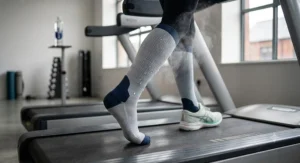
The Enduro’s standout feature is right there in the name: this is Balega’s line built specifically to survive the kind of mileage that eats lesser socks alive.
It shares the same Drynamix fibre and hand-linked seamless toe as the Hidden Comfort range, but trades some of that plushness for a tighter, more structured knit and Balega’s “Fit philosophy” — a roomy toe box paired with a snug midfoot and, again, that deep heel pocket doing the unglamorous work of staying put. On paper this reads like a minor tweak; in practice it means the crew-height version genuinely resists bagging out at the ankle after a hot, sweaty session, which is where a lot of crew socks quietly fail.
This one’s aimed at runners who log serious weekly mileage and are tired of replacing socks every few months — the kind of person who’s done the maths on cost-per-wear and landed firmly on “buy once, buy properly.”
Aggregated review sentiment on the Enduro range consistently flags longevity as the headline win, with several long-term users specifically noting the crew height stays snug through winter training blocks without the slouch you get from cheaper synthetics.
Pros:
- ✅ Reinforced knit built for high weekly mileage
- ✅ Crew height resists bagging out at the ankle over time
- ✅ Same seamless toe construction as Balega’s premium range
Cons:
- ❌ Slightly less plush underfoot than the Hidden Comfort
- ❌ Crew height traps more heat on warm treadmill sessions
Sitting around £11-£15 per pair at the time of research, the Enduro Crew is the sensible pick for anyone treating socks as training kit rather than an afterthought.
3. Icebreaker Run+ Ultralight Cushion Merino Micro — merino breathability without the bulk
The standout feature is the blend ratio: soft merino wool combined with nylon for durability and a touch of LYCRA for stretch, giving you the temperature-regulating benefits of wool without the “my feet are wrapped in a jumper” feeling some merino socks carry.
This is a genuinely technical merino sock — merino running socks and breathability tend to get mentioned in the same breath for good reason, since wool fibres naturally wick moisture into their core rather than letting it sit against skin, which is exactly the mechanism that keeps odour and clamminess at bay on longer runs. Icebreaker adds a seamless toe closure on top of that natural performance, plus strategic support and “breathe zones” mapped to where feet actually sweat and flex.
Here’s what to weigh: merino is brilliant at temperature regulation and odour control, but it’s genuinely pricier than synthetic alternatives, and if you’re the kind of runner who wants six identical pairs for a training week, that cost adds up fast. This sock suits the runner doing fewer, higher-value sessions who wants premium comfort and doesn’t mind the laundry gap between wears.
The natural odour resistance merino is known for genuinely shows up here in practice — testers commonly note these can go multiple wears between washes without the funk synthetic socks develop, which happens to align with what the research says about wool’s fibre structure.
Pros:
- ✅ Merino/nylon/LYCRA blend balances warmth with stretch
- ✅ Naturally odour-resistant across multiple wears
- ✅ Seamless toe closure reduces blister risk
Cons:
- ❌ Pricier per pair than synthetic ankle socks
- ❌ Requires gentler washing to preserve merino’s natural properties
At £16-£20 per pair at the time of research, this is a premium buy that rewards runners who actually use merino’s temperature-regulating properties rather than just liking the idea of them.
4. Bridgedale Trail Run Ultra Light T2 Merino Sport Low — zonal cushioning meets low-cut coverage
The standout is Bridgedale’s T2 “double-loop” cushioning system — a loop within a loop, in their own description — mapped specifically to the areas of the foot that take the most repeated impact.
Built with a merino and technical fibre blend and finished with an almost invisible hand-linked toe seam, this low-cut sock delivers targeted padding rather than blanket cushioning everywhere, which matters because uniform padding tends to add bulk exactly where you don’t need it. Reviewers consistently note the fit stays snug through a full run without any of that slow, sock-creeping-down sensation that ruins mile eight of anything.
This is the pick for runners who split their time between treadmill sessions and actual trail miles and don’t want two entirely separate sock drawers — Bridgedale’s “trail run” branding undersells how well this crosses over indoors.
Aggregated feedback on Bridgedale’s broader T2 range consistently highlights the targeted cushioning zones as noticeably reducing pressure points on longer efforts, which tracks with independent research showing that denser, structured knit padding does more for blister prevention than fibre choice alone.
Pros:
- ✅ Zonal T2 cushioning targets high-impact areas specifically
- ✅ Merino blend adds breathability without excess bulk
- ✅ Hand-linked toe seam is genuinely close to invisible
Cons:
- ❌ Low-cut height offers minimal ankle coverage for trail debris
- ❌ Premium pricing versus generic ankle sock multipacks
Priced around £13-£17 per pair at the time of research, this one earns its keep specifically if your training genuinely alternates between belt and gravel.
5. DANISH ENDURANCE Cushioned Running Socks — the value-driven multipack
The standout advantage here is straightforward: genuinely cushioned, anti-blister construction sold in three- or five-pair packs, which quietly solves the “I own two decent pairs and eleven terrible ones” problem most runners are secretly living with.
These quarter-length socks combine sweat-wicking synthetic fibres with cushioned zones under the ball of the foot and heel, aiming at the exact friction points most likely to blister on a long treadmill session. What most buyers overlook about multipack running socks generally is that “budget” and “under-engineered” aren’t actually the same thing — DANISH ENDURANCE’s construction still targets the right zones, it just skips the premium branding markup layered on top.
This is the pick for runners building out a full weekly rotation without wanting to spend Balega-level money on every single pair — genuinely useful if you’re new to running and haven’t yet worked out your foot’s specific quirks and hot spots.
Review sentiment across DANISH ENDURANCE’s running range consistently praises the anti-blister performance relative to price, with the multipack format specifically called out as convenient for stocking an entire training week in one purchase.
Pros:
- ✅ Genuine cushioning and anti-blister zones at multipack pricing
- ✅ Quarter length suits both treadmill and outdoor running
- ✅ Sweat-wicking synthetic fibres dry quickly between wears
Cons:
- ❌ Less plush than premium single-pair options
- ❌ Synthetic-only construction lacks merino’s odour resistance
At £13-£20 for a 3-5 pair pack at the time of research, this is arguably the best cost-per-wear option on this entire list if you’re stocking a drawer rather than buying a single hero pair.
6. More Mile Running Socks — the accessible entry point
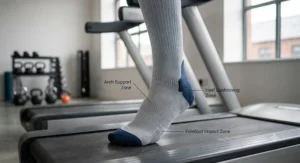
The standout feature is accessibility — More Mile shows up repeatedly among the UK’s best-selling running socks specifically because it nails the basics at a genuinely low price point without pretending to be something it isn’t.
Constructed as a straightforward ankle-length technical sock with moisture-wicking synthetic fibres and light cushioning, More Mile isn’t chasing the zonal-padding arms race that brands like Bridgedale and Balega are engaged in — it’s aiming squarely at runners who want a reliable, breathable ankle sock for regular treadmill and road sessions without a premium price tag attached. On paper, that’s a more honest pitch than most budget sportswear manages.
This suits newer runners still working out how much they’re willing to spend on kit, or anyone who’s decided socks genuinely don’t need to be a status purchase — a perfectly reasonable position, frankly.
Aggregated feedback on More Mile’s running range tends to highlight solid value and reliable comfort for the price, without the kind of standout technical claims premium brands lean on, which is a fair trade if budget is your primary constraint.
Pros:
- ✅ Genuinely low price point for a technical ankle sock
- ✅ Moisture-wicking construction covers the basics well
- ✅ Ankle height suits regular treadmill and road sessions
Cons:
- ❌ Lacks the zonal cushioning of premium competitors
- ❌ Less durable over high weekly mileage than reinforced ranges
Sitting around £8-£12 for a 2-3 pack at the time of research, More Mile is the sensible starting point if you’re not yet certain running is a long-term habit worth investing heavily in.
7. Nike Performance Cushion Crew (With Band) — the familiar gym-to-street crossover
The standout feature is sheer familiarity and versatility: this is the crew sock most people already picture when they think “gym sock,” and Nike sells it in bulk six-packs that make sense for anyone who wants one sock drawer covering running, gym floor work, and general daily wear.
Built with cushioned soles and a supportive band at the arch, this crew-height sock trades the zonal engineering of niche running brands for broad, reliable comfort that works across activities rather than being optimised purely for treadmill miles. What most buyers overlook is that this trade-off is entirely reasonable if you’re not logging serious weekly distance — a highly specialised sock is solving a problem you might not actually have yet.
This is the pick for runners who treat the treadmill as one part of a broader gym routine rather than a dedicated training discipline, and who’d rather buy one flexible six-pack than separate socks for separate activities.
Review sentiment across Nike’s cushioned crew range is consistently positive on comfort and value for everyday gym use, with the band construction specifically noted for keeping the sock securely in place during mixed training sessions.
Pros:
- ✅ Genuinely versatile across gym, treadmill, and daily wear
- ✅ Cushioned sole and supportive arch band included
- ✅ Sold in practical bulk six-packs for value
Cons:
- ❌ Less specialised cushioning than dedicated running brands
- ❌ Crew height runs warmer on longer indoor sessions
At £15-£22 for six pairs at the time of research, this is the pick for the generalist gym-goer rather than the runner chasing marginal technical gains.
Practical Usage Guide: Building a Sock Rotation That Actually Works
Buying one brilliant pair of socks and wearing them every single session is a rookie mistake — fibres need recovery time between wears just like muscles do, and a sock that’s still damp from yesterday’s run starts today’s session already compromised. Aim for a rotation of at least five to seven pairs if you’re running most days, mixing an ankle-height technical pair for warmer treadmill sessions with a crew pair or two for colder outdoor efforts.
In the first thirty days of switching to proper technical socks, the most common mistake is pairing them with the wrong shoe volume — a plush, heavily cushioned sock inside an already snug shoe just creates new pressure points instead of solving old ones. Try your new socks with your actual running shoes before committing to a bulk order, and check the fit at the end of a session rather than at the start, since feet swell during exercise. Wash technical socks inside out on a gentle cycle, skip the fabric softener (it clogs the moisture-wicking fibres), and resist the tumble dryer’s high heat setting, which is the fastest way to wreck elastane and merino alike.
Real-World Scenario: Matching Sock Height to Your Training Life
Picture the treadmill regular who trains indoors year-round, mostly in a climate-controlled gym that runs warmer than any British street ever does — for them, ankle-length technical socks like the Balega Hidden Comfort or More Mile’s budget ankle range make far more sense than crew height, since there’s no cold, no debris, and no reason to trap extra heat around the ankle. Now picture the marathon-in-training runner who’s logging outdoor long runs through a proper British winter — crew height starts pulling its weight here, offering genuine warmth and shin coverage on frosty mornings, which is exactly where the Balega Enduro Crew or Nike’s cushioned crew earn their spot in the bag. Finally, picture the hybrid athlete splitting weeks between gym treadmill sessions and weekend trail routes — Bridgedale’s low-cut merino blend threads that needle nicely, offering trail-grade zonal cushioning without committing to full crew coverage indoors.
Problem → Solution: Fixing the Complaints You Already Have
If your sock keeps sliding down inside your shoe mid-run, the fix usually isn’t a tighter cuff — it’s a deeper heel pocket, which is precisely the engineering Balega leans on across its range to physically anchor the sock in place. If you’re getting blisters specifically between your toes, seamless toe construction like Icebreaker’s or Bridgedale’s hand-linked closure addresses the actual friction point rather than just adding more cushioning elsewhere, which won’t help if the seam itself is the problem. If your feet feel damp and cold on longer outdoor runs despite “moisture-wicking” branding, the honest fix is often merino rather than pure synthetic — wool absorbs and holds moisture within its fibre structure rather than just pushing it outward, which behaves differently once your sock is genuinely saturated with sweat. And if you’re replacing socks every couple of months, that’s a durability problem, not a bad-luck problem — reinforced ranges like the Balega Enduro exist specifically because standard synthetic knits give up faster under repeated mileage.
Treadmill Socks: Ankle vs Crew — The Full Breakdown
Let’s actually settle this properly, because “it depends” isn’t a satisfying answer when you’re standing in front of a sock display trying to make a decision before your next session.
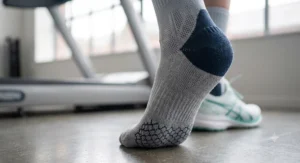
Ankle-length socks win on breathability, full stop — less fabric around the lower leg means more airflow, which matters disproportionately indoors, where treadmill rooms trap heat in a way open roads simply don’t. They also disappear more cleanly inside low-top running shoes, avoiding the slightly awkward bunching you sometimes get when a crew sock’s cuff meets a shoe’s ankle collar. Where they lose out is protection: no Achilles coverage, no shin coverage, and if you’re the sort of runner whose ankle occasionally clips the opposite shin mid-stride, there’s nothing there to soften that contact.
Crew-length socks flip that calculation. The extra fabric traps warmth, which is a genuine liability on a warm indoor session but a real asset outdoors once temperatures drop. They also offer Achilles tendon coverage that some runners specifically need if they’re prone to irritation from a shoe’s heel counter, and they simply feel more secure to some people — less like the sock might vanish mid-run, even though that’s rarely a real risk with decent elastic construction.
The honest verdict: for pure treadmill work, especially in a warm gym, ankle-height technical socks are the better default, and most of our top picks reflect that — five of the seven products above are ankle or quarter length for exactly this reason. Crew earns its place specifically for cold-weather outdoor training or for runners with a specific Achilles or shin sensitivity that genuinely benefits from the extra coverage. If you only buy one style, buy ankle for the treadmill and add crew later once your training actually calls for it.
How to Choose Technical Running Socks for Men
- Match the height to where you’ll actually run most. Treadmill-dominant training points toward ankle length; frequent cold-weather outdoor sessions point toward crew.
- Check for a genuinely seamless toe closure. Hand-linked construction, as used by Balega, Icebreaker, and Bridgedale, is worth paying for if you’ve ever had a toe blister — it’s solving a real, specific friction point. 3** Look for a deep, structured heel pocket.** This is the actual mechanism that stops socks sliding down inside your shoe, not marketing language about “grip.”
- Decide between merino and synthetic based on wash frequency, not hype. Merino rewards runners doing fewer, higher-value sessions who don’t mind gentle washing; synthetic suits high-frequency training and easier laundry days.
- Prioritise moisture management over raw cushioning thickness. A thinner sock that wicks well often outperforms a thick sock that holds onto sweat.
- Buy enough pairs to actually rotate. A single brilliant pair worn daily without rest time underperforms five decent pairs used in sensible rotation.
- Try before bulk-buying. Fit varies enough between brands that one pair tested with your actual running shoes beats reading ten reviews.
Merino Wool vs Synthetic: Breathability Compared
This is where merino running socks and breathability genuinely earn the attention they get, rather than it being pure marketing spin. Merino fibres are naturally hygroscopic, meaning they absorb moisture into the fibre’s core rather than simply repelling it outward — a peer-reviewed comparative study of sock base fabrics found that natural fibre structures like wool interact with moisture and microbial activity differently than synthetic knits, which lines up with why merino socks tend to stay fresher across multiple wears without washing, as detailed in this comparative fabric research published via the National Institutes of Health.
Synthetic fibres like nylon and polyester, by contrast, don’t absorb moisture into the fibre itself — they rely on wicking it along the surface and pushing it toward the outer layer of the sock, which works brilliantly right up until the sock is genuinely saturated, at which point synthetics can feel colder and clammier than merino in the same conditions. The trade-off is durability and cost: synthetic blends generally survive more wash cycles and cost less per pair, which is exactly why budget multipacks like DANISH ENDURANCE and More Mile lean synthetic rather than merino.
The practical verdict for treadmill use specifically: since indoor training doesn’t expose feet to genuine cold, synthetic’s slight breathability edge in warm conditions often outweighs merino’s cold-weather advantage. Save the merino budget for outdoor winter miles, where its actual strengths come into play.
Common Mistakes When Buying Running Socks
The single biggest mistake is buying purely on price without checking the toe construction — a bargain sock with a rough, non-seamless toe seam can undo every other good decision you’ve made about shoes and training. A close second is buying crew-length socks for treadmill-only training out of habit, when ankle height would genuinely serve better in a warm indoor environment. Runners also frequently underestimate how much fit varies by brand; a “medium” in one range can run noticeably differently to a “medium” in another, so sizing charts matter more than they get credit for. Finally, plenty of people buy technical socks once, wear the same pair to death without rotation, and then wrongly conclude the brand “doesn’t work” — when the actual issue was never giving the fibres recovery time between sessions.
Padded Heel & Seamless Toe: Features That Actually Matter
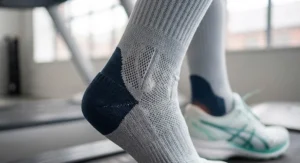
Padded heel running socks earn their keep specifically on longer sessions, where repeated heel-strike impact benefits from genuine cushioning rather than a token layer of extra fabric — Bridgedale’s T2 double-loop zonal system and Balega’s high-needle-count knit both target this properly rather than just claiming “extra cushion” on the packaging. Seamless toe construction matters even more directly: a hand-linked seam, as used across Balega, Icebreaker, and Bridgedale’s ranges, removes the specific friction point most responsible for toe blisters, which independent research on friction blister prevention strategies consistently identifies as a genuine mechanical risk factor rather than bad luck.
What matters far less than marketing copy suggests: sock colour, “compression” claims without a specific mmHg figure attached, and vague “engineered” language that doesn’t specify what’s actually been engineered. If a listing leans hard on aesthetic language but stays vague on toe construction and heel structure, that’s usually a sign the actual technical substance is thinner than the packaging suggests.
Long-Term Cost & Maintenance
Premium technical socks cost more per pair upfront, but the maths shifts once you factor in durability — a £14 pair of Balega Enduro socks that survives two full years of regular training works out cheaper per wear than replacing a £4 bargain pair every eight weeks because the elastic has given up. Merino, despite its higher sticker price, often needs washing less frequently thanks to its natural odour resistance, which quietly saves on both water and the wear-and-tear washing itself causes to fibres.
On the maintenance side: wash technical socks inside out, skip fabric softener entirely since it coats and dulls moisture-wicking fibres, and air dry where possible rather than defaulting to a tumble dryer’s high heat, which is the single fastest way to degrade elastane and shrink merino blends. Rotate at least five pairs through regular training so no single pair is doing all the work, and you’ll get meaningfully more life out of every pair you own.
Frequently Asked Questions
❓ Are ankle socks better than crew socks for treadmill running?
❓ Do merino wool running socks actually keep feet cooler?
❓ What makes a running sock 'seamless toe'?
❓ How many pairs of running socks should I own?
❓ Do padded heel running socks really prevent blisters?
Conclusion
The treadmill socks ankle vs crew debate isn’t really a debate once you strip away the brand loyalty and look at what each height is actually built to do. Ankle wins indoors, crew wins in the cold, and the honest answer for most regular gym-goers is to own a rotation of both rather than picking a permanent side. Of the seven picks above, the Balega Hidden Comfort and More Mile ranges suit dedicated ankle-sock treadmill training at opposite ends of the budget spectrum, Bridgedale and Icebreaker earn their premium pricing through genuine merino and zonal-cushioning engineering, and the Enduro Crew and Nike crew options cover you the moment your training moves outdoors or your gym routine widens beyond pure treadmill miles.
Whatever you land on, the checklist stays consistent: check the toe seam, check the heel pocket, match the height to where you’re actually training, and buy enough pairs to give every sock proper recovery time between sessions.
✨ Don’t Miss These Exclusive Deals!
🔍 Take your treadmill sessions to the next level with these carefully researched technical socks. Click through to check current pricing and availability on any of the seven picks above, and stop letting a five-pound problem sabotage a five-hundred-pound training plan.
Recommended for You
- Blister Prevention Socks Treadmill: 7 Best Picks 2026
- Compression Socks Treadmill Workout: 7 Top Picks for 2026
- Best Socks for Treadmill Running 2026: 7 Top UK Picks Tested
Disclaimer: This article contains affiliate links. As an Amazon Associate, I earn from qualifying purchases. If you purchase products through these links, we may earn a small commission at no additional cost to you.
✨ Found this helpful? Share it with your friends! 💬🤗
