
In This Article
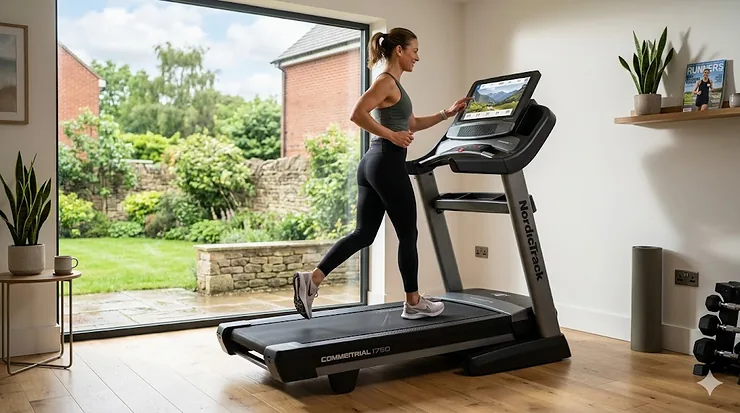
If you’ve been researching serious home treadmills, you’ve almost certainly encountered the NordicTrack Commercial 1750. It’s become something of a benchmark in the £2,000-£2,500 range, and for rather good reasons. What most Amazon listings won’t tell you, though, is how this American-designed machine translates to British homes—smaller rooms, damper climate, 230V electrical systems, and the perpetual question of whether you can actually get the thing up a narrow Victorian staircase.
The nordictrack commercial 1750 sits in that sweet spot between consumer-grade treadmills and proper commercial kit. It’s built for people who take their running seriously but aren’t ready to fork out £5,000 for a Technogym. With a 3.75 CHP motor, 0-15% incline, and -3% decline capability, it handles everything from recovery walks to interval training. The NHS recommends at least 150 minutes of moderate-intensity aerobic activity per week for adults, and a quality home treadmill makes hitting that target considerably more achievable when British weather turns miserable. The 10-inch HD touchscreen comes with a year of iFIT membership included, which effectively makes your spare bedroom feel less like a cupboard and more like a training ground with routes through the Alps, New Zealand, or—if you’re feeling masochistic—straight up Alpe d’Huez.
But here’s what matters for UK buyers: this treadmill needs roughly 198cm × 91cm of floor space when assembled, runs on standard UK mains power (though you’ll want a surge protector), and ships to most mainland UK addresses via Amazon.co.uk with free delivery on orders over £25. The Commercial 1750 typically sells in the £2,200-£2,500 range, though refurbished units occasionally appear around £1,700-£1,900. For context, that’s about the same as mid-range commercial series features from competing brands, but with considerably better interactive training capabilities.
In this guide, we’ll examine seven treadmills available on Amazon UK, including the nordictrack commercial 2950 uk price positioning, best nordictrack commercial treadmill uk options, and genuinely strong alternatives from ProForm, Sole, and JTX. We’ll also address the questions British buyers actually ask: Will it fit through my front door? Does the motor cope with British voltage without issue? And can someone in a first-floor flat realistically use this without the downstairs neighbours filing a noise complaint?
Quick Comparison: Top 7 Treadmills for UK Homes
| Model | Motor Power | Max Speed | Incline Range | Price Range (£) | Best For |
|---|---|---|---|---|---|
| NordicTrack Commercial 1750 | 3.75 CHP | 22 km/h | -3% to 15% | £2,200-£2,500 | Serious runners wanting iFIT integration |
| NordicTrack Commercial 2950 | 4.25 CHP | 22 km/h | -3% to 15% | £2,400-£2,700 | Premium users with space for 22″ screen |
| ProForm Pro 9000 | 4.0 CHP | 22 km/h | -3% to 15% | £1,800-£2,100 | Budget-conscious iFIT enthusiasts |
| Sole F80 | 3.5 CHP | 19 km/h | 0-15% | £1,600-£1,900 | No-subscription reliability seekers |
| JTX Sprint-9 Pro | 4.0 HP | 22 km/h | 0-15% | £1,700-£2,000 | UK-based support priority |
| Horizon 7.0 AT | 3.0 CHP | 19 km/h | -3% to 15% | £1,400-£1,700 | Mid-range versatility |
| NordicTrack T Series 5 | 2.6 CHP | 16 km/h | 0-10% | £700-£900 | Beginners on a budget |
From this comparison, the Commercial 1750 emerges as the Goldilocks option—not the cheapest, not the most expensive, but rather cleverly positioned to offer decline capability (which the Sole F80 lacks), a robust motor that won’t struggle on British voltage, and iFIT integration that actually feels worth the subscription fee. The Commercial 2950 is tempting if you’ve got the space and budget, but for most UK homes with standard ceiling heights and room dimensions, the 1750’s 10-inch screen is perfectly adequate. What’s more telling: the 1750 handles the 135kg user capacity without the deck flex issues that plague cheaper models, which matters rather a lot when you’re six months into marathon training and pushing tempo runs at 18 km/h.
💬 Just one click — help others make better buying decisions too! 😊
Top 7 Premium Treadmills: Expert Analysis for UK Buyers
1. NordicTrack Commercial 1750 — The Benchmark
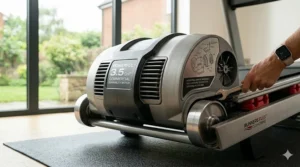
The NordicTrack Commercial 1750 has earned its reputation through consistently solid performance rather than flashy marketing. The 3.75 CHP DurX Commercial Plus motor uses self-cooling technology, which means it doesn’t sound like a tumble dryer when you’re hitting 20 km/h intervals—rather important in British homes where walls are thinner than American drywall. The motor’s designed for continuous duty at UK voltage (230V), unlike some imported models that technically work but run slightly hotter than ideal.
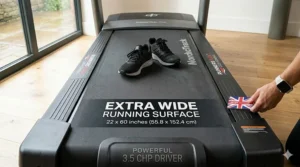
Key specifications translate to real-world use like this: the -3% to 15% incline/decline range lets you simulate downhill running, which trains eccentric muscle control that standard flat-belt treadmills completely ignore. The 55cm × 152cm RunFlex cushioned deck offers enough width for natural stride mechanics without feeling like you’re tiptoeing down a balance beam. And crucially for flats and terraced houses, the SpaceSaver design folds to roughly 91cm × 99cm × 175cm when stored vertically—still substantial, but manageable with the EasyLift Assist hydraulic system.
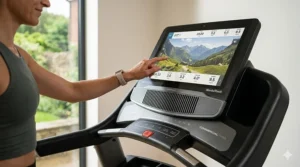
What UK buyers particularly appreciate: the iFIT membership (one year included, then £29/month) provides British-specific content including Lake District routes, Scottish Highland trails, and London marathon prep programmes. The trainers automatically adjust your speed and incline to match terrain, which genuinely transforms the experience from “staring at a wall” to “actually engaged.” The 10-inch HD touchscreen tilts and swivels, though in direct sunlight from a south-facing window you’ll notice some glare—minor quibble, but worth positioning accordingly. For independent assessments of treadmills available in the UK, Which? magazine’s expert testing provides valuable consumer insights.
Customer feedback from UK Amazon reviewers highlights assembly as the main friction point. The console attachment requires two people and about 90 minutes, with the pulse grip halves proving particularly fiddly due to restricted access around the fan housing. Once assembled, though, build quality impresses—this feels like commercial gym equipment, not a wobbly Amazon special. Some users report software glitches with iFIT connectivity, though these typically resolve with router restarts or app updates.
Pros:
✅ Decline capability rare at this price point
✅ Motor handles British voltage without overheating issues
✅ iFIT content genuinely enhances training value
Cons:
❌ Two-person assembly required, roughly 90 minutes
❌ iFIT subscription becomes £29/month after first year
Around £2,200-£2,500 depending on sales, the Commercial 1750 represents solid value for serious home training. It’s not the cheapest route to cardiovascular fitness, but it’s considerably less expensive than gym memberships over three years (£50/month gym = £1,800/year), and you avoid the British weather entirely.
2. NordicTrack Commercial 2950 — Premium Powerhouse
The NordicTrack Commercial 2950 is essentially the Commercial 1750’s older sibling who went to university and came back insufferable—but undeniably more capable. The 4.25 CHP motor delivers genuinely commercial-grade performance, handling sustained high-speed running without the motor whine that creeps in on lesser models around the 18 km/h mark. For marathon training or serious interval work, this additional motor capacity matters more than the spec sheet suggests.
The standout feature is the 22-inch pivoting HD touchscreen, which transforms iFIT workouts from “reasonably engaging” to “properly immersive.” Watching a trainer guide you through Norwegian fjords on a 10-inch screen is nice; experiencing it on 22 inches approaches the threshold where your brain forgets you’re in a Croydon spare bedroom. The screen pivots 360 degrees, which proves surprisingly useful for off-treadmill floor workouts that iFIT includes in its programming.
However—and this matters for UK buyers—the 2950 requires more floor space (roughly 201cm × 99cm × 170cm assembled) and weighs 10kg more than the 1750. If you’re in a Victorian terrace or a new-build flat, getting this upstairs becomes a genuine logistical challenge. The additional features (larger screen, slightly more powerful motor, upgraded speakers) push the price to around £2,400-£2,700, which represents roughly 15-20% more outlay than the 1750.
UK customer reviews on Amazon.co.uk average 4.2 stars across several hundred verified purchases, with most criticism directed at post-warranty failures rather than initial quality. One verified UK reviewer reported their screen failing at month 37 (just past the three-year point), which prompted a rather expensive repair through third-party technicians since NordicTrack UK support can be hit-and-miss for older models.
Pros:
✅ 22-inch screen genuinely enhances immersion
✅ 4.25 CHP motor handles sustained high-intensity work
✅ 360-degree screen pivot adds genuine versatility
Cons:
❌ Larger footprint challenging for smaller UK homes
❌ Price premium over 1750 difficult to justify for casual users
For UK buyers with space and budget—and serious training goals—the Commercial 2950 makes sense. For everyone else, the 1750 offers 90% of the experience for 85% of the cost.
3. ProForm Pro 9000 — Budget iFIT Alternative
The ProForm Pro 9000 is what happens when NordicTrack’s parent company (iFIT) creates a more affordable version of their premium models. Same ecosystem, similar features, but with enough cost-saving measures to hit the £1,800-£2,100 range on Amazon UK. The 4.0 CHP motor sits between the 1750 and 2950 in power, delivering reliable performance without quite matching NordicTrack’s refined engineering.
What you’re getting: a 22-inch HD touchscreen (same size as the Commercial 2950), -3% to 15% incline/decline range, and iFIT integration with one-year free membership. The 50cm × 140cm tread belt is slightly narrower and shorter than the Commercial series, which taller runners will notice but average-height users won’t. The ProShox cushioning system feels firmer than RunFlex—not uncomfortable, just less forgiving on joints during long runs.
The trade-offs become apparent in build quality. Where NordicTrack treadmills feel hewty and commercial-grade, the Pro 9000 has a bit more plastic in the console housing and frame accents. It’s still solid—this isn’t a £400 Amazon walking pad—but you can tell where the cost savings occurred. UK buyers report generally positive experiences, though Amazon reviews mention occasional belt tracking issues that require manual adjustment via the rear roller bolts.
Pros:
✅ 22-inch screen at £600-£800 less than Commercial 2950
✅ Same iFIT ecosystem as premium NordicTrack models
✅ 4.0 CHP motor handles serious running
Cons:
❌ Build quality feels noticeably less premium
❌ Narrower belt can feel cramped for taller runners
If budget is the primary constraint but you want iFIT integration and a large screen, the ProForm Pro 9000 represents rather good value. It’s the practical choice for buyers who understand they’re paying £600 less for a reason but consider those compromises acceptable.
4. Sole F80 — No-Subscription Workhorse
The Sole F80 takes an entirely different approach: no touchscreen ecosystem, no mandatory subscription, just a straightforward, well-engineered treadmill that does precisely what the tin says. For UK buyers allergic to monthly fees or wary of iFIT’s ongoing costs, the F80 makes a compelling argument.
The 3.5 CHP motor delivers smooth, consistent power without the self-cooling tech found in NordicTrack models, which means it runs slightly louder under sustained load—think “noticeable hum” rather than “disruptive noise.” Maximum speed caps at 19 km/h, which limits sprint training but covers everything from recovery jogs to tempo runs. The 0-15% incline range omits decline capability, which some will miss but many won’t notice.
What sets Sole apart: build quality focuses on longevity rather than features. The frame warranty extends to lifetime (compared to NordicTrack’s 10 years), suggesting confidence in durability. The 56cm × 152cm deck offers generous width, and the Cushion Flex Whisper Deck absorbs impact effectively without the mushy feel of over-damped cheaper models. The 9-inch LCD display shows basic metrics—speed, time, distance, calories, heart rate—without trying to be a smart device.
UK Amazon reviewers consistently mention reliability and straightforward maintenance. No app crashes, no firmware updates, no WiFi connectivity issues—it’s refreshingly analogue in an increasingly digital product category. The F80 typically sells around £1,600-£1,900, positioning it roughly £500-£700 below the Commercial 1750. Over five years with no subscription fees, that gap narrows: F80 total cost £1,750 versus Commercial 1750 at £3,990 (£2,250 + £29/month × 48 months).
Pros:
✅ Zero ongoing subscription costs
✅ Lifetime frame warranty suggests build confidence
✅ Straightforward operation, minimal tech complications
Cons:
❌ No decline capability
❌ Basic display won’t suit tech-oriented users
For UK buyers who prefer ownership without ongoing fees, the Sole F80 deserves serious consideration. It’s the treadmill equivalent of a Toyota—not exciting, but reliably competent.
5. JTX Sprint-9 Pro — British-Made Support
The JTX Sprint-9 Pro comes from a UK-based company with showrooms across Britain, which translates to tangible advantages: UK-based customer service that actually answers calls, engineers who understand British homes and voltage systems, and a three-year home repair warranty that doesn’t require you to navigate American call centres.
The 4.0 HP motor (note: HP not CHP, so not directly comparable) pushes speeds up to 22 km/h with 0-15% incline capability. The 153cm × 52cm cushioned running deck offers ample space, and the folding mechanism with hydraulic assist makes storage genuinely manageable in typical British homes. The 7-inch blue-backlit LCD display won’t win design awards but presents information clearly.
What UK buyers particularly value: JTX ships from UK warehouses with realistic delivery windows (not “3-7 months” like some Amazon listings for American brands). Assembly instructions account for British tools and electrical systems. And if something goes wrong, you’re dealing with Birmingham or Manchester, not Nebraska. The company’s built its reputation on reliable customer service, which British buyers—accustomed to being treated as afterthoughts by American brands—genuinely appreciate.
The Sprint-9 Pro sells around £1,700-£2,000, making it competitive with ProForm and undercutting NordicTrack. You’re sacrificing touchscreen features and iFIT integration, but gaining peace of mind through local support. For buyers who value the ability to phone someone in the UK when a belt needs adjusting or a sensor fails, that trade-off makes perfect sense.
Pros:
✅ UK-based customer service and warranty support
✅ Three-year home repair warranty with UK engineers
✅ Ships from UK warehouses, realistic delivery windows
Cons:
❌ No touchscreen or interactive training platform
❌ Less brand recognition than NordicTrack or ProForm
The JTX Sprint-9 Pro represents the “buy British” option in a category dominated by American brands. It’s a sensible choice for buyers who prioritise local support over flashy features.
6. Horizon 7.0 AT — Mid-Range Versatility
The Horizon 7.0 AT slots into that middle ground where price, features, and reliability converge into a package that won’t excite anyone but won’t disappoint either. The 3.0 CHP motor handles speeds up to 19 km/h—adequate for most runners, limiting for serious athletes. The -3% to 15% incline/decline range matches NordicTrack’s offerings, providing proper downhill simulation at roughly half the price.
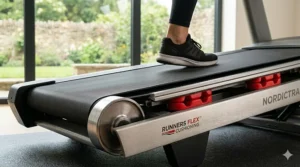
Horizon’s Variable Response Cushioning employs three zones: soft landing, moderate transition, and firm push-off. It’s biomechanically sensible and feels notably different from single-zone cushioning, though whether you prefer it remains subjective. The console offers Bluetooth connectivity to third-party apps rather than a proprietary ecosystem, which provides flexibility but less integration than iFIT’s automatic adjustments.
UK availability on Amazon tends to fluctuate—sometimes in stock with Prime delivery, other times listing extended lead times. When available, pricing hovers around £1,400-£1,700, making it one of the more affordable options with genuine decline capability. British reviewers appreciate the straightforward assembly (roughly 60-75 minutes solo) and relatively compact footprint when folded.
Pros:
✅ Decline capability at mid-range pricing
✅ Three-zone cushioning offers biomechanical advantages
✅ Bluetooth connectivity to multiple fitness apps
Cons:
❌ 3.0 CHP motor less robust than premium models
❌ UK stock availability can be inconsistent
The Horizon 7.0 AT suits buyers seeking capable equipment without premium pricing or subscription commitments. It’s the reliable middle child nobody talks about but everyone gets along with.
7. NordicTrack T Series 5 — Entry-Level Option
The NordicTrack T Series 5 occupies the budget end of NordicTrack’s range, delivering basic iFIT integration and decent build quality around £700-£900. The 2.6 CHP motor caps at 16 km/h, which limits training intensity but covers walking, jogging, and light running. The 0-10% incline range lacks decline capability but provides enough variation for most beginners.
The 10-inch tilting touchscreen mirrors the Commercial 1750’s display size, though with slightly lower resolution. You still get one year of iFIT membership included, making this the most affordable entry into NordicTrack’s ecosystem. The 51cm × 140cm tread belt feels noticeably narrower than commercial series models—fine for average builds, cramped for larger runners or those with wider gaits.
UK buyers on Amazon.co.uk report generally positive first experiences, with criticisms emerging primarily from users who outgrow the T Series 5’s capabilities after six months of consistent training. If you’re genuinely unsure whether you’ll stick with home running, this represents a sensible trial before committing to premium models. But for anyone with running experience or clear training goals, the additional £1,000-£1,500 for the Commercial 1750 buys substantially more capability and longevity.
Pros:
✅ Most affordable iFIT entry point
✅ Compact footprint suits smaller UK homes
✅ Good starter option for testing home treadmill commitment
Cons:
❌ Motor and belt size limit training progression
❌ Users often outgrow capabilities within 6-12 months
The T Series 5 works for beginners wanting to test the waters without diving in at £2,000+. Just understand you’re buying training wheels, not a long-term solution.
How to Choose the Right Treadmill for Your UK Home
Choosing a treadmill isn’t about finding the “best” model—it’s about matching capabilities to your actual circumstances. Here’s how to navigate the decision without drowning in marketing claims.
1. Assess Your Ceiling Height and Doorframe Clearance
British homes weren’t built with American-sized fitness equipment in mind. Measure your ceiling height in the intended room—you need at least 210cm clearance for comfortable running (average British ceiling: 230-240cm in newer builds, 250-270cm in Victorian properties). Then measure your narrowest doorframe on the delivery route. Most treadmills arrive partially assembled, and getting a 90cm-wide frame through a 76cm doorframe involves either complete disassembly or resigned acceptance that your treadmill lives downstairs.
2. Calculate Total Cost of Ownership in GBP
The sticker price is only part of the equation. For iFIT-enabled models, add £29/month × however many years you realistically plan to use the treadmill. A £2,200 Commercial 1750 becomes £3,990 over five years with subscription. A £1,700 Sole F80 with no subscription stays £1,700. Factor in electricity costs too—a 3.5-4.0 CHP motor running an hour daily adds roughly £120-£150 annually to your energy bill at current UK rates.
3. Match Motor Power to Training Intensity
For walking and light jogging (under 10 km/h), a 2.5-3.0 CHP motor suffices. For regular running (10-16 km/h), look for 3.0-3.75 CHP. For serious training with intervals and tempo runs (16-20 km/h), invest in 3.75-4.25 CHP. Underpowered motors wear faster under sustained high loads, and replacement costs often approach half the treadmill’s purchase price.
4. Consider British Climate Impact on Equipment
Damp British air accelerates rust on cheaper metal components. If your treadmill lives in a garage, conservatory, or unheated spare room, prioritise models with corrosion-resistant frames and sealed bearings. The additional £200-£300 for better weatherproofing beats replacing corroded parts in year three.
5. Test the Subscription Model Against Your Personality
Be honest: will you actually use iFIT’s guided workouts, or will you mostly run while watching Netflix? If you’re a “put on a podcast and zone out” runner, paying £29/month for features you ignore makes little sense. If you genuinely engage with structured programmes and need external motivation, iFIT’s investment justifies itself. There’s no wrong answer, just an honest self-assessment.
6. Account for Assembly Complexity
British homes often lack the generous garage workshops American assembly instructions assume. NordicTrack models typically require two people and 90-120 minutes. Sole and JTX models tend toward 60-75 minutes solo assembly. ProForm sits somewhere between. If you’re assembling in a cramped upstairs bedroom, simpler is better.
7. Evaluate Warranty Against Realistic Lifespan
Frame warranties extending 10 years or lifetime signal manufacturer confidence. Motor warranties typically run 3-5 years, parts 1-3 years. For UK buyers, verify that warranty service operates through UK channels—some American brands route warranty claims through US call centres with international shipping costs that effectively void coverage.
Common Mistakes When Buying Treadmills in the UK
Most treadmill purchases fail not because of product quality but because buyers overlook predictable friction points. Here are the errors British buyers make repeatedly.
Underestimating Space Requirements
Treadmills consume more space than their folded dimensions suggest. You need clearance behind (minimum 1 metre for safe dismount), clearance at sides (50cm each side prevents that “tunnel vision” feeling), and vertical clearance (arms above head during running). Measure three times, buy once—retrofitting a 200cm treadmill into a 180cm space ends in regret.
Ignoring Electrical Requirements
British homes run 230V/50Hz, and most American-designed treadmills accommodate this. However, cheaper models or grey-market imports might expect 120V/60Hz, requiring step-down transformers that void warranties and create safety hazards. Verify electrical compatibility explicitly before purchasing—Amazon listings don’t always clarify this.
Overlooking Noise Levels in Shared Housing
Motor noise registers around 60-70 decibels during operation—comparable to normal conversation. But impact noise from your feet hitting the belt transmits through floors to rooms below. In flats or terraced housing, this becomes a genuine issue. If you’re not on the ground floor, prioritise models with superior cushioning (RunFlex, Cushion Flex, Variable Response) and consider anti-vibration mats.
Buying for Aspirational Use Rather Than Realistic Use
You won’t suddenly become an ultra-marathoner because you bought a £2,500 treadmill. If you currently run 5km twice weekly, a mid-range model handles that fine. Aspirational purchases often become expensive clothes racks when the initial enthusiasm fades. Buy for your actual training pattern plus modest growth, not your fantasy self.
Neglecting UKCA Certification and Safety Standards
Post-Brexit, fitness equipment sold in Great Britain should carry UKCA marking indicating compliance with UK safety regulations. Specifically, treadmills should meet BS EN 957-6 standards covering stability, emergency stop functionality, and electrical safety. Purchasing from Amazon UK’s official marketplace offers more protection than third-party sellers shipping from outside the UK.
Forgetting About Post-Brexit Import Considerations
Some EU-manufactured models now carry slightly higher UK prices due to import adjustments. However, buying from Amazon UK ensures you’re covered by the UK Consumer Rights Act 2015, which provides stronger protections than ordering directly from EU retailers. You also avoid potential customs complications if warranty claims require returning equipment.
Ignoring the 14-Day Returns Window
UK Consumer Contracts Regulations grant a 14-day cooling-off period for online purchases. This becomes crucial with treadmills—assemble it, test it properly during those two weeks. If the motor whines annoyingly, the belt tracks poorly, or it simply doesn’t suit your stride, you can return it. After 14 days, you’re relying on warranty coverage, which won’t cover “I just don’t like it.”
Setting Up Your Treadmill: UK-Specific Considerations
Assembly represents the first major hurdle. Here’s how to navigate it without throwing tools across the room.
Unboxing and Room Preparation
Treadmills ship in boxes weighing 80-120kg. You’ll need two people to move the box from your doorstep to the assembly location. Clear the entire room first—you need 3-4 metres of floor space to spread out components during assembly. Lay down cardboard or old blankets to protect flooring from dropped bolts or dragged frame pieces.
Voltage and Plug Compatibility
Most reputable models sold through Amazon UK arrive with UK three-pin plugs and 230V compatibility. If your model arrives with a European two-pin plug, you’ll need a proper adapter (not a cheap travel adapter—a rated one handling sustained 15-amp loads). Never use American 120V equipment with a transformer in a home setting; the fire risk isn’t worth the “bargain” pricing.
Assembly Sequence and Common Pitfalls
Follow the manufacturer’s sequence exactly. The most common error: attaching the console before checking belt alignment, which makes subsequent adjustments far more difficult. Verify belt tracking (centred on deck, not rubbing frame) before securing the console permanently. Hand-tighten bolts first, then use tools for final torque—overtightening plastic-threaded components cracks housings.
Calibration and Belt Tensioning
New belts require break-in and tension adjustment after first use. Too tight: motor works harder, premature wear. Too loose: slippage under load, tracking issues. The correct tension allows you to lift the belt roughly 7-8cm from the deck when not running. Adjust using rear roller bolts—quarter-turns, test, repeat. This isn’t a one-time process; check monthly for first six months.
Weatherproofing for Garages and Conservatories
If your treadmill lives in an unheated space, cover it when not in use. British damp accelerates rust on exposed metal components. Apply silicone spray to moving parts quarterly. Run the motor briefly every week even if you’re not training—this prevents seals from drying and bearings from pitting.
Real-World Performance: What to Expect in British Homes
Theory meets practice when you actually start using these machines daily. Here’s what UK owners report after months of use.
Case Study 1: London Flat Dweller
Emma, first-floor flat in Isleworth, purchased a Commercial 1750 for marathon training. Her main challenges: getting the treadmill upstairs (required professional movers, £180), noise complaints from below (resolved with 2cm anti-vibration mat, £60), and WiFi connectivity issues (router too far away, required WiFi extender, £35). After six months and 600km logged, she considers it worthwhile but wishes she’d budgeted an extra £300 for the installation realities.
Case Study 2: Suburban Family in Birmingham
The Patels bought a ProForm Pro 9000 for their garage, primarily for Mr Patel’s evening runs and Mrs Patel’s morning walks. British winters proved brutal—condensation on the console required keeping a small dehumidifier running (adds £15/month electricity cost). They solved this by moving the treadmill to a spare bedroom, which improved consistency but required assembling anti-vibration measures to prevent disturbing sleeping children.
Case Study 3: Rural Wales Runner
Gareth in Snowdonia uses a JTX Sprint-9 Pro in his converted barn. The UK-based customer service proved crucial when a belt needed replacing—JTX sent an engineer who drove from Cardiff, completed the work in 45 minutes, covered by warranty. He contrasts this with his previous experience with an American brand where warranty claims required shipping parts from the US with a six-week wait.
Long-Term Ownership Costs and Maintenance
Running costs extend beyond the purchase price. Here’s what British owners spend annually.
Energy Consumption
A 3.5 CHP motor running one hour daily consumes roughly 330-370 kWh annually. At average UK electricity rates (£0.35/kWh as of 2026), that’s £115-£130 yearly. Larger 4.25 CHP motors push this to £140-£160. Using off-peak tariffs (if your provider offers time-of-use pricing) can reduce this by 30-40%.
Replacement Parts and Servicing
Belt replacement (every 3,000-5,000km depending on use): £80-£150 including labour if you hire someone. Deck lubrication (quarterly): £15 for quality silicone spray. Console battery replacement (touchscreen models, every 2-3 years): £40-£60. Motor brushes (after 5-7 years heavy use): £150-£200 parts and labour.
iFIT Subscription Costs
After the included year, iFIT costs £29/month or £299 annually if paid upfront (saves £49). Family memberships (up to 5 profiles) run £39/month or £390 annually. Over five years, this represents £1,450-£1,900 in ongoing costs—factor this into your decision.
Insurance Considerations
Home contents insurance typically covers treadmills up to £2,000-£3,000 without specific declaration. For premium models exceeding this, notify your insurer—usually adds £20-£40 annually to your policy. Some insurers request UKCA certification proof, so retain documentation.
UK Regulations and Safety Compliance
British fitness equipment operates under specific legal frameworks often overlooked by casual buyers.
UKCA Marking Requirements
Post-Brexit, fitness equipment sold in Great Britain must carry UKCA marking (UK Conformity Assessed) indicating compliance with UK safety regulations. This replaced CE marking for GB markets, though Northern Ireland still follows EU regulations. Treadmills should meet BS EN 957-6 (stationary training equipment safety standards) covering stability tests, emergency stop functionality, electrical safety, and user protection.
Electrical Safety Regulations
The Electrical Equipment (Safety) Regulations 2016 require fitness equipment to meet specific voltage safety standards. Equipment must include automatic shutoff if safety key disconnects, ground fault protection, and proper insulation. When buying from Amazon UK’s main marketplace, you’re reasonably assured of compliance. Grey-market imports or third-party sellers warrant additional scrutiny.
Consumer Rights Act 2015
UK buyers benefit from stronger consumer protections than most countries. Products must be “as described, fit for purpose, and of satisfactory quality.” If a treadmill fails within six months, the burden of proof lies with the seller to prove it wasn’t defective at purchase. Between six months and six years, you retain rights but must prove the defect existed at purchase. This extends significantly beyond most manufacturers’ warranties. You can read more about your rights on the Consumer Rights Act 2015 Wikipedia page.
Distance Selling Regulations
Purchasing online grants you 14 days to change your mind for any reason. For treadmills, this means assembling it fully and testing it during those two weeks. If it wobbles, the motor grinds, or you simply regret the purchase, you can return it. The seller must collect bulky items like treadmills at their expense—you’re not responsible for hiring a courier.
FAQ: Your NordicTrack Commercial 1750 Questions Answered
❓ Is the NordicTrack Commercial 1750 available on Amazon UK?
❓ Do I need an iFIT subscription to use the Commercial 1750?
❓ Will the Commercial 1750 work on British 230V power?
❓ How much space do I need for the Commercial 1750 in a UK home?
❓ What's the difference between Commercial 1750 and 2950 for UK buyers?
Conclusion: Finding Your Ideal Treadmill
The nordictrack commercial 1750 earned its benchmark status through consistent competence rather than revolutionary features. It handles the fundamentals—motor power, incline range, build quality—without cutting corners, then layers on iFIT integration that genuinely enhances training for users who engage with it. For British buyers, it represents sensible middle-ground pricing at £2,200-£2,500, avoiding budget-tier compromises while steering clear of premium-tier excess.
But “best” remains context-dependent. If you’re allergic to subscriptions, the Sole F80 offers comparable performance for less total cost. If you’re serious about training and have the space, the Commercial 2950’s larger screen and more powerful motor justify their premium. If you value UK-based support over flashy features, JTX deserves consideration. And if you’re genuinely testing whether home running suits you, the T Series 5 provides an affordable entry point.
The common thread: buy for your actual circumstances, not aspirational fantasies. Measure your space. Calculate total ownership costs including subscriptions and electricity. Consider British climate impacts if it’s living in a garage. Verify UKCA compliance and electrical compatibility. Use the 14-day returns window properly—assemble it fully and test it honestly.
Done thoughtfully, a quality treadmill transforms British winters from “no running today, too wet” to “45 minutes of intervals whilst the rain hammers the windows.” That’s worth rather more than the purchase price suggests.
Recommended for You
- Domyos T900C Treadmill UK 2026: 7 Premium Features Worth Every Penny
- Decathlon Domyos Run 100: 7 Best Budget Treadmills UK 2026 Guide
- 7 Best JTX Slimline Home Treadmill UK 2026
Disclaimer: This article contains affiliate links. As an Amazon Associate, I earn from qualifying purchases. If you purchase products through these links, we may earn a small commission at no additional cost to you.
✨ Found this helpful? Share it with your mates! 💬🤗
