
In This Article
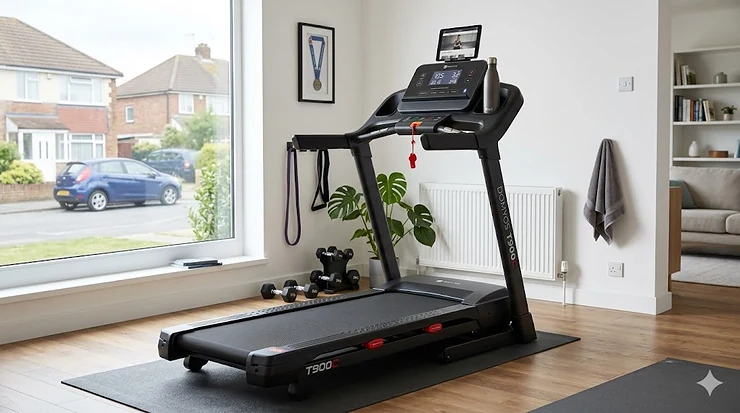
The Domyos T900C treadmill launched in 2019, yet it remains one of the most talked-about mid-range running machines in British homes. Here’s the uncomfortable truth most reviews won’t tell you: Decathlon discontinued selling this model new several years ago, which means you’ll primarily find it on the secondhand market through platforms like eBay UK, Facebook Marketplace, or Gumtree. But that doesn’t diminish its relevance. In fact, according to Sport England’s research, over 63% of UK adults now prefer home-based workouts compared to pre-2020 levels, driving continued demand for quality secondhand equipment. The T900C’s robust build quality means well-maintained units still deliver exceptional value in 2026, often at prices that make newer budget treadmills look rather questionable.
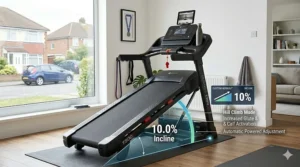
What most UK buyers overlook about this model is how it bridged the gap between entry-level walking pads and £2,000+ commercial-grade machines. The domyos t900c treadmill was designed for regular, high-intensity training sessions up to five hours weekly, featuring a 2.5 HP motor, 18 km/h maximum speed, and motorised 10% incline. That specification sheet translates into something rather important for British buyers: you can actually run properly on this machine, not just shuffle along like you’re walking to the corner shop. The NHS recommends 150 minutes of moderate aerobic activity weekly, which this treadmill comfortably supports for home-based training regardless of British weather conditions.
The current UK treadmill landscape in 2026 has shifted dramatically. Budget machines under £300 flood Amazon.co.uk, whilst premium models like the Peloton Tread command £2,500+. The premium domyos model T900C represents what the market increasingly lacks: proper mid-range performance without the subscription fees, app ecosystems, or touchscreen gimmickry that inflate prices. For anyone considering a secondhand purchase or comparing what £400-£600 bought in 2019 versus today, understanding the T900C’s genuine capabilities matters more than ever.
Quick Comparison: Domyos T900C vs Current UK Alternatives
| Feature | Domyos T900C (Used) | Decathlon T520B (New) | JLL S300 (New) | NordicTrack T5 (New) |
|---|---|---|---|---|
| Motor Power | 2.5 HP continuous | 2.5 HP | 2.5 HP | 2.75 HP |
| Max Speed | 18 km/h | 13 km/h | 16 km/h | 18 km/h |
| Incline | Motorised 0-10% | Manual 2 levels | Motorised 0-12% | Motorised 0-10% |
| Running Surface | 143 x 50 cm | 120 x 40 cm | 122 x 41 cm | 140 x 51 cm |
| Programs | 32 pre-set | 9 | 15 | 20 |
| App Connectivity | Bluetooth (Econnected/Kinomap) | None | None | iFit compatible |
| Typical UK Price | £300-£500 (used) | £450-£510 | £350-£450 | £500-£650 |
| Best For | Serious runners, budget-conscious | Casual joggers | Value seekers | Tech enthusiasts |
The comparison reveals something rather telling: the T900C’s 18 km/h top speed still matches or exceeds most current budget models, whilst its generous 143 cm running deck accommodates longer strides better than compact alternatives. The motorised incline saves you from manual adjustment mid-workout, a feature that budget buyers in 2026 frequently sacrifice. According to consumer research from Which?, the UK’s independent consumer champion, running deck length and motor consistency rank among the top factors affecting long-term user satisfaction with home treadmills. What you gain in performance with the T900C, though, you trade in warranty security and manufacturer support. That’s the secondhand market reality for British buyers.
💬 Just one click — help others make better buying decisions too!😊
Top 7 Home Treadmills for UK Buyers: Expert Analysis
1. Domyos T900C (Secondhand Market)
The Domyos T900C treadmill represents the flagship Decathlon once offered serious home runners. Even on the secondhand market in 2026, this machine commands respect. The 2.5 HP continuous motor delivers consistent power from 1-18 km/h, which genuinely supports sprint intervals and tempo runs, not just brisk walking. The motorised incline system adjusts from 0-10% at the press of a button, replicating hill training without the British weather getting involved.
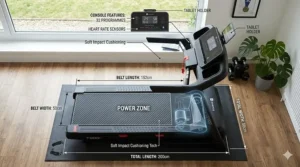
What the spec sheet won’t tell you: the 143 x 50 cm running surface feels noticeably more spacious than the 120-130 cm decks common on £400 treadmills today. If you’re over 5’10” or have a naturally long stride, that extra 13-23 cm prevents the cramped sensation where you’re constantly worried about clipping the front console. The cushioning system reduces joint impact compared to road running, which matters tremendously when you’re logging 20-30 km weekly on British pavements the rest of the time.
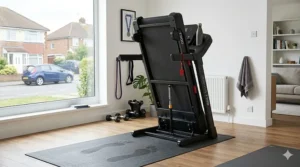
British buyers should know: the T900C weighs 89 kg, which provides stability during high-speed running but requires two people for assembly or moving between rooms. It folds vertically to approximately 133 x 88 cm, freeing floor space in typical British homes where the spare bedroom doubles as an office, storage unit, and occasional gym. According to UK Government housing statistics, the average British new-build home has decreased in size by 20% over the past decade, making space-efficient equipment increasingly important for home fitness setups. Look for units that include the original chest heart rate belt, as hand-grip sensors provide only rough estimates.
Customer feedback from UK owners consistently highlights the machine’s durability. Units sold in 2019-2020 are still running smoothly in 2026 with basic maintenance. However, the Bluetooth connectivity to Domyos Econnected app has become less reliable as Decathlon shifted focus to newer models. Kinomap still works, though.
✅ Motorised 10% incline for proper hill training
✅ 18 km/h top speed supports interval work
✅ Spacious 143 cm deck suits taller runners
❌ Secondhand only, no manufacturer warranty
❌ Heavy at 89 kg, difficult to move alone
Price Range: £300-£500 depending on condition and location. In good working order with minimal wear, expect around £400. The domyos t900 vs t900c comparison uk often comes up, but the T900C is simply the updated model designation.
2. Decathlon Run500 Smart Folding Treadmill
The Decathlon Run500 is what happened when Decathlon redesigned their treadmill strategy for 2024-2026: fully assembled delivery, touchscreen interface, and app connectivity at a price that makes competitors rather uncomfortable. This machine arrives at your door ready to run, no Allen keys required, which addresses the number one complaint British buyers have about home fitness equipment.
The 1.25 HP motor limits top speed to 16 km/h, placing this firmly in the “jogger and walker” category rather than serious runner territory. That’s not a criticism, it’s honest positioning. The motorised incline reaches 10%, matching the T900C’s capability for 12-3-30 workouts that have become rather popular on social media. The console features a touchscreen that connects via WiFi to compatible apps, though it won’t automatically adjust speed like premium models.
For UK living conditions, the Run500’s compact profile matters. It folds vertically and includes transport wheels, making it manageable for one person to shift around. The running surface measures smaller than the T900C at approximately 125 x 42 cm, adequate for most users under 6 feet tall but potentially cramped for longer strides.
Customer reviews on Argos UK average 4.5 stars across hundreds of verified purchases. British buyers particularly appreciate the 1-year warranty and Decathlon’s physical UK stores for after-sales support. When something goes wrong, you can actually walk into a shop rather than navigating email chains with overseas customer service.
✅ Arrives fully assembled, plug-and-play convenience
✅ Touchscreen and app connectivity
✅ Foldable with transport wheels
❌ 1.25 HP motor limits serious running
❌ Smaller running deck than T900C
Price Range: Around £600-£700 on Argos and Decathlon.co.uk. Check for Click & Collect to save on delivery fees.
3. JTX Sprint-9 Pro
The JTX Sprint-9 Pro is what British buyers get when a UK-based manufacturer decides to compete seriously with commercial gym equipment. JTX operates from Essex, providing genuine UK customer support and a 3-year in-home warranty that sends engineers to your house if anything fails. That confidence speaks volumes.
The 4 HP motor is genuinely powerful, supporting speeds up to 22 km/h and handling users up to 150 kg without strain. The motorised incline adjusts to 15%, steeper than most home treadmills, opening up advanced hill training protocols. The 153 x 52 cm cushioned running deck provides ample space, and the thick rollers (2.4″ front, 2.8″ rear) ensure smooth, stable operation even during sprint intervals.
What sets this apart for UK runners: the build quality feels commercial-grade, not like a budget machine wearing premium branding. The console includes Bluetooth connectivity for Zwift and Kinomap, transforming solo treadmill sessions into virtual group runs through the Peak District or Alps. The LED display clearly shows workout metrics, and 36 pre-set programmes provide variety without requiring constant manual adjustments.
UK buyers consistently mention the weight (approximately 120 kg) as both advantage and limitation. It doesn’t wobble or shift during aggressive running, but moving it between rooms requires serious planning and probably a mate to help. The machine does fold, though lifting that weight isn’t trivial.
✅ Commercial-grade build quality and 4 HP motor
✅ 3-year in-home UK warranty with engineer visits
✅ Generous 153 cm running deck
❌ Heavy at 120 kg, difficult to relocate
❌ Premium pricing reflects UK manufacturing support
Price Range: £1,200-£1,500 range. Watch for sales around January and summer months when JTX occasionally offers £100-£200 discounts.
4. NordicTrack T Series 5.5
The NordicTrack T Series 5.5 dominates UK budget-to-mid-range discussions for good reason: it delivers features that used to cost £1,000+ at prices that regularly drop below £600 during sales. The 2.75 HP motor provides enough power for proper running, not just walking with delusions of grandeur, supporting speeds up to 18 km/h.
The motorised incline adjusts to 10%, and whilst that’s becoming standard, NordicTrack’s implementation feels smoother than budget competitors. The 140 x 51 cm running deck sits comfortably between compact models and commercial machines, accommodating most UK users without feeling cramped. The FlexSelect cushioning system lets you adjust deck firmness, useful if you’re alternating between race-pace training (prefer firmer) and recovery runs (prefer softer).
For British buyers navigating damp flats and terraced houses, the folding mechanism and 76 kg weight represent a reasonable compromise. It’s not featherlight, but one person can manage it with care. The 10-year frame warranty and 2-year parts warranty exceed most budget competitors, though actually claiming warranty service from an American brand requires patience with international customer support.
The iFit compatibility is both selling point and controversy. The treadmill works perfectly well without subscription, but you’ll miss the automatic speed/incline adjustments during guided workouts. At £39/month for iFit Family, that’s an ongoing cost to consider. Many UK buyers simply use the manual controls and save the subscription fees.
✅ 2.75 HP motor supports proper running
✅ FlexSelect cushioning adjusts deck firmness
✅ 10-year frame warranty
❌ iFit subscription needed for full features
❌ International customer support can be slow
Price Range: £550-£700, frequently on sale around £500-£600. Amazon.co.uk often beats Decathlon pricing during Prime events.
5. Decathlon T520B
The Decathlon T520B is possibly the most underrated treadmill on the UK market in 2026. Decathlon doesn’t splash money on influencer marketing or flashy advertising, so this machine quietly delivers solid performance whilst competitors charge 30% more for similar specifications. The 2.5 HP motor reaches 13 km/h, positioning this for walkers and light joggers rather than serious runners.
What makes the T520B special for UK buyers is the warranty structure: 2 years parts and labour, 5-year metallic frame warranty, and spare parts available for 10 years. That last point deserves emphasis. Budget brands that disappear after 18 months leave you with expensive doorstops when something breaks. Decathlon has physical stores across Britain and isn’t going anywhere.
The running deck measures 120 x 40 cm, noticeably smaller than the T900C or premium models. If you’re primarily walking or jogging at moderate pace, it’s adequate. If you’re training for a half-marathon with long strides, you’ll notice the limitation. The machine includes 9 pre-set programmes covering different fitness goals, and whilst that’s fewer than the T900C’s 32, most users settle into 2-3 favourite workouts anyway.
British buyers on Decathlon’s website average 4.6 stars across 826 reviews. The consistent praise focuses on reliability, quietness, and the reassurance of walking into a store if something needs attention. It’s not exciting, but it works, and sometimes that’s exactly what you need.
✅ Excellent warranty coverage and UK store support
✅ Quiet operation, ideal for flats
✅ Reliable Decathlon build quality
❌ 13 km/h max speed limits running potential
❌ Smaller deck than premium alternatives
Price Range: £450-£510 at Decathlon.co.uk. Occasionally drops to £400 during sales.
6. JLL S300
The JLL S300 has become one of Britain’s best-selling budget treadmills for a straightforward reason: it’s made by a UK company (JLL Fitness, based in Yorkshire) that actually answers customer service calls and delivers spare parts when needed. The 2.5 HP motor reaches 16 km/h, and the motorised incline adjusts to 12% across 20 levels, providing proper hill training capability.
The 122 x 41 cm running surface sits smaller than ideal for serious runners but works perfectly well for fitness joggers and walkers. The 5-inch blue backlit display won’t win design awards, but it clearly shows essential metrics: time, distance, speed, calories, heart rate. Fifteen pre-set workout programmes provide variety without overwhelming new users.
What UK buyers appreciate about JLL is the no-nonsense approach. This isn’t a machine trying to sell you app subscriptions or monthly coaching fees. It’s a treadmill that runs when you press start, adjusts when you press buttons, and stops when you’re done. The customer service team operates from the UK, speaks recognisable English, and genuinely tries to help when problems arise.
The build quality feels solid for the price point, though the maximum user weight of 110 kg sits lower than commercial machines. The machine folds for storage and weighs approximately 65 kg, making it more manageable than heavier premium models for moving between rooms or carrying upstairs.
✅ UK-based company with responsive customer service
✅ 12% motorised incline supports 12-3-30 workouts
✅ Straightforward operation, no subscription requirements
❌ Smaller running deck limits stride length
❌ Basic display compared to touchscreen models
Price Range: £350-£450, frequently available around £400. Check JLL’s own website and Amazon.co.uk for best pricing.
7. CITYSPORTS Folding Treadmill
The CITYSPORTS Folding Treadmill isn’t trying to be a serious running machine, and honesty deserves credit. This ultra-compact walking pad folds flatter than a pizza box (okay, a rather thick pizza box), weighing just 27 kg compared to the T900C’s 89 kg. For UK buyers in studio flats, shared houses, or anywhere storage space costs more than the equipment, this represents a genuine solution.
The motor tops out around 10 km/h, firmly in walking and light jogging territory. Don’t expect sprint intervals or race training. What you get instead is something you can slide under a bed, lean against a wall, or hide in a cupboard when your landlord visits. The 120 x 40 cm belt provides enough space for comfortable walking, and the LED display tracks basic metrics.
British buyers on Amazon.co.uk average 4.2 stars across hundreds of reviews. The consistent theme: this works brilliantly for its intended purpose (walking whilst watching telly, accumulating daily steps, gentle exercise) and disappoints anyone expecting proper running capability. The remote control lets you adjust speed without bending down to the console, rather handy when you’re walking at a standing desk or watching Netflix.
The noise level stays reasonable for walking pace, though British buyers in ground-floor flats report neighbour complaints when jogging. The lightweight construction that makes it portable also means it wobbles slightly at higher speeds. Use this for what it’s designed for, not what you wish it could do.
✅ Ultra-compact, folds for minimal storage
✅ Lightweight at 27 kg, easy to move
✅ Remote control for speed adjustment
❌ Walking only, not suitable for running
❌ Lightweight construction can wobble
Price Range: £180-£280 depending on sales. Regularly available under £200 during Amazon Prime events.
How to Choose the Right Treadmill for British Conditions
Selecting a treadmill for a UK home involves considerations that American or Australian buyers don’t face. Our smaller homes, ground-floor flats with noise-conscious neighbours, and damp climate create specific requirements that generic buying guides ignore. Here’s what actually matters when you’re spending £300-£1,500 on a machine that needs to survive British life.
Space Reality in UK Homes
The average British home has less floor space than comparable properties in North America. A treadmill that seems “compact” in American reviews might dominate your spare bedroom. The domyos t900c treadmill measures 185 cm long when unfolded, which sounds manageable until you realise that’s longer than a standard single bed. Factor in clearance space (50-100 cm) behind the machine for safety and you’re looking at nearly 3 metres of room length.
Folding capability matters tremendously, but don’t assume all folding mechanisms are equal. Hydraulic-assisted systems let you lift and lower the deck without risking crushed fingers or strained backs. Manual folding works fine on lightweight walking pads but becomes rather dicey when you’re wrestling an 80 kg running deck upright. If you’re planning to fold and unfold regularly, test the mechanism before buying. If it feels awkward in the shop, it’ll feel worse after a sweaty workout in your own home.
The Damp British Climate Factor
British homes contend with moisture levels that Americans and Australians rarely consider. Garages, sheds, and conservatories experience condensation during our mild but persistently damp winters. Electronics and moisture don’t mix brilliantly, which is why storing treadmills in unheated spaces requires extra care. According to Met Office climate data, the UK experiences an average of 133 rainy days annually, creating persistent humidity that affects indoor equipment storage. If your garage regularly hits dewpoint, either bring the machine indoors or accept you’ll be replacing electronic components sooner than expected.
The T900C and similar mid-range models include dust covers for the motor housing, but they’re designed for indoor use. Rust prevention requires monthly inspection of exposed metal components, particularly the running deck frame and adjustment mechanisms. A light coating of silicone spray protects vulnerable joints, though avoid getting lubricant on the running belt itself.
Noise Considerations for Flats and Terraced Houses
British homes share more walls than detached houses elsewhere, and sound transmission matters. Motor noise varies dramatically between models: the T900C measured around 52 dB at 10 km/h without a user, whilst cheaper models can hit 70+ dB (roughly the difference between conversation and a vacuum cleaner). If you’re running at 6 AM before work or 10 PM after putting kids to bed, that difference determines whether neighbours complain.
Belt noise often exceeds motor noise during actual use. Cheaper treadmills develop squeaks and rhythmic thumping as belts wear, whilst quality models maintain consistent quietness for years. British buyers in first-floor flats report that even “quiet” treadmills transmit vibration through floor joists. A good quality rubber mat (not the thin foam ones from discount shops) absorbs impact and reduces transmission to approximately 30-40%, which can be the difference between acceptable and actionable nuisance.
Running Surface Dimensions Matter More Than You Think
Treadmill manufacturers measure running surfaces optimistically, often including the stationary plastic border. The domyos t900 specifications list 143 x 50 cm, which genuinely provides usable space. Budget models claiming “140 cm” might deliver only 125 cm of actual belt. If you’re 5’6″ with a moderate stride, most surfaces work. If you’re 6’2″ with a naturally long gait, inadequate length means constantly adjusting your stride to avoid clipping the console or stepping off the back.
Width matters less than length for most users, but heavier runners benefit from 50+ cm belts for lateral stability. The psychological comfort of wider surfaces shouldn’t be discounted, particularly for new runners still building confidence. Running feels different when you’re consciously monitoring foot placement versus letting your natural gait flow.
Incline Capability and British Training Reality
British weather makes outdoor hill training miserable six months yearly. Motorised incline becomes genuinely valuable rather than luxury marketing. The difference between manual 2-position incline and motorised 0-10% adjustment is the difference between “that’s nice” and “I can actually replicate my outdoor training indoors.” The T900C’s motorised system lets you programme interval sessions that automatically adjust gradient, impossible with manual systems.
That said, most users overestimate how much incline they’ll actually use. If you’re primarily walking or jogging at steady pace, 5% incline covers most needs. The 10-15% capability matters for specific training protocols (12-3-30 workouts, hill repeats) or replicating particularly steep outdoor routes. Don’t pay premium prices for 15% incline if you’re realistically going to use 0-5%.
Warranty Reality in the UK Market
American brands offering impressive warranties sometimes struggle with UK service. That “10-year frame warranty” sounds brilliant until you discover the service centre is in Texas and shipping a defective 90 kg frame costs more than buying a new treadmill. UK-based brands like JLL and Decathlon provide local service, though response times vary seasonally. Under the Consumer Rights Act 2015, UK buyers have legal protections for faulty goods, but these rights apply primarily to new purchases from retailers, not secondhand private sales.
Secondhand purchases like used T900C units come without manufacturer warranty, placing maintenance responsibility entirely on you. Budget an extra £100-£150 for potential repairs during the first year: replacement belts cost £40-£80, motor issues can run £100-£200 if you find a local repair service. Sometimes buying secondhand still makes financial sense, but factor in the risk.
Understanding the Domyos T900 vs T900C Comparison UK
The domyos t900 vs t900c comparison uk question appears frequently in British treadmill forums, creating confusion that deserves clearing up. Decathlon’s naming conventions weren’t brilliantly transparent, but here’s what actually changed between models.
The original T900 and the T900C are essentially the same machine with incremental refinements. The “C” designation indicated an updated production run around 2019-2020 that included improved Bluetooth connectivity, a slightly revised console interface, and updated Domyos Econnected app compatibility. The motor, running deck, frame construction, and fundamental specifications remained identical. Think of it like annual car model updates: a 2019 vs 2020 version with minor tweaks rather than complete redesign.
For British buyers on the secondhand market in 2026, the distinction barely matters. Both versions deliver the same core performance: 2.5 HP motor, 18 km/h top speed, 10% motorised incline, 143 x 50 cm running surface. The Bluetooth connectivity that differentiated the C model has become less relevant as Decathlon shifted focus to newer products. Both connect to Kinomap reasonably well; both struggle with modern iFit and Zwift integration due to age.
Pricing on UK secondhand markets doesn’t reliably distinguish between T900 and T900C. Sellers often list whichever designation they remember or find on their paperwork, sometimes incorrectly. Focus on the machine’s actual condition, hours of use, and mechanical soundness rather than model letter suffixes. A well-maintained T900 from 2018 outperforms an abused T900C from 2020.
The decathlon flagship treadmill designation now applies to newer models like the Run500 and upcoming releases, not the discontinued T900 series. Decathlon’s strategy shifted toward fully-assembled delivery and touchscreen interfaces, leaving the T900C as a reminder of when they prioritised pure performance over technological integration.
Real-World Performance in British Homes
Theory and specifications matter until you actually use a treadmill in a typical British home, where spare bedrooms double as offices, storage, and occasional gyms. The domyos t900c treadmill experience differs considerably from showroom impressions once you’re running in your own environment.
Assembly and Setup Reality
The T900C requires two-person assembly, typically taking 45-90 minutes depending on DIY confidence. British buyers consistently mention the weight as both reassuring (stability during use) and annoying (moving it up stairs, positioning in tight rooms). The assembly instructions Decathlon provided were adequate rather than brilliant, with occasional translation quirks from French that require interpretation. YouTube videos from other UK owners prove more helpful than official documentation.
Getting the machine level matters more than you’d expect. British homes built on anything other than modern foundations sometimes have noticeably uneven floors. The T900C includes adjustable feet, but if your floor slopes more than 2-3 degrees, you’ll notice belt drift and uneven motor noise. A spirit level and patience during setup prevent irritation later.
The First Run Experience
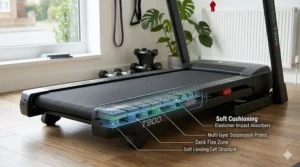
New users consistently report the belt feels firmer than expected compared to gym treadmills. The cushioning system reduces impact versus road running, but it’s not the cloud-like softness of commercial machines costing three times as much. This is actually appropriate for home use: overly soft cushioning can encourage poor running form and doesn’t prepare you well for outdoor running.
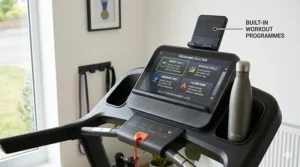
The console takes about three runs to become intuitive. Decathlon’s interface logic differs slightly from mainstream brands like NordicTrack or Peloton. Speed and incline quick-select buttons provide the fastest control once you memorise their layout, whilst programme selection involves more button-pressing than ideal. Most UK owners settle into using quick-select functions rather than pre-set programmes.
Noise in Actual British Homes
The 52 dB specification applies under laboratory conditions without a user. Add a 70-85 kg runner and that figure climbs to 60-65 dB, roughly equivalent to normal conversation volume. For ground-floor use or detached homes, it’s perfectly acceptable. For first-floor flats with neighbours below, it’s borderline. Early morning or late evening running generates complaints unless you’ve invested in a proper 15-20 mm rubber mat underneath.
The belt develops a rhythmic pattern as it rotates, which some users describe as meditative and others find mildly irritating. British homes with solid floors and thick carpets absorb this better than modern flats with laminate flooring over concrete. If you’re particularly sensitive to repetitive sounds, test a similar model in person before committing.
Maintenance Demands Over Time
The T900C requires belt lubrication approximately every 200 hours of use, translating to roughly 3-6 months for regular users. Decathlon recommends silicone-based lubricant applied to the underside of the belt, a process that takes 15 minutes and costs about £8 for lubricant. Skip this, and the motor works harder, generating excess heat and wearing components faster.
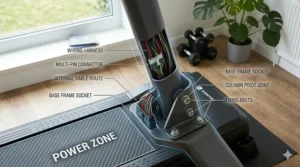
Monthly bolt-tightening prevents the rattling that develops as vibration loosens connections. A quick tour with an Allen key keeps everything secure. British buyers in damp environments (coastal areas, poorly-heated garages) should wipe exposed metal monthly to prevent rust, particularly around the incline adjustment mechanism.
The running belt itself typically lasts 800-1,500 hours depending on user weight and running style. Heavier runners or those who predominantly run rather than walk wear belts faster. Replacement belts for the T900C cost £60-£100 and require moderate DIY skill to install, or you can pay a local fitness equipment repair service £80-£120 for professional replacement.
The Decathlon Domyos T900 UK Worth Buying Decision
The question “is the decathlon domyos t900 uk worth buying in 2026″ depends entirely on what you’re actually buying and what alternatives exist at similar prices. Let’s approach this with the honesty it deserves rather than affiliate-link-driven enthusiasm.
When the T900C Makes Sense
If you find a well-maintained T900C for £300-£400 with minimal hours (under 500), original accessories intact, and the seller can demonstrate it running properly, it represents genuinely good value. You’re getting specifications that match or exceed current budget models selling new for £450-£600: better running surface, equivalent motor power, similar incline capability. The money you save buys a quality rubber mat, replacement lubricant, and potentially a year of iFit subscription on a different machine.
For British buyers who prioritise running performance over technological features, the T900C delivers what matters: consistent speed, reliable incline adjustment, and enough deck space to run naturally. The lack of touchscreen, automatic workout adjustment, and cutting-edge app integration doesn’t affect the quality of your actual running session. If you’re content controlling things manually, older models perform identically to newer versions with fancier interfaces.
The secondhand market also means you can often negotiate price based on cosmetic condition. A T900C with scuffed plastic and faded stickers but perfect mechanical function costs £100-£150 less than pristine units. If it’s going in a spare bedroom where appearance doesn’t matter, focus on function and pocket the savings.
When the T900C Doesn’t Make Sense
If the cheapest T900C you find costs £500-£600, new alternatives offer better value. The Decathlon T520B at £450-£510 provides manufacturer warranty, known service history, and the reassurance of buying from a retailer with physical UK stores. The JLL S300 around £400 delivers similar performance with UK-based customer support. Paying secondhand prices that approach new-model costs eliminates the financial advantage.
For buyers prioritising technological integration, the T900C’s aging Bluetooth connectivity and discontinued app support create frustration. Newer models sync seamlessly with Zwift, iFit, and Peloton apps, automatically adjusting speed and incline during virtual workouts. The T900C technically connects but often requires workarounds, manual adjustments, and periodic reconnection. If you value the full smart treadmill experience, spending £150-£200 extra on current models pays dividends in reduced aggravation.
The warranty void is genuinely significant for anyone uncomfortable with DIY repairs. When a new treadmill develops motor issues or electronic failures during the warranty period, manufacturers replace or repair at their cost. When a secondhand T900C fails, you’re sourcing replacement parts, finding local repair services, or selling for parts and starting over. Some British buyers have mechanical aptitude and consider repairs part of ownership; others want to press a button and have the manufacturer solve problems. Know which category you occupy before buying secondhand.
The Honest Middle Ground
The domyos t900c treadmill occupies an interesting position in 2026: too good to dismiss, too old to recommend unreservedly. It’s like buying a well-maintained 2019 family car versus a brand new budget model. The 2019 car has better specifications but uncertain history and no warranty; the new budget model has inferior features but manufacturer backing and known condition.
For British buyers with moderate mechanical confidence, willing to perform basic maintenance, and prioritising performance over technology, a T900C at the right price (£300-£400) represents solid value. For buyers wanting warranty protection, modern app integration, and the reassurance of manufacturer support, new alternatives make more sense despite slightly inferior running specifications.
Common Mistakes When Buying Home Treadmills in the UK
British treadmill buyers make predictable errors that cost money, create frustration, or result in expensive doorstops gathering dust. Learning from others’ mistakes is considerably cheaper than making your own, so here are the patterns that repeat across UK treadmill forums and reviews.
Mistake 1: Prioritising Top Speed Over Usable Features
New buyers fixate on maximum speed specifications, convinced they need 20 km/h capability for their training. The uncomfortable truth: most people never exceed 12 km/h during actual use. Walking pace ranges 5-7 km/h, jogging sits around 8-11 km/h, and running occupies 12-16 km/h for recreational athletes. Unless you’re specifically training for competitive racing, 18 km/h (the T900C’s maximum) exceeds what you’ll realistically use.
What matters more: consistent speed delivery across the range you actually use. A treadmill that wavers between 9.8-10.2 km/h when set to 10 km/h creates an inconsistent training stimulus. The domyos t900 features review uk consistently praises stable speed delivery, which contributes more to training quality than theoretical maximum capability you’ll access twice in five years of ownership.
Mistake 2: Underestimating Noise Impact
Showroom testing or shop demonstrations occur in large, open spaces with ambient noise and brief testing periods. Running for 40 minutes in your first-floor flat at 7 AM sounds entirely different. British buyers in shared housing or above ground-floor neighbours consistently underestimate how much vibration and noise transmit through typical construction.
The solution isn’t necessarily buying the absolute quietest model (which often costs premium prices) but factoring proper acoustic treatment into your budget. A quality 15 mm rubber mat costs £40-£80 and reduces noise transmission by 30-40%. Combining a reasonably quiet treadmill with proper matting outperforms buying the quietest model without acoustic consideration.
Mistake 3: Ignoring Assembly Implications
Many British buyers don’t realise that “some assembly required” for treadmills means 1-2 hours of moderately complex work, often requiring two people. Unlike flat-pack furniture where worst case means wonky shelves, incorrectly assembled treadmills create genuine safety hazards. Improperly tightened bolts lead to mechanical failures during use; incorrectly aligned belts cause premature wear; poor levelling creates annoying drift and noise.
If you’re not confident with assembly, factor professional installation into your budget (£50-£120 depending on location and access difficulty) or prioritise models like the Decathlon Run500 that arrive fully assembled. The extra £100 cost of pre-assembled delivery often proves cheaper than paying someone to fix your DIY assembly mistakes.
Mistake 4: Buying Based on Gym Equipment Familiarity
Commercial gym treadmills cost £3,000-£8,000 and withstand 8-12 hours of daily use from multiple users. The expectation that a £500 home treadmill replicates that experience is fundamentally unrealistic. British buyers who’ve only experienced premium gym equipment often review budget home models harshly, not recognising the inevitable compromises at different price points.
Home treadmills rated for 5 hours weekly use mean exactly that. Running 90 minutes daily, six days weekly (approximately 9 hours) exceeds design specifications and accelerates wear. If your training volume approaches commercial use levels, either accept more frequent maintenance/replacement or invest in commercial-grade home equipment (£1,500-£3,000 range).
Mistake 5: Neglecting to Measure Actual Space
The number of British buyers who purchase treadmills too large for their intended space is both amusing and tragic. Measure your room carefully, accounting for the treadmill’s unfolded dimensions plus safety clearance (minimum 50 cm behind, 100 cm recommended). The T900C measures 185 cm long unfolded, but you need 235-285 cm of room length to use it safely.
Door widths matter tremendously in British homes. Standard internal doors measure 76-78 cm wide, whilst the T900C requires 90+ cm clearance for manoeuvring. If you’re planning upstairs placement, measure stairwell width and turning radius. Many buyers discover too late that the treadmill doesn’t fit through doorways or around stair landings, requiring expensive professional disassembly or outdoor crane lifting.
Mistake 6: Assuming Folding Equals Convenient Storage
“Foldable” sounds brilliantly convenient until you’re actually lifting an 80-90 kg running deck twice daily. Hydraulic-assisted folding helps, but you’re still manoeuvring substantial weight. British buyers who purchased foldable treadmills intending to store them daily often abandon the routine after a week, leaving the machine permanently deployed because folding becomes a chore.
If you’re genuinely planning daily folding, test the mechanism extensively before buying. Lightweight walking pads (25-35 kg) fold and unfold easily; mid-weight runners (60-80 kg) require effort but remain manageable; heavy machines (90+ kg) are technically foldable but practically inconvenient for anyone under 80 kg bodyweight or with back problems.
Domyos T900C Features Review UK: What Actually Matters
The domyos t900c features review uk market is cluttered with regurgitated specifications and affiliate marketing, so let’s focus on features that genuinely impact your training experience versus those that exist primarily for marketing differentiation.
Feature That Matters: Motorised Incline Control
The T900C’s motorised 0-10% incline adjustment changes workouts fundamentally. Manual incline systems require dismounting, manually adjusting pins or levers, then remounting. This interrupts interval training, prevents smooth programme transitions, and encourages laziness (most users set an incline once and leave it). Motorised adjustment enables the 12-3-30 workout protocol (12% incline, 3 mph speed, 30 minutes) that’s become rather popular for its fat-burning efficiency. Research published in the British Journal of Sports Medicine demonstrates that incline walking significantly increases caloric expenditure whilst reducing joint impact compared to flat running, making it particularly suitable for British users managing weight whilst protecting long-term joint health.
Ten percent maximum incline adequately covers most home training needs. Serious hill runners might want 12-15% for replicating Lake District or Scottish Highland routes, but most British terrain and training protocols work within 0-10%. The smooth adjustment between increments matters more than maximum capability: cheap motorised systems jump between set positions, whilst quality implementations like the T900C’s provide continuous adjustment.
Feature That Matters: Running Deck Dimensions
The 143 x 50 cm running surface isn’t flashy, but it’s the difference between comfortable running and constantly monitoring foot placement. Shorter decks (120-130 cm) force stride modification, particularly for taller runners or anyone working on speed. The psychological comfort of adequate space cannot be overstated: running feels different when you’re confident versus anxious about clipping the console or stepping off the back.
Width matters for heavier runners or those with naturally wider gaits. The 50 cm belt provides reasonable lateral stability without the excessive width that drives manufacturing costs up. Wider doesn’t always equal better: commercial gyms use 55-60 cm belts primarily for heavier user capacity and longer machine lifespan, not because narrower belts are inadequate for normal use.
Feature That Matters: Consistent Motor Performance
The 2.5 HP continuous rating (not peak HP, which is marketing nonsense) determines whether the motor delivers consistent power under load or struggles and overheats. The T900C’s motor handles users up to 130 kg across the full speed range without strain. Cheaper motors rated at equivalent continuous HP often use inferior components that overheat during sustained use, triggering thermal protection shutdowns.
British buyers rarely encounter the thermal shutdown issue until summer, when ambient temperatures rise and poor motor cooling becomes apparent. A quality motor maintains performance regardless of ambient conditions; budget motors develop problems in warm rooms or during long sessions. If you’re primarily walking or doing short jogs, motor quality matters less. If you’re training seriously with 45-60 minute sessions, motor reliability becomes crucial.
Feature That Barely Matters: Pre-Set Programme Quantity
The T900C includes 32 pre-set programmes covering various fitness goals: endurance, interval training, calorie burning, wellness. Marketing emphasises quantity, but most users utilise 2-3 favourite programmes repeatedly or simply use manual control. The quality and logic of available programmes matters more than quantity. Eight well-designed programmes beat 40 mediocre variations on the same theme.
British buyers report that programme names (“Endurance 1”, “Interval 3”) aren’t particularly descriptive, requiring trial and error to find suitable sessions. The ability to manually adjust speed and incline during programmes provides more practical value than programme quantity. If a pre-set session feels too easy or difficult, real-time adjustment keeps you in the appropriate training zone.
Feature That Barely Matters: Console Bells and Whistles
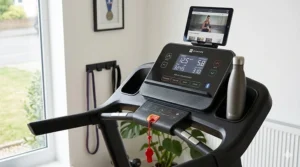
The T900C’s console displays time, distance, speed, calories, heart rate, and programme information. That’s adequate for effective training. Touchscreens, colour displays, and integrated entertainment systems add cost without improving workout quality. British buyers who prioritised flashy consoles often report they ignore most features after the novelty period, using basic metrics and external devices (tablets, phones) for entertainment.
The USB charging port and audio jack prove useful for maintaining device battery during longer sessions, but they’re convenience features rather than essential capabilities. The built-in speakers are adequate for casual background music but can’t compete with decent headphones or external speakers. Most users connect via Bluetooth to their own audio equipment rather than using treadmill speakers.
Feature Assessment: Bluetooth Connectivity
The T900C’s Bluetooth connectivity to Domyos Econnected and Kinomap falls somewhere between “useful” and “mildly frustrating.” When it works properly, it adds workout tracking, virtual routes, and social features. When it doesn’t—which British buyers report happens periodically—you’re manually logging workouts and running without virtual integration.
Compared to newer models with native iFit or Zwift integration, the T900C’s connectivity feels dated. The apps still function but require more setup, experience occasional dropouts, and lack the automatic speed/incline adjustment that premium systems provide. For buyers who don’t care about app integration, this is irrelevant. For those wanting seamless virtual training, it’s a significant limitation.
Long-Term Cost & Maintenance in the UK
Purchasing a treadmill represents the initial investment, but British owners face ongoing costs that significantly impact total cost of ownership. The domyos t900c treadmill and similar mid-range machines demand regular maintenance and occasional repairs that budget buyers often overlook during purchase decisions.
Routine Maintenance Costs
Belt lubrication every 200 hours requires silicone-based lubricant (£6-£10 per bottle, lasting 2-3 applications). Annual consumption for regular users: £10-£15. This isn’t optional maintenance—proper lubrication extends belt life by 40-60% and prevents motor strain. British buyers who skip lubrication inevitably post forum complaints about premature belt wear and motor problems, having saved £10 annually whilst creating £100+ repair bills.
Cleaning supplies matter more in British homes than arid climates. Our damp conditions encourage mould and mildew on neglected equipment, particularly in garages or conservatories. Monthly cleaning with appropriate products (avoid ammonia-based cleaners on plastic components) costs minimal amounts but prevents deterioration. A quality rubber mat underneath (£40-£80 initial investment) protects both treadmill and flooring, lasting 3-5 years with proper care.
Replacement Part Costs
Running belts wear out eventually, typically lasting 800-1,500 hours depending on usage patterns. For the T900C, replacement belts cost £60-£100 from third-party suppliers, as Decathlon no longer stocks original parts for discontinued models. Professional installation adds £80-£120, or you can DIY with moderate mechanical skill and patience. Total replacement cost: £60-£220 depending on your DIY confidence.
Motor replacements represent major expenses (£200-£400 including installation) that often exceed secondhand machine value. Most UK owners facing motor failure on machines over five years old choose replacement rather than repair, particularly for discontinued models like the T900C. New machines with warranty coverage handle motor issues at manufacturer expense; secondhand purchases place this risk entirely on you.
Console electronics fail less frequently than mechanical components but cost more to replace. Third-party electronics for the T900C run £80-£150, assuming you can source compatible parts. Some failures result from moisture ingress (British damp striking again), others from component age. Modern machines with touchscreens face even higher replacement costs (£200-£400) when screens crack or electronics fail.
Energy Consumption
The T900C consumes approximately 500-650 watts during operation, translating to 0.5-0.65 kWh per hour of use. At current UK electricity rates (averaging £0.25-£0.35 per kWh in 2026 according to Ofgem, the UK energy regulator), running costs approximately £0.13-£0.23 per hour. An hour daily costs £4-£7 monthly, or £48-£84 annually. Not prohibitive, but worth factoring into budgets alongside gym membership comparisons.
Standby power consumption adds minimal cost (approximately 3-5 watts when plugged in but not operating), totalling £2-£4 annually if left permanently connected. British buyers concerned about energy efficiency can unplug after use, though repeated plug/unplug cycles eventually stress connection points.
Total Cost of Ownership Comparison
Assuming a secondhand T900C purchased for £400, used three times weekly (approx. 150 hours annually), over a five-year ownership period:
- Initial purchase: £400
- Rubber mat: £60
- Annual lubrication: £15 × 5 = £75
- Belt replacement (year 3): £150
- Annual electricity: £60 × 5 = £300
- Miscellaneous repairs/parts: £100 (conservative estimate)
Total: £1,085 over 5 years, or £217 annually.
Compare this to budget gym membership (£20-£35 monthly, or £240-£420 annually). The treadmill breaks even against budget gyms within 1-2 years, assuming you actually use it consistently. Premium gym memberships (£40-£80 monthly) make home equipment even more cost-effective. However, gyms provide variety (weights, classes, swimming) that a single treadmill cannot match.
New treadmill purchase at £600 with 2-year warranty shifts the calculation:
- Initial purchase: £600
- Rubber mat: £60
- Annual lubrication: £15 × 5 = £75
- Annual electricity: £60 × 5 = £300
- No major repairs during warranty, estimated £50 post-warranty
Total: £1,085 over 5 years (coincidentally identical to the secondhand scenario, though with less repair risk early on).
The financial equation favours home equipment for consistent users but falls apart if the machine becomes a clothes rack. British buyers should honestly assess their commitment: if you’ve failed to maintain gym membership or previous home equipment, adding another £400-£600 machine to the failure pile makes poor financial sense. Data from ukactive, the UK’s trade association for physical activity providers, shows that home fitness equipment sees 40% higher consistent usage when placed in visible, accessible locations rather than tucked away in spare rooms or garages.
FAQ
❓ Can I find the Domyos T900C new on Amazon UK in 2026?
❓ Is the Domyos T900C suitable for marathon training in the UK?
❓ What's the difference between manual and motorised incline on treadmills?
❓ How much space do I need in a UK home for the Domyos T900C?
❓ Does the Domyos T900C work with UK voltage and plugs?
Conclusion: Making the Right Choice for Your British Home
The domyos t900c treadmill represents a fascinating case study in British home fitness equipment: a discontinued model that remains relevant through robust engineering and thoughtful design, available primarily through secondhand markets at prices that challenge new budget alternatives. For UK buyers navigating the 2026 treadmill landscape, the decision isn’t simply “should I buy a T900C” but rather “what combination of performance, price, warranty, and support best serves my actual needs?”
If you find a well-maintained T900C for £300-£400, with verifiable low hours and mechanical soundness, it genuinely competes with new machines costing £500-£600. The 18 km/h capability, motorised 10% incline, and spacious 143 cm running deck deliver specifications that budget manufacturers still struggle to match. You sacrifice warranty protection and modern app integration, but you gain proven performance at attractive pricing.
Alternatively, current models like the Decathlon T520B (£450-£510), JLL S300 (£350-£450), or NordicTrack T5 (£500-£650) provide manufacturer warranty, UK-based support, and known service history. The peace of mind costs £50-£150 more than equivalent secondhand machines but eliminates repair risk during warranty periods. For British buyers uncomfortable with DIY maintenance or uncertain about secondhand condition, new purchases make financial sense despite slightly inferior specifications.
The broader lesson transcends any single model: successful home fitness equipment purchases depend on honest self-assessment rather than optimistic intentions. The best treadmill is the one you’ll actually use consistently, positioned in space you’ll access willingly, with features you’ll genuinely engage rather than ignore. A basic £400 machine used four times weekly outperforms a £2,000 model gathering dust as an expensive clothes rack.
British buyers should consider their actual training patterns, available space, noise tolerance, and mechanical confidence before purchasing. The decathlon flagship treadmill era has passed, replaced by newer models with different priorities. But well-engineered machines like the T900C demonstrate that fundamental performance—reliable motors, proper running surfaces, practical incline capability—matters more than technological gimmickry for serious training.
Whether you choose a secondhand T900C, a current budget alternative, or a premium model depends on your specific circumstances rather than universal recommendations. Measure your space carefully, assess your genuine commitment to regular use, factor ongoing costs beyond purchase price, and buy the machine that fits your life rather than your aspirations. The T900C earned its reputation through solid performance and durability; it remains a viable option in 2026 for buyers who understand its strengths and limitations.
✨ Recommended for You
- Decathlon Domyos Run 100: 7 Best Budget Treadmills UK 2026 Guide
- 7 Best JTX Slimline Home Treadmill UK 2026
- JTX Sprint 9 Treadmill UK Review Honest: 7 Expert Picks 2026
Disclaimer: This article contains affiliate links. As an Amazon Associate, I earn from qualifying purchases. If you purchase products through these links, we may earn a small commission at no additional cost to you.
✨ Found this helpful? Share it with your mates! 💬🤗
