In This Article
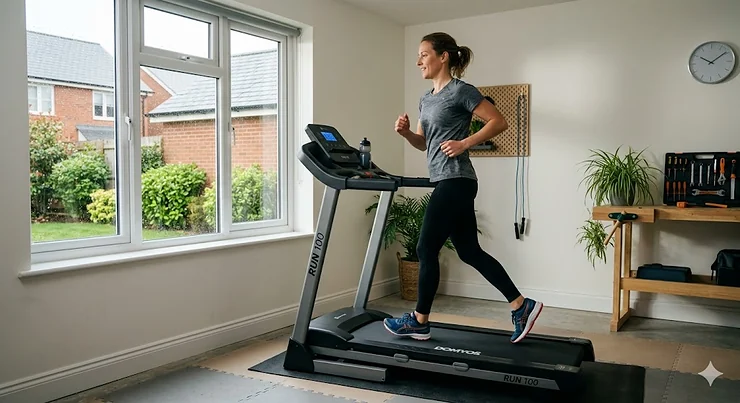
The Decathlon Domyos Run 100 has quietly become one of Britain’s most talked-about budget treadmills, and for rather compelling reasons. In an era when fitness equipment prices have gone slightly mad, this compact folder offers something increasingly rare: genuine value without the usual compromises that plague sub-£500 machines.
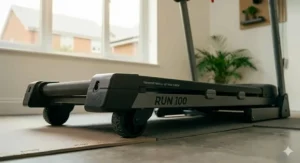
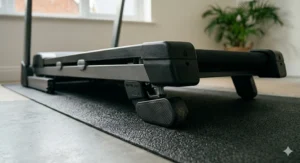
What most buyers overlook about the Decathlon Domyos Run 100 is its origin story. Decathlon’s engineering team didn’t simply rebadge a generic Chinese treadmill. They spent considerable time addressing the specific constraints of British homes—narrow hallways in Victorian terraces, compact flats in Manchester tower blocks, damp garages in Edinburgh suburbs. The result is a treadmill that folds to just 14 cm thick and weighs a manageable 41 kg, making it genuinely movable by one person. That’s rather important when you’re navigating tight corners in a typical British semi-detached.
The British weather doesn’t improve, does it? Six months of drizzle, grey skies by 4pm, and pavements that alternate between slippery leaves and icy patches. This reality has driven thousands of UK residents toward home treadmills in 2026, creating a market where the Decathlon Domyos Run 100 and its competitors fight for attention. According to NHS physical activity guidelines, adults need 150 minutes of moderate-intensity activity weekly—considerably easier to achieve when the weather outside isn’t biblical and your treadmill is already set up in the spare bedroom.
This guide examines seven treadmills available on Amazon.co.uk, with the Domyos Run 100 as our starting point. We’ll explore what each machine delivers in real British conditions, where they excel, and crucially, which specific type of UK buyer benefits most from each model. No marketing fluff, no spec-sheet copy-pasting. Just straightforward analysis based on how these machines actually perform in compact British homes.
Quick Comparison: Top 7 Budget Treadmills UK
| Model | Top Speed | Motor Power | Incline | Deck Size | Folded Size | Price Range (£) | Best For |
|---|---|---|---|---|---|---|---|
| Decathlon Domyos Run 100 | 14 km/h | 1.25 HP / 800W | 3% manual | 45×120 cm | 14 cm thick | £350-£450 | Compact storage, beginners |
| NordicTrack T Series 5 | 16 km/h (10 mph) | 2.6 CHP | 10% powered | 130×46 cm | Standard fold | £400-£500 | Tech features, serious joggers |
| Domyos Run 500 | 16 km/h | 1.25 HP / 932W | 10% powered | 45×130 cm | 27 cm thick | £550-£700 | App connectivity, progression |
| JLL Pegasus | 12 km/h (7.5 mph) | Not specified | 3-level manual | 51×120 cm | 15 cm flat | £450-£550 | Wide deck, flat storage |
| Reebok i-Run 5.0 | 15 km/h (9.3 mph) | Not specified | 12-level powered | Standard | Standard fold | £400-£500 | Incline training, Zwift users |
| CITYSPORTS WP9 | 6 km/h | 440W | Flat only | 40×110 cm | Ultra-compact | £180-£220 | Walking only, under-desk use |
| Mobvoi Home Treadmill | 10 km/h | Not specified | Flat only | 42×120 cm | Foldable handle | £250-£350 | Walking to light jogging, versatility |
From this comparison, three distinct categories emerge. The Decathlon Domyos Run 100 sits comfortably in the “serious beginner” bracket—enough power and features for regular jogging, but priced sensibly and designed for British space constraints. The NordicTrack and Domyos Run 500 offer more tech and power for those willing to stretch the budget, whilst the walking pads (CITYSPORTS, Mobvoi) serve a completely different purpose. What the table doesn’t show is how these machines handle the British damp, whether their motors whine through terraced walls at 6am, or which ones actually fit in the boot of a typical hatchback for those without ground-floor access. We’ll address all of that in the detailed reviews.
💬 Just one click — help others make better buying decisions too!😊
Top 7 Budget Treadmills for UK Homes: Expert Analysis
1. Decathlon Domyos Run 100 – The Compact All-Rounder
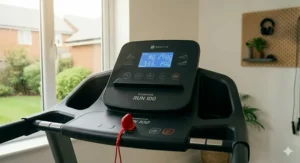
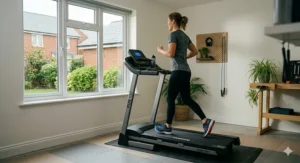
The Decathlon Domyos Run 100 represents what happens when a French sporting goods giant actually listens to British customers. This isn’t trying to be everything to everyone—it’s a focused, well-executed treadmill for regular home use in compact spaces.
Key Specifications:
- Maximum speed: 14 km/h (8.7 mph)
- Motor: 1.25 HP continuous / 800W
- Running surface: 45 cm × 120 cm
- Manual incline: 0-3% (adjustable feet)
- Folded dimensions: 150 × 75 × 14 cm
- Weight: 41 kg
- Maximum user weight: 130 kg
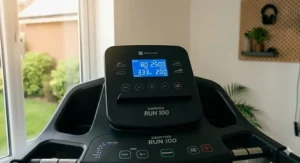
- Console: Backlit LCD showing time, distance, speed, pace, calories, heart rate
- Programmes: 30 built-in (calorie burn, endurance, interval training)
- Connectivity: Domyos E-Connected, Kinomap, Zwift compatible
- Noise level: 65 dB at maximum speed
Expert Commentary:
The 14 km/h top speed translates to roughly 8.7 mph—entirely adequate for jogging and brisk running, though serious runners training for competitive times will find it limiting. What sets the Decathlon Domyos Run 100 apart from cheaper machines is the motor quality. That 1.25 HP continuous rating means it actually delivers consistent power rather than surging and whining as you accelerate. In practical terms, you can settle into a 10 km/h pace for 30 minutes without the motor straining audibly—rather important when you’re running at 6am in a terraced house with shared walls.
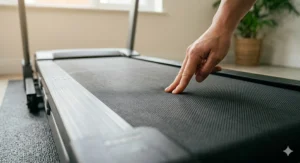
The 45 cm belt width proves adequate for most runners with natural gaits. Taller individuals with wider strides might occasionally feel the need to check foot placement, but it’s far from dangerous. The 120 cm length works well for jogging; serious runners doing sprint intervals would prefer 130+ cm. The manual 3% incline adjustment uses simple fold-down feet at the rear—not elegant, but reliable and maintenance-free. You won’t find yourself calling Decathlon because the electronic incline motor has packed in, which happens more often than manufacturers admit.
British buyers consistently praise two specific features in their Amazon.co.uk reviews. First, the genuinely compact fold—at 14 cm thick, this tucks behind a sofa or slides under most beds without requiring you to dismantle half the bedroom. Second, the fact it arrives essentially ready to use. No hour-long assembly nightmares with Allen keys and incomprehensible diagrams. Unbox, unfold, plug in, run. For a nation that treats flat-pack furniture assembly as a relationship stress test, this matters.
The app connectivity deserves specific mention. Whilst the Decathlon Domyos Run 100 works perfectly well as a standalone machine, connecting to Kinomap or Zwift transforms it into something considerably more engaging. The treadmill responds to virtual terrain changes in real-time, which makes indoor running substantially less tedious. Worth noting: you’ll need your own tablet or smartphone—there’s a holder but no integrated screen.
Customer Feedback:
UK reviewers on Amazon.co.uk (averaging 4.3 stars from 200+ reviews) particularly appreciate the quiet operation and storage footprint. One Birmingham buyer noted: “Bought it for our Victorian terrace—narrow stairs, small spare room. It actually fits. Motor doesn’t wake the baby. Solid enough for daily 5K sessions.” The most common criticism involves the basic console, which lacks the touchscreen sophistication of pricier models.
✅ Pros:
- Genuinely compact 14 cm fold suits British homes
- Quiet 65 dB operation (quieter than many dishwashers)
- Arrives pre-assembled and ready to use
- App connectivity adds training variety
- 5-year frame warranty plus 10-year spare parts availability
❌ Cons:
- Manual incline adjustment requires stopping and lifting
- Basic LCD console (no touchscreen)
Price & Verdict:
The Decathlon Domyos Run 100 typically ranges from £350-£450 on Amazon.co.uk, though Decathlon’s own website occasionally runs sales that drop it closer to £330. At this price point, you’re getting a treadmill that genuinely balances performance with British space constraints. It’s not trying to be a gym-quality machine, and that’s precisely its strength. For the beginner to intermediate runner living in a typical British home—terraced, semi-detached, or compact flat—this represents exceptional value in 2026.
2. NordicTrack T Series 5 – Tech Features at Budget Pricing
The NordicTrack T Series 5 brings American fitness tech to British budgets, offering features that shouldn’t exist at this price point. NordicTrack’s reputation in professional fitness equipment lends credibility that many budget brands simply can’t match.
Key Specifications:
- Maximum speed: 16 km/h (10 mph)
- Motor: 2.6 CHP continuous
- Powered incline: 10% (button-adjustable)
- Running surface: 130 × 46 cm
- Maximum user weight: 113 kg
- Folding: SpaceSaver with EasyLift Assist
- Warranty: Lifetime frame, 10-year motor, 2-year parts (requires registration within 28 days)
Expert Commentary:
The 10% powered incline adjusts at the touch of a button rather than requiring you to stop, dismount, and manually lift the deck. This transforms workout variety—you can replicate hill training, follow iFIT virtual routes that respond to terrain changes, or simply spike intensity mid-session without breaking stride. Research from Sport England shows that incline walking burns approximately 50% more calories than flat walking at the same speed, making this feature genuinely valuable rather than mere marketing.
The 2.6 CHP motor delivers noticeably smoother power than the Decathlon Domyos Run 100, particularly at higher speeds. At 14-16 km/h, cheaper motors start to whine and vibrate; the NordicTrack maintains composure. This matters less for steady-state joggers, but interval runners and those progressing toward faster paces will appreciate the difference.
The British weather context: at 113 kg maximum user weight, this accommodates lighter users comfortably but heavier runners should consider alternatives. The deck size at 130 × 46 cm provides adequate length for most runners, though the 46 cm width feels slightly narrow for wider-gait individuals.
One frustration specific to UK buyers: NordicTrack’s warranty requires registration within 28 days of purchase at ifitsupport.eu. Miss that window and you drop from lifetime frame coverage to a basic 12-month warranty. Set a phone reminder immediately after delivery.
Customer Feedback:
Amazon.co.uk reviews (4.1 stars, 150+ reviews) frequently mention build quality exceeding expectations for the price. A Manchester buyer noted: “Heavier and more substantial than expected. Doesn’t rock or wobble during runs. The powered incline makes a genuine difference to calorie burn.” Common criticisms involve the iFIT subscription upselling—the machine works fine without it, but NordicTrack rather aggressively promotes the paid service.
✅ Pros:
- Powered 10% incline at budget pricing
- Stronger 2.6 CHP motor handles sustained running
- Recognized brand with established UK support network
- iFIT compatibility for virtual training routes
- Generous warranty (if registered promptly)
❌ Cons:
- Lower 113 kg max user weight than competitors
- Warranty requires registration within 28 days
- Constant iFIT upselling can be tiresome
Price & Verdict:
The NordicTrack T Series 5 typically sits around £400-£500 on Amazon.co.uk, occasionally dropping to £380 during sales events. For UK buyers who want powered incline without spending £700+, this represents the best entry point. It’s particularly suited to those progressing beyond basic jogging into more structured training programs, especially if British weather makes outdoor hill work impractical six months of the year.
3. Domyos Run 500 – The Premium Decathlon Option
The Domyos Run 500 represents Decathlon’s answer to mid-range treadmills, offering features that directly compete with machines costing £200-£300 more. It’s essentially what the Run 100 becomes when you add a touchscreen, more powerful motor, and powered incline.
Key Specifications:
- Maximum speed: 16 km/h (10 mph)
- Motor: 1.25 HP / 932W
- Powered incline: 10% (motorized adjustment)
- Running surface: 45 × 130 cm
- Folded dimensions: 162 × 75 × 27 cm
- Weight: 58 kg
- Maximum user weight: 130 kg
- Console: LED touchscreen with backlit display
- Programmes: 30 customisable pre-set programmes
- Connectivity: Kinomap, Domyos E-Connected, Zwift compatible (Bluetooth and ANT+)
- Noise level: 62 dB at maximum speed
- Warranty: 2 years parts/labour, 5 years frame
Expert Commentary:
The 10 cm longer deck (130 cm vs 120 cm on the Run 100) makes a noticeable difference at faster paces—you can fully extend your stride without feeling cramped. The powered 10% incline responds to both manual button presses and app commands when connected to Kinomap or Zwift, which transforms indoor training from monotonous to genuinely engaging.
The touchscreen console represents a significant upgrade from the Run 100’s basic LCD. You get proper workout tracking, programme visualization, and heart rate monitoring (requires separate Bluetooth chest strap, not included). The remote control magnetic clip allows speed and incline adjustments without reaching for the console—particularly useful during interval sessions when you’re breathing hard and your coordination suffers.
What Decathlon doesn’t advertise loudly: this arrives fully assembled. For UK buyers navigating narrow stairs or tight doorways, that 58 kg weight becomes manageable because you’re not wrestling with partially-assembled components. Two people can reasonably handle delivery and positioning.
The British damp consideration: at 62 dB, this runs quieter than the Run 100 despite more power. For flat-dwellers concerned about downstairs neighbours or terraced house residents sharing walls, those three decibels matter more than you’d think. It’s the difference between “I can hear someone’s exercising” and “that’s actively annoying.”
Customer Feedback:
Argos and Very.co.uk reviews (4.4 stars across 300+ reviews) consistently praise the ready-to-use delivery and genuinely compact fold despite the touchscreen. One Edinburgh buyer mentioned: “Sceptical about app connectivity being useful—it genuinely transforms indoor running. The treadmill responds to Kinomap virtual hills, making Scottish winter training far less tedious.” The main criticism involves the app occasionally disconnecting mid-session, requiring Bluetooth re-pairing.
✅ Pros:
- LED touchscreen provides proper workout visualization
- Arrives fully assembled (major advantage for UK homes with stairs)
- Quieter 62 dB operation than cheaper models
- 10% powered incline competitive with £800+ machines
- Strong Decathlon UK support network (walk-in shops for issues)
❌ Cons:
- Heavier 58 kg weight limits single-person repositioning
- 27 cm folded thickness larger than Run 100’s 14 cm
- App connectivity occasionally temperamental
- No integrated tablet screen (requires your device)
Price & Verdict:
The Domyos Run 500 typically ranges £550-£700 on Amazon.co.uk, with Decathlon’s own site occasionally offering £450-£500 during sales events (particularly January and September). At this price, you’re paying approximately £250 more than the Run 100 for the touchscreen, powered incline, and longer deck. That investment makes sense for runners logging 4-5 sessions weekly who want structured progression—the app connectivity and incline training genuinely expand workout variety beyond what the Run 100 offers. For casual 2-3 times weekly users, the Run 100 represents better value.
4. JLL Pegasus – Wide Deck, Flat Fold Design
The JLL Pegasus occupies an interesting niche between walking pad and full treadmill. Its party trick is a 51 cm wide running belt—considerably more generous than standard budget treadmills—combined with a genuinely flat 15 cm fold.
Key Specifications:
- Maximum speed: 12 km/h (7.5 mph)
- Motor: Not specified by manufacturer
- Manual incline: 3 positions
- Running surface: 51 × 120 cm (notably wide)
- Folded thickness: 15 cm (flat fold)
- Maximum user weight: 120 kg
- Foldable handlebar design
- Programmes: Basic time/distance tracking
Expert Commentary:
That 51 cm belt width is the widest you’ll find under £600, which matters more than spec sheets suggest. Runners with naturally wide gaits or anyone who finds themselves constantly centering on narrower belts will immediately notice the difference. You can properly relax into your stride rather than subconsciously monitoring foot placement.
The 12 km/h (7.5 mph) maximum speed firmly positions this as a walking-to-light-jogging machine. Serious runners training at 5:00/km pace or faster will find it limiting. But for the substantial British demographic doing Couch to 5K programmes, brisk walking, or gentle recovery jogs, 12 km/h proves entirely adequate. It’s worth noting that many people overestimate how fast they actually run—a comfortable 6 km/h walk feels quite brisk, and 10 km/h represents a decent jogging pace for beginners.
The flat fold to 15 cm means this genuinely slides under beds or sofas without requiring you to shift furniture. For compact British flats where every centimetre matters, this storage efficiency rivals the Decathlon Domyos Run 100 whilst offering a wider running surface.
The British context: JLL operates as a UK-based brand with local customer service, which occasionally matters when things go wrong. Their warranty covers parts and labour, though it’s standard manufacturer support rather than in-home engineer visits.
Customer Feedback:
Amazon.co.uk buyers (4.2 stars, 180+ reviews) consistently mention the wide belt as the standout feature. A Bristol buyer noted: “I’m not particularly wide, but I naturally run with a slightly wider gait. Every other budget treadmill felt constraining. This one lets me run naturally.” The main complaint involves the basic console lacking programme variety and app connectivity.
✅ Pros:
- 51 cm belt width exceptional for price point
- Flat 15 cm fold rivals walking pads for storage
- Foldable handlebar adds versatility
- UK-based brand with local support
- 120 kg max user weight competitive
❌ Cons:
- 12 km/h maximum speed limits serious runners
- Basic console lacks programmes and connectivity
- Manual incline only 3 positions
- Motor specifications not published (raises durability questions)
Price & Verdict:
The JLL Pegasus typically ranges £450-£550 on Amazon.co.uk, positioning it between the Decathlon Domyos Run 100 and Run 500. It’s best suited for a specific UK buyer: someone with a wider gait or who prioritizes running comfort, living in a space-constrained environment (compact flat, terraced house), and whose running needs don’t extend beyond walking and light jogging. If you’re training for half-marathons or doing serious pace work, look elsewhere. If you’re maintaining fitness, losing weight, and want something that stores invisibly, this deserves consideration.
5. Reebok i-Run 5.0 – Incline Training Specialist
The Reebok i-Run 5.0 brings one specific feature to budget pricing: 12-level powered incline adjustment. For UK buyers interested in indoor hill training without outdoor weather complications, it represents a compelling alternative to the Decathlon Domyos Run 100.
Key Specifications:
- Maximum speed: 15 km/h (9.3 mph)
- Motor: Not specified
- Powered incline: 12 levels (precise percentage not published)
- Running surface: Standard dimensions
- Maximum user weight: Approximately 120 kg
- Zwift compatible
- No assembly required (arrives ready to use)
- Automatic warranty (no registration deadline)
Expert Commentary:
The 12-level powered incline is the headline feature, allowing you to replicate the 12-3-30 workout that’s become popular on UK fitness forums—12% incline, 3 mph (roughly 5 km/h), 30 minutes. According to research from Loughborough University, incline walking at moderate pace burns significantly more calories than faster flat walking whilst reducing joint impact, making it particularly suitable for heavier individuals or those with knee concerns common in the British demographic.
The Zwift compatibility matters for UK indoor training. When grey skies and horizontal rain make outdoor running miserable from October through March, virtual routes through Alpine climbs or California coastlines maintain motivation considerably better than staring at a wall. The treadmill automatically adjusts incline to match virtual terrain, creating a genuinely immersive experience.
Reebok’s warranty approach differs notably from NordicTrack: it’s automatic upon purchase, requiring no registration within arbitrary deadlines. For the organizationally challenged among us (which is most people), this removes one failure point. The warranty itself is standard 2-year parts and labour, nothing exceptional but adequate.
The British context: Reebok maintains UK support infrastructure through established retail partnerships (Sports Direct, JD Sports), meaning service and parts availability tends to be reliable. You’re not dealing with an unknown Chinese brand operating solely through Amazon.
Customer Feedback:
Amazon.co.uk reviews (4.0 stars, 120+ reviews) highlight the no-assembly delivery as a major convenience. A Leeds buyer mentioned: “Delivered on a Tuesday, running by Tuesday afternoon. The powered incline makes a genuine difference to workout intensity without needing to run faster.” Common criticisms involve the console feeling dated compared to touchscreen competitors and occasional Zwift connectivity hiccups.
✅ Pros:
- 12-level powered incline enables varied hill training
- Zwift compatibility adds virtual route variety
- No assembly required (major UK convenience)
- Automatic warranty (no registration deadline hassle)
- Established Reebok UK support network
❌ Cons:
- Basic console lacks modern touchscreen
- 15 km/h maximum speed limits faster runners
- Motor specifications unpublished (durability uncertainty)
- Heavier and bulkier than compact alternatives
Price & Verdict:
The Reebok i-Run 5.0 typically ranges £400-£500 on Amazon.co.uk, directly competing with the NordicTrack T Series 5. The choice between them hinges on priorities: if you want a touchscreen and iFIT ecosystem, choose NordicTrack. If you prioritize incline variety, no-fuss warranty, and Zwift compatibility, choose Reebok. For UK buyers specifically interested in the 12-3-30 workout or those training for hilly races (hello, Lake District and Scottish Highlands runners), the i-Run 5.0’s incline capabilities justify the investment over the Decathlon Domyos Run 100‘s manual 3% adjustment.
6. CITYSPORTS WP9 – Under-Desk Walking Specialist
The CITYSPORTS WP9 isn’t trying to be a treadmill for running—it’s a walking pad designed for under-desk use and compact living. At £180-£220, it serves an entirely different purpose than the Decathlon Domyos Run 100, but deserves mention for specific UK use cases.
Key Specifications:
- Maximum speed: 6 km/h (walking pace)
- Motor: 440W
- No incline capability
- Running surface: 40 × 110 cm
- Weight: 26.5 kg (highly portable)
- Ultra-compact storage
- Maximum user weight: 110 kg
- Remote control operation
Expert Commentary:
The 6 km/h maximum speed is walking only—attempting to jog on this would be both awkward and potentially unsafe. But for its intended purpose—steady walking whilst working at a standing desk or boosting daily step count in a compact flat—it performs admirably. The 440W motor handles continuous walking without overheating, which plagued earlier-generation walking pads.
The 26.5 kg weight makes this genuinely portable. One person can easily move it from under a desk to storage without assistance—rather important in British flats where space reconfiguration happens regularly. The slim profile slides under most sofas and beds without requiring furniture rearrangement.
The British context: at just over 60 dB during operation, this won’t disturb downstairs neighbours in flats or family members through shared walls in terraced housing. For the work-from-home demographic (which expanded substantially post-2020 and hasn’t fully reversed), the ability to walk 10,000 steps daily without leaving your home office addresses a genuine problem in British sedentary lifestyle patterns.
Customer Feedback:
Amazon.co.uk reviews (4.2 stars, 1,000+ reviews) predominantly come from home office workers. A Manchester buyer noted: “I was sceptical about walking whilst typing, but you adapt within a week. Hit 12,000 steps yesterday without leaving the flat. British weather hasn’t stopped my activity.” Criticisms involve the lack of running capability and basic console.
✅ Pros:
- Genuinely portable at 26.5 kg (one-person movable)
- Ultra-compact storage suits small flats
- Whisper-quiet operation (under-desk use)
- Budget-friendly £180-£220 pricing
- Perfect for British work-from-home lifestyle
❌ Cons:
- Walking only (6 km/h maximum)
- No incline capability
- Basic functionality (not for fitness training)
- Narrow 40 cm belt width
Price & Verdict:
At £180-£220, the CITYSPORTS WP9 serves a completely different market than the Decathlon Domyos Run 100. If your goal is fitness training, jogging, or structured workouts, buy an actual treadmill. If your goal is combating sedentary work-from-home lifestyle, boosting daily step count, and gently moving whilst answering emails, this represents exceptional value. For British remote workers in compact flats, it’s genuinely worth considering as a health investment rather than fitness equipment.
7. Mobvoi Home Treadmill – Walking to Light Jogging Hybrid
The Mobvoi Home Treadmill attempts to bridge walking pads and full treadmills through a foldable handlebar design. It’s more capable than the CITYSPORTS but less robust than the Decathlon Domyos Run 100, positioning it for a specific intermediate use case.
Key Specifications:
- Maximum speed: 10 km/h (moderate jogging pace)
- Motor: Not specified
- No incline capability
- Running surface: 42 × 120 cm
- Foldable handlebar (transforms walking pad to treadmill)
- Maximum user weight: Approximately 100 kg
- App connectivity available
- Safety clip auto-stop
Expert Commentary:
The transforming handlebar is the defining feature—fold it down for under-desk walking pad mode, raise it for proper jogging with handlebar support. This versatility appeals to space-constrained UK buyers who want both desk-walking capability and proper exercise options without storing two separate machines.
The 10 km/h maximum speed allows light jogging and interval work beyond simple walking, making it considerably more useful for fitness progression than pure walking pads. However, serious runners will find it limiting—you can’t sustain proper training paces beyond gentle recovery jogs.
The British context: at approximately 100 kg maximum user weight, this accommodates lighter individuals but excludes a significant portion of the UK demographic. Heavier users should absolutely look at alternatives with higher weight limits (Decathlon Domyos Run 100 supports 130 kg).
The app connectivity provides basic workout tracking and virtual routes, though it’s less sophisticated than Kinomap or Zwift integration offered by Decathlon models. The safety clip immediately stops the belt if detached—essential for raised handlebar jogging mode where falling could mean hitting the floor.
Customer Feedback:
Amazon.co.uk reviews (3.9 stars, 150+ reviews) appreciate the dual functionality but note quality concerns. A Birmingham buyer mentioned: “Bought for desk walking but use the running mode regularly. Feels less stable at 10 km/h than I’d like—fine for 7-8 km/h jogging.” Common criticisms involve the handlebar feeling slightly wobbly during faster sessions and the app being temperamental.
✅ Pros:
- Dual functionality (walking pad + treadmill)
- Space-efficient for small British flats
- 10 km/h allows light jogging
- App connectivity adds tracking
- Reasonable £250-£350 pricing
❌ Cons:
- Lower 100 kg max user weight restrictive
- Handlebar stability concerns at higher speeds
- No incline capability limits training variety
- Motor specifications unpublished
Price & Verdict:
The Mobvoi Home Treadmill at £250-£350 sits between pure walking pads and serious treadmills in both price and capability. It’s best suited for UK buyers in extremely space-constrained environments (studio flats, small rooms) who want both under-desk walking and light jogging capability without committing to a full-size treadmill like the Decathlon Domyos Run 100. If you know you’ll primarily jog or run, invest in a proper treadmill. If you genuinely need desk-walking capability plus occasional jogging, this hybrid approach makes sense.
How to Choose the Right Budget Treadmill for Your UK Home
Selecting a treadmill involves balancing six critical factors, each weighted differently depending on your specific British living situation. Here’s how to think through the decision systematically.
1. Space Constraints Come First
British homes trend smaller than American equivalents, making storage the primary constraint rather than an afterthought. Measure three dimensions before considering any treadmill: available floor space when in use, storage space when folded, and doorway/stairway width for delivery access.
The Decathlon Domyos Run 100 at 14 cm folded thickness genuinely disappears behind sofas or under beds. The Domyos Run 500 at 27 cm folded requires more dedicated storage space—it won’t slide under standard beds. Walking pads (CITYSPORTS, Mobvoi) offer maximum compactness but sacrifice running capability. Measure your actual available space before falling in love with features.
Victorian terraces, Georgian conversions, and older British housing stock often feature narrow staircases and tight corners. The Decathlon models arrive pre-assembled, meaning you’re maneuvering a complete 41-58 kg unit rather than carrying components separately. Two people can typically navigate standard British stairs with these weights, but solo delivery into a third-floor flat becomes problematic. Consider ground-floor positioning or recruit assistance.
2. Match Speed to Realistic Usage
Marketing materials promote maximum speeds, but honest self-assessment reveals what you’ll actually use. A comfortable walking pace is 5-6 km/h. Brisk walking reaches 6-7 km/h. Light jogging starts around 8-9 km/h. Most recreational joggers sustain 10-12 km/h comfortably. Serious runners train at 14-16 km/h and above.
If you’re genuinely training for races or maintaining competitive fitness, the NordicTrack T Series 5 or Domyos Run 500 at 16 km/h makes sense. If you’re doing Couch to 5K, general fitness, or weight management, the Decathlon Domyos Run 100 at 14 km/h handles those needs entirely. Walking-focused buyers should seriously consider the CITYSPORTS or Mobvoi rather than overpaying for speed they’ll never use.
One critical consideration: budget motors struggle at maximum advertised speeds. A 14 km/h-rated treadmill runs smoothly at 10-12 km/h but whines and vibrates at 14 km/h. Build in headroom—if you regularly jog at 12 km/h, buy a treadmill rated for 16 km/h to ensure comfortable operation.
3. Incline Capability Transforms Training
The difference between flat-only and incline-capable treadmills is substantial for British indoor training. Our weather makes outdoor hill work impractical roughly six months yearly, yet cardiovascular benefits of incline training are significant.
Powered incline (NordicTrack T Series 5, Domyos Run 500, Reebok i-Run 5.0) allows mid-workout adjustments without stopping. Manual incline (Decathlon Domyos Run 100, JLL Pegasus) requires dismounting and physically adjusting feet—fine for structured sessions where you set incline once, frustrating for interval work requiring frequent changes.
The 12-3-30 workout phenomenon (12% incline, 3 mph, 30 minutes) specifically requires powered incline. If this interests you, manual incline won’t work. If you’re content with occasional gentle incline walking, manual adjustment suffices. Be honest about whether you’ll actually use powered incline enough to justify £150-£200 premium.
4. Consider British Climate Impact on Longevity
British homes suffer from damp more than heating-dominated continental climates. Treadmills stored in damp garages, conservatories, or unheated spare rooms develop rust on metal components and electronic failures considerably faster than spec sheets suggest.
The Decathlon models specify “do not store in damp places or outdoors”—this matters more in Britain than manufacturers acknowledge. If your only storage option is a damp garage, invest in a dehumidifier or accept shortened lifespan. Placing a protective mat (£20-40 for 6-8mm thick exercise mats on Amazon.co.uk) underneath helps floor protection and reduces moisture transfer.
Post-Brexit considerations: some European-manufactured models now carry slightly higher UK prices due to import adjustments, though Amazon.co.uk pricing generally reflects this already. UKCA marking replaced CE marking for electrical safety—all treadmills sold on Amazon.co.uk should carry appropriate certification for UK 230V/50Hz mains supply. According to UK Government trading standards, electrical products must meet specific safety requirements before being sold in the UK market.
5. Noise Levels Matter in British Housing
Terraced housing, semi-detached properties, and flats mean shared walls and floors. A treadmill operating above 65 dB disturbs neighbours and family members. The Decathlon Domyos Run 100 at 65 dB, Domyos Run 500 at 62 dB, and CITYSPORTS under 60 dB all qualify as “apartment-friendly.”
Belt quality affects noise substantially. Cheaper single-layer belts slap and squeak; multi-layer belts with proper lubrication run considerably quieter. The Decathlon models use quality belts requiring lubrication every 200 km, which genuinely affects long-term noise levels.
Motor whine increases dramatically when running at maximum rated speed. A treadmill rated 14 km/h but regularly used at 13-14 km/h will be considerably noisier than the same treadmill used at 10-11 km/h. If quiet operation matters (early morning sessions, sleeping children, downstairs neighbours), build in speed headroom and never run at maximum.
6. Budget Realistically for Total Cost
The treadmill purchase is only the beginning. Factor in:
- Protective floor mat (£20-40 for quality 6-8mm thickness)
- Heart rate monitor chest strap if wanted (£25-50 for Bluetooth models)
- Lubricant for belt maintenance (£10-15 per bottle, needed every 200-300 km)
- Potential app subscriptions (Kinomap £8-12/month, Zwift £13/month)
- Electricity costs (500-1400W consumption, roughly 0.5-1 kWh per hour use)
At 2026 UK energy prices (approximately £0.25-0.30 per kWh), running a treadmill for one hour costs around £0.15-0.30. Daily use adds roughly £4-9 monthly to electricity bills—negligible for most, but worth knowing.
Warranty and service access matters more than price suggests. Decathlon operates physical UK stores where you can walk in with issues. JLL and Reebok have established UK support networks. Unknown Amazon brands operate solely through distant customer service emails and ship replacement parts from overseas.
Real-World UK User Scenarios: Which Treadmill Fits Your Life?
The London Commuter (Studio Flat, Zone 2)
Profile: Works from home three days weekly, 30-minute daily exercise goal, storage space behind sofa only, downstairs neighbours, budget £350-450.
Best Choice: Decathlon Domyos Run 100
Reasoning: The 14 cm fold fits behind a sofa without furniture rearrangement. At 65 dB, it won’t generate neighbour complaints during morning sessions. The 14 km/h maximum speed handles 30-minute jogging entirely adequately. App connectivity (Kinomap, Zwift) maintains engagement when staring at the same studio flat walls daily. The £350-450 price point leaves budget for the essential floor mat and doesn’t require stretching finances in expensive London living.
Alternative: CITYSPORTS WP9 if truly only walking and want under-desk use whilst working.
The Birmingham Suburb Family (Semi-Detached, Three Bedrooms)
Profile: Shared between two adults for fitness maintenance, stored in spare bedroom, children in adjacent rooms, budget £500-700, progression toward structured training.
Best Choice: Domyos Run 500
Reasoning: The touchscreen and 30 built-in programmes provide variety for two users with different fitness levels. The 10% powered incline enables proper progressive training as fitness improves. At 62 dB, it’s quieter than the Run 100—important with children sleeping nearby. The spare bedroom storage space can accommodate the 27 cm folded thickness without issues. The £550-700 investment splits across two users, making the £250 premium over the Run 100 more justifiable. Decathlon’s UK store network (including Birmingham locations) provides walk-in support if problems arise.
Alternative: NordicTrack T Series 5 if iFIT ecosystem appeals and willing to manage registration deadline.
The Edinburgh Flat Dweller (First Floor, Victorian Conversion)
Profile: Training for charity half-marathon, runs 4-5 times weekly, narrow stairs, limited space, downstairs neighbours, budget £400-550.
Best Choice: JLL Pegasus or NordicTrack T Series 5
Reasoning: The choice depends on priorities. The JLL Pegasus offers the widest belt (51 cm) for comfortable stride, stores in just 15 cm flat-fold, and won’t disturb downstairs neighbours. However, the 12 km/h maximum speed limits race-pace training. The NordicTrack T Series 5 provides 16 km/h for proper tempo runs and 10% powered incline for Edinburgh’s hilly training equivalent, but bulkier storage and navigation up narrow Victorian stairs becomes challenging. For serious half-marathon training, the NordicTrack despite delivery hassles. For casual running maintaining fitness, the JLL Pegasus for storage convenience.
Alternative: Domyos Run 100 splits the difference—adequate speed, compact storage, middle-ground pricing.
The Manchester Remote Worker (Terraced House, Home Office)
Profile: Sedentary desk job, wants 10,000 daily steps, work-from-home three days weekly, limited space, budget £180-350.
Best Choice: CITYSPORTS WP9 or Mobvoi Home Treadmill
Reasoning: For pure under-desk walking during work hours, the CITYSPORTS WP9 at £180-220 represents unbeatable value. If wanting occasional light jogging capability beyond desk walking, the Mobvoi at £250-350 provides versatility through the foldable handlebar design. Neither requires serious storage commitment—both slide under desks or behind sofas. The critical question: will you actually jog, or just walk? If honest answer is “mostly walk,” save £100+ and buy the CITYSPORTS.
Alternative: If jogging matters, skip hybrid solutions and invest in Decathlon Domyos Run 100 for proper running capability.
The Rural Wales Resident (Detached Cottage, Garage Storage)
Profile: Serious runner, outdoor training limited by dark evenings October-March, garage storage available, budget £550-700.
Best Choice: Domyos Run 500 or Reebok i-Run 5.0
Reasoning: The garage storage removes British urban space constraints, allowing focus on performance features. The Domyos Run 500 provides touchscreen, 16 km/h speed, 10% powered incline, and app connectivity for virtual Welsh mountain routes when actual mountains are dark and wet. The Reebok i-Run 5.0 offers 12-level incline specifically valuable for hill training equivalent when outdoor terrain is inaccessible. Both require addressing garage damp through protective matting and considering a dehumidifier to prevent rust on metal components. The serious runner usage justifies the £550-700 investment over budget alternatives.
Alternative: Stretch budget to NordicTrack Commercial range if training for competitive races and want gym-quality build.
Common Mistakes UK Buyers Make When Choosing Budget Treadmills
Mistake 1: Ignoring Folded Dimensions
People measure floor space when the treadmill is in use but forget to measure storage space when folded. The Decathlon Domyos Run 100 folded (150 × 75 × 14 cm) fits very different spaces than the Domyos Run 500 folded (162 × 75 × 27 cm). That 13 cm thickness difference determines whether it slides under a bed or requires dedicated floor space.
Measure your actual intended storage location—behind sofa, under bed, corner of spare room—before purchasing. Account for the fact that you’ll likely be slightly too lazy to fold it every single time, meaning it’ll probably live semi-permanently somewhere. Choose based on that reality rather than ideal intentions.
Mistake 2: Buying for Aspirational Speed Rather Than Realistic Usage
The enthusiastic beginner buys a 16 km/h treadmill despite currently walking at 5 km/h, imagining they’ll rapidly progress to serious running. Three months later, they’re still walking at 6 km/h and paid £200 extra for speed they never use.
Be brutally honest about your current fitness level and realistic progression. If you’re starting from minimal activity, the Decathlon Domyos Run 100 at 14 km/h handles everything you’ll realistically do in the first year. You can always upgrade later if you become a serious runner—resale values on well-maintained budget treadmills remain reasonable on Facebook Marketplace and Gumtree.
Mistake 3: Underestimating Importance of UK Voltage Compatibility
Some Amazon.co.uk sellers list products designed for other markets. Treadmills built for US 110V operation don’t work properly on UK 230V mains without proper conversion—motors overheat, electronics fail, warranties void. Always verify the product explicitly states UK 230V/50Hz compatibility and includes a UK three-pin plug (Type G).
UKCA marking (UK Conformity Assessed) confirms the product meets UK electrical safety standards post-Brexit. CE marking (European Conformity) still appears on products manufactured before Brexit transition but new products should carry UKCA. Check listing descriptions and photos for proper certification markings before purchase. The Office for Product Safety & Standards provides guidance on required product markings.
Mistake 4: Assuming Quiet Operation Without Checking Decibel Ratings
“Quiet” is subjective marketing language. Actual decibel ratings matter. For context: 50 dB is quiet conversation, 60 dB is normal conversation, 70 dB is vacuum cleaner. Budget treadmills claiming “whisper quiet” often operate at 70-75 dB, which distinctly disturbs neighbours through shared walls.
The Decathlon Domyos Run 100 at 65 dB, Domyos Run 500 at 62 dB, and CITYSPORTS under 60 dB all genuinely qualify as apartment-appropriate. Anything above 70 dB risks neighbour complaints in typical British terraced or semi-detached housing. If the listing doesn’t specify decibel rating, treat that as a red flag—manufacturers proud of quiet operation prominently advertise the number.
Mistake 5: Overlooking British Damp and Storage Conditions
Storing treadmills in British garages, sheds, conservatories, or unheated spare rooms exposes them to damp considerably more aggressive than Mediterranean or continental climates. Metal components rust, electronic boards corrode, belts develop mildew.
All Decathlon models explicitly state “do not store in damp places”—this isn’t overcaution; it’s engineering reality. If your only storage option is a damp space, either reconsider the purchase or invest in a dehumidifier (£150-250 for quality models) to protect your £350-700 treadmill investment. Placing a protective mat underneath helps but doesn’t solve fundamental damp problems.
Mistake 6: Failing to Register Warranties Within Deadlines
NordicTrack requires warranty registration within 28 days at ifitsupport.eu. Miss that deadline and lifetime frame coverage drops to 12 months. This isn’t theoretical—reviews on Amazon.co.uk regularly feature buyers discovering this too late.
Set a phone reminder immediately after treadmill delivery. Photograph the serial number, save the purchase receipt, complete registration before assembly. The five minutes this takes protects a £400-500 investment. Brands with automatic warranties (Reebok, Decathlon) eliminate this failure point but often offer less generous coverage.
Mistake 7: Ignoring Electrical Running Costs
At 500-1400W power consumption, treadmills aren’t electricity monsters, but daily use adds measurable cost to British energy bills. One hour at 800W consumes 0.8 kWh. At £0.25/kWh typical 2026 UK rates, that’s £0.20 per session. Daily use is roughly £6 monthly, £72 annually.
This won’t bankrupt anyone, but worth knowing. More efficient motors (NordicTrack’s 2.6 CHP runs more efficiently than smaller motors working harder) actually reduce long-term running costs despite higher initial purchase price. Factor total cost of ownership over 3-5 year expected lifespan rather than just purchase price.
Long-Term Maintenance in British Conditions
The 200-Kilometre Service Cycle
Both Decathlon models specify lubrication every 200 km of use. This isn’t optional maintenance—skip it and belt wear accelerates dramatically, motor strain increases, and warranty claims may be denied. At typical casual usage (3 sessions weekly, 5 km per session), you’ll reach 200 km every 13-14 weeks. More intensive users hit it faster.
Domyos lubricant (Ref: 8326425) costs approximately £10-15 per bottle from Decathlon UK stores or website. Application takes five minutes: spray twice underneath the belt on each side, run the treadmill at 5 km/h for five minutes without standing on it. Mark calendar or set recurring phone reminders—relying on memory guarantees you’ll forget.
The British damp factor: belts in damp environments require more frequent lubrication. If stored in a garage or unheated room, consider lubricating every 150 km rather than 200 km. Excessive squeaking or resistance when walking barefoot on a stationary belt indicates urgent lubrication needed.
Component Replacement Schedule
Manufacturers provide optimistic replacement schedules assuming ideal conditions. British reality requires adjustment:
Running belt: Rated 500 hours/3,000 km but expect 400-450 hours in damp British conditions. Replacement costs £60-120 depending on model. Signs of wear: visible cracking, excessive noise, slipping during use.
Running deck: Rated 700 hours/4,200 km but British damp reduces this to 550-650 hours. Replacement costs £80-150. Signs of wear: uneven surface, resistance when manually spinning belt.
Drive belt and motor: Rated 600 hours/3,600 km. This usually holds true even in UK conditions. Replacement costs £40-80 for belt, £150-300 for motor (often cheaper to replace entire treadmill at this point).
Rollers: Rated 600 hours/3,600 km. Replacement costs £50-100 per roller pair.
The critical insight: at casual usage (3 hours weekly), you’ll reach 600 hours in roughly 4 years. At intensive usage (10 hours weekly), 600 hours arrives in just over a year. Match your purchase price to realistic lifespan—spending £700 on a treadmill you’ll intensively use makes sense; spending £700 for three weekly walking sessions doesn’t.
British-Specific Maintenance Issues
Rust prevention: Metal frame components, particularly on cheaper models, develop surface rust in damp British garages. Wipe down with dry cloth after each use, consider silicon-based furniture polish on exposed metal, and absolutely use a dehumidifier if storing in damp spaces.
Electronic corrosion: Console connections and circuit boards suffer in British humidity. Keep the safety key removed when not in use (prevents standby power draw and reduces electronic exposure). If stored in damp conditions, consider wrapping the console in a waterproof cover between uses.
Belt mildew: Rare but possible in extremely damp conditions. If you notice musty smell or visible discoloration on the belt, clean with diluted white vinegar (1:3 ratio with water), wipe thoroughly, and run at low speed for 10 minutes to dry completely.
UK winter static electricity: Dry winter indoor air creates static buildup, particularly on synthetic running belts. This manifests as small shocks when touching metal frame components. Solutions: increase room humidity slightly, use anti-static spray (£8-12 from Amazon.co.uk), or simply touch the frame before turning on to discharge.
Warranty Claims and UK Consumer Rights
The Consumer Rights Act 2015 provides baseline protection beyond manufacturer warranties. Within six months of purchase, if a fault develops, the retailer must prove it wasn’t present at sale (essentially, you’re protected). Between six months and six years, you must prove the fault existed at purchase (harder, but possible for manufacturing defects).
For Amazon.co.uk purchases, this means contacting Amazon customer service first rather than the manufacturer. Amazon’s A-to-Z Guarantee provides additional buyer protection. Keep all packaging for at least 30 days—many warranty claims require return in original packaging. For detailed information on your consumer rights, consult Which? Consumer Rights guidance.
Decathlon’s advantage: walk-in stores across the UK (Birmingham, Manchester, London, Edinburgh, etc.) allow in-person service consultations. You can physically bring problematic components to staff who understand the products. This beats emailing photos to distant customer service teams.
DIY Repairs vs Professional Service
Safe DIY repairs:
- Belt lubrication (explicitly user-maintainable)
- Belt tension adjustment (requires Allen key, detailed in manual)
- Running belt centering (simple quarter-turn adjustments)
- Console battery replacement (usually standard watch batteries)
- Cleaning and basic maintenance
For guidance on DIY treadmill maintenance, Wikipedia’s treadmill article provides useful technical background on mechanical components and common issues.
Professional service required:
- Motor replacement or repair
- Electronic board replacement
- Drive belt replacement (requires partial disassembly)
- Running deck replacement
- Structural frame damage
Decathlon UK stores offer service packages: roughly £50-80 for basic service (inspection, lubrication, tension adjustment), £150-250 for component replacement labour (parts additional). Many buyers find this worthwhile for extending treadmill lifespan beyond warranty periods.
Third-party repair services: UK-based specialists like PartsForTreadmill.com and local fitness equipment repair companies service most brands. Expect £80-120 callout fees plus parts and labour. Often economical for £500+ treadmills, questionable for sub-£300 models where replacement may cost less than repair.
Decathlon Domyos Run 100 vs Traditional Alternatives: Making the Right Choice
Treadmill vs Gym Membership
Annual treadmill cost breakdown (Decathlon Domyos Run 100):
- Initial purchase: £400 (amortized over 4 years = £100/year)
- Electricity (daily use): £72/year
- Maintenance (lubricant, mat): £30/year
- Total: £202/year
Annual gym membership cost (UK average 2026):
- Budget chains (PureGym, The Gym): £240-360/year
- Mid-range (David Lloyd, Nuffield): £600-900/year
- Premium (Virgin Active, Third Space): £1,200-2,000/year
The Decathlon Domyos Run 100 pays for itself in 12-18 months compared to budget gyms, assuming you actually use it. The critical question: will you? Gym memberships provide variety (weights, classes, swimming) that home treadmills don’t. Home treadmills provide convenience and zero commute time that gyms can’t match.
For British weather contexts, home treadmills eliminate the “it’s raining, I’ll skip the gym” excuse that tanks gym attendance October through March. You’re already home. The treadmill is right there. The psychological barrier is considerably lower.
Hybrid approach: Many UK fitness enthusiasts combine budget gym membership (£20-30/month for basic access) with home treadmill for cardio convenience. This provides strength training and variety from the gym whilst eliminating weather-dependent cardio excuses.
Treadmill vs Outdoor Running
Advantages of treadmill ownership:
- British weather independence (rain, ice, dark evenings)
- Controlled pacing for interval training
- Reduced impact on joints (cushioned decks)
- Safety (no traffic, uneven pavements, poorly lit areas)
- Convenience (no changing, showering in public facilities)
- Consistent surface (UK pavements vary wildly in quality)
Advantages of outdoor running:
- Free (no equipment purchase)
- Natural terrain variety
- Vitamin D exposure (limited in British winters)
- Mental health benefits of outdoor exposure
- Social running groups and parkrun culture
- Genuine fresh air (even British rain smells better than indoor air)
The reality for most UK runners: both. Outdoor running dominates April through September when weather cooperates and evenings stay light. Treadmill running dominates October through March when darkness arrives at 4pm and horizontal rain makes outdoor running miserable. The Decathlon Domyos Run 100 serves as weather insurance rather than complete outdoor replacement.
Specific British context: UK pavements suffer from uneven surfaces, tree roots, and inconsistent maintenance. Twisted ankles on poorly maintained pavements drive many runners toward treadmills despite preferring outdoor running. The controlled, consistent surface of the Domyos Run 100 eliminates this injury risk. According to British Journal of Sports Medicine research, treadmill running can reduce impact forces by up to 15% compared to concrete pavement running.
Treadmill vs Exercise Bike
Both serve indoor cardio needs but target different muscles and joint impacts. Treadmills engage full-body running mechanics, burn more calories per hour (roughly 600-900 vs 400-600 for cycling at equivalent intensity), but create more joint impact. Exercise bikes provide zero-impact cardio excellent for knee problems, occupy similar floor space when folded, but engage limited muscle groups.
For British home fitness, the choice often hinges on injury history and living situation. Treadmill running creates vibration that travels through floors—problematic in flats with downstairs neighbours. Exercise bikes run virtually silent. If joint health or noise concerns dominate, choose the bike. If calorie burn and full-body engagement matter more, choose the treadmill.
Cost comparison: Budget exercise bikes (£200-400) and budget treadmills (£300-500) occupy similar price ranges. Both require similar maintenance (lubrication, belt/chain replacement). Neither clearly wins on economics.
Treadmill vs Walking Pad
Pure walking pads (CITYSPORTS WP9, similar models) cost £180-250, weigh 20-30 kg, and store ultra-compactly. Full treadmills (Decathlon Domyos Run 100) cost £350-450, weigh 40-60 kg, and require more storage. The £150-200 price difference matters in British budgets.
The critical distinction: walking pads cap at 6 km/h (walking only), whilst treadmills enable jogging and running at 10-16 km/h. If your honest assessment is “I’ll only walk,” buying a treadmill wastes £200. If you’ll progress to jogging or want running capability, walking pads frustrate within months.
British work-from-home culture favours walking pads for under-desk use during work hours. You cannot jog whilst typing—the use cases don’t overlap. If your primary goal is combating sedentary desk work, the walking pad wins. If your goal is fitness training, the treadmill wins.
Frequently Asked Questions
❓ Can you use the Decathlon Domyos Run 100 for serious marathon training in the UK?
❓ How does the Decathlon Domyos Run 100 handle UK electrical supply and will it increase my energy bills significantly?
❓ Does the Decathlon Domyos Run 100 work properly in damp British garages or conservatories?
❓ Can I use the Decathlon Domyos Run 100 in a UK flat without disturbing downstairs neighbours?
❓ What's the realistic lifespan of the Decathlon Domyos Run 100 with regular UK home use?
Conclusion: Is the Decathlon Domyos Run 100 Right for Your UK Home?
The Decathlon Domyos Run 100 succeeds precisely because it doesn’t try to be everything to everyone. It’s a focused, well-executed budget treadmill designed specifically for the constraints of British home fitness—compact storage, weather independence, reasonable pricing, and adequate performance for the vast majority of casual to intermediate runners.
At £350-450, it occupies the sweet spot between flimsy walking pads and expensive gym-replacement machines. You’re getting genuine Decathlon engineering quality, a motor that handles regular jogging without complaint, and a fold system that genuinely disappears in typical British homes. The 14 km/h maximum speed accommodates everyone except serious competitive runners. The manual 3% incline provides gentle hills for variety without the complexity and failure points of powered systems. The app connectivity transforms monotonous indoor running into engaging virtual routes when British weather makes outdoor running miserable.
The British context matters enormously here. This treadmill was designed for European home fitness markets where space comes at a premium, weather creates genuine outdoor exercise barriers, and consumers value long-term reliability over flashy features. It’s why the Decathlon Domyos Run 100 folds to 14 cm whilst American-market treadmills barely fold at all. It’s why Decathlon operates physical UK stores for walk-in service support rather than relying solely on distant customer service emails. It’s why the warranty explicitly prohibits damp storage—they understand British garages and conservatories.
For whom does this treadmill make sense? The beginner to intermediate runner living in typical British housing (terraced, semi-detached, compact flat), exercising 3-5 times weekly, seeking weather independence without gym membership costs, and realistic about never becoming an elite competitive athlete. If that describes you, the Decathlon Domyos Run 100 represents exceptional 2026 value.
For whom should look elsewhere? Serious runners training competitively need the Domyos Run 500 or NordicTrack T Series for faster speeds and powered incline. Pure walkers should save money with the CITYSPORTS WP9. Space-unlimited buyers in detached houses might prefer full-size non-folding models with larger decks. But for the mainstream British home fitness market, this treadmill delivers precisely what’s needed without excess.
The alternatives examined—NordicTrack T Series 5, Domyos Run 500, JLL Pegasus, Reebok i-Run 5.0, CITYSPORTS WP9, Mobvoi Home—each excel in specific niches. But for balanced, practical home fitness in typical British conditions and budgets, the Decathlon Domyos Run 100 remains the sensible starting point in 2026.
Recommended for You
- 7 Best JTX Slimline Home Treadmill UK 2026
- JTX Sprint 9 Treadmill UK Review Honest: 7 Expert Picks 2026
- 7 Best Curved Treadmill for HIIT Training UK 2026
Disclaimer: This article contains affiliate links. As an Amazon Associate, I earn from qualifying purchases. If you purchase products through these links, we may earn a small commission at no additional cost to you.
✨ Found this helpful? Share it with your mates! 💬🤗
