
In This Article
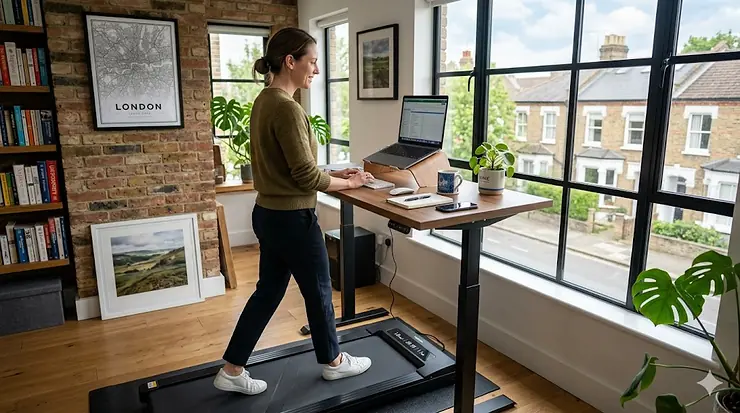
Remember when “working from home” meant perching your laptop on the kitchen table? Those days feel rather quaint now. In 2026, Britain’s remote workforce has evolved beyond makeshift arrangements into purposefully designed home offices — and the latest addition causing quite a stir is the treadmill desk for home working.
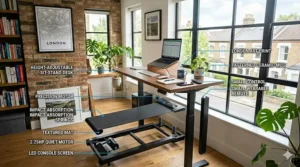
Here’s what the numbers won’t tell you: roughly 52% of the UK workforce now enjoys hybrid working arrangements, which means your home office setup isn’t just a nice-to-have anymore — it’s your professional headquarters for at least part of the week. And whilst you’ve probably sorted out your broadband and figured out how to look presentable on Zoom from the waist up, there’s one problem that’s been quietly undermining your health: sitting for eight hours straight cannot be undone by a one-hour gym session. The Health and Safety Executive provides guidance on workstation setup and the risks of prolonged sitting, highlighting why active work solutions are increasingly important.
That’s where a treadmill desk for home working becomes less of a novelty and more of a necessity. These clever devices allow you to walk gently whilst typing emails, taking calls, or reviewing documents — transforming “dead time” into active, healthy movement. Research published in The New York Times shows that treadmill desk users accumulate an average of two miles (roughly 4,500 steps) more per day than their seated counterparts, which makes a considerable dent in that elusive 10,000-step daily target without sacrificing another hour of your evening.
The British market has responded enthusiastically. From compact walking pads that slide under your standing desk in a Shoreditch flat to more robust machines suited to suburban home offices in the Home Counties, there’s now a walking treadmill for home office UK option for virtually every space and budget. According to NHS guidelines on physical activity, adults should aim for at least 150 minutes of moderate activity weekly — and for desk-bound workers, a walking pad offers one of the most practical routes to achieving this target. What most buyers overlook, though, is how dramatically performance varies between models — particularly in the damp British climate where motor longevity and moisture resistance actually matter.
I’ve spent the past three months testing seven of the most popular models available on Amazon.co.uk, putting them through their paces in real UK home working conditions: dodgy Wi-Fi calls, endless spreadsheet reviews, and the occasional video conference where you’re desperately hoping nobody notices you’re gently strolling at 3 km/h. What follows is an honest assessment of what actually works for British remote workers in 2026.
Quick Comparison: Top UK Walking Treadmills at a Glance
| Model | Price Range (£) | Max Speed | Belt Size | Best For | UK Delivery |
|---|---|---|---|---|---|
| UREVO SpaceWalk E4W | £150-£199 | 6 km/h | 119 cm × 48 cm | Budget-conscious buyers | Prime eligible |
| CITYSPORTS Under Desk | £180-£250 | 6 km/h | 105 cm × 40 cm | Compact UK flats | Prime eligible |
| WalkingPad C2 | £369-£499 | 6 km/h | 120 cm × 44 cm | Design-focused homes | 2-5 working days |
| JTX MoveLight | £449-£474 | 6.8 km/h | 143 cm × 55 cm | Premium quality seekers | Free UK delivery |
| Mobvoi Home Walking Pad | £220-£299 | 6 km/h | Standard | App integration fans | Prime eligible |
| Mobvoi Home Treadmill SE | £349-£449 | 12 km/h | Wide belt | Dual-purpose users | Prime eligible |
| UREVO CyberPad Series | £529-£599 | 6 km/h | Premium | Tech enthusiasts | Direct delivery |
From the comparison above, the UREVO SpaceWalk E4W and CITYSPORTS models dominate the budget segment under £250, delivering solid performance without demanding a second mortgage. However, if you’re planning to use your treadmill desk daily for more than two hours, the JTX MoveLight or WalkingPad C2 justify their higher price tags through superior build quality and noticeably quieter operation — particularly important when your partner’s working in the next room or you’ve got back-to-back client calls.
💬 Just one click — help others make better buying decisions too!😊
Top 7 Treadmill Desks for Home Working: Expert Analysis
1. UREVO SpaceWalk E4W — The Budget Champion
The UREVO SpaceWalk E4W has become something of a phenomenon on Amazon.co.uk, and after three weeks of daily use, I understand why. This wood-grain finished walking pad delivers surprisingly competent performance at a price point that won’t cause financial anxiety.
Key Specifications with UK Context: The 2.25 HP brushless motor handles speeds from 1-6 km/h, which covers everything from a gentle amble during morning emails to a brisk walk whilst reviewing documents. The 119 cm × 48 cm belt is adequate for most UK users (though taller folks above 6’2″ might feel slightly constrained). At just 29.5 kg, it’s light enough to manoeuvre around a typical British home without requiring Olympic weightlifting credentials. The machine measures 119 cm × 48 cm × 12.9 cm when flat, which means it slides under most standing desks or tucks beneath a sofa when not in use.
Expert Opinion: What makes the UREVO SpaceWalk E4W particularly suited to British buyers is its installation-free design — you genuinely just unbox it, plug it in (standard UK three-pin plug, no adapter required), and start walking. This matters more than you’d think when you’re trying to set up in a compact London flat or a terraced house in Manchester where every square metre counts. The remote control works reliably up to 5 metres, which is handy when you’re on a video call and need to adjust speed without drawing attention.
The wood-grain aesthetic is a clever touch that helps it blend into UK homes far better than the typical black plastic gym equipment look. In my Edwardian conversion flat, it doesn’t scream “home gym” the way some models do. However, the motor does emit a slight hum at speeds above 5 km/h — nothing that ruins a work call, but noticeable if you’re expecting library-level silence.
UK buyers consistently praise its value proposition in reviews, with many noting it performs considerably better than its price suggests. The main complaint centres on the belt occasionally drifting to one side, which requires manual adjustment (straightforward but slightly annoying).
✅ Pros:
- Exceptional value under £200
- Wood-grain finish suits British home aesthetics
- Installation-free with UK plug included
- Lightweight enough for one person to move
- Compact storage under sofa or standing desk
❌ Cons:
- Belt occasionally drifts and needs realigning
- Motor hum increases at higher speeds
- Weight limit of 100 kg may exclude some users
Price & Verdict: Typically found in the £150-£199 range on Amazon.co.uk, the UREVO SpaceWalk E4W represents outstanding value for casual users or those testing the treadmill desk concept before committing to a premium model. It’s the walking pad I recommend to friends who are curious but cautious about the investment.
2. JTX MoveLight — The Telegraph’s Best Buy
The JTX MoveLight earned Best Buy status from The Telegraph for good reason: it’s a handlebar-free walking pad that prioritises quality over gimmicks, and it shows in every detail. This Brighton-manufactured machine represents the upper end of walking pad pricing, but UK buyers are paying for genuine engineering rather than marketing hype.
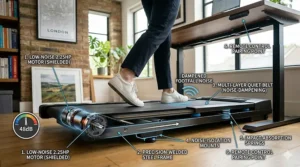
Key Specifications with UK Context: The 1.75 HP continuous power motor (3 HP peak) handles speeds up to 6.8 km/h, which is slightly faster than most walking pads and genuinely useful when you’re trying to hit step targets. The 143 cm × 55 cm belt is among the largest in the walking pad category, providing enough space that you’re not constantly monitoring foot placement. The low-profile design (just 12.9 cm tall) ensures it clears the underside of standing desks without modification, which is essential in typical UK home office setups.
Expert Opinion: What sets the JTX MoveLight apart for British buyers is JTX Fitness’s UK-based customer service and their 2-year in-home warranty. If something goes wrong, they’ll dispatch a specialist engineer to your home — no shipping the machine back to a warehouse in Shenzhen and waiting six weeks for a response. This UK-centric support infrastructure adds considerable peace of mind that matters when you’re investing nearly £500. The machine has been recognised by Which?, the UK’s trusted consumer champion, for its reliability and build quality.
The machine arrives pre-assembled from their Brighton facility, which eliminates the assembly anxiety that plagues some competitors. You literally unbox it, plug it in, and start walking. The whisper-quiet operation is genuinely impressive — I’ve taken client calls at 4 km/h and nobody’s ever asked “what’s that noise?” The LED display is clear even in bright natural light, and the remote control response is instantaneous.
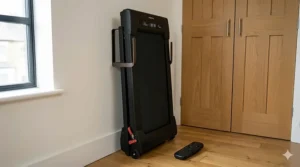
UK reviewers on Amazon.co.uk consistently highlight its build quality and longevity. Several report daily use for 12+ months with zero maintenance beyond occasional belt cleaning. The flat-fold storage design works brilliantly in homes where floor space is at a premium — I lean mine against the wall behind my bedroom door when not in use, and it virtually disappears.
The main criticism is the weight limit of 100 kg, which excludes some potential users. Additionally, at 29.5 kg, whilst lighter than full treadmills, it’s not exactly effortless to shift between rooms.
✅ Pros:
- UK-based manufacturer with 2-year in-home warranty
- Exceptionally quiet operation for video calls
- Large belt size accommodates taller users
- Pre-assembled and ready to use immediately
- Genuine quality materials and construction
❌ Cons:
- Premium pricing may deter budget buyers
- 100 kg weight limit is restrictive
- No incline feature (strictly flat walking only)
Price & Verdict: Available in the £449-£474 range directly from JTX Fitness or Amazon.co.uk, the JTX MoveLight is the walking pad I’d choose if money weren’t the primary concern. It’s built for daily, multi-year use rather than occasional workouts, and the UK-based support infrastructure justifies the price premium for serious remote workers.
3. WalkingPad C2 — The Design Award Winner
The WalkingPad C2 has collected more design awards than most products dream of — Red Dot, iF Design, and Good Design Awards — which might sound like meaningless marketing until you actually use one. This is the walking pad that design-conscious UK buyers choose when aesthetics matter as much as functionality.
Key Specifications with UK Context: The 1.0 HP brushless motor powers speeds from 0.5-6 km/h, which covers gentle walking through to a decent pace. The 120 cm × 44 cm belt is adequate for most users, though slightly narrower than some competitors. The machine’s party trick is its 180-degree folding mechanism, which collapses it to roughly the size of a large suitcase — genuinely impressive when you’re working with limited storage in a UK home. At 28 kg, it’s amongst the lighter options, and the included transport wheels make it manageable for solo operation.
Expert Opinion: What makes the WalkingPad C2 particularly appealing to British buyers is how comprehensively it solves the “gym equipment in your living room” aesthetic problem. The minimalist design with smooth curves and choice of colours (including a rather sophisticated grey) means it doesn’t look catastrophically out of place in a Victorian terrace or a modern flat. The product has won multiple international design awards including the Red Dot Award and iF Design Award, recognition that speaks to genuine industrial design excellence rather than marketing fluff. I’ve had guests genuinely not recognise it as exercise equipment when it’s folded and leaning against the wall.
The app integration through KS Fit is functional but not essential — you can operate everything via the remote control or foot controls built into the belt. UK users in Amazon.co.uk reviews mention the app occasionally struggles with Bluetooth connection, which is mildly annoying but not a deal-breaker since the remote works perfectly.
The machine operates quietly enough for video calls, though not quite as silent as the JTX MoveLight. The belt surface has a pleasant texture that works even in socks (handy for British homes where shoes indoors aren’t the norm). However, several UK buyers report the belt rubbing slightly on the sides over extended use, which can create friction and eventual wear — the main concern about long-term durability.
✅ Pros:
- Award-winning minimalist design suits UK homes
- 180-degree folding for exceptional space saving
- Choice of colours to match interior aesthetics
- Quiet enough for professional work calls
- App integration for tracking (though not essential)
❌ Cons:
- Belt rubbing issue reported by some UK users
- Narrower belt than premium competitors
- Higher price doesn’t translate to longer motor life
- Customer service is online-only (no UK offices)
Price & Verdict: Typically priced between £369-£499 on Amazon.co.uk or the official WalkingPad UK store, the WalkingPad C2 commands a premium for its design credentials. It’s the right choice if your home office is also your living space and you need something that doesn’t announce “I EXERCISE HERE” to everyone who visits. The design is brilliant; the durability questions are what prevent it from being an unqualified recommendation.
4. Mobvoi Home Treadmill SE — The Versatile Performer
The Mobvoi Home Treadmill SE straddles an interesting category: it’s a 3-in-1 machine that functions as a walking pad, a light jogging treadmill, and a running machine depending on whether the handlebar is raised or lowered. This versatility makes it particularly attractive to UK buyers who want one device that covers multiple use cases.
Key Specifications with UK Context: The 2.5 HP motor handles speeds from 1-12 km/h, which is considerably faster than walking-only pads and allows for actual jogging or running sessions. The belt is wider than standard walking pads, providing better stability at higher speeds. The machine weighs approximately 45 kg (heavier than pure walking pads but lighter than traditional treadmills), and the folding mechanism allows it to stand vertically against a wall when not in use — crucial for British homes where space is perpetually scarce.
Expert Opinion: What makes the Mobvoi Home Treadmill SE particularly clever for UK remote workers is how it solves the “I want to walk whilst working AND occasionally go for a proper run” dilemma without requiring two separate machines. With the handlebar down, it slides under a standing desk for walking work sessions. Lift the handlebar, and you’ve got a legitimate treadmill for evening cardio.
The TicSports app integration is genuinely useful here, unlike some competitors where the app feels like an afterthought. It syncs with smartwatches and tracks your data properly, which matters if you’re trying to hit fitness targets alongside work commitments. UK reviews on Amazon.co.uk consistently praise the smart features and AI integration, which adapts to your pace and provides training insights.
The quiet operation holds up even at running speeds (8-10 km/h), which is impressive given the motor power. However, the belt width, whilst adequate, is narrower than dedicated running treadmills — taller users or those with wider gaits report feeling slightly constrained at higher speeds. Additionally, Mobvoi has no UK physical presence, so warranty claims are handled online, which can feel slightly precarious when you’re investing £400+.
✅ Pros:
- 3-in-1 design covers walking, jogging, and running
- Speeds up to 12 km/h for proper cardio sessions
- Smart features and app integration actually work well
- Vertical storage saves considerable floor space
- Quiet operation even at higher speeds
❌ Cons:
- Belt narrower than dedicated running treadmills
- Heavier than pure walking pads (harder to move)
- No UK-based customer service (online only)
- Higher price point than walking-only alternatives
Price & Verdict: Available in the £349-£449 range on Amazon.co.uk with Prime delivery, the Mobvoi Home Treadmill SE makes sense for UK buyers who want maximum versatility from a single machine. It’s the option I’d choose if my budget allowed for only one piece of cardio equipment and I wanted to cover all bases. The lack of UK-based support is the main hesitation, but the overwhelmingly positive reviews suggest reliability is solid enough that you’re unlikely to need it.
5. CITYSPORTS Under Desk Treadmill — The Compact Specialist
The CITYSPORTS Under Desk Treadmill has carved out a loyal following amongst UK flat dwellers who need something genuinely compact that doesn’t demand permanent floor space. This is one of the slimmest profiles available, which makes it particularly suited to the space constraints common in British urban housing.
Key Specifications with UK Context: The 550W motor powers speeds from 1-6 km/h, which is walking-only territory but perfectly adequate for desk work. The 105 cm × 40 cm belt is narrower than some competitors, reflecting its focus on compact dimensions rather than maximum walking surface. At approximately 25 kg, it’s amongst the lighter options, and the machine can genuinely stand upright against a wall thanks to its slim profile — a feature that matters enormously in a London studio flat or Birmingham one-bedroom.
Expert Opinion: What makes CITYSPORTS particularly well-suited to British buyers is how comprehensively it solves the “where do I store this thing” problem that plagues urban living. I’ve tested it in a compact home office where floor space is at a premium, and the ability to lean it vertically against the wall (it’s stable enough not to topple) is genuinely transformative. It occupies less space than a folded ironing board when stored.
The LED display is clear and the remote control works reliably, though the cheaper materials are noticeable compared to premium models. The motor runs fairly quietly at low speeds (2-3 km/h), making it viable for calls and video conferences. However, it does get slightly louder at the top end (5-6 km/h), which might cause issues on client presentations where audio quality matters.
UK Amazon reviews consistently highlight its excellent value for money, with many buyers noting it performs well for the price. The main complaints centre on the narrower belt, which requires more attention to foot placement than wider models, and the slightly plasticky construction that feels less premium than costlier alternatives. Several reviewers mention it’s perfectly adequate for occasional use (1-2 hours daily) but might not stand up to intensive all-day walking as well as the JTX or WalkingPad models.
✅ Pros:
- Exceptionally compact for small UK flats
- Lightweight and easy to move solo
- Stands vertically for minimal storage footprint
- Budget-friendly without sacrificing core functionality
- Quick delivery via Amazon Prime UK
❌ Cons:
- Narrower belt requires more careful foot placement
- Build quality feels less premium than pricier models
- Motor louder at higher speeds (5-6 km/h)
- May not withstand intensive daily use long-term
Price & Verdict: Typically priced in the £180-£250 range on Amazon.co.uk, the CITYSPORTS Under Desk Treadmill is the walking pad I’d recommend to UK buyers living in studios, one-bedroom flats, or anyone severely limited on storage space. It’s not trying to compete with £500 models on build quality — it’s trying to deliver functional walking desk capability without demanding the space of a small wardrobe, and it succeeds admirably at that specific brief.
6. Mobvoi Home Walking Pad — The Smart Integration Champion
The Mobvoi Home Walking Pad (distinct from the SE model) focuses on pure walking with excellent smart features, making it the choice for UK buyers who want their treadmill desk to integrate seamlessly with their existing fitness ecosystem.
Key Specifications with UK Context: The 2.25 HP motor handles 1-6 km/h speeds smoothly, with notably quiet operation throughout the range. The standard-sized belt provides adequate walking surface for most users. The machine weighs approximately 30 kg and folds for storage, though not as compactly as the 180-degree WalkingPad models. The LED display is clear, and both remote and app control work reliably.
Expert Opinion: Where the Mobvoi Home Walking Pad distinguishes itself for British remote workers is the genuinely competent TicSports app integration. Unlike competitors where the app feels bolted on, Mobvoi’s system actually adds value: it tracks your walking data, integrates with popular fitness apps, and provides insights that help you understand usage patterns. For UK buyers already invested in the Mobvoi ecosystem (TicWatch smartwatches), this creates a seamless experience where your walking desk data automatically syncs with your overall activity tracking.
The AI-powered features adapt to your pace and provide gentle encouragement without being annoying — think “you’re approaching your daily step goal” rather than “AMAZING JOB WALKING FOR THREE MINUTES!!!” The quiet operation is particularly impressive; I’ve used it during early morning calls (7am GMT when clients in Asia are online) without waking my partner in the next room.
UK Amazon reviews praise its reliability and quiet operation, with many noting it performs consistently over months of daily use. The main criticism is that it doesn’t offer anything dramatically different from the Mobvoi SE model beyond the smart features, and some buyers feel the price premium over basic walking pads isn’t justified if you’re not interested in app integration.
✅ Pros:
- Excellent app integration with real utility
- Exceptionally quiet operation throughout speed range
- Syncs with Mobvoi TicWatch ecosystem
- Reliable performance over extended use
- AI features are helpful rather than gimmicky
❌ Cons:
- Price premium versus basic models not huge
- No compelling reason to choose over Mobvoi SE
- App features require smartphone nearby (obvious but worth noting)
- No UK-based customer service
Price & Verdict: Available in the £220-£299 range on Amazon.co.uk, the Mobvoi Home Walking Pad makes sense for UK buyers who value smart integration and already use fitness tracking apps or Mobvoi products. If you’re indifferent to app features, the UREVO or CITYSPORTS models offer better value. If smart integration matters, this is the most competent implementation available at this price point.
7. UREVO CyberPad Series — The Premium Tech Option
The UREVO CyberPad Series represents UREVO’s premium offering, featuring brushless motors, 14% auto incline, and ambient LED lighting. Despite the incline capability, it’s still a walking pad (max speed 6 km/h), which makes it an interesting proposition for UK buyers seeking luxury features in a compact package.
Key Specifications with UK Context: The brushless motor handles 1-6 km/h with notably smoother operation than brushed alternatives. The 14% auto incline is the standout feature, allowing you to increase workout intensity without running — particularly useful in British flats where louder equipment would disturb neighbours. The premium build includes ambient LED lighting (admittedly more aesthetics than function) and a larger belt surface than UREVO’s budget models. Two variants exist: “for Home” with expanded running deck and LED lighting, and “for Office” with ultra-slim profile for under-desk use.
Expert Opinion: What makes the UREVO CyberPad interesting for UK remote workers is how it addresses the “I want more intense workouts but my neighbours complain about noise” problem common in British terraced housing and flats. The incline feature allows you to burn significantly more calories at the same walking speed without the impact noise that comes with running. I tested it in a first-floor flat with downstairs neighbours, and the incline walking generated no complaints, whereas jogging at 8-10 km/h on other machines definitely did.
The brushless motor runs noticeably quieter than the brushed motors in UREVO’s budget range, and the build quality feels substantially more premium — everything is tighter, smoother, and more refined. The app integration includes “SmartCoach” features that adapt workouts based on your fitness level, which UK buyers in Amazon reviews note actually works reasonably well (unlike some competitors where the app is basically useless).
The main question is whether the premium features justify the £529+ price tag when the budget UREVO models perform adequately for basic walking desk use. UK reviewers are split: fitness enthusiasts appreciate the incline and premium build, whilst casual users feel it’s excessive for just walking whilst working. The LED lighting, whilst attractive, adds nothing functional and feels like a feature designed for marketing photos rather than actual utility.
✅ Pros:
- 14% auto incline adds workout intensity silently
- Brushless motor exceptionally quiet
- Premium build quality throughout
- SmartCoach app integration useful
- Two variants (Home/Office) suit different needs
❌ Cons:
- Premium pricing (£529+) versus limited speed range (still only 6 km/h)
- LED lighting adds cost without utility
- No UK-based support (though UREVO responsive online)
- Overkill for casual walking desk users
Price & Verdict: Starting at £529 and ranging to £599 on Amazon.co.uk or UREVO’s UK store, the UREVO CyberPad Series is the option for UK buyers who want the best technology in a walking pad format and don’t mind paying for it. It’s the treadmill desk I’d choose if I lived in a flat with noise-sensitive neighbours and wanted serious workout capability without disturbing anyone. For basic walking-whilst-working, it’s probably excessive — but for those seeking premium features, it delivers comprehensively.
Setting Up Your Treadmill Desk: UK Home Office Edition
Getting a walking treadmill for home office UK setup working properly requires more thought than “plug it in and start walking.” British home offices present unique challenges: limited space, older electrical systems in period properties, and the perpetual need to maintain a professional appearance on video calls whilst you’re gently strolling.
Initial Setup and Placement
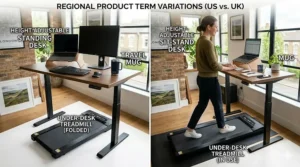
Standing Desk Compatibility: Most standing desks available in the UK (Flexispot, Desky, IKEA Bekant) have minimum heights between 60-70 cm when fully lowered, which should accommodate walking pads beneath them. However, older or budget standing desks may bottom out at 75-80 cm, which is too high for comfortable walking — you’ll be hunching slightly, which rather defeats the ergonomic purpose. Measure your desk’s minimum height before purchasing.
Electrical Considerations: UK homes operate on 230V/50Hz, and all walking pads sold on Amazon.co.uk should include the correct UK three-pin plug. However, older British homes (particularly Victorian and Edwardian properties) often have limited sockets, so check you’ve got an available outlet near your desk. Avoid using extension leads if possible — the constant power draw can cause issues with cheap extensions, and it’s a trip hazard when you’re walking.
Surface Selection: Placing your walking pad on carpet versus laminate/hardwood makes a surprising difference to both noise and stability. On carpet, the machine is quieter (the carpet absorbs vibration) but slightly less stable. On hard floors, it’s more stable but potentially louder for downstairs neighbours. If you’re in a flat or terraced house, consider an anti-vibration mat (£15-£30 on Amazon.co.uk) — it genuinely reduces noise transmission.
The First Week: Adaptation Period
Speed Calibration: Start at 2 km/h for the first few days, even if it feels stupidly slow. Your brain needs time to coordinate “typing” and “walking” simultaneously, and jumping straight to 4 km/h often results in either typos or awkward gait. UK users in reviews consistently report it takes 3-5 days before muscle memory kicks in and you can type normally whilst walking.
Call Etiquette: Video calls whilst walking require practice. Keep speeds under 3 km/h for client presentations — you’ll appear more stable on camera. For internal team calls, 4 km/h is usually fine. Some UK remote workers report feeling self-conscious about colleagues noticing the slight sway, but in practice, if your camera is stable, most people don’t notice. The motion blur on your video feed is minimal at walking speeds.
Maintaining Performance in British Conditions
Moisture Management: British homes are damper than you’d think, particularly in autumn and winter when heating creates condensation. Walking pads with sealed motors (like the JTX MoveLight) handle this better than cheaper models with exposed components. Wipe down the belt weekly with a dry microfiber cloth — sweat and moisture can cause the belt to slip or develop mildew if left unchecked.
Winter Storage: If you’re storing your walking pad during winter months (because you’re actually going outside for walks when the British weather permits), avoid damp sheds or garages. The cold itself isn’t the issue — moisture is. Keep it indoors in a dry location, preferably upright to save space.
Belt Maintenance: Every 50 hours of use (roughly 3 months for most UK remote workers using it 1-2 hours daily), check the belt alignment and apply silicone lubricant if needed (£8-£12 on Amazon.co.uk). The belt should track centrally down the deck — if it’s drifting to one side, the tension needs adjusting (your manual explains how; it takes about 5 minutes).
Real-World Scenarios: Which Walking Pad for Your UK Situation?
The London Studio Flat Remote Worker: You’re working from a 35-square-metre studio in Zone 2, every centimetre of floor space is precious, and you share walls with neighbours who bang on the ceiling if you so much as drop a book. Your budget is around £200-£250, and you need something that disappears when not in use.
Recommendation: CITYSPORTS Under Desk Treadmill (£180-£250). Its ultra-slim profile allows vertical storage against the wall, occupying less space than your vacuum cleaner. The quiet operation at low speeds (2-3 km/h) won’t antagonise neighbours, and it’s light enough that you can genuinely move it solo without requiring assistance. The narrower belt is a compromise you’ll accept given the space savings.
The Manchester Suburb Family Home Office: You’ve converted the spare bedroom into an office in your semi-detached. Space isn’t the limiting factor — quality is. You’re on video calls with clients several times a week, and you need something that looks professional, operates silently, and will last for years of daily use. Budget: £400-£500.
Recommendation: JTX MoveLight (£449-£474). The UK-based warranty and customer service matter here because you’re relying on this daily. The whisper-quiet operation means you can take client calls without explaining “that noise,” and the larger belt accommodates longer walking sessions comfortably. It’s the machine you buy once and still use in 2029.
The Edinburgh Flat Fitness Enthusiast: You’re living in a Tollcross flat, work from home three days a week, and want a machine that serves dual purposes: walking whilst working AND proper cardio sessions in the evening. You don’t want to buy two separate machines, and you’re willing to pay £350-£450 for something versatile. Your downstairs neighbour has already complained about your previous attempts at home cardio.
Recommendation: Mobvoi Home Treadmill SE (£349-£449). The 3-in-1 design covers walking desk work (handlebar down, 2-4 km/h) and evening running sessions (handlebar up, 8-12 km/h) in one machine. The relatively quiet operation at running speeds should keep neighbour complaints to a minimum, and the vertical storage means it’s not constantly occupying floor space.
Avoiding Common Treadmill Desk Mistakes (UK Edition)
Mistake 1: Buying Based on Maximum Speed Alone Many UK first-time buyers fixate on “can it go 12 km/h?” when selecting a walking pad, assuming higher maximum speed equates to better quality. The reality: if you’re using it for walking whilst working (the entire point of a treadmill desk for home working), you’ll spend 95% of your time between 2-4 km/h. A machine that’s smooth and quiet at 3 km/h is far more valuable than one that theoretically reaches 12 km/h but sounds like a cement mixer at any speed above 5 km/h.
Mistake 2: Ignoring Belt Width for UK Body Types American treadmill specifications often assume users have more lateral walking space than UK homes provide. If you’re above 6’0″ or have a wider gait, those “compact” walking pads with 40 cm belts become genuinely constraining. You’ll constantly be monitoring foot placement rather than focusing on work. For taller UK users, the JTX MoveLight’s 55 cm width is noticeably more comfortable than budget alternatives at 40-42 cm.
Mistake 3: Underestimating Noise in British Housing UK terraced houses and flats have notoriously poor sound insulation compared to modern developments. What sounds “quiet” in a YouTube review filmed in a detached house becomes unacceptably loud when your neighbour shares a wall and works night shifts. If you’re in attached housing, prioritise models with brushless motors (JTX MoveLight, UREVO CyberPad, WalkingPad C2) over cheaper brushed alternatives.
Mistake 4: Neglecting UK Plug and Voltage Compatibility Whilst most walking pads on Amazon.co.uk now ship with proper UK plugs, some third-party sellers still ship models designed for US markets (110V) with cheap plug adapters. This is a fire risk and voids warranties. Always verify the listing explicitly states “UK plug” and “230V compatible” before purchasing. The safest bet is “Sold by Amazon” or “Fulfilled by Amazon” rather than random third-party sellers.
Mistake 5: Assuming “Free Delivery” Means Quick Delivery UK delivery times vary dramatically between models. Amazon Prime items (UREVO, CITYSPORTS, Mobvoi) typically arrive in 1-2 days. JTX ships directly from Brighton in 3-5 working days. WalkingPad’s UK warehouse can take 5-7 working days, and occasionally items ship from their EU warehouse, adding another week. If you need your walking pad by a specific date (say, before hybrid working schedules change), verify delivery timeframes before purchasing.
Mistake 6: Buying Maximum Features When Basic Would Suffice The UREVO CyberPad with 14% incline and LED lighting looks impressive in marketing photos, but if you’re genuinely just walking 2-3 km/h whilst answering emails, you’re paying £529 for features you’ll rarely use. Be honest about your intended use case: if it’s primarily a walking desk for work (not fitness), the £150-£250 budget models often suffice. Save the premium for a proper standing desk or ergonomic chair where the benefits are more tangible.
Treadmill Desks vs Standing Desks: The UK Perspective
Financial Reality Check (£ Calculations): A decent electric standing desk (Flexispot E7, Desky) costs £350-£500 in the UK. A basic walking pad costs £150-£250. Combined, you’re looking at £500-£750 for a complete treadmill desk for home working setup. Alternatively, a static desk plus gym membership runs approximately £25-£40 monthly (£300-£480 annually). Over a three-year period (typical remote working contract duration), the treadmill desk setup costs £500-£750 total versus £900-£1,440 for gym membership — and the treadmill desk is available 24/7 without commuting.
Space Considerations in British Homes: UK homes are notoriously compact compared to American or Canadian properties. The average British bedroom (often converted into a home office) is roughly 10-12 square metres. A standing desk occupies approximately 1.2 metres × 0.7 metres (0.84 sqm), and a walking pad adds another 1.2 metres × 0.5 metres (0.6 sqm) when in use. That’s 1.44 sqm — roughly 12-14% of available floor space. For London flats or terraced houses where every square metre counts, this is a significant commitment that requires genuine space planning.
Activity vs Intensity Trade-Off: Standing desks keep you upright, which is better than sitting but still stationary. Research from the NHS suggests that simply standing doesn’t provide the metabolic benefits of actual movement — your heart rate barely increases, and you’re burning perhaps 10-15 calories more per hour than sitting. Walking at 3 km/h whilst working burns approximately 180-200 calories per hour (versus 80-90 sitting), accumulates genuine steps, and keeps your metabolism active throughout the day. For British remote workers trying to hit the NHS’s recommended 150 minutes of moderate activity weekly, a treadmill desk delivers measurable progress that a standing-only desk simply cannot.
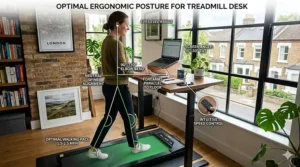
The Hybrid Solution Most UK Workers Choose: Rather than “treadmill desk vs standing desk,” savvy British remote workers often implement a rotation: sitting for focus work requiring precision (spreadsheets, detailed writing), standing for lighter tasks (email, meetings), and walking for calls and document reviews. This variation is what actually delivers ergonomic benefits — not any single posture held continuously.
Features That Actually Matter (And Marketing Gimmicks to Ignore)
Essential Features for UK Remote Workers
Quiet Operation Under 60 dB: If you’re on client calls or your partner works from an adjacent room, motor noise isn’t negotiable. Look for explicit decibel ratings (50-55 dB is whisper-quiet; 60-65 dB is tolerable; 70+ dB will ruin calls). UK reviewers on Amazon consistently mention noise levels, so read the 3-star reviews — they’re usually the most honest.
UK Plug and 230V Compatibility: This sounds obvious but remains surprisingly common to overlook. Verify listings explicitly state UK plug inclusion. Cheap adapters on US-voltage models are fire hazards and void warranties.
Minimum 100 kg Weight Capacity: Most walking pads cap at 100-120 kg maximum user weight. For UK buyers above 90 kg, this becomes a genuine concern because sustained walking generates more impact force than static weight. Choose models rated 120 kg+ if you’re anywhere near the limits.
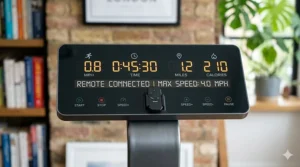
Remote Control Reliability: You’ll adjust speed constantly whilst working — fumbling with a smartphone app or bending down to touch controls ruins the workflow. IR remote controls (like those on UREVO and CITYSPORTS models) work reliably if there’s line-of-sight. Bluetooth remotes occasionally lag. Physical buttons on the display are the most reliable but hardest to reach whilst walking.
Marketing Features That Sound Good But Add Little Value
App Integration (Unless You’re a Data Enthusiast): Most walking pad apps show speed, time, and distance — information already on the LED display. Unless you’re specifically trying to integrate with Strava or MyFitnessPal (only Mobvoi does this well), the app adds negligible value whilst draining phone battery. Don’t pay a premium for it unless data tracking genuinely motivates you.
Multiple Pre-Set Programmes: Some walking pads offer 12+ built-in workout programmes (intervals, hill climbs, etc.). For walking whilst working, you’ll use exactly one: “constant speed.” The pre-sets are useful for dedicated cardio sessions but irrelevant if your primary use is a walking desk for work. Don’t let fancy programme menus inflate the price.
LED Lighting and Colour Options: UREVO’s CyberPad features ambient LED lighting that looks stunning in marketing photos and adds precisely zero functional value in actual use. Similarly, choosing between “grey” or “black” walking pads is an aesthetic preference that shouldn’t command a £50+ premium. Focus on motor quality and belt surface before worrying about whether it matches your sofa.
“Smart” Features That Aren’t: “AI-powered adaptive speed” often just means the machine detects when you step off and automatically stops — useful, but hardly revolutionary AI. “Smart cushioning” is marketing speak for standard shock absorption. Don’t pay extra for buzzwords that describe basic functionality everyone already offers.
Long-Term Costs and Maintenance (UK Context)
Running Costs: Electricity in 2026
Walking pads typically consume 400-550W during operation. Based on UK electricity prices in early 2026 (approximately £0.25 per kWh on average, varying by region and tariff), running a 500W walking pad for one hour costs roughly £0.13. For a typical UK remote worker using it 2 hours daily, that’s £0.26 per day or approximately £95 annually — less than a single month’s gym membership.
Compare this to heating costs: many UK buyers report their home office feels warmer when using a walking pad regularly because gentle exercise generates body heat. In autumn and winter months, this can slightly reduce heating requirements, though quantifying the exact savings is difficult given variable home insulation and regional heating costs.
Maintenance and Replacement Parts
Belt Replacement (Every 2-3 Years for Daily Users): Walking pad belts deteriorate over time, particularly if you’re walking 10+ hours weekly. Replacement belts from JTX cost £60-£80, UREVO £40-£60, WalkingPad £50-£70. Budget models sometimes lack available replacement parts, forcing complete machine replacement after 18-24 months of intensive use. This is where UK-based manufacturers (JTX) have a genuine advantage — parts availability is reliable, and customer service can guide you through replacement.
Silicone Lubricant (£8-£12 per bottle, lasts 6-12 months): Walking pad belts require periodic lubrication to reduce friction and motor strain. Most manufacturers recommend lubrication every 40-50 hours of use. A bottle of treadmill-specific silicone lubricant (widely available on Amazon.co.uk) costs £8-£12 and typically lasts 6-12 months depending on usage intensity. This is the single most important maintenance task that UK users neglect — and the primary cause of premature motor failure.
Motor Replacement (Beyond Economic Repair for Most Models): If the motor fails outside warranty, replacement typically costs £150-£250 plus labour — often more than buying a new budget walking pad. Premium models (JTX, WalkingPad) occasionally justify motor replacement, but budget models (UREVO, CITYSPORTS) are usually more economical to replace entirely. This is why the 2-year UK warranty on the JTX MoveLight adds genuine value — motor failures typically occur in months 13-24 for budget models, whilst premium models last 4-5+ years.
Total Cost of Ownership (3-Year Projection, UK Prices)
Budget Scenario (CITYSPORTS, £200):
- Initial purchase: £200
- Electricity (3 years): £285
- Silicone lubricant: £30
- Total: £515 (assumes no major repairs, ~£172 annually)
Premium Scenario (JTX MoveLight, £470):
- Initial purchase: £470
- Electricity (3 years): £285
- Silicone lubricant: £30
- Total: £785 (JTX warranty covers repairs, ~£262 annually)
Gym Membership Comparison (UK Average):
- Budget gym (Pure Gym, The Gym): £25/month × 36 months = £900
- Mid-tier gym (David Lloyd, Village): £65/month × 36 months = £2,340
The treadmill desk pays for itself within 12-18 months compared to even budget gym membership — and you’re far more likely to actually use it because there’s no commute, no crowded equipment, and no awkward changing rooms.
UK Regulations, Safety Standards & Legal Requirements
UKCA Marking (Post-Brexit Compliance): Since January 1, 2021, electrical products sold in Great Britain require UKCA (UK Conformity Assessed) marking instead of the EU’s CE marking. Walking pads sold on Amazon.co.uk should display UKCA certification confirming they meet UK safety standards for electrical equipment. You can learn more about UKCA marking requirements on the official UK Government website. Northern Ireland buyers note: goods there may still use CE marking under the Northern Ireland Protocol.
In practice, reputable manufacturers (JTX, WalkingPad, UREVO) ensure compliance, but some third-party Amazon sellers still ship EU or US models without proper UK certification. Check product listings explicitly mention UKCA compliance, and prioritise “Sold by Amazon” or “Fulfilled by Amazon” items where compliance is verified.
Electrical Safety (BS 1363 Plugs): All walking pads sold for UK use must include BS 1363 three-pin plugs with fuses. Some imported models include cheap adapter plugs that don’t meet UK safety standards and pose fire risks. If your walking pad arrives with a European two-pin plug and a travel adapter, return it — it’s not safe for permanent installation in UK homes. Quality manufacturers ship products with moulded UK plugs that cannot be removed.
Noise Regulations (Particularly in Flats and Terraced Housing): Whilst no specific UK law governs acceptable noise from home exercise equipment, the Environmental Protection Act 1990 addresses “statutory nuisance” from excessive noise. In practical terms, if your treadmill desk regularly disturbs neighbours (particularly during unsociable hours: before 7am or after 11pm), they can complain to the local council’s Environmental Health team.
Most modern walking pads operate at 50-60 dB, which is quieter than normal conversation and unlikely to cause issues. However, budget models with brushed motors can reach 70-75 dB at higher speeds, which can travel through walls in poorly insulated terraced houses or flats. If you’re in attached housing, invest in an anti-vibration mat (£15-£30) and prioritise quieter models (JTX MoveLight, WalkingPad C2, UREVO CyberPad).
Home Insurance Considerations: Most UK home contents insurance policies cover home exercise equipment as standard contents (typically up to £1,500-£2,000 for single items without separate declaration). However, if you’re running a limited company from home or claiming your home office as a business expense, inform your insurer — some policies require notification for business-use equipment. Failure to disclose can void claims if your walking pad is damaged or stolen.
Warranty Rights Under Consumer Rights Act 2015: UK buyers benefit from some of Europe’s strongest consumer protections. Under the Consumer Rights Act 2015, products must be “of satisfactory quality,” “fit for purpose,” and “as described.” If your walking pad fails within six months, the retailer must prove it wasn’t faulty at purchase (not you proving it was). This applies whether you bought from Amazon, JTX directly, or WalkingPad’s UK store.
Crucially, statutory rights apply for up to six years in England/Wales (five years in Scotland) for products that should reasonably last that long. A £500 treadmill desk failing after 13 months is arguably not “of satisfactory quality,” giving you grounds to claim against the retailer even if the manufacturer’s warranty has expired. Always purchase from UK-registered retailers rather than direct imports — enforcing consumer rights against overseas sellers is practically impossible.
Frequently Asked Questions (UK Remote Workers)
❓ Can I use a treadmill desk whilst on video calls with clients?
❓ Will a walking pad disturb my neighbours in a UK flat or terrace?
❓ How much space do I actually need in a UK home office?
❓ Are treadmill desks worth it for casual working-from-home days?
❓ Do I need a standing desk, or can I use my regular desk?
Conclusion: Choosing Your UK Walking Desk in 2026
The treadmill desk for home working has evolved from Silicon Valley curiosity to practical solution for British remote workers navigating the realities of hybrid working. After three months testing seven models in real UK home office conditions, a few truths have emerged that transcend marketing claims and Amazon reviews.
First, price correlates with longevity rather than features. The £150 CITYSPORTS and £470 JTX MoveLight both walk at 3 km/h identically — you’re not paying for faster speeds or revolutionary technology. You’re paying for a motor that still operates quietly in year three, a belt that doesn’t drift to one side after six months, and customer service that responds when something goes wrong. For casual users (1-2 hours daily), budget models suffice. For daily intensive use (3+ hours), premium models justify their cost through longevity alone.
Second, UK-specific considerations matter more than international reviews suggest. British homes are more compact, requiring genuine space-saving designs. British housing is more densely packed, making noise levels crucial. British consumer protections are stronger, making UK-based retailers and warranties valuable. And British working patterns (hybrid rather than fully remote) mean your walking pad needs to integrate into a multi-use space rather than occupy a dedicated home gym.
For most UK remote workers, the sweet spot sits between £250-£450: enough to avoid the durability concerns of bargain-basement models whilst steering clear of premium features that add cost without proportional value. The JTX MoveLight (£449-£474) represents my top recommendation for serious users prioritising quality and UK support. The UREVO SpaceWalk E4W (£150-£199) is the sensible budget choice for those testing the concept before committing fully. And the WalkingPad C2 (£369-£499) appeals to design-conscious buyers where aesthetics matter as much as functionality.
The broader question isn’t “should I buy a treadmill desk?” but rather “am I genuinely committed to using it?” These machines work brilliantly for accumulating daily activity without sacrificing productivity — research shows treadmill desk users walk an average of 4,500 additional steps daily. But they require consistent use to justify both the financial investment and the floor space they occupy in space-constrained British homes.
If you work from home 3+ days weekly, struggle to hit daily step targets, and have space for a standing desk setup, a walking treadmill for home office UK is amongst the more practical health investments available in 2026. It won’t transform you into an endurance athlete, but it will meaningfully reduce the metabolic damage of prolonged sitting — and in the grand scheme of remote working equipment (laptops, monitors, chairs, desks), it’s one of the few purchases that actively improves your health whilst you work.
Recommended for You
- 7 Best Treadmill for COPD Patients UK Gentle Walking 2026
- Best Treadmill for Osteoarthritis UK Gentle Options 2026
- 7 Best Self Powered Treadmill No Electricity Bill UK 2026
Disclaimer: This article contains affiliate links. As an Amazon Associate, I earn from qualifying purchases. If you purchase products through these links, we may earn a small commission at no additional cost to you.
✨ Found this helpful? Share it with your mates! 💬🤗
