
In This Article
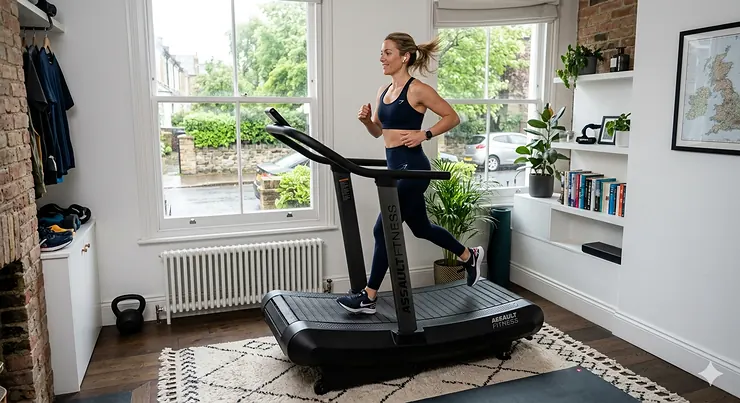
There’s something quietly radical about a non electric treadmill. No motor. No power cable trailing across your living room. No electricity bill ticking upward with every kilometre. Just you, your legs, and a belt that moves precisely as fast as you push it — not one millimetre faster.
It sounds almost retro, doesn’t it? And yet, the non electric treadmill uk best models market has been expanding steadily through 2025 and into 2026, driven by a very British cocktail of concerns: rising energy costs, compact city flats with no spare socket near the spare room, and a growing interest in biomechanically natural movement. British physiotherapists and running coaches have been quietly recommending self-powered treadmills for years. The rest of us are only just catching up.
A non electric treadmill — also called a manual treadmill, non-motorised treadmill, or self-powered treadmill — is precisely what it sounds like. The belt doesn’t move until you move it. There’s no 500-watt motor humming beneath your feet. This means near-silent operation (your downstairs neighbour in the flat below will actually thank you), zero running electricity costs, and significantly less to go wrong mechanically. According to Wikipedia’s overview of treadmill mechanics, early treadmills were entirely human-powered, and the engineering principle hasn’t changed — what has changed is how cleverly modern manufacturers have refined the experience.
There are two distinct categories you need to understand before browsing: flat manual treadmills, which are the budget-friendly, compact, foldable machines ideal for walking and light jogging; and curved manual treadmills, which are the arched, slat-belt beasts favoured by serious runners, CrossFit athletes, and anyone who wants an absolutely brutal calorie burn without a power outlet in sight. Both have their place. Both will feature in this guide.
We’ve researched the non electric treadmill uk best models currently available on Amazon.co.uk and direct to UK buyers, covering price ranges from under £150 to well over £2,000, so whatever your budget or fitness ambition, there’s something here that’ll suit your home and your goals.
Quick Comparison: Non Electric Treadmill UK Best Models at a Glance
| Model | Type | Belt Size (approx.) | Max User Weight | Price Range | Best For |
|---|---|---|---|---|---|
| Sunny Health & Fitness SF-T1407M | Flat manual | 107cm × 33cm | 100kg | Under £150 | Budget walkers, small flats |
| HOMCOM Non-Motorised Incline Treadmill | Flat manual w/ incline | 100cm × 36cm | 90kg | £120–£180 | Incline walkers, compact spaces |
| Ultrasport F-Walker 100B | Flat manual | 96cm × 32cm | 100kg | £100–£160 | Beginners, tight budgets |
| HXD-ERGO Curved Treadmill | Curved manual | 150cm × 46cm | 150kg | £600–£900 | Intermediate runners, home gyms |
| Primal Strength Curved Manual Treadmill | Curved manual | 152cm × 51cm | 150kg | £1,500–£2,000 | Serious runners, UK brand |
| NOHRD Sprintbok | Curved manual | 158cm × 50cm | 150kg | £4,500–£6,000 | Premium, design-conscious buyers |
| AssaultRunner Pro | Curved slat-belt | 155cm × 43cm | 180kg | £2,500–£3,500 | Athletes, CrossFit, commercial use |
What the table tells you: There’s a dramatic split between the flat budget machines (under £200) and the curved premium ones (£600 and above). For pure walking fitness at home, the affordable flat models more than do the job. But if you want to run — genuinely run, with power and pace — the curved options deliver a fundamentally different workout experience. The mid-range is thin, which is why the HXD-ERGO sits in interesting territory: it’s the first rung on the curved-treadmill ladder that doesn’t require a second mortgage.
✨ Don’t Miss These Exclusive Deals!
🔍 Take your fitness to the next level with these carefully selected manual treadmills. Click on any highlighted item to check current pricing and availability on Amazon.co.uk. Whether you’re after a compact folder or a serious curved runner — these picks will help you find exactly what you need!
💬 Just one click — help others make better buying decisions too! 😊
Top 7 Non Electric Treadmill UK Best Models: Expert Analysis
1. Sunny Health & Fitness SF-T1407M Manual Walking Treadmill
The SF-T1407M is the entry point into non-electric fitness that most UK buyers encounter first — and for good reason. It’s compact, folds flat, and requires precisely zero electricity to operate. The running belt measures approximately 107cm × 33cm (42″ × 13″), which is modest but adequate for steady walking. A small LCD display runs on AA batteries and tracks time, speed, distance, and calories — enough data to keep you honest without requiring a PhD to navigate.
What does this mean in practice for a UK buyer? If you live in a flat or a terraced house in Sheffield, Bristol, or anywhere else where the “spare room” is also the ironing room and the cat’s room, the SF-T1407M is genuinely workable. It weighs around 18kg, folds in half, and can stand vertically in a corner or slide behind a sofa. The built-in transport wheels are a small but genuinely useful touch.
Here’s what most buyers overlook: the fixed incline. Unlike motorised treadmills where you dial in your gradient, this machine has a slight, permanent incline built into the frame — roughly 10-13% — which is what keeps the belt moving under your feet. You can’t flatten it. For some people, that’s ideal (incline walking is genuinely good for glutes and calories). For others who want a truly flat walk, it’s a frustration. Factor that in before purchasing.
UK customer feedback is broadly positive for the walking application, though several UK reviewers note the belt can feel stiff initially and benefits from a light silicon spray every few months — easy enough maintenance in exchange for zero electricity costs.
Pros:
✅ Genuinely compact and foldable — fits most UK flats and terraced houses
✅ Zero running electricity costs, near-silent operation
✅ Battery-powered LCD monitor included at this price
Cons:
❌ Fixed incline only — not adjustable
❌ 100kg maximum user weight is on the lower side
Price range: Under £150 — exceptional value for a no-frills walking solution. Available on Amazon.co.uk, often Prime-eligible. Check current price on Amazon.co.uk.
2. HOMCOM Non-Motorised Manual Treadmill with Adjustable Incline
HOMCOM is a brand that UK shoppers know well through Amazon.co.uk, and their non-motorised treadmill is a step up from the Sunny in one important respect: adjustable incline. Most models in this range offer two to three incline positions, which is a meaningful upgrade if variety matters to your training.
The belt surface sits at around 100cm × 36cm — comparable to the SF-T1407M, and similarly suited to brisk walking rather than all-out jogging. The battery-powered LCD provides the same essential metrics. Handlebar height is adjustable between approximately 105cm and 120cm, which is genuinely useful for UK households where more than one person might be using the machine.
HOMCOM targets the budget-conscious UK buyer who wants a touch more flexibility than the absolute entry-level machines offer. The adjustable incline means you can simulate a gentle hillside walk (good for cardiovascular benefit without impact) or drop to the lower setting for steady-state movement. British physio guidance increasingly supports incline walking as a joint-friendly alternative to running — particularly relevant for anyone returning to exercise after a knee injury or managing conditions like osteoarthritis. You can read more about the NHS guidance on low-impact exercise for context on why this matters.
UK buyers do note that the build feels slightly lightweight at this price tier — appropriate for daily walking, but not for anyone who wants to push into jogging territory regularly. Max user weight sits around 90kg on most variants, so do check the specific listing you’re purchasing.
Pros:
✅ Adjustable incline adds genuine workout variety
✅ Good storage solution — folds compactly
✅ Affordable with Amazon.co.uk availability and UK-compatible (no mains power needed)
Cons:
❌ Lower max user weight than some competitors
❌ Belt width is modest for anything beyond walking pace
Price range: £120–£180. A sensible mid-entry budget choice. Check current price on Amazon.co.uk.
3. Ultrasport F-Walker 100B Treadmill
Ultrasport is a German brand with solid UK distribution through Amazon.co.uk, and the F-Walker 100B is their flat-belt manual offering that occupies the same budget tier as the HOMCOM and Sunny options. What distinguishes it slightly is build quality perception: the frame feels marginally sturdier under foot than some purely budget competitors, and the brand’s customer service reputation in the UK market is generally more consistent.
The running surface is approximately 96cm × 32cm — slightly shorter than the SF-T1407M, which is worth noting if you have a longer stride. Belt resistance is manually adjustable via a tension knob, which gives you a degree of workout customisation that pure fixed-belt models don’t offer. Higher resistance means more effort per stride — effectively simulating a heavier incline without changing the frame angle.
For the UK buyer in a mid-terrace in Manchester or a purpose-built flat in Leeds who has decided that daily walking is the fitness priority, the F-Walker 100B is a solid, unfussy choice. It doesn’t do anything flashy. It doesn’t need to. Quiet, compact, electricity-free, and available via Amazon Prime for next-day delivery to most UK addresses — sometimes that’s genuinely all you need.
One real-world caveat worth mentioning: no electricity means no fan, no audio, no touchscreen. If your motivation depends heavily on entertainment technology, you’ll want your phone or tablet set up independently before stepping on. Most UK flat-belt manual treadmill users find a podcast or audiobook from their phone more than sufficient.
Pros:
✅ Adjustable belt resistance for workout variety
✅ German brand with reliable UK customer support
✅ Slightly more robust feel than comparable budget alternatives
Cons:
❌ Shorter belt surface — less comfortable for taller users
❌ Basic LCD monitor lacks app connectivity
Price range: £100–£160. Available on Amazon.co.uk, typically Prime-eligible. Check current price on Amazon.co.uk.
4. HXD-ERGO Curved Manual Treadmill
This is where things get genuinely interesting. The HXD-ERGO is a curved non electric treadmill — and if you’ve never run on a curved belt before, prepare for a revelation. The arched running surface means your foot naturally strikes the belt at the front of the curve, driving it backwards as you push off. The result is a running action that activates the posterior chain (hamstrings, glutes, calves) significantly more than a flat motorised treadmill, while also encouraging a midfoot strike rather than the heel-strike that motorised belts subtly promote.
British physiotherapists have begun recommending curved treadmills more frequently, and the reasons are sound: the self-paced nature means you literally cannot outrun the belt, the running form tends to improve naturally, and the impact characteristics are more akin to outdoor running on grass. According to research highlighted by Sport England’s active living resources, natural movement patterns are increasingly prioritised in rehabilitation and fitness guidance.
The HXD-ERGO sits at the more accessible end of the curved treadmill market, making it the obvious recommendation for a UK buyer who wants curved-belt performance without the commercial-grade price tag of an AssaultRunner or NOHRD Sprintbok. At approximately 150cm × 46cm running surface and a 150kg user weight limit, it handles real running comfortably. Bluetooth app connectivity allows progress tracking — a feature absent on budget flat models.
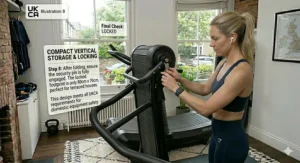
Worth noting for British buyers: the HXD-ERGO is foldable, which is relatively unusual in the curved treadmill category and addresses the perennial UK storage problem elegantly. It won’t slide under a bed, but it will stand upright in a hallway or garage without taking over the room.
Pros:
✅ Curved belt encourages natural running form and greater calorie burn
✅ App connectivity for progress tracking
✅ Foldable design — unusual and valuable in the curved category
Cons:
❌ Significant step up in price from flat manual models
❌ Requires more initial effort to get the belt moving — not ideal for casual walkers
Price range: £600–£900. Available to UK buyers via Amazon.co.uk. Check current price on Amazon.co.uk.
5. Primal Strength Curved Manual Treadmill
Here’s a bit of welcome home-team news: Primal Strength is a British fitness equipment brand, and their curved manual treadmill has earned genuine respect among UK gym owners and serious home athletes alike. If you’re looking for a non electric treadmill that’ll still feel like a worthwhile investment in five years’ time, this is where the conversation gets serious.
The running surface runs to approximately 152cm × 51cm, which is generous — comparable to commercial gym machines. The slat-belt construction (individual rubber slats rather than a continuous fabric belt) means the ride quality is noticeably better: more responsive underfoot, better grip, and longer-lasting than traditional flat belts. The self-powered mechanism responds immediately to pace changes, making it excellent for interval training and HIIT sessions.
For UK buyers, there’s a practical advantage beyond national pride: parts availability and customer support are easier to navigate when the brand operates from British soil. Post-Brexit, sourcing warranty components for EU-manufactured gym equipment can sometimes involve unexpected delays or import considerations. A UK-based brand sidesteps that entirely.
Who should buy this? The home athlete who runs 4-5 times per week, does interval sessions, and understands that spending properly once is considerably less painful than replacing cheap equipment every two years. Buyers in cities where gym memberships run £80–£120 per month will recoup the price difference faster than they might expect.
Pros:
✅ UK brand — straightforward warranty, parts, and support
✅ Commercial-grade slat belt construction for long-term durability
✅ Excellent for HIIT and interval training
Cons:
❌ Premium price point requires considered investment
❌ Non-folding — you need a dedicated space of roughly 2m × 1m
Price range: £1,500–£2,000. Available via UK fitness retailers and Amazon.co.uk. Check current price on Amazon.co.uk.
6. NOHRD Sprintbok Curved Treadmill
There are premium products, and then there are products that make you slightly emotional when you look at them. The NOHRD Sprintbok — available in ash, walnut, cherry, and oak wood finishes — is firmly in the second category. This is a German-engineered curved manual treadmill built around real hardwood side rails, and it looks absolutely nothing like the black-and-red plastic machines you’d find in a high street gym.
If you’re fitting a home gym in a period property — a Victorian terrace in Bath, say, or a converted barn in the Cotswolds — the Sprintbok doesn’t assault the aesthetic the way most gym equipment does. It looks like furniture that happens to be a world-class running machine. That matters more than it sounds.
Performance-wise, the Sprintbok delivers genuine commercial-grade capability: a wide 158cm × 50cm running surface, smooth self-powered belt that responds instantly to effort, and a 150kg user weight capacity. It’s quiet enough that you won’t disturb anyone through period walls — important in older UK housing stock where sound travels freely.
At this price, you’re also buying a machine that will genuinely last decades with basic maintenance. The NOHRD brand, part of the WaterRower family, has a track record in UK homes that’s difficult to argue with. UK buyers can access the Sprintbok through specialist retailers and Amazon.co.uk marketplace sellers — do verify Amazon.co.uk availability and check for Prime delivery options on the specific listing at the time of purchase.
Pros:
✅ Extraordinarily beautiful — design that works in real living spaces
✅ Commercial performance from a machine that looks at home in your study
✅ Built to last decades, not years
Cons:
❌ Very significant investment — not a casual purchase
❌ Limited colour/style choice compared to its electric counterparts
Price range: £4,500–£6,000. Available through specialist UK fitness retailers and Amazon.co.uk marketplace. Check current pricing and availability on Amazon.co.uk.
7. AssaultRunner Pro Curved Slat Treadmill
The AssaultRunner Pro is to curved manual treadmills what a Land Rover Defender is to cars: built to work hard, designed without unnecessary frills, and respected by professionals who depend on equipment day after day. It’s a fixture in CrossFit boxes and elite training facilities across the UK, and its reputation among competitive athletes is essentially unimpeachable.
The slat belt construction uses individual rubber segments rather than a continuous belt, providing superior grip, better energy return, and a maintenance cycle that’s vastly simpler than traditional belt-and-deck systems. The running surface at approximately 155cm × 43cm is slightly narrower than some competitors, but athletes consistently report it feels natural — the design encourages proper lane discipline in your stride, which actually improves form over time.
Bluetooth and ANT+ connectivity means you can pair it with fitness apps including Zwift and the Assault Fitness App — useful for data nerds who want their non-electric session tracked in the same ecosystem as the rest of their training. Max user weight sits at a very comfortable 180kg, the highest of any model in this guide, making it genuinely inclusive for a wider range of users.
For UK buyers: the AssaultRunner Pro is available on Amazon.co.uk and from UK fitness equipment distributors. At this investment level, factor in whether your floor can handle the weight — at approximately 80kg, you’ll want solid flooring under it, ideally a good quality rubber gym mat to protect both machine and surface.
Pros:
✅ Battle-tested in elite UK training environments — this machine genuinely handles punishment
✅ Highest user weight capacity in our guide at 180kg
✅ App connectivity (Zwift, Assault App) for data-driven training
Cons:
❌ Significant price tag that requires serious fitness commitment to justify
❌ Narrower belt width than some premium competitors
Price range: £2,500–£3,500. Available on Amazon.co.uk. Check current price on Amazon.co.uk.
How a Non Electric Treadmill Fits Into Real British Home Life
The “Where on Earth Do I Put It?” Problem — Solved
Let’s be honest about something. The single biggest objection to any home gym equipment in the UK isn’t price. It’s space. The average British home is considerably smaller than its American or Australian equivalent. We have terraced houses where the “exercise room” is also the box room, also the guest room, also the room where old Amazon parcels accumulate because you couldn’t be bothered taking them to the recycling centre.
This is where non-electric treadmills divide sharply by type.
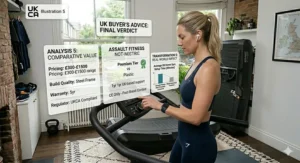
The flat budget models — your SF-T1407M, HOMCOM, and Ultrasport options — are genuinely compact. The SF-T1407M folds to approximately 51cm × 58cm × 127cm when vertical, which means it stands in a corner without significantly intruding. In a typical two-bedroom terrace in Leeds, Birmingham, or Cardiff, this is entirely workable. You set it up, use it, fold it away. The lack of a power cable is, surprisingly, one of the most practical aspects — no socket required means you can use it in almost any room, including unheated garages or garden rooms where running a cable would be inconvenient.
The curved models are a different calculation. The AssaultRunner Pro, NOHRD Sprintbok, and Primal Strength machines are large, heavy, and non-folding. They need a dedicated footprint of approximately 200cm × 100cm, plus 1–2 metres of clearance behind for safe use. For a detached house or ground floor flat with a garage, that’s fine. For a second-floor flat in Hackney, it’s a conversation you’ll need to have with yourself — and quite possibly with your structural engineer.
UK Climate Considerations: The Garage and Garden Room Question
British winters are mild by global standards but relentlessly damp, and that matters for fitness equipment stored in garages or outbuildings. The good news about non-electric treadmills: no motor means no electrical components at risk of moisture ingress. The belt, rollers, and frame are the main concerns.
For flat manual treadmills stored in unheated spaces, a simple precaution is applying a light coat of silicon lubricant to the belt and deck every three to six months — more frequently in Scotland and the wetter western regions. A breathable equipment cover (widely available on Amazon.co.uk for under £20) prevents dust and condensation buildup. The Health and Safety Executive guidance on equipment maintenance is worth a glance if you’re setting up a home gym in a shared or commercial space.
For premium curved machines like the NOHRD Sprintbok with its hardwood elements, a temperature-controlled environment is genuinely recommended. Sustained damp and cold can affect the wood over years. The living room, not the garage, is the natural home for a £5,000 piece of furniture-grade fitness equipment.
Who Should Actually Buy a Non Electric Treadmill? Real UK Scenarios
Scenario 1: The London Flat Dweller, Budget Under £200
Sarah lives in a one-bedroom flat in Clapham. She’s on the second floor. She’s tried running outside in British winter and found it largely miserable. She wants to walk 30 minutes daily, can’t justify a gym membership at London prices (around £80–100 per month in Zone 2), and has approximately one square metre of floor space available next to her wardrobe.
Recommendation: Sunny Health & Fitness SF-T1407M. The compact fold means it genuinely fits her space. Zero electricity use means no concern about power cables near her only bedroom socket. The fixed incline actually works in her favour — incline walking burns more calories than flat. Total annual running cost: £0 in electricity. Payback on a gym membership equivalent: approximately 2 months.
Scenario 2: The Manchester Suburban Runner, Budget £600–£1,000
James lives in a semi-detached in Didsbury. He runs 5K three times a week but winter is disrupting his training — dark evenings, wet pavements, and the general dreariness that settles on Manchester between November and March. He has a garage he could dedicate to fitness, but the idea of a motorised treadmill running up his electricity bill doesn’t appeal.
Recommendation: HXD-ERGO Curved Treadmill. The curved belt will feel closer to outdoor running than any flat treadmill he could buy. No electricity means the garage location is perfectly practical — no extension cable needed. The improved running form benefits will carry back to his outdoor running when the clocks go forward.
Scenario 3: The Serious Home Athlete, Budget £1,500+
Kate is a former university track runner in Edinburgh who now trains around her job and two kids. She needs equipment that genuinely handles hard intervals, won’t break down after 18 months, and doesn’t have her flat mates in the tenement above complaining about motor noise at 6am.
Recommendation: Primal Strength Curved Manual Treadmill or AssaultRunner Pro. The UK-brand advantage matters at this investment level. Silent operation at 6am is a genuine lifestyle benefit in Edinburgh tenement living. The interval training capability on either machine is unmatched at this price by any motorised equivalent.
How to Choose a Non Electric Treadmill in the UK: 7 Key Criteria
Buying a non electric treadmill uk best models comes down to seven practical decisions. Work through these before opening Amazon.co.uk.
- Identify your primary use: walking or running. This is the single most important filter. If walking, a flat manual treadmill is entirely sufficient. If running (genuinely running, not jogging), you need a curved model. The belt mechanics are fundamentally different and the flat ones will frustrate runners.
- Measure your available space — honestly. Don’t measure the ideal space; measure where it will actually live. Flat folders need roughly 120cm × 60cm of floor space when in use, plus clearance behind. Curved machines need dedicated permanent space.
- Check your user weight against the specification. The listed maximum weight should be treated as a safe operating limit, not a suggestion. For longevity, aim to choose a machine rated at least 15–20kg above the heaviest user in your household.
- Consider the noise implications of your home. In flats or terraced houses, noise matters enormously. Manual treadmills are inherently quieter than motorised ones, but curved slat belts are generally quieter still at running speeds. Your downstairs neighbour will have opinions.
- Evaluate the belt surface dimensions. A 33cm (13-inch) wide belt sounds fine until you’re walking at pace and instinctively step slightly sideways. Taller users (over 185cm) with longer strides will particularly benefit from a longer belt deck — look for 107cm or more in length.
- Factor in total cost of ownership. Manual treadmills have essentially no running electricity cost and minimal maintenance requirements (belt lubrication, occasional roller adjustment). Over five years, the saving compared to a motorised machine can be considerable, particularly with current UK energy tariffs.
- Verify Amazon.co.uk availability and Prime status. For peace of mind on returns and delivery, Prime-eligible products on Amazon.co.uk are typically the safest purchase option for UK buyers, particularly for larger items where return logistics can be complicated.
What to Expect: Real-World Performance in British Conditions
Non-motorised treadmills behave differently from their electric counterparts in ways that aren’t always clearly communicated in product listings. Here’s the unvarnished version.
The “getting started” moment is different. On a motorised treadmill, the belt is already moving when you step on. On a manual treadmill, it won’t move until you push it. Some users — particularly those transitioning from electric machines — find the initial push awkward for the first few sessions. It normalises quickly, but expect a brief learning curve.
Flat belts feel harder than electric equivalents at the same apparent speed. Because you’re driving the belt yourself, the caloric demand is measurably higher. A 30-minute walk on a flat manual treadmill requires noticeably more effort than 30 minutes on an electric belt set to the same speed. For weight management goals, that’s actually an advantage — you’re working harder without necessarily increasing perceived intensity dramatically.
Curved treadmills feel significantly more demanding than flat manual machines. First-time curved treadmill users are frequently humbled. The combination of self-power, posterior chain activation, and natural running mechanics means an honest effort at curved-belt pace burns something in the region of 30% more calories than an equivalent effort on a flat electric treadmill. This is not marketing — it’s biomechanics, and it’s why curved machines have become fixtures in elite training facilities.
Cold garages slow things down — briefly. If your manual treadmill lives in an unheated garage through a British winter, the belt and rollers will feel stiffer on first use in cold weather. A two-minute warm-up walk at easy pace is sufficient to bring everything to operating temperature. This isn’t a flaw; it’s physics.
Common Mistakes When Buying a Non Electric Treadmill
Most of the buying mistakes in this category come from the same source: not fully understanding the difference between a manual treadmill and an electric treadmill with a manual incline adjustment.
Mistake 1: Confusing “manual incline” with “non-electric.” Many electric treadmills have inclines you adjust manually (by hand, not electronically), but they still have a motor driving the belt. A non electric treadmill has no motor at all. Double-check product listings carefully — the phrase “manual incline” in a product title does not mean the machine is non-electric.
Mistake 2: Buying a curved treadmill for walking. Curved treadmills are engineered for running. At walking speed, the belt resistance is disproportionately high and the experience is awkward. If your primary goal is daily walking, a flat manual treadmill is not only cheaper but genuinely more appropriate.
Mistake 3: Underestimating the weight and dimensions. At higher price points, curved machines can weigh 80–120kg. “Assembly required” listings on Amazon.co.uk can involve components arriving in multiple boxes. Check the delivery details carefully — some Amazon third-party sellers of larger gym equipment deliver to the door only, not into the room. Knowing this before delivery day saves considerable stress.
Mistake 4: Ignoring post-Brexit warranty considerations. Several European-manufactured fitness machines are sold in the UK via Amazon.co.uk marketplace. Consumer Rights Act 2015 protections apply to purchases made in the UK regardless of where the product is manufactured, but warranty claims on EU-made products may involve longer logistics than a UK-brand equivalent. UK-headquartered brands like Primal Strength sidestep this issue entirely.
Mistake 5: Skipping the gym mat. Every non-electric treadmill — regardless of price — will benefit from a dedicated rubber mat underneath. It protects your floor from belt friction and minor movement, reduces vibration transmission to lower floors (critical in flats), and extends the life of the machine by keeping debris away from rollers. They cost £20–£50 on Amazon.co.uk and are entirely worth it.
Long-Term Value: The True Cost of Going Electric-Free
Let’s run the numbers that nobody puts in the product listing.
A typical motorised home treadmill consumes between 600W and 1,500W during use. At the UK’s current residential electricity rates (roughly 24–28p per kWh as of 2026, per Ofgem’s standard tariff guidance), 30 minutes of daily use on a 1,000W motor costs approximately £3.50–£4.00 per month, or £40–£50 per year. Over five years: £200–£250 in electricity alone. Over ten years: £400–£500.
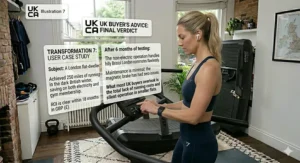
A non electric treadmill costs £0 per year to run. The saving over five years covers roughly a third of the cost of an entry-level flat manual machine, or contributes meaningfully to the cost of a higher-spec curved model.
Maintenance costs also diverge sharply. Motorised treadmills require regular belt lubrication, occasional motor servicing, and have electrical components (motor, control board, speed sensor) that can fail and require replacement. A quality manual treadmill needs belt tension adjustment and periodic lubrication — work most owners can manage themselves with a silicon spray and a spanner.
The environmental case is equally clear: a self-powered treadmill has a substantially lower carbon footprint over its lifetime than a motorised equivalent. For UK households working toward net-zero targets — or simply mindful of the carbon cost of everyday life — that’s not a trivial consideration.
| Cost Factor | Electric Treadmill | Non Electric Treadmill |
|---|---|---|
| Electricity (5 years daily use) | £200–£250 | £0 |
| Motor maintenance/replacement | £50–£200 | N/A |
| Belt lubrication | Similar | Similar |
| Control board failure risk | Present | None |
| Average 10-year running cost | £300–£500+ | Under £50 |
The long-term value case for going non-electric is, frankly, rather compelling. The upfront premium on quality models pays itself back in running costs, simpler maintenance, and — if you choose well — in durability that outlasts several generations of motorised equivalents.
Frequently Asked Questions
❓ Are non electric treadmills any good for actual running, or just walking?
❓ Can I use a manual treadmill in a flat without disturbing my neighbours?
❓ Do non electric treadmills work for weight loss?
❓ What's the maximum user weight I should look for in a UK manual treadmill?
❓ Do manual treadmills qualify for Amazon Prime delivery in the UK?
Conclusion: The Case for Unplugging Your Treadmill
The manual, non-electric treadmill doesn’t ask much of you. No socket, no subscription, no monthly motor servicing, no electricity cost quietly ticking up in the background. What it does ask is that you power the thing yourself — which, as it turns out, is rather the point.
For the vast majority of UK buyers, the right answer is shaped by three questions: How much space do you actually have? Are you walking or running? And how much do you want to spend? The SF-T1407M and HOMCOM models answer the first-category question brilliantly and honestly — they’re compact, affordable, and entirely fit for purpose as daily walking machines. The HXD-ERGO represents a genuinely exciting mid-range entry into curved running. And the Primal Strength, NOHRD Sprintbok, and AssaultRunner Pro are, simply, among the best self-powered training machines on the planet.
Whatever your budget, the non electric treadmill uk best models reviewed here represent some of the most honest fitness purchases you can make in 2026: straightforward machines that do exactly what they’re supposed to, without asking anything from your electricity supply in return.
✨ Ready to Find Your Perfect Non-Electric Treadmill?
🔍 Click on any highlighted product above to check current pricing and availability on Amazon.co.uk. All models have been researched for UK availability — find the one that fits your space, your stride, and your ambitions.
Recommended for You
- Best Zero Electricity Treadmill UK 2026: 7 Sustainable Self-Powered Picks
- Best Standard Motorised Treadmill UK Reliable: 7 Picks for 2026
- Best Home Fitness Treadmill UK 2026: 7 All-Round Picks That Actually Deliver
Disclaimer: This article contains affiliate links. As an Amazon Associate, I earn from qualifying purchases. If you purchase products through these links, we may earn a small commission at no additional cost to you.
✨ Found this helpful? Share it with your mates! 💬🤗
