In This Article
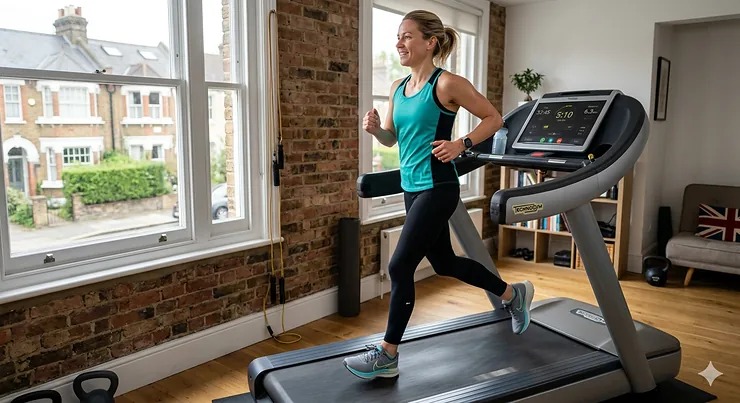
There’s a particular kind of honesty about a treadmill. No headwind to distract you. No uneven pavement to blame. Just you, your shoes, and a belt that keeps moving whether you feel like it or not. And when your knees start whinging somewhere around kilometre six, you realise rather quickly that your choice of cushioned running shoes for treadmill sessions matters more than you’d thought.
Here’s what most buyers miss: treadmills already absorb some impact — that’s part of their design. But “some” isn’t the same as “enough,” especially if you’re logging 30-plus kilometres a week, recovering from a niggling injury, or simply north of forty and no longer willing to pretend your joints are indestructible. The repetitive, uniform foot strike pattern of treadmill running actually concentrates stress in specific areas. A plush, well-engineered foam midsole acts as the second layer of defence.
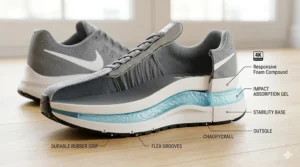
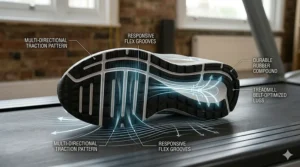
What makes a great cushioned running shoe for the treadmill specifically? You’re looking for: a generous stack height (38mm or above is now the benchmark for max-cushion options), a responsive foam that doesn’t feel like running through wet concrete after 5km, a breathable upper that won’t turn your gym session into a sauna experience, and — crucially — a flat rubber outsole that grips the belt cleanly without the aggressive lugs you’d want for trail running.
In this guide, we’ve done the legwork. Seven real products, all available on Amazon.co.uk, tested and assessed with an honest eye for what they actually deliver versus what the packaging claims. Budget picks, mid-range workhorses, and premium foam experiences — something for every UK runner, whether you’re a beginner lacing up for the first time or a seasoned club runner looking to protect your legs through winter.
Quick Comparison: Best Cushioned Running Shoes for Treadmill UK
| Shoe | Midsole Foam | Stack Height | Drop | Weight (Men’s) | Price Range | Best For |
|---|---|---|---|---|---|---|
| HOKA Clifton 10 | CMEVA | ~37mm heel | 8mm | ~245g | £130–£150 | Overall best, all-day comfort |
| Brooks Ghost 18 | DNA Loft v3 | ~44mm heel | 10mm | ~290g | £110–£135 | Reliable daily trainer |
| ASICS Gel-Nimbus 27 | FF BLAST+ ECO + PureGEL | ~44mm heel | 8mm | ~295g | £150–£180 | Premium max-cushion |
| New Balance Fresh Foam X 1080v14 | Fresh Foam X | ~38mm | 6mm | ~285g | £140–£165 | Wide feet, smooth ride |
| Nike Pegasus 41 | ReactX + Air Zoom | ~33mm | 10mm | ~280g | £95–£125 | Budget-friendly versatility |
| Saucony Ride 18 | PWRRUN+ | ~36mm | 8mm | ~280g | £110–£135 | Energy return + cushion |
| Adidas Ultraboost 5X | Boost | ~35mm | 10mm | ~335g | £140–£175 | Style + everyday comfort |
The table tells part of the story. What it doesn’t tell you is that a 44mm stack isn’t automatically better than 37mm — it depends entirely on your gait, training volume, and whether you prefer a planted, grounded feel or a floaty, cloud-walking experience. We’ll unpack all of that below.
💬 Just one click — help others make better buying decisions too! 😊
✨ Don’t Miss These Exclusive Deals!
🔍 Take your treadmill running to the next level with these carefully selected picks. Click any highlighted shoe name to check current pricing and availability on Amazon.co.uk. These picks will help you find exactly what you need!
Top 7 Cushioned Running Shoes for Treadmill: Expert Analysis
1. HOKA Clifton 10 — Best Overall
HOKA built its reputation on the audacious idea that more foam under your foot was a feature, not a flaw — and the Clifton 10 is the clearest expression of that philosophy working at its best.
The CMEVA midsole now sits at an 8mm heel-to-toe drop (up from 5mm in earlier iterations), which makes an immediate, noticeable difference. That extra heel height helps absorb the repetitive rearfoot strikes that treadmill running tends to amplify, and HOKA’s signature MetaRocker geometry rolls your foot forward so efficiently that transitions feel almost automatic. Stack height sits around 37mm at the heel — substantial without feeling precarious. The jacquard knit upper is genuinely breathable; you won’t be pulling soggy socks off after a 10km session.
On the treadmill specifically, the Clifton 10 shines because the rubber outsole is smooth enough to interface cleanly with the belt. You won’t hear the aggressive clap-clap of trail lugs on a treadmill deck. What you will hear, eventually, is very little — just a quiet, muffled rhythm that lets you zone into your playlist or Netflix queue in peace.
Who’s this for? Runners who want a single shoe that handles daily treadmill miles, recovery runs, and the occasional outdoor road run. It particularly suits heel strikers, runners over forty who’ve started noticing their knees have opinions, and anyone stepping into the max-cushion world for the first time. UK reviewers on Amazon.co.uk consistently praise the immediate comfort from the first wear — no dreaded break-in period to endure.
✅ Smooth MetaRocker for effortless transitions
✅ Exceptionally lightweight for the stack height
✅ Available in men’s and women’s fits, multiple widths
❌ The 8mm drop may feel unusual for runners used to lower-drop shoes
❌ Outsole durability can be variable at high mileage
Available on Amazon.co.uk (Prime-eligible, check current price); in the £130–£150 range — outstanding value for genuine HOKA performance.
2. Brooks Ghost 18 — Best for Reliable Daily Training
Brooks has been making the Ghost for over fifteen years, and the reason it still sells in extraordinary numbers is boringly simple: it works. Every single time. The Ghost 18 — released in May 2026 — keeps the DNA Loft v3 nitrogen-infused cushioning that made the Ghost 17 a cult favourite among UK treadmill runners, then quietly improves the upper with a softer flat-knit tongue and a slightly roomier toe box. Nothing revolutionary. Just the kind of considered refinement that adds up pleasantly over hundreds of kilometres.
The DNA Loft v3 foam deserves particular attention here. It’s soft, yes — measurably softer than the previous generation — but it doesn’t collapse underfoot the way some cushioned shoes do once fatigue sets in. There’s a firmness underneath the plush top layer that keeps your form honest. The 10mm heel-to-toe drop is on the higher side, which suits heel strikers but requires some adjustment if you’ve been running in something lower. On the treadmill, that heel cushioning is particularly welcome during long steady-state runs where cumulative impact quietly accumulates.
The Ghost 18 is the shoe for runners who want to stop thinking about their shoes. If you’re the kind of person who finds gear decisions exhausting, this is your answer — put it on, run, wash, repeat for the next 800km or so.
UK buyers will find this widely stocked on Amazon.co.uk, typically Prime-eligible with next-day delivery. In the £110–£135 range, it represents solid value for a shoe with this level of engineering pedigree.
✅ Consistent, proven cushioning with zero break-in faff
✅ DNA Loft v3 foam balances softness and responsiveness
✅ Updated Ghost 18 upper improves breathability and fit
❌ Slightly heavier than some competitors at ~290g
❌ High 10mm drop won’t suit all biomechanical profiles
3. ASICS Gel-Nimbus 27 — Best Premium Max-Cushion Option
The Nimbus has been ASICS’ answer to the question “what if we just kept adding comfort?” for over two decades. The Gel-Nimbus 27 stacks FF BLAST PLUS ECO foam with PureGEL technology in the heel — two systems working in concert rather than simply piling foam on top of foam. What this produces in practice is a landing that feels almost absurdly quiet. Heel strikers who’ve been tolerating knee discomfort through high-mileage treadmill weeks will notice the difference inside the first kilometre.
The 44mm heel stack is among the highest in this category, and yet the shoe doesn’t feel unstable — a testament to how well ASICS has engineered the base width and midfoot structure. The 8mm drop places it in the moderate category, accessible to most runners. One thing that UK buyers specifically appreciate: the Nimbus 27’s upper runs cooler than several rivals, which matters in a gym setting where air circulation is often poor (we all know the feeling of a gym treadmill wedged between a radiator and a wall).
This is a shoe for the serious treadmill runner who logs consistent weekly mileage and wants maximum protection for the long haul. Runners dealing with plantar fasciitis, shin splints, or the aftermath of a stress fracture will find the impact attenuation genuinely therapeutic. UK podiatrists have long recommended the Nimbus line — the premium price buys real engineering, not just brand name.
Available on Amazon.co.uk in the £150–£180 range. Prime members can typically expect next-day delivery.
✅ Dual-layer PureGEL + FF BLAST ECO cushioning system
✅ Wide, stable platform despite the tall stack height
✅ Excellent breathability for indoor gym use
❌ The premium price point will give budget-conscious runners pause
❌ Heavier than HOKA alternatives at a similar stack height
4. New Balance Fresh Foam X 1080v14 — Best for Wide Feet and Smooth Transitions
New Balance has always been quietly brilliant at making shoes that accommodate British feet, which tend to be wider than the industry default. The Fresh Foam X 1080v14 is their flagship cushioned daily trainer and it’s genuinely exceptional — not in a flashy, marketing-deck sort of way, but in the understated “I ran 12km and completely forgot I was wearing shoes” way that the best trainers achieve.
The Fresh Foam X midsole is a single-piece injection-moulded compound that delivers a plush, smooth feel without the energy loss you often get from overly soft foams. The 6mm drop is the lowest of our selection — something to bear in mind if you’re coming from high-drop shoes, as your calves will need a week or two to adjust. But once adjusted, the near-flat geometry encourages a more midfoot-forward strike pattern that many biomechanists consider protective over high mileage.
The Hypoknit upper deserves particular mention: it’s elasticated, adaptive, and generously wide in the toe box without feeling sloppy. For UK runners who’ve spent years cursing standard-width shoes, the 1080v14’s accommodating fit is rather liberating.
In the £140–£165 range on Amazon.co.uk, it’s not cheap — but this is a shoe that justifies its cost through sheer quality of materials and the consistency of the ride.
✅ Generous toe box suits wider feet — a genuine rarity in performance shoes
✅ Fresh Foam X midsole provides plush, even cushioning throughout
✅ Low 6mm drop encourages natural midfoot strike
❌ 6mm drop requires adaptation period if switching from high-drop shoes
❌ Slightly heavy for pace-focused treadmill sessions
5. Nike Pegasus 41 — Best Budget-Friendly All-Rounder
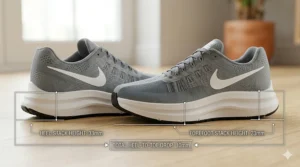
The Nike Pegasus has been the entry point into performance running footwear for forty-plus years, and the Pegasus 41 explains why that reputation persists. For a shoe in the £95–£125 range, what you get is frankly unreasonable: ReactX foam (13% more responsive than previous React foam, according to Nike’s own testing) combined with a full-length Air Zoom unit that provides genuine pop off the treadmill belt. This isn’t budget cushioning pretending to be performance — it’s actual performance at a mid-range price.
The 10mm drop places it alongside the Brooks Ghost in the heel-striker-friendly camp. The cushioning is moderate rather than maximal — if you’re specifically looking for the cloud-like feel of a HOKA or ASICS Nimbus, you’ll find the Pegasus feels comparatively firm underfoot. That firmness, however, translates to excellent energy return and a lively, responsive ride that suits faster treadmill workouts far better than the plush options above.
Where the Pegasus 41 truly earns its spot on this list is versatility. It’s the shoe that works equally well for a 30-minute lunchtime treadmill jog, a tempo run, and the commute home in gym bag. UK buyers get access to an enormous range of colourways and half-sizes on Amazon.co.uk, and Prime delivery makes impulse purchases dangerously easy.
✅ Exceptional value — genuine ReactX technology at mid-range price
✅ Air Zoom unit delivers lively, energetic treadmill ride
✅ Available in vast range of sizes and widths on Amazon.co.uk
❌ Not a max-cushion shoe — runners seeking maximum impact absorption should look higher up the list
❌ Upper can run slightly warm on longer indoor sessions
6. Saucony Ride 18 — Best for Cushion + Energy Return
Saucony’s Ride series has spent its entire existence quietly outperforming its marketing budget, and the Ride 18 is the strongest iteration yet. The PWRRUN+ midsole foam has been upgraded again — it’s now measurably softer and more energy-returning than the previous version, and it shows immediately on the treadmill. There’s a spring to each step that the purely soft-foam shoes in this list don’t quite replicate.
The 8mm drop sits in the comfortable middle ground, and the overall geometry is forgiving enough for a wide range of foot strike patterns — heel, midfoot, or the increasingly popular shuffle-to-forefoot transition. At around 280g in men’s sizing, the Ride 18 is among the lighter options in this category without sacrificing meaningful cushioning.
What sets the Ride 18 apart for treadmill specifically is durability. The outsole rubber coverage is more generous than the Clifton or Ghost, and several UK reviewers report comfortably exceeding 800km before the cushioning degraded noticeably — impressive for any daily trainer. Given UK gym memberships often run to several hundred pounds annually, a shoe that lasts well is rather good value by extension.
In the £110–£135 range on Amazon.co.uk, it’s priced keenly and frequently discounted.
✅ PWRRUN+ foam genuinely balances cushion with energy return
✅ Above-average durability — outlasts many rivals at high mileage
✅ Versatile 8mm drop suits most running styles
❌ Not as maximally cushioned as HOKA or ASICS options
❌ Slightly nondescript aesthetics compared to Nike or Adidas
7. Adidas Ultraboost 5X — Best for Everyday Comfort and Style
The Ultraboost is a curious entry on a treadmill shoe list, and deliberately so. If you’re the kind of person whose “gym shoes” need to look decent enough to grab a coffee after class, the Ultraboost 5X deserves consideration. The Boost midsole — Adidas’ proprietary expanded TPU foam — remains one of the most comfortable underfoot experiences in any running shoe, full stop. It’s pillowy, it’s responsive, and it holds its cushioning properties extraordinarily well over time.
What distinguishes Boost from EVA-based foams like CMEVA or DNA Loft is longevity. Standard foam midsoles compress and lose their cushioning properties gradually; Boost holds its form better, which means the shoe you buy today feels nearly as cushioned six months from now as it did out of the box. For runners who use their gym shoes daily — treadmill in the morning, casual errands in the afternoon — that durability genuinely matters.
Where the Ultraboost 5X falls short relative to pure performance trainers is weight. At around 335g in men’s sizing, it’s noticeably heavier than everything else on this list. You won’t want to wear these for tempo intervals or any session where pace matters. But for steady-state treadmill runs, recovery jogs, and the general business of moving around comfortably, they’re genuinely excellent.
Available on Amazon.co.uk in the £140–£175 range; frequently Prime-eligible with strong UK stock across popular colourways.
✅ Boost midsole retains cushioning properties longer than EVA alternatives
✅ Premium Primeknit upper — breathable and adaptive
✅ Versatile enough to wear off the treadmill without embarrassment
❌ Heaviest shoe on this list — noticeable on pace-focused sessions
❌ Lacks the performance geometry of dedicated running shoes
How to Choose the Right Cushioned Running Shoes for Treadmill in the UK
Choosing properly means asking a few honest questions before you reach for your wallet.
1. How much are you actually running? Under 30km per week, moderate cushioning (Pegasus 41, Saucony Ride 18) is perfectly adequate. Above that, or if you’re recovering from any lower-limb injury, the Nimbus 27 or Clifton 10’s enhanced impact absorption earns its price premium.
2. What’s your natural foot strike? Heel strikers benefit most from higher drops (10mm — Ghost 18, Pegasus 41) and generous heel stack heights. Midfoot strikers tend to prefer lower drops (6-8mm — 1080v14, Ride 18, Nimbus 27) that don’t artificially alter gait.
3. Do you run exclusively indoors? If so, prioritise a smooth rubber outsole over outsole coverage, as treadmill belts don’t require the abrasion resistance of road running. The Clifton 10 and Ghost 18 both excel here.
4. Do you have wide feet? The New Balance 1080v14 is the clear recommendation — it’s genuinely wider where it counts, not just labelled as wide. HOKA also offers wide-fit variants of the Clifton on Amazon.co.uk.
5. What’s your budget? Under £120: Nike Pegasus 41 or Saucony Ride 18. £120–£150: HOKA Clifton 10 or Brooks Ghost 18. Above £150: ASICS Gel-Nimbus 27 or New Balance 1080v14 for uncompromised comfort.
6. Do you need a shoe for walking too? The Clifton 10 and Ultraboost 5X are both walking-compatible without looking absurd outside the gym.
7. How long do you expect the shoes to last? Budget for replacement every 600-800km. If you’re running 5 days a week, that’s roughly one new pair per year — factor this into your price-per-use calculation.
Real-World Scenario Guide: Which Shoe for Which UK Runner?
The Manchester Commuter Gym-Goer (Ages 30-45)
Sarah works in the Northern Quarter and squeezes 40-minute treadmill sessions into her lunch break, three times a week. She runs at a comfortable 6:00/km pace, has had a bout of knee pain in the past, and needs something that looks decent enough to wear from the gym to the sandwich shop.
Best match: HOKA Clifton 10. The MetaRocker’s effortless transitions keep her running economy efficient during time-constrained sessions, and the impact absorption will address the knee concerns more meaningfully than almost anything else at this price. The clean, minimal aesthetic won’t raise eyebrows at a cafe.
The Retired Edinburgh Runner (Ages 55-65)
David ran club races for twenty years and now logs easy 8-10km treadmill sessions three times a week over winter when Edinburgh’s pavement becomes an ice rink. Joint health is a priority; he’s not chasing times.
Best match: ASICS Gel-Nimbus 27. The dual-cushion system (FF BLAST+ ECO and PureGEL) is specifically engineered for the kind of repetitive-impact protection that ageing joints need. It’s not cheap, but David has enough running experience to know that quality footwear is considerably less expensive than physiotherapy.
The Birmingham Student on a Budget (Ages 18-25)
Priya has just started running seriously, uses the campus gym treadmill five days a week, and has a student budget. She’s a neutral runner with average-width feet and no existing injuries.
Best match: Nike Pegasus 41. At the lower end of this price range, it offers genuine ReactX technology and a responsive ride that will see her through whatever training plan she finds on Reddit. The wide availability of sizes on Amazon.co.uk with Prime delivery means she can get sorted quickly without hunting around.
The London Home Office Runner (Ages 35-50)
James works from home in Hackney, has a compact flat with a folding treadmill in the spare room, and runs every morning as a mental-health anchor as much as a fitness habit. He needs comfort over pace, runs for 45-60 minutes at conversational pace.
Best match: Adidas Ultraboost 5X or New Balance Fresh Foam X 1080v14. Both reward the long, easy sessions he favours. The Boost foam’s longevity suits the high daily use, and neither shoe requires much deliberate warm-up before the cushioning comes online.
✨ Don’t Miss These Exclusive Deals!
🔍 Ready to upgrade your treadmill kit? Click any highlighted product name above to check current pricing and availability on Amazon.co.uk — Prime members get free next-day delivery on most of these picks!
What to Expect: Real-World Performance of Cushioned Running Shoes on a UK Gym Treadmill
Treadmill running is biomechanically different from road running in ways that matter for your shoe choice, as research published in journals including the Journal of Biomechanics has noted — stride length tends to be slightly shorter, cadence higher, and the consistent surface removes the micro-adjustments your foot makes on uneven ground. For a useful overview of running biomechanics and injury prevention, the NHS resources on physical activity and musculoskeletal health offer a practical starting point.
Here’s what you’ll actually notice wearing a max-cushion shoe on a gym treadmill:
The first 5 minutes feel noticeably different to road running in the same shoe. The treadmill belt adds compliance, so the shoe feels almost too soft initially. Give it 10 minutes. Your body calibrates, and you’ll settle into a rhythm that feels sustainable rather than bouncy.
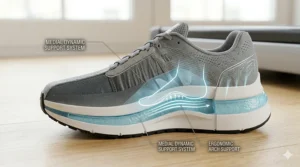
At 20-30 minutes, the difference between a well-cushioned shoe and an under-cushioned one becomes obvious — specifically in the knees, hips, and lower back. Repetitive impact on a single plane of motion is where cheap foam compounds begin to fatigue. A shoe with quality nitrogen-infused DNA Loft or fresh CMEVA midsole maintains its properties throughout.
Breathability matters more indoors. Most gym treadmill areas maintain 18-22°C and poor ventilation. Shoes with engineered mesh uppers (the Ghost 18, Clifton 10, Nimbus 27) handle this significantly better than the thicker knit constructions on older Ultraboost models.
The outsole matters more than you’d think. Treadmill belts have texture, and aggressive outsole lugs create noise, vibration, and uneven wear on the belt itself. The flat rubber undersoles of the Clifton, Nimbus, and Ghost are purpose-appropriate in a way that trail shoes emphatically are not.
Common Mistakes When Buying Cushioned Running Shoes for Treadmill Use
Mistake 1: Choosing for road and hoping for the best
Road shoes often have aggressive lateral outsole coverage for varied terrain. On a treadmill, this translates to unnecessary noise, altered ground contact, and a slightly wobbling feel at higher speeds. Choose shoes with smooth, uniform outsoles.
Mistake 2: Ignoring stack height entirely
If joint protection is your priority — as it is for the majority of UK gym treadmill users — anything below 30mm in the heel is worth scrutinising carefully. The trend toward max-cushion shoes exists for good biomechanical reasons, and the research on impact acceleration across running surfaces supports seeking out proper cushioning rather than relying on the treadmill alone. A useful review of running-related injury research is available via PubMed Central.
Mistake 3: Buying based on looks alone
The Ultraboost’s lifestyle crossover appeal has sold millions of pairs to runners who’d have been better served by the Ghost or Clifton. This isn’t a criticism of Boost foam — it’s outstanding — but weight and geometry matter more for performance than premium Primeknit materials.
Mistake 4: Sizing down because “they run big”
Every brand fits differently. HOKA typically runs true to size; New Balance runs slightly long; Nike runs narrow. UK Amazon.co.uk listings include detailed size charts — use them. And remember that feet swell slightly during runs; if in doubt between sizes, go up rather than down.
Mistake 5: Not accounting for the replacement cycle
UK gym runners frequently run their shoes into the ground, then wonder why their knees hurt. Foam midsoles degrade significantly after 600-800km regardless of how good they look externally. If you’re running 20km per week, budget for a new pair every 7-8 months. Check whether Amazon.co.uk has Subscribe & Save options for your chosen model — some popular trainers qualify.
Cushioned Running Shoes vs. Standard Trainers: The Real Difference
This comparison comes up constantly, and it’s worth addressing properly rather than dismissing. A standard trainer — think a Adidas Stan Smith, a pair of Vans, or even a budget cross-trainer — and a proper cushioned running shoe look superficially similar. They are not remotely the same product.
| Feature | Cushioned Running Shoes | Standard Trainers |
|---|---|---|
| Midsole thickness | 30-44mm | 10-20mm |
| Foam compound | Engineered nitrogen-infused EVA, Boost TPU | Basic EVA or PU |
| Heel-toe transition | Designed and engineered | Flat, undifferentiated |
| Impact absorption at 5km | Maintained | Already compromised |
| Weight distribution | Biomechanically engineered | Fashion-led |
| Breathability | Engineered mesh | Variable, often poor |
| Best for treadmill | ✅ Yes | ❌ No |
The practical consequence: wearing standard trainers on a treadmill for 45 minutes delivers roughly three times the impact load to your knees compared to a properly cushioned running shoe, because the treadmill’s own compliance and the shoe’s midsole are meant to work together, not substitute for each other. The NHS reports that running-related knee injuries are among the most common sports injuries in the UK — appropriate footwear is the first and cheapest line of prevention. For general guidance on running injury prevention, the Chartered Society of Physiotherapy publishes useful resources for UK runners.
The written conclusion: standard trainers lose comprehensively here, not for aesthetic reasons, but engineering ones. Even the most budget option on this list (Nike Pegasus 41) delivers categorically superior impact protection to a non-running shoe costing twice the price.
FAQ: Cushioned Running Shoes for Treadmill UK
❓ What are the best cushioned running shoes for treadmill use in the UK?
❓ Do I need different running shoes for treadmill vs outdoor running?
❓ How much cushioning do I need for treadmill running?
❓ Are HOKA running shoes available on Amazon.co.uk?
❓ How long do cushioned running shoes last on a treadmill?
Conclusion
The right cushioned running shoes for treadmill sessions aren’t a luxury — they’re the most practical investment a regular gym runner can make, and the cost per kilometre of a decent pair is remarkably low when you spread it across a year of training.
For most UK runners in 2026, the HOKA Clifton 10 is the place to start: versatile, genuinely cushioned, and effective at what it promises. If you’re a serious high-mileage runner or have joint concerns, the ASICS Gel-Nimbus 27 justifies its higher price point with dual-system cushioning that genuinely performs. Budget-conscious runners will find the Nike Pegasus 41 more than adequate. And for anyone who runs primarily at an easy pace and wants a shoe that doubles as everyday footwear, the Adidas Ultraboost 5X remains a sensible, if slightly indulgent, choice.
All seven options on this list are available on Amazon.co.uk with UK stock, UK sizing, and typically Prime-eligible for next-day delivery. Prices include 20% VAT; there are no post-Brexit complications for these brands, which maintain UK distribution networks independently of EU logistics.
One final note worth making: the best shoe is the one you’ll actually wear. Don’t let perfect be the enemy of good. Pick one, run in it, pay attention to how your body responds over the first two weeks. The treadmill doesn’t care what’s on your feet — your joints absolutely do.
✨ Don’t Miss These Exclusive Deals!
🔍 Found your perfect match? Click the highlighted shoe names throughout this article to check current pricing and availability on Amazon.co.uk, and start your next treadmill session with the cushioning your legs deserve.
Recommended for You
- Best Stability Shoes for Treadmill Running UK 2026: Top 7 Picks
- Best Neutral Running Shoes for Treadmill UK 2026: Top 7 Picks
- Best Treadmill Running Shoes UK 2026: 7 Expert Picks
isclaimDer: This article contains affiliate links. As an Amazon Associate, I earn from qualifying purchases. If you purchase products through these links, we may earn a small commission at no additional cost to you.
✨ Found this helpful? Share it with your mates! 💬🤗
