In This Article
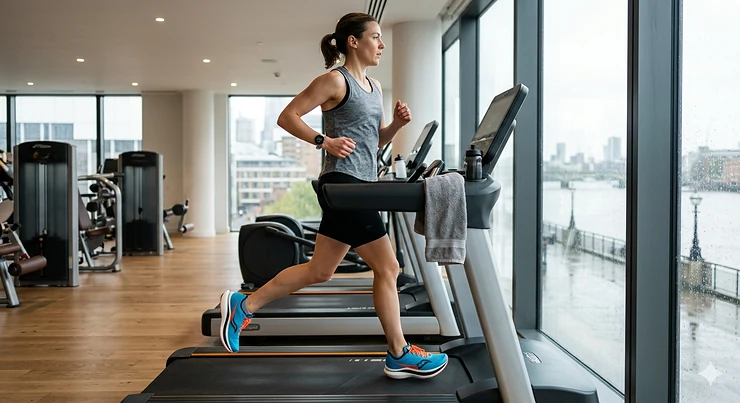
There’s a moment on a treadmill — usually mid-tempo run, sweat flying, legs turning over quicker than you thought possible — when you realise the shoes on your feet have changed everything. That’s the carbon plate effect. And no, it’s not just for elite runners chasing marathon glory at the London or Manchester finish lines.
Carbon plate shoes for treadmill running have become one of the savviest tools in a British runner’s arsenal. Whether you’re training through another grey November with the rain hammering outside, or doing structured speed sessions before a spring race, slipping into a super shoe on the belt is genuinely transformative.
But here’s what most guides won’t tell you: not every carbon shoe performs equally well on a treadmill. The slightly forgiving surface of the belt, the absence of wind resistance, the controlled pace — these factors change how a shoe feels. A shoe that’s spectacular on the road might feel oddly mechanical indoors. And one that seemed fussy on pavements? On a treadmill belt, it can absolutely sing.
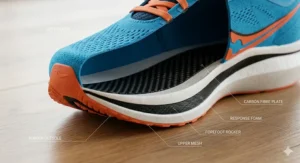
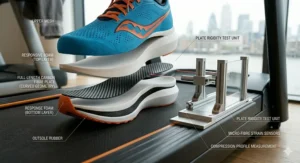
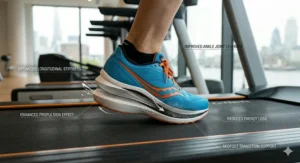
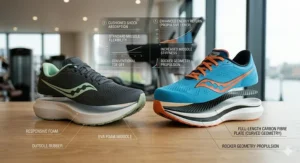
So, what are carbon plate shoes for treadmill use, exactly? In simple terms: these are running shoes built with a rigid carbon fibre plate embedded within the midsole. That plate acts like a spring — storing energy on landing and releasing it on toe-off, driving you forward with a propulsive snap that standard trainers simply cannot replicate. Pair that with ultra-lightweight PEBA-based foams and a rocker geometry, and you have a shoe that makes running faster feel… almost effortless. Research published in peer-reviewed journals confirms that carbon-plated shoes can reduce the energy cost of running by approximately 4%, which adds up considerably over a tempo session or a simulated race effort.
For UK runners, treadmill sessions aren’t a fallback — they’re a tactical choice. When the British weather delivers its famous winter treatment (relentless drizzle, 5°C, a headwind of dubious motivation), the treadmill becomes your best mate. Having the right carbon plate shoe for those sessions? That’s just sensible.
This guide covers 7 of the best carbon plate shoes for treadmill use available on Amazon.co.uk right now, covering every budget from accessible to eye-watering, with expert commentary on what actually makes each shoe tick.
Quick Comparison: The Best Carbon Plate Shoes for Treadmill
| Shoe | Carbon Tech | Drop | Approx. Weight | Price Range (GBP) | Best For |
|---|---|---|---|---|---|
| Nike ZoomX Vaporfly NEXT% 3 | Full-length carbon plate | 8mm | ~193g (men’s UK 9) | £140–£160 | 5K–marathon tempo |
| Nike Alphafly 3 | Carbon plate + Air Zoom | 8mm | ~218g (men’s UK 9) | £230–£260 | Marathon simulation |
| Adidas Adizero Adios Pro 3 | EnergyRods 2.0 (carbon rods) | 8.5mm | ~206g (men’s UK 9) | £150–£200 | Versatile treadmill speed |
| Saucony Endorphin Pro 4 | Carbon plate | 8mm | ~195g (men’s UK 9) | £160–£200 | Stability-focused runners |
| New Balance FuelCell SuperComp Elite v4 | Energy Arc carbon plate | 4mm | ~211g (men’s UK 9) | £200–£230 | Long treadmill efforts |
| ASICS Metaspeed Sky Tokyo | Full-length carbon plate | 5mm | ~169g (UK 9) | £220–£260 | Stride runners, 5K–half marathon |
| Puma Deviate Nitro Elite 4 | Full-length carbon plate | 8mm | ~195g (men’s UK 9) | £200–£220 | Stable, all-rounder treadmill racer |
The table above reveals an important pattern: the lightest shoe (ASICS Metaspeed Sky Tokyo) suits shorter, faster treadmill efforts, while the New Balance and Nike Alphafly offer the cushioning depth you need for long simulation runs. Notably, the Adidas Adios Pro 3 sits in a compelling middle ground — fast enough for intervals, cushioned enough for longer efforts — at a price that’s dropped considerably since its launch. Do check current prices on Amazon.co.uk, as they fluctuate.
💬 Just one click — help others make better buying decisions too! 😊
✨ Don’t Miss These Exclusive Deals!
🔍 Take your treadmill training to the next level with these expert-selected carbon plate shoes. Click on any highlighted product name to check current pricing and availability on Amazon.co.uk. Prime members enjoy free next-day delivery on eligible orders!
Top 7 Carbon Plate Shoes for Treadmill: Expert Analysis
1. Nike ZoomX Vaporfly NEXT% 3 — The Benchmark Super Shoe
The shoe that started a revolution. The Vaporfly 3 is still, years on from its first appearance, one of the sharpest tools you can bring to a treadmill speed session.
The full-length carbon fibre plate sits within a deep ZoomX foam midsole — Nike’s PEBA compound, which is both ludicrously light and energetically bouncy. On a treadmill, that combination pays dividends during interval training: the plate snaps you into each stride, and the foam absorbs the repetitive impact of the belt better than many stiffer rivals. The 8mm heel-to-toe drop means it suits a natural heel-to-midfoot strike pattern, which is how most recreational UK runners naturally land. The VaporWeave upper is breathable enough to keep your feet cool during heated indoor sessions — useful when the gym has its heating cranked up to subtropical levels, which is seemingly mandatory in every UK leisure centre from October to April.
Who’s this for? Honestly, anyone who wants to feel what a super shoe is supposed to feel like without spending Alphafly money. If you’re training for a spring 10K or half marathon and want a shoe that bridges the gap between training and racing, the Vaporfly 3 is the one. UK reviewers consistently praise its fit (note: sizing runs slightly narrow — consider half a size up).
✅ Lightweight and energetic on the treadmill belt
✅ Excellent for tempo and interval sessions
✅ Well-established, reliable technology
❌ Less durable than daily trainers — save it for quality sessions
❌ Narrow fit can cramp wider UK feet
Available on Amazon.co.uk (Prime eligible, free delivery on qualifying orders). In the £140–£160 range, the Vaporfly 3 represents arguably the best entry point into carbon plate treadmill running.
2. Nike Alphafly 3 — The Marathon Machine for Indoor Simulations
If the Vaporfly is the sharp scalpel of speed work, the Alphafly 3 is the heavy artillery. This shoe is designed for marathon-distance efforts — which means it’s exceptionally well-suited to those long treadmill sessions where you’re genuinely rehearsing race pace for 90 minutes or more.
The Alphafly 3 combines ZoomX foam with two Air Zoom units housed in the forefoot — a dual-energy system that creates a notably more propulsive and cushioned feel than the Vaporfly. The updated Atomknit upper and slightly wider carbon plate improve stability compared to earlier versions, addressing one of the main criticisms of the Alphafly line. On a treadmill, the additional stack height means your legs feel fresher for longer, which matters enormously when you’re simulating the final 10K of a marathon effort.
This is the shoe for the runner who is genuinely targeting a PB at, say, Manchester, Leeds, or Edinburgh Marathon, and wants to build physiological and psychological familiarity with race pace before the start line. The slightly heftier build compared to the Vaporfly is a trade-off, but for long indoor runs, that extra protection pays off.
UK runners who’ve logged multiple long runs in the Alphafly 3 consistently report feeling noticeably fresher post-session compared to standard training shoes. It’s not subtle.
✅ Exceptional cushioning for long treadmill efforts
✅ Dual Air Zoom + ZoomX energy system
✅ Improved stability vs. previous Alphafly versions
❌ Premium price point — a significant investment
❌ Overkill for short intervals or casual sessions
Available on Amazon.co.uk. Expect to pay in the £230–£260 range — pricey, but justifiable if marathon training is your focus.
3. Adidas Adizero Adios Pro 3 — The Versatile Carbon Performer
Adidas took a different design philosophy with the Adios Pro 3. Rather than a single flat carbon plate, they use EnergyRods 2.0 — a cluster of carbon fibre tubes that mimic the metatarsal bones of the foot. The result is a shoe that feels distinctively different to Nike’s offerings: a little more organic, a little more forgiving, and notably better suited to a range of treadmill paces.
The double layer of LightstrikePRO foam (another PEBA compound) provides excellent energy return across a wide range of speeds — unlike some carbon shoes that only “click” at threshold pace or faster, the Adios Pro 3 feels lively even at 5:30/km (roughly 8:50/mile) treadmill pace. This makes it genuinely useful for progressive long runs on the belt, where you might start easy and build to race pace over 90 minutes.
The upper has been reengineered to be lighter and more breathable for this generation, which you’ll appreciate during harder treadmill sessions. The 8.5mm drop is one of the slightly higher options on this list, making it comfortable for heel strikers and runners transitioning from traditional trainers.
Worth noting: the Adios Pro 3 has been replaced by the Adios Pro 4 at full retail in some channels, which means the Pro 3 is frequently available at reduced prices on Amazon.co.uk — excellent value for a shoe of this calibre.
✅ EnergyRods 2.0 for a more natural, organic propulsion feel
✅ Works well at a range of treadmill paces
✅ Often available at competitive prices as a previous-generation model
❌ Higher drop may not suit committed forefoot strikers
❌ Not the absolute lightest option on this list
Available on Amazon.co.uk in the £150–£200 range. Brilliant value for money, especially at the lower end.
4. Saucony Endorphin Pro 4 — The Stability-Focused Speed Shoe
Saucony’s Endorphin Pro 4 is the most stable super shoe on this list — and that’s not a backhanded compliment. On a treadmill, where you’re running consistently on a flat, predictable surface with no camber, stability matters less than on the road. But if you’re a runner who finds the wobbly, tippy feeling of more aggressive super shoes unsettling, the Endorphin Pro 4 is your answer.
The dual-density midsole pairs PWRRUN HG (a high-gradient, PEBA-based foam) directly under the foot with PWRRUN PB beneath — creating a setup where the responsive foam is closest to your stride, and the bouncy foam amplifies energy return on toe-off. The carbon plate sits between these layers and provides strong propulsion without that mechanical, “on rails” feeling some runners find disconcerting. The heel-to-toe rocker geometry is particularly smooth, which translates into an easy, rhythmic treadmill running experience.
The integrated flat-knit tongue and silky heel liner make the Endorphin Pro 4 one of the most comfortable carbon shoes to wear for extended treadmill sessions — there’s no drama with hotspots or chafing, which matters when you’re 70 minutes into a tempo run with nowhere to adjust your kit.
For UK runners who want a carbon shoe that also functions as a long-run training shoe (rather than a pure race-day reserve), this is arguably the strongest case on the list.
✅ Best stability of any shoe in this comparison
✅ Comfortable for extended treadmill sessions
✅ Excellent rocker geometry for smooth belt running
❌ Slightly less explosive energy return than Vaporfly or Metaspeed
❌ Heavier than some rivals
Available on Amazon.co.uk in the £160–£200 range, with both men’s and women’s versions stocked.
5. New Balance FuelCell SuperComp Elite v4 — The Comfort-First Marathon Companion
New Balance doesn’t shout as loudly as Nike or Adidas in the super shoe wars, but the FuelCell SuperComp Elite v4 is quietly exceptional for treadmill use — particularly for runners who want a plush, cushioned experience during long indoor efforts.
The FuelCell midsole is made from PEBA (the same performance polymer used in most premium super shoes) and is notably softer and more cushioned than the ZoomX or FF Turbo+ found in rival shoes. The Energy Arc carbon plate is paired with strategic midsole voids that increase energy storage and return — it’s a clever bit of engineering that doesn’t feel as rigid as a traditional flat plate. The 4mm drop is the lowest on this list, which places you closer to a natural foot position on the treadmill and rewards midfoot strikers.
The v4 is also one of the most forgiving super shoes for runners whose form breaks down over long efforts — it protects your legs even when fatigue compromises your mechanics. This is genuine value on a two-hour treadmill run preparing for an autumn marathon.
One real-world caveat: the fit runs slightly wide compared to Japanese and American brands on this list, which is actually a blessing for many UK runners who struggle with the famously narrow fit of shoes like the Metaspeed Sky Tokyo.
✅ Outstanding cushioning for long indoor efforts
✅ Lower drop suits natural-form runners
✅ Available in wider fits — rare among super shoes
❌ Less explosive energy return than more aggressive options
❌ Heavier than ASICS and Saucony alternatives
Available on Amazon.co.uk in the £200–£230 range. Prime eligible with free next-day delivery for members.
6. ASICS Metaspeed Sky Tokyo — The Lightweights’ Champion
The ASICS Metaspeed Sky Tokyo is, in one word, fast. At approximately 169g, it’s the lightest shoe on this list by a meaningful margin — and that lightness is felt immediately when you step onto the treadmill belt and push the pace.
The Tokyo iteration updates the Sky Paris with a dual-foam midsole: FF Leap (ASICS’ new ATPU compound, 15% lighter and 14% more responsive than the previous foam) sits in the bottom layer closest to the ground, while FF Turbo+ occupies the upper layer directly beneath the foot. The full-length carbon plate is positioned higher in the midsole than many rivals, which creates a powerful, whip-like propulsion on toe-off. For treadmill interval sessions — say, 6×1,000m at 5K race pace — this shoe is almost unfair.
The Motion Wrap 3.0 upper is incredibly lightweight and breathable, which is a significant advantage in the stuffier environment of an indoor gym. The ASICSGRIP outsole provides reliable traction on the treadmill belt surface without the sort of excessive grip that wears faster on repeated belt contact.
One honest note: the Metaspeed Sky Tokyo is designed for stride-style runners (longer ground contact, powerful push-off). If you’re a cadence-focused runner (short, quick steps), the Metaspeed Edge Tokyo is the ASICS equivalent built for you.
Available in the UK for around £220–£260 — check Amazon.co.uk for current availability across sizes.
✅ Lightest shoe on this list — transformative at speed
✅ Dual-layer FF foam is genuinely next-level
✅ Superb for treadmill intervals and short race simulations
❌ Narrow fit — size up if between sizes
❌ Limited durability; not suitable for daily treadmill use
7. Puma Deviate Nitro Elite 4 — The Stable All-Rounder
Released in early 2026 at a notably accessible price for a top-tier carbon shoe, the Puma Deviate Nitro Elite 4 is the pick for UK runners who want a genuine race-day super shoe without the Alphafly price tag.
Puma’s Nitro Elite foam is a proprietary nitrogen-infused compound that delivers impressive energy return with a more natural, less mechanical feel than some competitors. The full-length carbon plate provides clear propulsion, but it’s tuned to feel approachable rather than aggressive — it’s not going to feel like running on a catapult, which is precisely the point. For treadmill use, this translates to a shoe you can run comfortably at moderate pace and still feel genuinely propelled when you push hard.
The updated geometry in the v4 improves stability compared to the Deviate Nitro Elite 3, addressing feedback that the previous generation felt somewhat unpredictable at slower speeds. That broader platform is particularly welcome on a treadmill, where any lateral instability becomes immediately noticeable on the enclosed belt surface. At around £200–£220 in the UK — significantly less than the Nike Alphafly — the Deviate Nitro Elite 4 represents one of the best value propositions in the current super shoe market.
UK reviewers note it’s also one of the easier carbon shoes to break in, requiring minimal adjustment time — ideal if you’re picking it up a few weeks before a target race.
✅ Best value for money on this list
✅ More stable than most carbon competitors
✅ Approachable at a range of paces — not just for elites
❌ Foam not quite as explosive as Metaspeed Sky Tokyo or Alphafly
❌ Newer model — fewer long-term durability data points
Available in the UK; check Amazon.co.uk for current stock and sizing. In the £200–£220 range.
✨ Don’t Miss These Exclusive Deals!
🔍 Ready to invest in your treadmill training? Click any highlighted shoe name above to check current pricing and availability on Amazon.co.uk. Prime members get free next-day delivery — perfect if race day is approaching fast! 🏃♂️
How to Use Carbon Plate Shoes for Treadmill Without Wrecking Them
This is where most guides go quiet. Carbon plate shoes are expensive, and using them carelessly on a treadmill is a fast route to premature deterioration. Here’s what you actually need to know.
Limit mileage per session. Most carbon super shoes are rated for 300–500km of life (roughly 186–310 miles). Every treadmill session dips into that bank. Save them for your quality sessions — tempo runs, race simulations, interval workouts — and use conventional training shoes for easy efforts.
Check the treadmill belt condition. A worn or abrasive treadmill belt will chew through the thin outsole of a carbon shoe faster than anything else. If the belt feels rough or you can feel the seams, use an older pair or switch machines. Modern gyms in the UK are generally well-maintained, but home treadmills from discount retailers are often less kind on outsoles.
Mind the speed. Carbon shoes come alive at pace. Running at 6:00/km on a carbon shoe is neither sensible nor particularly rewarding — you’re not generating enough force to engage the plate effectively. As a general guide, use carbon plate shoes for treadmill sessions where at least part of the effort is at your 10K pace or faster.
Storage matters. After a session, remove the shoes and store them at room temperature away from direct heat. UK houses tend to have damp utility rooms and garages — not ideal for the adhesives used in premium footwear. A breathable shoe bag at room temperature will significantly extend their life.
UK Runner Profiles: Which Carbon Plate Shoe Is Right for You?
The London Commuter (First Carbon Shoe, 5K–10K Focus): You run a couple of evenings a week, your treadmill sessions are 30–50 minutes of mixed pace, and you’re building toward a spring parkrun PB or a local 10K. The Saucony Endorphin Pro 4 is your shoe — it’s stable enough to be forgiving of imperfect form, energetic enough to make you feel the benefit, and doesn’t require race-pace running to actually function. The Adidas Adios Pro 3 at a reduced price is a close second.
The Marathon Trainer (Manchester/Edinburgh/London Build-Up, Long Treadmill Runs): Your treadmill sessions regularly exceed 90 minutes as you accumulate marathon-specific mileage when British November makes outdoor running miserable. The New Balance FuelCell SuperComp Elite v4 gives you the plush cushioning to protect your legs, while the Nike Alphafly 3 suits those who want maximum energy return on those gruelling 25K+ indoor simulations.
The Speed Demon (Interval-Focused, Already Race-Fit): You know your way around a track, you love a 400m rep session, and you want a shoe that makes fast feel electric on the treadmill. The ASICS Metaspeed Sky Tokyo was practically built for you — lightweight, snappy, and responsive enough to make 3:30/km reps feel like a dance rather than a battle.
The Value-Conscious Competitive Runner (Sub-4 Marathon, Budget-Aware): You’re serious about running but the idea of spending £260 on a pair of shoes you’ll wear for 400km makes you slightly queasy. The Puma Deviate Nitro Elite 4 at around £200–£220 delivers elite-level carbon technology at a price that doesn’t require an awkward conversation with your bank.
How to Choose Carbon Plate Shoes for Treadmill in the UK
Choosing the right carbon plate shoes for treadmill use is more nuanced than simply picking the highest-rated shoe. Here’s a numbered framework to guide your decision:
- Know your drop preference. If you’re used to traditional running shoes with a 10–12mm drop, shoes like the Nike Vaporfly (8mm) or Adidas Adios Pro (8.5mm) are gentler transitions. The New Balance v4 at 4mm demands a more natural forefoot strike — excellent for experienced minimalists, but a potential calf strain risk for runners new to low-drop footwear.
- Match the shoe to your session type. Short, intense intervals (400m–1,000m reps) suit lighter shoes like the ASICS Metaspeed Sky Tokyo. Longer tempo runs and marathon simulations suit more cushioned options like the Alphafly 3 or New Balance v4.
- Be honest about your pace. Carbon plate shoes perform best above roughly 4:45/km (7:40/mile). If your treadmill sessions are primarily at conversational pace, you’d gain more from a well-cushioned training shoe than from a super shoe.
- Consider fit carefully. The Metaspeed Sky Tokyo runs notably narrow; the New Balance v4 is relatively generous. If you have wider feet — common among UK runners, particularly those in the north of England — prioritise fit over brand loyalty.
- Budget sensibly. Carbon shoes wear out. Factor in the cost-per-use: spending £160 on a Saucony Endorphin Pro 4 that lasts 400km works out at around 40p per kilometre. Spending £260 on an Alphafly that lasts the same mileage is 65p per kilometre. Decide what your training genuinely requires.
Carbon Plate Shoes vs Regular Running Shoes: The Real Difference
The difference between carbon plate shoes and regular running shoes is not merely theoretical — it’s immediately felt. According to research published in the Journal of Physiology, carbon-plated shoes reduce the metabolic cost of running by around 4%, primarily because the plate prevents the natural “energy-wasting” bending of the metatarsal bones on each foot strike.
In practice, on a treadmill, this manifests as follows: at the same pace, you feel less effort. Your breathing is easier. Your legs feel fresher 40 minutes in than they would in a standard trainer. You may find yourself inadvertently running faster simply because the physiological cost has dropped.
Regular training shoes — even excellent, cushioned ones — lack this mechanical energy return. They’re softer, more forgiving, and more suitable for daily use. Carbon shoes are the Formula 1 car of footwear: brilliant at what they’re designed for, but you wouldn’t use one to nip to Tesco.
| Feature | Carbon Plate Shoe | Standard Running Shoe |
|---|---|---|
| Energy return | High (4–8% efficiency gain) | Standard |
| Midsole foam | PEBA/ultra-light compounds | EVA or standard foam |
| Durability | 300–500km | 800–1,000km |
| Daily use suitability | Not recommended | Yes |
| Treadmill interval suitability | ⭐⭐⭐⭐⭐ | ⭐⭐⭐ |
| Price range (GBP) | £140–£260+ | £60–£180 |
The verdict is clear: regular shoes remain the sensible daily driver, while carbon plate shoes are the precision tool for quality treadmill sessions. The runners who get the most out of them treat them accordingly.
Features That Actually Matter on a Treadmill (And Those That Don’t)
Marketing departments are wonderfully creative. Here’s an honest filter:
Matters on a treadmill:
- Stack height: Treadmill running generates repetitive impact on the same surface. More foam between you and the belt equals less fatigue over long sessions.
- Rocker geometry: The curved sole design of most carbon shoes creates a smooth, forward-rolling heel-to-toe transition that feels particularly natural on a flat treadmill belt.
- Upper breathability: You’re indoors, likely in a warm gym. A well-ventilated mesh upper (see: Metaspeed Sky Tokyo’s Motion Wrap 3.0) matters more than it would outdoors in British drizzle.
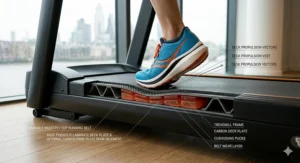
- Outsole durability: Thin rubber outsoles wear faster on treadmill belts than on road surfaces due to the friction of the moving belt. Thicker outsole coverage (Saucony Endorphin Pro 4, Adidas Adios Pro 3) extends lifespan.
Matters less than you’d think:
- Water resistance: You’re inside. Leave the GTX versions for trail running.
- Outsole grip pattern: Treadmill belts don’t require aggressive grip — in fact, overly sticky outsoles can wear prematurely on the belt’s texture.
- Reflective elements: Not relevant indoors.
Common Mistakes When Buying Carbon Plate Running Shoes in the UK
1. Using them for every session. This is the cardinal sin. Carbon shoes are designed for quality training and racing, not daily miles. Use them for 20–30% of your training sessions, maximum. The other 70–80% should be done in durable trainers.
2. Ignoring UK sizing differences. Several of the shoes on this list (particularly ASICS and Nike) run narrower than British runners tend to expect. Always check the sizing guidance and, where possible, size up. Returns are easy on Amazon.co.uk thanks to UK Consumer Rights Act 2015 protections — free returns within 30 days on most eligible orders.
3. Buying based on what an elite runner wore. Kenenisa Bekele and Kelvin Kiptum have a slightly different training background to most of us. The shoe that helped them run 2:01 may not be the shoe that helps you run 3:45. Match the shoe to your stride type, pace range, and session goals.
4. Neglecting warm-up in super shoes. Carbon shoes can amplify calf and Achilles loading due to the low drop and stiff plate. Always warm up properly before engaging the plate at race pace — five minutes of easy running first.
5. Expecting road-feel on the treadmill. Carbon shoes feel slightly different on a treadmill belt than on the road — the belt has a small degree of give that changes the plate’s engagement. Give yourself two or three sessions to adapt before drawing conclusions about a new shoe.
Are Carbon Plate Shoes Worth It for Treadmill Running? 🇬🇧
Bluntly: yes, if you’re using the treadmill for structured, quality training sessions. No, if your treadmill work is primarily recovery miles or casual jogging.
For the UK runner who takes their running seriously — training for a spring marathon, chasing a 10K PB, building fitness for a summer race calendar — investing in a single pair of carbon plate shoes for treadmill quality sessions is among the most impactful kit decisions you can make. The physiological benefit is real and measurable, not marketing fiction.
The economics are reasonable too. A pair of Saucony Endorphin Pro 4s at around £180 used exclusively for quality treadmill sessions (say, twice weekly, 45–60 minutes each) will comfortably last 12–18 months of training. That’s less than a monthly gym membership in most British cities.
The NHS recommends at least 150 minutes of moderate-intensity activity per week for adults — and structured treadmill running with the right tools is one of the most time-efficient ways to hit that target while genuinely improving your fitness.
The only caveat? Don’t be tempted to use them every day. The treadmill is the tool; the carbon shoe is the edge. Used wisely, together they’re remarkably powerful.
✨ Don’t Miss These Deals!
🔍 Ready to upgrade your treadmill training in 2026? Click through to Amazon.co.uk on any highlighted product above to check today’s pricing. Prime members get free next-day delivery — get sorted before your next speed session! 🏃♀️
FAQ: Carbon Plate Shoes for Treadmill ❓
❓ Are carbon plate shoes safe to use on a treadmill?
❓ How long do carbon plate shoes last on a treadmill?
❓ Which carbon plate shoe is best for treadmill beginners in the UK?
❓ Can I use carbon plate running shoes for daily treadmill training?
❓ Do I need to break in carbon plate shoes before using them on the treadmill?
Conclusion: The Right Carbon Plate Shoe Will Change Your Treadmill Sessions
The British running scene has embraced super shoes enthusiastically — and rightly so. Whether you’re sprinting through winter speed sessions on the treadmill while the rain batters the windows outside, or meticulously simulating marathon pace in preparation for London or Manchester, the right carbon plate shoe makes a tangible, measurable difference.
From the explosive lightness of the ASICS Metaspeed Sky Tokyo to the plush, marathon-ready cushioning of the Nike Alphafly 3, there is a carbon plate shoe for every treadmill purpose and every budget covered in this guide. The key is matching the shoe to the session — use the lighter, more aggressive options for short intervals, the more cushioned models for long simulations, and the stable options (Saucony Endorphin Pro 4, Puma Deviate Nitro Elite 4) if you’re new to the carbon category or want a more forgiving experience.
A sensible starting point for most UK runners? The Saucony Endorphin Pro 4 or Adidas Adizero Adios Pro 3 — both available on Amazon.co.uk with free returns, both genuinely exciting to run in, both priced at a level that doesn’t require a lengthy cost-benefit analysis in a spreadsheet.
Run faster. Train smarter. Your treadmill sessions deserve better than average.
✨ Found Your Perfect Carbon Shoe?
🔍 Click through to Amazon.co.uk to check current pricing and Prime delivery options on any of the shoes featured in this guide. Happy running! 🏃♂️🇬🇧
Recommended for You 🔗
- Best Cushioned Running Shoes for Treadmill UK 2026
- Best Stability Shoes for Treadmill Running UK 2026: Top 7 Picks
- Best Neutral Running Shoes for Treadmill UK 2026: Top 7 Picks
Disclaimer: This article contains affiliate links. As an Amazon Associate, I earn from qualifying purchases. If you purchase products through these links, we may earn a small commission at no additional cost to you.
✨ Found this helpful? Share it with your mates! 💬🤗
