

In This Article
So — can you use road shoes on treadmill? If those road shoes happen to be your trusty running trainers, then yes, broadly speaking. But if you’ve somehow wandered in from the cycling world wearing clipless shoes with prominent plastic cleats poking out of carbon-fibre soles, then no — absolutely not — and honestly, please step away from the treadmill before something goes catastrophically wrong.
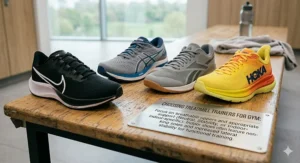
Here’s the thing: “road shoes” is one of those terms that means wildly different things depending on who you ask. For runners, road shoes are lightweight, cushioned trainers designed for pavement. For cyclists, road shoes are stiff-soled instruments of power transfer, fitted with protruding cleats that make a sound like a tap-dancer auditioning for a Riverdance production whenever you attempt to walk on hard flooring. These two categories behave very differently on a treadmill belt — and understanding that distinction could save you from a nasty fall, a ruined belt, or both.
As a general rule, road running shoes are perfectly suitable for treadmill use — and often better than trail shoes, which can chew through a treadmill belt with their aggressive lugs. Road cycling shoes, on the other hand, are genuinely dangerous on a moving treadmill: the stiff sole offers zero flex, the cleat creates an uneven contact point, and there’s no grip whatsoever on the smooth belt surface. According to REI’s expert cycling guide, road cycling shoes “are not designed for extended walking due to their lack of traction on the sole, their inability to flex, and cleats that protrude from the soles.” That’s before you even switch the belt on.
In this guide, we’ll unpack exactly what makes a shoe treadmill-safe, what the research says, and which seven shoes available right now on Amazon.co.uk are genuinely worth your money in 2026.
Quick Comparison: Road Shoes vs Treadmill Requirements
| Shoe Type | Sole Flexibility | Belt Grip | Cleat Risk | Treadmill Safe? |
|---|---|---|---|---|
| Road Running Shoe | ✅ Good | ✅ Excellent | ❌ None | ✅ Yes |
| Trail Running Shoe | ✅ Moderate | ⚠️ Too much lug | ❌ None | ⚠️ Caution |
| Road Cycling Shoe | ❌ Rigid | ❌ None | ✅ High Risk | ❌ No |
| MTB Cycling Shoe (SPD) | ⚠️ Semi-stiff | ⚠️ Recessed cleat | ⚠️ Lower Risk | ❌ Still No |
| Dedicated Treadmill Shoe | ✅ Excellent | ✅ Perfect | ❌ None | ✅ Best option |
The comparison above tells a clear story: road running shoes sit in the sweet spot — flexible enough to follow natural foot movement, with flat rubber outsoles that grip the belt cleanly without excessive lug depth. Trail shoes, by contrast, have chunky knobbled outsoles designed for mud; these can accelerate belt wear and create uneven contact on a flat rubber surface. And cycling shoes of any variety simply have no business on a treadmill.
💬 Just one click — help others make better buying decisions too! 😊
Top 7 Best Treadmill Shoes on Amazon.co.uk: Expert Analysis
1. Brooks Ghost 18 — Best All-Rounder for UK Treadmill Runners
Brooks’s Ghost line has become something of a British institution at this point — and the Ghost 18, released in May 2026, earns that reputation squarely. The DNA LOFT v3 midsole delivers cushioning that’s generous without being marshmallow-soft, which is exactly what you want on a treadmill where the repetitive, impact-identical footstrikes can quickly expose a shoe that’s either too firm (jarring) or too plush (destabilising).
The Ghost 18 sits at roughly 10mm heel-to-toe drop — traditional territory that suits most heel-strikers without asking them to relearn their gait. The engineered air-mesh upper breathes well, which matters considerably when you’re running in a warm living room or a gym in Manchester in August with the heating inexplicably still on. The outsole rubber covers the heel and forefoot comprehensively, providing flat-surface grip that plays beautifully with treadmill belts.
UK buyers particularly appreciate that Brooks offer this in multiple widths — important when you’re running in a gym and can’t pop outside to shake out a hot foot. Customer reviews on Amazon.co.uk consistently praise the out-of-the-box comfort, with many noting zero break-in period. This is the shoe for the everyday UK runner who just wants something that works, every time, without drama.
✅ Excellent neutral cushioning for long sessions
✅ Breathable upper ideal for indoor heat
✅ Multiple width options including wide fit
❌ Higher heel drop won’t suit forefoot strikers
❌ Heavier than true lightweight options
Price range: £130–£150 | Available on Amazon.co.uk with Prime next-day delivery
2. Nike Pegasus 42 — The Reliable Workhorse That Never Lets You Down
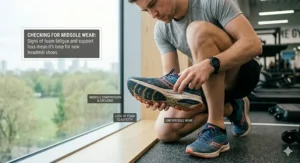
Forty-two versions in and the Pegasus is still here, still popular, and still rather good. The Pegasus 42 uses ReactX foam — firmer and more energy-returning than its predecessor — with two Zoom Air bags adding that lively, springy underfoot feel that Nike runners have come to expect. On a treadmill belt, that firm-but-responsive platform means you’re getting genuine energy return with every stride rather than sinking into foam that deadens your effort.
Where the Pegasus 42 shines on the treadmill specifically is in its outsole. The carbon rubber compound covers the heel and forefoot comprehensively with a relatively flat, smooth contact patch — exactly what a treadmill belt rewards. The 10mm drop is traditional and accessible, and the snug sleeve upper keeps foot slippage minimal at higher speeds. Worth noting for UK buyers: the Pegasus 42 is widely stocked on Amazon.co.uk in an excellent size range from UK 3.5 through UK 14, and typically qualifies for Amazon Prime next-day delivery.
The one caveat? Don’t wear these exclusively outdoors if you want them to last on the treadmill. The waxy-feel waffle outsole pattern, while durable, develops some slipperiness on wet British pavements once worn — so keeping a pair specifically for indoor use is genuinely sensible advice.
✅ Proven platform refined over four decades
✅ Excellent outsole grip on treadmill belt surface
✅ Widely available in UK sizes and widths
❌ Not ideal for wet-weather outdoor running once worn
❌ Firmer ride won’t appeal to cushion-seekers
Price range: £115–£135 | Available on Amazon.co.uk; Prime-eligible
3. HOKA Mach 7 — Lightweight Speed for Interval Sessions
If the Ghost 18 is a comfortable armchair and the Pegasus a reliable saloon car, the HOKA Mach 7 is a sports hatchback — lighter, peppier, and considerably more fun when you’re chasing pace. Released in early 2026, the Mach 7 features HOKA’s updated ProFly+ foam: a dual-density arrangement that’s soft for cushioning but firmer at the contact point for propulsion. Weighing around 220g in a men’s UK 8, it’s notably lighter than the Ghost 18, which pays dividends on interval days when you’re hammering the treadmill at faster paces.
The meta-rocker geometry — HOKA’s signature — encourages a natural rolling gait that transitions smoothly from heel contact through to toe-off. On a treadmill, where the belt is already assisting your turnover, this creates a genuinely enjoyable sensation of effortless speed. The upper breathability is exceptional: smoke-test results in independent reviews score it at 5/5, meaning you won’t be generating swamp-foot halfway through your workout.
For UK buyers doing structured training — interval blocks, tempo runs, or progressive sessions — the Mach 7 is the smarter choice over something heavily cushioned. It does feel somewhat spartan on very easy runs where you want maximum comfort. But as a training shoe that doubles as an excellent treadmill option, it punches well above its price.
✅ Notably lightweight for faster treadmill sessions
✅ Outstanding breathability for indoor workouts
✅ Meta-rocker aids natural gait on moving belt
❌ Less cushioned than Ghost 18 or Clifton 10 for long easy runs
❌ Not ideal as a sole daily trainer
Price range: £130–£150 | Available on Amazon.co.uk; Prime-eligible
4. HOKA Clifton 10 — Maximum Cushioning Without the Wobble
The Clifton 10 is HOKA’s answer to a specific question: what if you could have truly substantial underfoot cushioning without the instability that often accompanies it? The CMEVA midsole is plush but maintains enough structure to feel secure at speed, and the compression-moulded foam provides excellent shock absorption for runners who put in long, steady treadmill sessions. Stack height is generous — around 36mm at the heel — but the rocker geometry keeps transitions smooth rather than making you feel like you’re running on a bouncy castle.
Where this particularly matters for the British market: if you’re working through a niggly knee or managing older joints — very common in the over-40 fitness crowd picking up running for the first time — the Clifton 10’s cushioning provides meaningful protection against the repetitive impact of treadmill running. The roomier forefoot in the updated 2026 version also accommodates UK runners who tend toward slightly wider feet, which is a sensible refinement.
Amazon.co.uk stock of the Clifton 10 is excellent, including clearance pricing on certain colourways that can bring it into very attractive territory for buyers watching their budget.
✅ Outstanding cushioning for long indoor sessions
✅ Rocker sole for smooth heel-to-toe transitions
✅ Roomier forefoot suits wider feet
❌ Heavier build — not a speed shoe
❌ Very high stack may unsettle heel-strikers initially
Price range: £120–£155 | Available on Amazon.co.uk including some sale pricing
5. Asics Gel-Cumulus 28 — The Dependable Neutral Daily Trainer
The Cumulus 28, released in early 2026, is the 28th iteration of Asics’s reliable neutral trainer — and while it’s not the most exciting shoe in any category, it is extraordinarily consistent. The FF BLAST PLUS midsole offers cushioning that doesn’t degrade noticeably over hundreds of miles, which matters enormously for treadmill runners who log the same shoe into oblivion across repetitive identical sessions.
What separates the Cumulus 28 from its predecessor is a refinement of the upper — now more breathable and with a better heel lockdown. For treadmill use specifically, heel lockdown matters: the belt is moving beneath you, and any slippage of the foot within the shoe amplifies that movement into instability. The Cumulus 28 holds the foot firmly without constricting it. Available in narrow, standard, wide, and extra-wide, it covers virtually every UK foot shape.
UK customer feedback on Amazon.co.uk highlights true-to-size fit and remarkable durability — several reviewers note getting 600+ miles from a pair, which at the price range represents genuinely excellent value per mile. If you’re after a no-fuss workhorse that won’t let you down, the Cumulus 28 deserves serious consideration.
✅ Available in four widths — excellent UK sizing options
✅ Durable foam maintains cushioning over many sessions
✅ Secure heel lockdown minimises foot slip on belt
❌ Fairly conservative ride — not exciting
❌ Slightly higher price than comparable options at this spec level
Price range: £120–£140 | Available on Amazon.co.uk; various widths stocked
6. Saucony Ride 19 — The All-Rounder That Earns Its Reputation
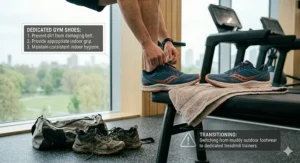
The Saucony Ride 19 is currently considered by multiple independent testing labs to be one of the finest all-round daily trainers on the market — and on a treadmill, it’s excellent. The PWRRUN+ expanded polyurethane foam hits an unusual sweet spot: plush enough for comfort on long sessions, yet firm and responsive enough to provide genuine energy return at tempo pace. Independent energy-return testing places it notably above the average for daily trainers.
The 8mm heel drop is moderate — lower than the Ghost 18 or Pegasus 42 — which makes it a solid choice for mid-foot strikers or anyone consciously working on running form on the treadmill. The carbon rubber outsole in high-wear zones provides durability that holds up through heavy treadmill use, and the engineered mesh upper earns high breathability scores in lab testing.
What most UK buyers overlook is how well the Ride 19 transitions between treadmill sessions and outdoor road running — it handles British wet pavement with composure, making it a genuinely versatile investment if you split your training between gym and outdoor miles.
✅ Excellent foam technology for cushion + responsiveness
✅ Versatile — transitions well to outdoor road running
✅ Durable carbon rubber outsole holds up to heavy use
❌ Moderate drop not ideal for committed heel-strikers
❌ Slightly narrow standard fit — check sizing carefully
Price range: £120–£135 | Available on Amazon.co.uk; Prime-eligible
7. On Cloudrunner 3 — Swiss Engineering for the Considered UK Buyer
On Running has built a devoted following in Britain, and the Cloudrunner 3 justifies much of the enthusiasm. The Helion superfoam midsole — On’s proprietary compound — offers a lively, springy sensation that makes treadmill running feel less mechanical than some rivals. The distinctive CloudTec® pods on the outsole compress on impact to absorb shock, then lock out for firm push-off — a dual-phase system that works particularly well on the consistent surface of a treadmill belt.
The Cloudrunner 3 is also the most aesthetically refined shoe on this list, which matters when you’re wearing it in a gym environment. Shallow, perhaps — but a shoe you actually want to put on is a shoe you’ll actually train in. UK buyers report sizing runs slightly large, so consider a half-size down. Amazon.co.uk stocks the full Cloudrunner 3 range in UK sizing with Prime delivery on most colourways.
One honest caveat: On’s warranty and returns process, while generally good, is handled through the UK Amazon fulfilment system rather than a dedicated UK service centre — entirely fine for most buyers, but worth knowing.
✅ Distinctive Helion foam delivers lively, energetic ride
✅ Dual-phase CloudTec® outsole excellent on flat belt surface
✅ Premium aesthetics — looks as good as it performs
❌ Pricier than comparable alternatives
❌ Runs slightly large — size down half a size
Price range: £140–£160 | Available on Amazon.co.uk; Prime-eligible in most colourways
✨ Don’t Miss These Exclusive Deals!
🔍 Take your treadmill training to the next level with these carefully selected shoes. Click any highlighted product name to check current pricing and availability on Amazon.co.uk. These picks cover every budget, every foot type, and every training style.
Why Road Cycling Shoes Are Genuinely Dangerous on a Treadmill
Let’s dwell here for a moment, because this is the practical safety issue that the internet doesn’t shout about loudly enough. Road cycling shoes are engineered with a single purpose: maximising power transfer to a pedal. The sole is carbon fibre or fibreglass — almost entirely rigid — and the three-bolt cleat system places a plastic protrusion directly beneath the ball of the foot.
Put that onto a moving treadmill belt at anything above walking pace and you have a recipe for disaster. The cleat creates an uneven, rocking contact point; the rigid sole provides zero flex as your foot rolls through the stride cycle; and the smooth underside offers no grip on the rubber belt surface. According to Cycling Weekly’s indoor cycling shoe guide, even walking in road cycling shoes with a prominent cleat is treacherous — running is genuinely not something these shoes can accommodate.
The damage extends to your equipment as well. Cleat edges will score and scratch the treadmill belt surface with every stride, accelerating wear and degrading the belt’s traction over time. Treadmill belt replacement — often a professional job — can cost anywhere from £80 to well over £200 for a quality belt and fitting. That’s an expensive consequence of the wrong footwear choice.
Mountain bike shoes with recessed SPD cleats sit in a grey area — the cleat doesn’t protrude as aggressively, and the sole has more rubber contact. But even these aren’t designed for walking or running, and we wouldn’t recommend them on a treadmill beyond a slow walk, and certainly not as a regular choice.
Trail Shoes on Treadmill: Damage Is Real, But Manageable
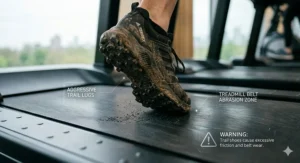
Trail shoes occupy an interesting middle ground. The uppers are often excellent — waterproof, breathable, well-structured — but the outsoles are aggressively lugged, designed to bite into mud and loose rock. On a flat rubber treadmill belt, those same lugs act like a grater against the belt surface, creating uneven wear and increasing the friction load on the motor.
This doesn’t mean you’ll immediately destroy your treadmill. Occasional trail shoe use is unlikely to cause catastrophic damage. But as a regular, daily-use scenario? A shoe with 5mm+ lug depth running 30 minutes per day, five days a week, will visibly degrade a treadmill belt considerably faster than a flat-soled road running shoe. If your treadmill is the centrepiece of a home gym where replacement belts would be costly and inconvenient — and given UK living conditions, where compact home gyms in spare bedrooms are common — it’s simply not worth the risk.
The consensus from treadmill technicians is consistent: stick to shoes with a relatively flat, smooth rubber outsole. Deep lugs and treadmill belts are not friends.
Practical Guide: Matching Your Shoe to Your Treadmill Training Style
Different treadmill sessions have genuinely different footwear requirements, and most UK buyers would benefit from thinking about this before reaching for their wallet.
If you’re walking for fitness on a treadmill, a well-cushioned road running shoe is ideal — the Asics Gel-Cumulus 28 or HOKA Clifton 10 would serve you particularly well. Walking is lower impact than running, so you need less energy return but more comfort across longer durations. These shoes deliver both.
If you’re doing interval or tempo runs, prioritise a lighter, more responsive option. The HOKA Mach 7 or Saucony Ride 19 will reward faster paces with genuine energy return, whereas maximally-cushioned shoes can feel sluggish at speed and subtly interfere with your natural cadence.
If you’re a beginner building up mileage, the Brooks Ghost 18’s forgiving fit, generous cushioning, and immediate out-of-the-box comfort make it the safest starting point. It won’t demand anything of your running form while your body adapts.
If you’re managing an injury or older joints, the HOKA Clifton 10’s ultra-plush midsole provides the most meaningful impact protection on the list. The NHS’s physical activity guidelines recommend low-impact cardiovascular exercise for maintaining fitness around injury — and a well-cushioned treadmill shoe is part of that equation.
How to Choose Treadmill Shoes in the UK: 5 Key Criteria
Choosing between options requires a clear framework. Here’s what actually matters, ranked by importance:
1. Outsole design — flat and grippy, not knobbly The treadmill belt is a uniform rubber surface. You need sufficient rubber coverage with a relatively smooth, flat contact patch. Avoid deep lugs, avoid cycling shoe soles, avoid anything designed for mud.
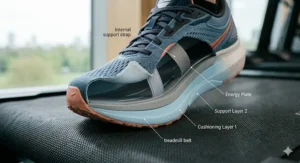
2. Cushioning level matched to your session type Moderate cushioning (30–38mm heel stack) suits most treadmill runners. Ultra-plush stacks above 40mm can feel unstable at speed; very minimal shoes can feel harsh on the repetitive impact of long treadmill sessions.
3. Breathability — arguably more important indoors than out Without wind and ambient airflow, feet heat up significantly more on a treadmill than on the road. A mesh upper with documented breathability is not a luxury — it’s a practical requirement for comfortable training.
4. Heel-to-toe drop matching your natural gait Treadmill running slightly increases ankle and calf load compared to road running, as noted by biomechanics researcher Jay Dicharry. If you’re transitioning from road running to more treadmill use, match your drop preference to your existing outdoor shoes rather than changing it abruptly.
5. Width availability for UK foot shapes British runners often have slightly wider forefoot measurements than US averages. Check that your shortlisted shoe comes in wide or extra-wide if needed — the Ghost 18, Cumulus 28, and New Balance 1080v15 have particularly strong UK width ranges.
What UK Gym Rules Actually Say About Treadmill Footwear
Most commercial UK gyms — from PureGym and David Lloyd to local council leisure centres — require closed-toe athletic footwear on all cardio equipment, including treadmills. This is a simple liability and safety requirement: open-toed shoes, Crocs, sandals, and — yes — cycling shoes with exposed cleats are typically prohibited.
The Consumer Rights Act 2015 means that UK gym members whose equipment sustains damage due to incorrect footwear use may find themselves liable for replacement costs. More pressingly, a fall caused by inappropriate footwear on a treadmill constitutes a significant personal safety risk — one that gyms and home users alike should take seriously.
For home treadmill users, the UK’s major treadmill manufacturers — including NordicTrack and Reebok, both well-represented on Amazon.co.uk — specify in their user manuals that appropriate athletic footwear must be worn. This typically means a flat-soled running shoe. Voiding your warranty through footwear misuse is a real possibility if belt damage is evident.
Long-Term Costs: Protecting Your Treadmill Belt Investment
A quality treadmill belt — say, on a NordicTrack T Series or a Reebok GT40z — represents a significant engineering component. According to specialist maintenance advice, running on a worn belt with inappropriate footwear can accelerate belt degradation from the standard 3–5 year lifespan to considerably less. Treadmill maintenance experts advise that belt wear from abrasive or uneven contact points is among the most common causes of premature replacement.
Belt replacements in the UK typically cost £80–£200 for parts alone, plus labour if you’re not confident fitting it yourself. Contrast that with the £120–£160 investment in a proper pair of treadmill running shoes, and the value calculation becomes rather obvious. The shoes pay for themselves simply by not destroying your equipment.
FAQ
❓ Can you use road shoes on treadmill without damaging the belt?
❓ Are trail shoes bad for treadmill belts?
❓ What is the best shoe to wear on a treadmill in the UK?
❓ Do treadmill shoes need special traction?
❓ Can I use the same shoes for treadmill and outdoor running in the UK?
Conclusion
The question of whether can you use road shoes on treadmill comes down to which road shoes you mean — and the answer is either a confident yes or a fairly alarmed no, depending on the answer. Road running shoes are entirely appropriate for treadmill use, often superior to trail shoes for belt longevity, and the seven options above represent the best of what’s available to UK buyers on Amazon.co.uk in 2026.
Road cycling shoes, by contrast, are unsuitable for treadmill use at any speed — the physics simply don’t work, and the safety and equipment damage risks are real. If you’ve ever wondered why gyms look at you oddly when you walk in with click-clacking cycling shoes, this is why.
The investment in a proper pair of running shoes for treadmill use isn’t extravagance — it’s straightforward protection of both yourself and your equipment. The Brooks Ghost 18 remains our overall recommendation for most UK runners: accessible, durable, immediately comfortable, and proven across millions of miles. Pick your level of cushioning and pace preference from the list above, and you’re sorted.
✨ Don’t Miss These Exclusive Deals!
🔍 Check current pricing on our full selection of top-rated treadmill shoes on Amazon.co.uk. These picks are updated for 2026 and cover every training style, foot type, and budget. Click through to see the latest availability.
Recommended for You
- 7 Best Wide Fit Treadmill Running Shoes Men UK (2026)
- 7 Best Marathon Shoes Treadmill Training in the UK (2026)
- 7 Best Waterproof Trail Running Shoes UK 2026
Disclaimer: This article contains affiliate links. As an Amazon Associate, I earn from qualifying purchases. If you purchase products through these links, we may earn a small commission at no additional cost to you.
✨ Found this helpful? Share it with your mates! 💬🤗
