
In This Article
Stand in any UK parkrun car park on a Saturday morning and you’ll spot the tell — half the wrists flash a soft Fitbit glow, the other half a Garmin watch face bristling with numbers. Fitbit vs Garmin fitness tracker for running isn’t just a spec-sheet argument, it’s practically a personality test. One camp wants their runs folded gently into a broader picture of sleep, stress and daily movement. The other wants pace alerts, training load, and a recovery advisor barking at them before they’ve even laced up.
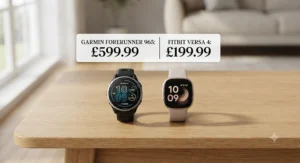
Here’s the short answer: Fitbit trackers are built for people who want running to sit alongside sleep and stress tracking in one friendly, low-effort package, while Garmin watches are built for people who want running itself to be the main event, with race predictors, structured workouts, and dedicated running dynamics. Neither brand is objectively “better” — they’re optimised for different runners, different budgets, and frankly different temperaments.
Over the next few thousand words, we’ll dig into seven real, currently available devices spanning budget to premium, unpack what Fitbit running features and Garmin fitness tracker running features actually mean on the road, and settle the daily step tracking, sleep score, and ecosystem lock-in questions that decide whether you’ll still be wearing the thing in six months. Both brands sell through amazon.co.uk, and the UK’s NHS physical activity guidelines — 150 minutes of moderate activity a week — form a useful backdrop for judging whether any of these trackers will genuinely nudge you towards that target rather than just displaying it.
Quick Comparison Table
| Category | Fitbit Pick | Garmin Pick | Best For |
|---|---|---|---|
| Daily wellbeing focus | Fitbit Charge 6 | Garmin Vivoactive range | All-day sleep, stress, steps |
| Serious running training | Fitbit Sense 2 (limited) | Garmin Forerunner 265 | Race prep, VO2 max, training load |
| Battery stamina | Up to 7 days | Up to 11-15 days | Multi-day trips, forgetful chargers |
| Beginner-friendly running watch | Fitbit Charge 6 | Garmin Forerunner 55 | New runners on a budget |
| App simplicity | Fitbit app | Garmin Connect | Data-shy users vs. data hungry users |
The table above makes the fork in the road obvious: Fitbit’s strength is turning fitness into something approachable, while Garmin leans into depth for people who actually plan their training weeks. Runners chasing a specific 5K or half marathon time will lean Garmin almost every time, because that’s where the race predictors and structured workouts live. Meanwhile, anyone whose “training plan” is really just “try to move more and sleep better” will get more day-to-day value from Fitbit’s gentler approach.
💬 Just one click — help others make better buying decisions too!😊
Top 7 Fitbit vs Garmin Fitness Trackers for Running: Expert Analysis
1. Garmin Forerunner 55 — best true budget running watch for beginners
The Garmin Forerunner 55 is proof that Garmin doesn’t gatekeep good running software behind a premium price tag. It expands on that 3–8 word promise immediately: this is the cheapest Garmin that still speaks fluent “runner.”
Its 1.04-inch screen is modest and low-resolution by 2026 standards, but the software underneath punches well above its weight — it’s packed full of impressive sports tracking and training analysis features, with several trickling down from pricier models like the Forerunner 245. In practice, that means daily suggested workouts, a recovery time advisor, race predictions for 5K through marathon distances, and Garmin’s five-button control scheme, which works brilliantly with sweaty fingers or winter gloves — something touchscreen-only devices simply can’t match.
Who’s this for? New runners who want proper training structure without paying Forerunner 265 money, and Garmin loyalists who want a reliable backup watch. Reviewers consistently note the trade-off is screen quality: expect a dated, low-res display rather than the AMOLED glow of pricier models. Aggregated buyer sentiment leans heavily positive on accuracy and battery life, with the recurring gripe being that the screen looks a generation behind everything else Garmin sells.
Pros:
- ✅ Genuine race-day training features at an entry-level price
- ✅ Physical buttons work reliably in rain, sweat, or gloves
- ✅ Roughly a week of battery life between charges
Cons:
- ❌ Low-resolution, non-touch screen feels dated
- ❌ No on-watch sleep widget for at-a-glance recovery data
Typically found in the sub-£180 range and often discounted further during sales events, the Garmin Forerunner 55 remains one of the smartest value picks in this whole comparison — check current price before buying, as Garmin regularly runs promotions on this model.
2. Fitbit Charge 6 — best affordable all-rounder for daily runners
The Fitbit Charge 6 flips the budget script the other way: instead of a dedicated running computer, you get Google’s most feature-dense fitness band yet, tuned for people who run sometimes but track everything always.
Built-in GPS means you can leave your phone at home for a route-mapped run — the Charge 6 supports 40+ exercise modes, all-day heart rate, active zone minutes and a daily readiness score, alongside ECG, SpO2 monitoring, and stress management tools, all backed by roughly six days of battery life. What the spec sheet won’t tell you is how that translates on the road: heart rate tracking during steady runs is genuinely strong, with accuracy typically within 2–3 BPM of a chest strap during steady-state cardio like running, though several testers flag that it can lag during sharp interval changes.
Based on the spec comparison with Garmin’s running-first devices, the Charge 6’s three heart rate zones (Fat Burn, Cardio, Peak) feel basic next to Garmin’s more granular zone system — fine for casual joggers, frustrating for anyone doing structured tempo runs. Reviewers consistently praise the sleep tracking as class-leading, and the Google Maps and Wallet integration is a genuine daily-life perk that Garmin simply doesn’t offer.
Pros:
- ✅ Built-in GPS and accurate steady-state heart rate tracking
- ✅ Class-leading sleep staging and nightly Sleep Score
- ✅ Google Wallet and Maps baked in for everyday convenience
Cons:
- ❌ Only three heart rate zones — thin for serious training
- ❌ Best features locked behind a Fitbit Premium subscription
Usually sitting in the under-£160 range, the Fitbit Charge 6 is the easiest recommendation for someone who wants “a bit of everything” rather than a dedicated running tool — check current price for the latest deals.
3. Fitbit Versa 4 — best lifestyle smartwatch with running smarts
If the Charge 6 is Fitbit’s band, the Fitbit Versa 4 is Fitbit’s watch — and the standout advantage here is genuinely wearing like a smartwatch while still tracking a run properly.
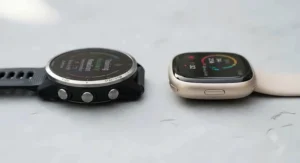
The Versa 4 brings a larger selection of built-in fitness and health features alongside usability upgrades including a slimmer case, a physical button, and a more responsive touchscreen, with 40 exercise modes — double the previous generation. That’s a meaningful jump for anyone who found the old Versa 3’s touch-only controls fiddly mid-run. What most buyers overlook about this model is that it deliberately trims some of the Sense 2’s advanced sensors (no EDA stress sensor, no ECG) in exchange for a lower price, which is exactly the right call if you never planned to use those features anyway.
On the run itself, honest reporting from testers is mixed: aggregated review sentiment flags occasional GPS lag when acquiring a satellite lock, and heart rate accuracy that’s solid for steady jogging but less dependable during sharp altitude or intensity changes. The lack of onboard music storage or third-party app support is a real gap versus both the Charge 6 and any Garmin at this price.
Pros:
- ✅ Comfortable, genuinely smartwatch-like everyday wear
- ✅ 40 exercise modes, up from 20 on the previous generation
- ✅ Around six days of battery life between charges
Cons:
- ❌ GPS can be slow to acquire a signal before a run
- ❌ No music storage or third-party app support
Typically priced in the £160–£220 range depending on promotions, the Fitbit Versa 4 suits runners who want their tracker to double as an actual smartwatch — check current price for availability.
4. Garmin Forerunner 165 — best mid-range AMOLED pick for serious training
Step up to the Garmin Forerunner 165 and the short standout feature is right there in the name of the tier it opened: Garmin’s cheapest watch with a proper AMOLED touchscreen.
The Forerunner 165 features a vibrant 1.2-inch AMOLED touchscreen, up to 11 days of battery life in smartwatch mode, Garmin Pay, 5 ATM water resistance, and multi-system GPS covering GPS, Galileo and GLONASS. What that spec sheet means in practice: you get the sharp, colourful display people associate with premium smartwatches, but paired with genuinely deep running software — heart rate, sleep, stress and recovery tracking alongside runner-specific metrics like VO2 Max, recovery time, and race time predictions.
Here’s what the spec comparison reveals against the FR55: you’re mainly paying for screen quality and battery longevity, not a huge leap in running intelligence. Garmin has made small sacrifices to hit this price point, such as using chemically strengthened glass rather than sapphire, but testers found it very good-looking to use, with 13 days of battery life reported in some reviews. The one functional gap reviewers flag repeatedly is the missing triathlon mode, which won’t bother pure runners but matters to multisport athletes.
Pros:
- ✅ Vibrant AMOLED touchscreen at a genuinely reasonable price
- ✅ Race-adaptive training plans and VO2 Max tracking
- ✅ Excellent multi-day battery life for its display type
Cons:
- ❌ No dual-band GPS for tricky urban or tree-covered routes
- ❌ Missing dedicated triathlon mode
At around the £220–£250 mark before frequent promotional pricing, the Garmin Forerunner 165 is arguably the mid-range sweet spot in this entire round-up — check current price, as this model sees regular discounting.
5. Fitbit Sense 2 — best Fitbit for stress and recovery insight
The Fitbit Sense 2 is Fitbit’s answer to “what if we prioritised your nervous system over your finish time” — and that’s genuinely the standout feature worth expanding on: this is Fitbit’s most advanced health sensor package, running included.
You get built-in GPS so you can see pace and distance without your phone, water resistance to 50 metres, stress notifications, guided breathing on your wrist, and up to six days of typical battery life, plus Google Maps, Fitbit Pay and Alexa built in. The EDA (electrodermal activity) sensor and skin temperature tracking, both absent from the cheaper Versa 4, are the real differentiator — they’re designed to flag stress and recovery patterns that pure step-and-pace trackers miss entirely.
Based on the spec comparison with Garmin’s Forerunner line, the Sense 2 deliberately isn’t built for structured training: there’s no race predictor, no training load metric, no VO2 Max trend. What most buyers overlook is that this makes it a poor choice for anyone training seriously for a specific race, but an excellent one for a runner who’s equally interested in managing burnout and sleep debt. Aggregated review sentiment is consistently strong on comfort and sleep insight, with the recurring complaint being that Premium subscription gates too many of the headline features.
Pros:
- ✅ EDA stress sensor and skin temperature tracking, rare at this price
- ✅ Built-in GPS with solid steady-run accuracy
- ✅ Comfortable, all-day wearable design
Cons:
- ❌ No structured running or race-training tools
- ❌ Best insights require an ongoing Fitbit Premium subscription
Prices for the Fitbit Sense 2 have softened considerably since launch, often landing in the £180–£270 range depending on retailer and promotion — check current price for the best available deal.
6. Garmin Forerunner 265 — best all-round running watch for dedicated runners
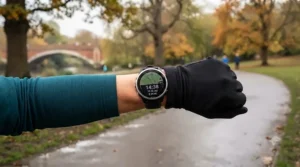
If there’s a single watch in this list that most closely answers “what does a serious runner actually want,” it’s the Garmin Forerunner 265 — the short standout feature is its unbeatably broad running feature set wrapped in a genuinely beautiful screen.
It offers excellent bright touchscreen quality, great GPS tracking, a lightweight build, and advanced tracking features, all in a 5ATM-rated AMOLED watch. Sitting between the entry-level Forerunner 55 and the flagship Forerunner 965, it comes in 42mm and 46mm sizes at the same price point — unusual for Garmin, which normally charges a premium for the larger case. On the run, this is where training readiness, race predictors, running dynamics, and structured workout support all come together properly, without needing an external sensor for things like ground contact time.
What the spec sheet won’t tell you, but reviewers note repeatedly, is that the jump from the Forerunner 255 mainly buys you the AMOLED screen and a training readiness score — the underlying running science hasn’t changed dramatically. That £130 price increase over the 255 is, in the view of several UK reviewers, a tough sell if you don’t specifically want the fancier screen. Even so, for anyone who wants the single best all-purpose running watch without stepping into full-blown multisport territory, this remains the class leader.
Pros:
- ✅ Best-in-class breadth of running and training features
- ✅ Bright, sharp AMOLED display that’s genuinely enjoyable to use
- ✅ Strong GPS and heart rate accuracy reported across reviews
Cons:
- ❌ Noticeably pricier than the otherwise similar Forerunner 255
- ❌ No offline mapping or navigation
Typically priced in the £400–£430 range, the Garmin Forerunner 265 rewards runners who’ll actually use its depth of features — check current price, as it’s frequently discounted around major sales events.
7. Garmin Venu 3 — best premium all-day smartwatch with running chops
Closing out the list, the Garmin Venu 3 is for runners who refuse to choose between “serious sports watch” and “watch I’m happy to wear to dinner” — its standout feature is that rare balance done properly.
Specs include a 1.4-inch, 454×454 AMOLED touchscreen, GPS/GLONASS/Galileo positioning, up to 14 days of battery in watch mode, 26 hours in GPS-only mode, and 5ATM water resistance, plus a built-in speaker and microphone for on-wrist calls. That speaker and mic aren’t just a gimmick either — they let you talk to your phone’s digital assistant and hear the reply through the watch, though it doesn’t pull this off quite as smoothly as an Apple Watch or Pixel Watch.
Here’s what most buyers overlook: the Venu 3 deliberately skips some of the Forerunner 265’s most premium running tools, like the dedicated Training Readiness score and Race Predictor, in favour of broader everyday wellness features — you instead get advanced sleep tracking and suggestions, an evening report, and wheelchair-specific training metrics that most Garmin running watches lack entirely. Reviewers are near-unanimous that GPS accuracy for road running is excellent regardless, so casual and intermediate runners won’t feel short-changed on the numbers that matter most day to day.
Pros:
- ✅ Outstanding battery life for an AMOLED smartwatch
- ✅ Excellent GPS accuracy for road running and cycling
- ✅ On-wrist calls and voice assistant via built-in speaker/mic
Cons:
- ❌ Misses Garmin’s most advanced race-training metrics
- ❌ Premium pricing sits close to the more running-focused Forerunner 265
Generally sitting in the mid-£400s, the Garmin Venu 3 is worth the outlay for runners who want their fitness tracker to double as their everyday smartwatch — check current price before deciding between this and the Forerunner 265.
Fitbit Running Features Explained
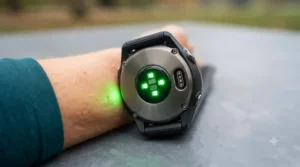
Google Maps navigation and stress tracking are eye-catching on a spec sheet, but what actually happens when you press “start” on a run with a Fitbit? The honest answer is: something reassuringly simple. Fitbit’s running mode auto-detects the activity, tracks pace, distance, and heart rate zone, and folds the result straight into your daily Readiness Score and Active Zone Minutes total.
That simplicity is the whole point. Fitbit running features are built for consistency over precision — the daily readiness score nudges you to run (or rest) based on sleep and recovery data, which suits casual and habit-building runners far better than a dedicated training plan would. What the spec sheet won’t tell you is that this comes at the cost of granularity: only three heart rate zones, no structured interval builder, and no race-time predictor on any current Fitbit model. If your running goal is “move more, sleep better, don’t overthink it,” Fitbit’s approach genuinely works. If your goal is a sub-90-minute half marathon, you’ll hit a ceiling fast.
Garmin Fitness Tracker Running Features Explained
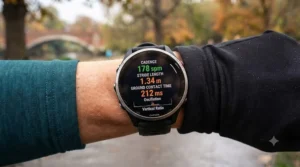
Garmin fitness tracker running features sit at the opposite end of the philosophy spectrum: depth first, simplicity second. Every Forerunner in this round-up offers race time predictions, a recovery advisor, and training load tracking that adjusts based on your recent runs — features that used to be reserved for £500+ watches but have trickled steadily down to the £150 Forerunner 55.
Based on the spec comparison across all four Garmin devices here, the meaningful upgrades as you climb the range are screen quality (AMOLED versus basic MIP), GPS precision (multi-band positioning on pricier models), and smart training tools like Training Readiness scores. What reviewers consistently highlight is that even the cheapest Garmin running watch gives you five-zone heart rate tracking and genuine race-adaptive training plans — a level of structure that no Fitbit model currently matches. The trade-off is a steeper learning curve; Garmin Connect throws a lot of data at you from day one, which some casual runners find overwhelming rather than motivating.
Fitness Tracker App Comparison: Fitbit App vs Garmin Connect
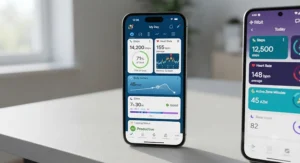
Software is where these ecosystems really diverge, and a fitness tracker app comparison matters more than most buyers expect before purchase. The Fitbit app is deliberately clean: a daily readiness score, a sleep score, and simplified activity rings dominate the home screen, with deeper metrics tucked behind a Fitbit Premium paywall.
Garmin Connect takes the opposite approach — every metric is visible by default, from training load balance to VO2 Max trends to race predictor timelines, none of it gated behind a subscription. Here’s what to weigh: Fitbit’s app is friendlier for someone who checks their phone once a day and wants a quick verdict; Garmin Connect rewards someone who enjoys digging into graphs after every run. According to independent UK testing group Which?, app usability and data clarity are now weighted as heavily as hardware accuracy in fitness tracker reviews — a sign that the software layer genuinely shapes which device suits which runner.
Daily Step Tracking: Which Brand Counts More Accurately
Daily step tracking sounds like a solved problem, but accuracy still varies meaningfully between brands and even between models from the same brand. Both Fitbit and Garmin use wrist accelerometers combined with algorithmic filtering to separate genuine steps from arm swings, typing, or driving over bumpy roads — and both are, on paper, in the same ballpark of accuracy for brisk walking and running.
What the spec sheet won’t tell you is that Fitbit tends to be slightly more generous during non-walking arm movement (cooking, gesturing while talking), while Garmin’s algorithm is tuned more conservatively, occasionally under-counting steps during very slow, shuffling walks. For runners specifically, this barely matters — GPS distance, not the step counter, drives your pace and mileage data during a run. Step tracking’s real value is filling in the other 23 hours of your day, and the NHS’s benchmark of 150 minutes of moderate activity a week is a more meaningful target to chase on either device than a specific step number.
Sleep Score: Which Tracker Tells You More
Sleep score is arguably where the Fitbit vs Garmin fitness tracker for running debate gets most personal, because a bad night genuinely changes how a run feels the next morning. Fitbit’s sleep staging algorithm has been validated in peer-reviewed research more extensively than most competitors at this price point, and the nightly Sleep Score presents that data in a single, digestible number most users check first thing.
Garmin’s equivalent — Sleep Score plus the wider Body Battery metric — leans harder into using sleep data as an input for training decisions, effectively telling you whether today is a good day to push your run or dial it back. Independent testing outlet Wareable notes that heart-rate-based sleep tracking has become significantly more reliable than older movement-only methods across the industry, which benefits both brands roughly equally. The practical difference: Fitbit’s score feels more like a report card, Garmin’s feels more like a coach’s instruction — pick whichever tone motivates you more.
Ecosystem Lock-In: What You’re Really Signing Up For
Ecosystem lock-in rarely gets mentioned in spec sheets, but it’s arguably the most consequential factor in this whole comparison. Buy into Fitbit and your historical sleep, activity, and heart rate data lives in Google’s ecosystem — genuinely handy if you already use Google Maps and Wallet, considerably less handy if you switch to an iPhone-only household or decide Google’s data practices don’t sit well with you.
Garmin Connect data, by contrast, stays within Garmin’s own platform regardless of phone brand, and exports more freely to third-party training tools like Strava or TrainingPeaks — a real advantage for anyone who might eventually want a coach or a more advanced training platform. Here’s what most buyers overlook until it’s too late: switching brands later means starting your historical fitness data from scratch, since neither company makes it simple to migrate years of sleep and training history elsewhere. If you’re relatively confident you’ll want deeper third-party training integration down the line, that alone tilts the decision toward Garmin.
Setting Up Your New Tracker: The First 30 Days
Getting a new Fitbit or Garmin dialled in properly during the first month makes a real difference to long-term accuracy and motivation. Start by wearing the device slightly higher on your wrist than a normal watch — roughly a finger’s width above the wrist bone — since this position noticeably improves optical heart rate accuracy on both brands, particularly during runs.
In week one, resist the urge to obsess over daily numbers; both Fitbit’s readiness score and Garmin’s Body Battery need seven to fourteen days of baseline data before they become genuinely personalised rather than generic estimates. A common first-month mistake is running with a phone in one hand for GPS backup “just in case” — modern Fitbit and Garmin running watches with built-in GPS don’t need this, and carrying a phone can actually throw off arm-swing-based step counting. Finally, dig into the notification settings within the first few days: both apps default to fairly aggressive alerts, and trimming these down early is the single biggest factor in whether people keep wearing their tracker past month two.
Real Runners, Real Choices: Three Scenarios
If you’re a university student commuting three miles by bike and running twice a week between lectures, the Garmin Forerunner 55 or Fitbit Charge 6 both make sense on price alone — but the Forerunner 55’s structured beginner workouts arguably teach better running habits than Fitbit’s more passive approach, for a similar spend.
If you’re a shift worker whose sleep schedule is genuinely irregular and running is your main stress outlet, the Fitbit Sense 2‘s EDA sensor and detailed sleep staging will likely deliver more day-to-day value than any Garmin’s race-training tools, because your recovery — not your race time — is the variable that needs managing most.
If you’re training for your first half marathon with a specific finish-time goal, the Garmin Forerunner 265 or Forerunner 165 are the more sensible picks: race predictors, training load balance, and recovery advisors directly support the kind of structured 12-week plan a goal time actually requires, in a way that no current Fitbit model is built to do.
How to Choose a Fitbit vs Garmin Fitness Tracker for Running
- Decide if running is your main activity or one of several. If it’s genuinely your main sport, lean Garmin; if it’s one piece of a broader wellness routine, Fitbit’s simplicity usually wins.
- Check your phone’s ecosystem. Fitbit’s Google Wallet and Maps integration favours Android; Garmin Connect works identically well on iOS and Android.
- Be honest about your training structure. Following a specific plan needs Garmin’s race predictors and training load metrics; running “on feel” suits Fitbit fine.
- Set a realistic budget band. Entry-level watches from both brands now include GPS and real running features — you rarely need to overspend for the basics.
- Weigh subscription costs. Fitbit Premium gates several headline features; Garmin Connect’s core running tools are free, which matters over a multi-year ownership period.
- Consider battery habits. If you’re forgetful about charging, Garmin’s longer battery life (up to 11-15 days on some models) is meaningfully more forgiving.
- Think about third-party integration. If you might want a coach or platforms like Strava/TrainingPeaks later, Garmin’s more open data export saves a headache down the line.
Common Mistakes When Buying a Running Fitness Tracker
The single most common mistake is buying based on brand loyalty rather than actual running goals — plenty of committed Garmin fans would genuinely be happier with a Fitbit if their real priority is sleep and stress, not race times. A close second is ignoring subscription costs at checkout; Fitbit Premium adds a recurring cost that isn’t obvious from the sticker price and can add up over several years of ownership.
Buyers also frequently underestimate how much screen quality affects daily satisfaction — a bright AMOLED display genuinely gets checked more often and feels nicer to live with than a basic screen, even if the underlying running data is identical. Independent testers note that watches like the Forerunner 265 earn their price partly through that screen upgrade alone, since the underlying running science versus the cheaper Forerunner 255 hasn’t changed dramatically. Finally, plenty of runners buy far more watch than they need: if your actual running consists of two or three easy 5Ks a week, the Forerunner 55 or Charge 6 will serve you just as well as anything costing three times as much.
FAQ
❓ Is Fitbit or Garmin better for running?
❓ Does Fitbit have GPS for running?
❓ Is Garmin more accurate than Fitbit for heart rate?
❓ Do I need Fitbit Premium to track running properly?
❓ Which is better for beginners, Fitbit Charge 6 or Garmin Forerunner 55?
Conclusion
Choosing between Fitbit and Garmin for running really comes down to one honest question: do you want running folded into your wider wellbeing, or do you want running to be the star of the show? Fitbit’s Charge 6, Sense 2, and Versa 4 all deliver that gentler, sleep-and-stress-aware experience with genuinely solid GPS running support layered on top. Garmin’s Forerunner 55, 165, and 265, alongside the more lifestyle-leaning Venu 3, all build outward from a running-first foundation, with structured training tools that scale from complete beginner to serious racer.
There’s no universally “correct” pick among these seven devices — only the one that matches how you actually train. Budget-conscious beginners are well served by either the Forerunner 55 or Charge 6; runners chasing a specific finish time should look hard at the Forerunner 265; and anyone whose wellbeing needs equal billing with their mileage will likely be happiest with the Sense 2 or Venu 3. Whichever direction you lean, all seven are real, currently available devices worth comparing side by side before you commit your budget.
Recommended for You
- Fitness Band Under £50: 7 Best Budget Picks For the UK (2026)
- Budget GPS Running Watch: 7 Brilliant Picks For UK Runners (2026)
- Running Watch For Marathon Training: 7 Proven Picks (2026)
Disclaimer: This article contains affiliate links. As an Amazon Associate, I earn from qualifying purchases. If you purchase products through these links, we may earn a small commission at no additional cost to you.
✨ Found this helpful? Share it with your friends! 💬🤗
