

In This Article
A running watch for marathon training is a GPS sports watch built to track pace, distance and heart rate over long efforts, then turn that data into guidance: pacing alerts, training load, recovery advice and race predictions. The best models last well beyond your finishing time and stay accurate between tall buildings.
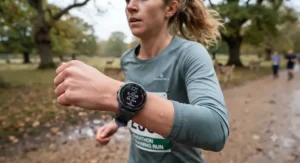
Here’s the thing about 26.2 miles: it’s a long time to be wrong about your pace. Go out twenty seconds a mile too fast and you’ll settle the bill around mile 20, legs like wet cement, dignity in tatters. A good running watch for marathon training is the calm, slightly nagging friend on your wrist who says “ease off” before your ego has finished warming up.
The market has split into clear lanes in 2026. Budget AMOLED watches now offer dual-frequency GPS. Mid-range models bring training load, VO2 max tracking and daily workout suggestions. Premium models add offline maps and titanium. The trouble is that spec sheets read like alphabet soup, and nobody has time to decode them mid-taper.
So this guide does the decoding. Every pick comes from published specs and the consistent findings of independent reviewers (I haven’t strapped all seven to my own wrist, and I won’t pretend otherwise). You’ll get honest analysis of what each number means on race day, a clear view of running watch training plans, running watch pace alerts and marathon pacing strategy, and a straight look at VO2 max estimates — including why you shouldn’t treat them as gospel.
Prices below are ranges from the time of research. Check current price before you buy.
Quick Comparison: The Best Running Watch for Marathon Training at a Glance
| Watch | Price range | GPS battery (claimed) | Multi-band GPS | Offline maps | Best For |
|---|---|---|---|---|---|
| Coros Pace 4 | £190–£230 | Up to 31 hrs (dual-frequency) | Yes | No | Budget first marathon |
| Garmin Forerunner 165 | £250–£300 | Up to 19 hrs | No | No | First Garmin, simple coaching |
| Garmin Forerunner 265 | £330–£430 | Up to 20 hrs | Yes | No | Structured all-rounder |
| Polar Vantage M3 | £300–£350 | Up to 30 hrs | Yes | Yes | Load and recovery nerds |
| Coros Pace Pro | £300–£350 | About 31 hrs (dual-frequency) | Yes | Yes | Maps and battery on a budget |
| Garmin Forerunner 570 | £450–£500 | 13 hrs multi-band (18 basic) | Yes | No (breadcrumb only) | Premium coaching, lighter case |
| Garmin Forerunner 970 | £600–£650 | 21 hrs multi-band (26 basic) | Yes | Yes | Do-everything flagship |
Two things stand out. First, every claimed GPS figure comfortably outlasts a five-hour marathon, so the real question is how much headroom you want for long runs, warm-ups and always-on screens, not whether you’ll reach the finish line. Second, offline maps only appear on the Polar Vantage M3, the Coros Pace Pro and the Garmin Forerunner 970, which matters if your training routes wander beyond the local park but is irrelevant on a well-marked road race.
💬 Just one click — help others make better buying decisions too!😊
Top 7 Running Watches for Marathon Training: Expert Analysis
Ordered from budget to premium. Each entry weighs the specs against real-world use and the recurring themes in published reviews, not marketing copy.
1. Coros Pace 4 — featherlight with 31-hour dual-band GPS
At roughly 32 g on its nylon strap, the Coros Pace 4 is the watch you forget you’re wearing — a small mercy around mile 22, when everything else feels heavy.
The specs earn their keep. A 1.2-inch AMOLED screen stays readable on a drizzly February long run, and dual-frequency GPS is rated for up to 31 hours (roughly 41 in all-systems mode). In practice that covers a five-hour marathon several times over, while the dual-frequency signal helps keep your track honest around tall buildings and tree cover. A built-in microphone even lets you leave voice notes mid-run, handy for logging how that gel sat with you.
Based on the spec comparison, this is the sensible choice for first-timers and time-poor club runners who want reliable pace and heart rate data without paying Garmin money. The trade-off is depth: its training tools are simpler than the richer coaching layers on pricier models, so anyone who wants a daily readiness verdict should look further up this list. Its running watch pace alerts are simple, which suits most road racers.
Reviewers consistently praise the battery life, low weight and value. Common criticisms are the all-plastic build, no offline maps, and no music streaming or contactless payments; one review also found distance tracking not quite pinpoint-sharp, though pace and heart rate looked accurate.
Pros:
- ✅ Dual-frequency GPS at a budget price
- ✅ Around 31 hours of dual-band GPS battery
- ✅ Very light, comfortable on small wrists
Cons:
- ❌ All-plastic case feels less premium
- ❌ No offline maps or contactless payments
Price range and verdict: around £190–£230 at the time of research — superb value for a running watch for marathon training; check current price.

2. Garmin Forerunner 165 — easiest on-ramp to Garmin’s coaching
Think of the Garmin Forerunner 165 as Garmin’s coaching brain in a small, friendly, wallet-kind body.
It carries a 1.2-inch AMOLED touchscreen, weighs about 39 g and is rated for up to 19 hours of GPS-only tracking (17 in all-systems mode), plus roughly 11 days in smartwatch mode, falling to about four with the screen always on. That GPS figure comfortably covers a marathon. What it lacks is multi-band GPS, so expect a little more wobble between skyscrapers than on dual-frequency rivals. It also omits the Training Readiness score, though Body Battery still offers a basic recovery signal.
On paper it suits the runner who wants daily suggested workouts, a race predictor and Garmin’s free running watch training plans without the flagship bill, especially anyone stepping up from a plain step counter. Here’s what to weigh: if your marathon route is city-centre heavy, the Coros Pace 4 offers dual-frequency GPS for similar money, while the Forerunner 165 wins on Garmin’s polish and coaching content.
Reviewers frequently describe the screen as vivid and the GPS as accurate enough for road marathon training. They also note that battery is only mid-pack for an AMOLED watch, and that it feels less polished as an everyday smartwatch.
Pros:
- ✅ Familiar Garmin training tools at entry price
- ✅ Bright AMOLED touchscreen plus physical buttons
- ✅ 19 hours of GPS is ample for a marathon
Cons:
- ❌ No multi-band GPS
- ❌ No Training Readiness score
Price range and verdict: around £250–£300 at the time of research (the music version costs more) — solid value for a first marathon.
3. Garmin Forerunner 265 — the proven all-rounder
The Garmin Forerunner 265 has spent years as the default answer to “which running watch?”, and the reasons haven’t gone stale.
The 46 mm version has a 1.3-inch 416×416 AMOLED and weighs 47 g; the smaller 265S drops to 39 g. GPS battery is up to 20 hours (24 on the 265S), and multi-band GPS keeps tracking steady in awkward urban stretches. Crucially, it adds Training Readiness and wrist-based running dynamics, which the Forerunner 165 doesn’t. On the wrist that means a morning nudge on whether to hammer the intervals or swap them for an easy jog, plus cadence data to catch form fade late in long runs. It has no offline maps, so navigation is basic, and its VO2 max tracking sits alongside a race predictor.
Here’s the honest analysis: it’s the pick for runners who follow structured running watch training plans and want serious training load tools without paying flagship money. What most buyers overlook is that its 20 hours of GPS is plenty; the extra battery on pricier models rarely matters over 26.2 miles.
Several UK roundups still rank it best overall in 2026. Reviewers praise the screen, the battery and the depth of training insight, and the most common complaint is that its launch price felt steep.
Pros:
- ✅ Training Readiness and running dynamics
- ✅ Multi-band GPS with 20 hours of battery
- ✅ Two sizes to suit different wrists
Cons:
- ❌ No offline maps
- ❌ Launch price felt high to reviewers
Price range and verdict: around £330–£430 at the time of research depending on retailer; a strong all-rounder if you catch it at the lower end.
4. Polar Vantage M3 — the training load and recovery specialist
If the Polar Vantage M3 were a coach, it would be the one obsessed with how tired your legs really are.
It pairs a 1.28-inch 416×416 AMOLED with dual-frequency GPS, weighs 53 g, and is rated for 30 hours in performance mode (up to 70 in eco mode) and about seven days in smartwatch mode. Offline topographic maps come as standard. The clever bit is Training Load Pro, which splits training strain into cardio, muscle and perceived load. Translation: after a hilly long run, it can tell you your muscles are cooked even when your heart rate barely complained. FuelWise fuelling prompts add race-day nutrition guidance, a feature many buyers overlook.
This is the watch for data-minded runners who like to understand training load in depth rather than glance at one number. The catch: Polar’s software feels less slick than Garmin’s, and its wrist heart rate isn’t flawless.
Reviewers praise the bright screen, the recovery tools and the mapping at this price. Recurring criticisms include fast battery drain overnight, an app that’s due a refresh, and no offline music.
Pros:
- ✅ Training Load Pro separates cardio and muscle strain
- ✅ 30-hour dual-frequency GPS performance mode
- ✅ Offline maps at a mid-range price
Cons:
- ❌ Battery drains quickly overnight
- ❌ No offline music storage
Price range and verdict: around £300–£350 at the time of research — excellent value if you love recovery data.
5. Coros Pace Pro — maps and marathon-proof battery for the money
The Coros Pace Pro is what you buy when the Coros Pace 4 feels too basic but a Garmin feels too fussy.
It has a 1.3-inch AMOLED screen rated up to 1,500 nits, a 37 g weight on the nylon strap, and dual-frequency GPS lasting roughly 31 hours. Offline topographic maps are included, though reviewers note they’re downloaded manually rather than fully routable. Storage is generous at 32 GB. In practice, that’s enough battery for a marathon plus a lazy Sunday of faff, and the bright screen is genuinely readable in low winter sun.
Here’s what to weigh: this is a lightweight, no-nonsense training tool, not a smartwatch. It suits runners who like Coros’s simplicity and want maps for hilly marathons, such as Snowdonia, without paying Garmin prices.
Reviewers highlight the bright screen, offline maps, long battery life and low weight. The recurring complaints are a price that jumped from the Coros Pace 3, an all-plastic build, limited smart features and, notably, criticism of wrist heart-rate accuracy — so pairing it with a chest strap is sensible if you train by heart-rate zones.
Pros:
- ✅ Bright AMOLED screen readable in any light
- ✅ Offline maps with very long battery life
- ✅ Featherlight at 37 g
Cons:
- ❌ Wrist heart-rate accuracy criticised in reviews
- ❌ Plastic build and limited smart features
Price range and verdict: around £300–£350 at the time of research — good value for maps and endurance.
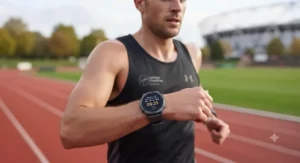
6. Garmin Forerunner 570 — premium coaching in a lighter case
The Garmin Forerunner 570 is the 265’s successor, and it arrives with a price that made reviewers wince.
It comes in 42 mm (42 g, 1.2-inch display) and 47 mm (50 g, 1.4-inch display) versions, both AMOLED, with an aluminium bezel, multi-band GPS, 8 GB of storage, and a speaker and microphone for calls. Expect roughly 13 hours of multi-band GPS (up to 18 in basic mode), so a marathon fits with plenty of margin. Training Readiness, training status, a race predictor and daily suggested workouts round out a full coaching toolkit, and its VO2 max tracking feeds those predictions.
The verdict on paper: brilliant tracking and coaching, but at this money you’d expect offline maps, and you only get breadcrumb navigation, plus no ECG. It makes most sense if you want Garmin’s latest sensor and screen in a lighter package than the Forerunner 970.
Reviewers describe reliably excellent tracking, a bright display and useful smarts, and one 2026 roundup names it best overall for most runners. The dominant complaint is price for what’s missing.
Pros:
- ✅ Two case sizes, 42 mm and 47 mm
- ✅ Full Garmin training toolkit and race predictor
- ✅ Bright AMOLED with speaker and microphone
Cons:
- ❌ Priced high for a watch without offline maps
- ❌ No ECG sensor at this price
Price range and verdict: around £450–£500 at the time of research — great tech, but the Forerunner 265 delivers most of the value for less.
7. Garmin Forerunner 970 — the do-everything flagship
The Garmin Forerunner 970 is what happens when a running watch stops being polite and starts being ambitious.
It’s a 47 mm watch with a 1.4-inch 454×454 AMOLED, titanium bezel, sapphire lens, LED flashlight, ECG sensor and 32 GB of storage. Full-colour offline maps with turn-by-turn navigation are the headline, alongside up to 26 hours of GPS (21 in multi-band mode) and up to 15 days in smartwatch mode. It also makes the best GPS watch for long runs in Garmin’s range, especially if your training includes 30-mile weekends.
Here’s the reality check. For a road marathon, maps are a luxury and battery headroom is a comfort, so you’re paying for materials, sensors and versatility. Some extra running metrics also require the separately sold Garmin HRM 600 chest strap, a hidden cost worth budgeting for.
Reviewers call it the most versatile Forerunner yet, but at the highest price. They also flag the strap requirement as the small print.
Pros:
- ✅ Offline maps with turn-by-turn navigation
- ✅ Titanium bezel and sapphire lens
- ✅ Up to 26 hours of GPS battery
Cons:
- ❌ Highest price in this round-up
- ❌ Some metrics need an extra chest strap
Price range and verdict: around £600–£650 at the time of research — outstanding, but only if you’ll use the extras.
Top 7 Compared: What Reviewers Praise and Criticise
| Watch | Standout strength (per reviewers) | Recurring criticism | Best For |
|---|---|---|---|
| Coros Pace 4 | Battery, low weight, value | Plastic build, no maps | First-time marathoners on a budget |
| Garmin Forerunner 165 | Bright screen, Garmin coaching basics | Single-band GPS, no Training Readiness | Beginners wanting Garmin’s ecosystem |
| Garmin Forerunner 265 | Balanced training insight and screen | Launch price, no maps | Runners following structured plans |
| Polar Vantage M3 | Load and recovery tools, maps | Overnight battery drain, app | Data-minded runners |
| Coros Pace Pro | Bright screen, maps, battery | Wrist heart-rate accuracy | Hilly-route runners on a budget |
| Garmin Forerunner 570 | Polished tracking, bright display | Price, breadcrumb-only navigation | Runners wanting the latest Garmin tech |
| Garmin Forerunner 970 | Maps, materials, battery | Price, chest strap for extras | Runners wanting everything |
Read across the rows and a pattern emerges: the weaknesses are mostly about price and missing extras, not core running accuracy. That’s good news, because it means even the cheapest picks here handle the essentials. If you’re stuck between the Forerunner 265 and the Forerunner 570, the analysis favours the cheaper watch unless you specifically want the newer sensor and larger screen options.
✨ Ready to Pick Your Race-Day Companion?
🔍 Take your marathon build to the next level with these carefully selected watches. Click any product name to check current pricing and availability, then get those long runs in the diary.
How to Choose a Running Watch for Marathon Training
Choosing a running watch for marathon training comes down to six decisions, in this order:
- Set your battery target. Pick a GPS rating at least double your expected finishing time, because always-on screens, music and sensors all shrink the claim.
- Check the GPS type. Multi-band GPS steadies tracking near tall buildings and trees; single-band is fine for open roads and parks.
- Judge the training tools. Training load, recovery advice and a race predictor turn raw data into decisions; running watch training plans matter more than gadget count.
- Test the alerts. Reliable running watch pace alerts (with adjustable pace windows) are the feature you’ll use most on race day.
- Prioritise comfort. You’ll wear it for four or five hours in one go, so weight and strap feel matter; the 32 g Coros Pace 4 and the 53 g Polar Vantage M3 feel very different.
- Tally the full cost. Include chest straps, spare straps and any subscription-locked features before you compare prices.
Independent test sites such as the5krunner’s running watch guide are worth cross-checking against, since accuracy testing over weeks beats a spec sheet. As a rule, the best GPS watch for long runs is the one whose battery margin, comfort and alerts you actually trust.
Marathon Pacing Strategy and Running Watch Pace Alerts: Setting Them Up Properly
A marathon pacing strategy is only as good as your ability to follow it at mile 18, when your brain starts negotiating. This is where running watch pace alerts earn their keep.
Set a sensible alert window
Rather than alerting on every second, set a window of roughly five to ten seconds per mile either side of your target. Too tight and the watch buzzes like an angry wasp; too loose and it’s decoration.
Use lap pace, not instant pace
Instant pace jitters, especially among trees or tall buildings. Average lap pace (per mile or kilometre) is calmer and closer to how your effort actually feels. Most watches let you set it as a data field.
Build the plan in splits
A sound marathon pacing strategy starts a touch conservatively, settles into goal pace by around mile three, and only asks for more after halfway. Some Garmin models can build a course-aware plan that adjusts for hills; check your model’s manual, as support varies.
Rehearse it
Practise your running watch pace alerts in long runs, ideally finishing with a stretch at goal pace. Then accept an awkward truth: your watch will almost certainly read slightly long on race day, because you never run the perfect racing line. When mile markers and your watch disagree, trust the markers for progress and your effort for pacing.
Training Load: Turning the Numbers Into Decisions
Training load estimates how much physiological stress your recent runs have added. Brands calculate it differently, which is why it pays to choose one ecosystem and stick with it.
Garmin surfaces training load through Training Status and Training Readiness on watches like the Garmin Forerunner 265 and Garmin Forerunner 570. Polar’s Training Load Pro on the Polar Vantage M3 separates cardio, muscle and perceived strain, so a hilly long run shows up differently from a flat tempo. Reviewers have noted that Garmin and Polar track training load, running power and cadence differently, so numbers aren’t interchangeable.
Use training load for three jobs. First, enforce easy days: if your legs are flagged as overloaded, an easy jog beats another hard session. Second, spot spikes: a sudden jump in weekly training load is a classic injury precursor. Third, check your taper: training load should fall in the final two weeks, and if it doesn’t, you’re still training.
Don’t chase green scores. Training load is a guide, and your body’s own feedback still gets a vote.

VO2 Max Tracking: A Compass, Not a Verdict
VO2 max tracking is one of the most-watched and most-misunderstood numbers on a running watch. True VO2 max is the maximum rate of oxygen consumption during exertion, measured in a laboratory; your watch produces an estimate from pace and heart rate.
That distinction matters. Wrist-based VO2 max tracking can drift with heat, hills, poor heart-rate data or a stretch of easy running. Treat it as a trend line over weeks, not a daily grade.
Used well, VO2 max tracking supports three decisions. It shows whether your fitness is rising as the build progresses, feeds the race predictor, and helps you sanity-check your marathon pacing strategy. If your predictor says 3:45 but your best long runs point to 4:10, believe the long runs.
Watches with VO2 max tracking, such as the Garmin Forerunner 265, Garmin Forerunner 570 and Polar Vantage M3, can all be thrown off by a weak wrist heart-rate signal. A chest strap improves consistency, which is one reason many reviewers suggest one for the Coros Pace Pro.
GPS Watch for Long Runs: Battery, Accuracy and Reality
A GPS watch for long runs has two jobs: last the distance and stay honest. Both are trade-offs.
Most watches let you choose satellite modes. DC Rainmaker’s in-depth Forerunner 165 review lists 19 hours in GPS-only mode versus 17 in all-systems mode, a neat example of accuracy costing hours. Multi-band GPS gives more accurate tracking near tall buildings but drains battery faster; the Garmin Forerunner 570‘s multi-band figure is noticeably lower than its basic GPS figure.
Do the maths. A five-hour marathon plus a one-hour warm-up and queue is six hours. Even the 19-hour Garmin Forerunner 165 covers that, but a 20-mile long run with music and always-on screen chips away at margins. Claimed figures are also maximums, not guarantees.
For a GPS watch for long runs, the practical rules are simple. Charge the night before, use multi-band only when the route demands it, and don’t pair sensors you don’t need. The Coros Pace 4, Polar Vantage M3 and Garmin Forerunner 970 offer the widest margins, while smartwatches trail badly.
Running Watch Training Plans: Which Ecosystem Coaches You Best
Running watch training plans are the quiet reason people stay loyal to a brand. The watch is the delivery mechanism; the plan is the brain.
Garmin’s free coaching tools are widely praised, and the Garmin Forerunner 165 includes free running watch training plans and detailed workout guidance. Higher up, the Garmin Forerunner 265 and Garmin Forerunner 570 add daily suggested workouts and readiness scores. Polar offers workout recommendations and fuelling guidance on the Polar Vantage M3, while Coros keeps things simpler on the Coros Pace 4 and Coros Pace Pro.
Beginners should be honest about their base. If you’re still building up, a structured programme such as the NHS Couch to 5K can lay the foundation before you commit to a marathon build. Once you’re ready, choose running watch training plans with a sensible ramp, rest days built in and a taper.
The best watch for training plans is the one that syncs cleanly, pushes structured workouts to your wrist without drama, and doesn’t tempt you into skipping easy days.
Real-World Scenarios: Matching the Watch to the Runner
The first-timer. A runner training four days a week for a spring marathon on a tight budget, aiming to finish in about five hours. The Coros Pace 4 or Garmin Forerunner 165 covers pace, heart rate and simple guidance. Choose the Coros Pace 4 for dual-frequency GPS, or the Garmin Forerunner 165 for a gentler, more guided experience with running watch training plans.
The club runner. Five runs a week, chasing a personal best, training through wet winters. The Garmin Forerunner 265 delivers readiness, load and a race predictor for a fair price, while the Garmin Forerunner 570 adds a newer sensor if the budget stretches. Pair either with a sound marathon pacing strategy and disciplined running watch pace alerts.
The hilly-route specialist. Someone eyeing a hilly race such as Snowdonia, with long training days on unfamiliar paths. Offline maps make the Polar Vantage M3, Coros Pace Pro and Garmin Forerunner 970 attractive. The Polar Vantage M3 suits those who love muscle-load data; the Coros Pace Pro suits minimalists; the Garmin Forerunner 970 suits anyone wanting everything.
Match budget, environment and frequency to the watch, not the other way round.
Running Watch vs Smartwatch vs Phone: What’s the Real Difference?
| Option | Marathon battery | GPS quality | Training tools | Best For |
|---|---|---|---|---|
| Dedicated running watch (Coros Pace 4, Garmin Forerunner 265) | Roughly 19–31 hrs claimed GPS | Multi-band on most models | Deep: load, readiness, pace guidance | Runners following structured plans |
| Mainstream smartwatch (Apple Watch Series 11) | About 24 hrs normal use, roughly 8 with GPS per one review | Single-band; accurate in the open, weaker near tall buildings | Basic training load, big app store | iPhone users wanting one do-it-all watch |
| Phone in an armband | Drains the phone quickly | Varies with phone and app | Basic via apps | Beginners testing the waters |
The dedicated watch wins on battery and specialised guidance, while the smartwatch wins on everyday convenience. Reviewers note the Apple Watch Series 11 will last a marathon and charges quickly, but it lacks dual-frequency GPS, so it isn’t the ideal GPS watch for long runs. Apple has just released the Series 12, so check what’s current before comparing.
If marathon training is your priority, a dedicated watch is the better tool; if you’d rather have one device for everything, a smartwatch is a reasonable compromise.
Common Mistakes When Buying a Running Watch for Marathon Training
- Buying on battery headlines alone. A marathon needs perhaps six hours; obsessing over 40-hour figures is like buying a lorry for the school run.
- Debuting a new watch on race week. Give yourself several weeks to learn buttons, alerts and data fields. Race morning is not the time to discover you’ve muted your running watch pace alerts.
- Ignoring hidden costs. The Garmin Forerunner 970 needs a Garmin HRM 600 for some metrics, and the Coros Pace Pro is best paired with a chest strap for accurate heart-rate zones.
- Worshipping scores. VO2 max tracking and readiness numbers are guides, not gospel.
- Skipping the plan. Even the best running watch for marathon training won’t help without sensible running watch training plans and a marathon pacing strategy you’ve rehearsed.
Long-Term Cost and Value: What a Running Watch for Marathon Training Really Costs
Sticker price is only the opening bid. A watch costing around £300 used for a year of about 200 runs works out at roughly £1.50 a run, which is cheaper than most post-run coffees.
Beyond the sticker, budget for a chest strap if you train by heart rate, a spare charging cable, and replacement straps. Check whether any features you want sit behind a subscription. Newer models usually trigger discounts on their predecessors, which is why the Garmin Forerunner 265 is often easier to justify than the Garmin Forerunner 570.
Battery health matters too. AMOLED watches charged frequently will age, so factor in a possible replacement after several seasons. For a running watch for marathon training, the sweet spot is usually the mid-range: enough sensors and coaching to help, without paying for maps or materials you won’t use.
FAQ
❓ Is a running watch for marathon training worth the money?
❓ How long should the battery last on a GPS watch for long runs?
❓ Which running watch pace alerts stop me going out too fast?
❓ Can my watch's race predictor tell me my marathon time?
❓ Do I need a chest strap for marathon training?
Conclusion: Choosing Your Running Watch for Marathon Training
The best running watch for marathon training is the one that fits your budget, your race and your habits. If money is tight, the Coros Pace 4 delivers dual-frequency GPS and a huge battery for surprisingly little, while the Garmin Forerunner 165 offers Garmin’s coaching at a gentle price. The Garmin Forerunner 265 remains the balanced all-rounder for structured training, the Polar Vantage M3 is the training load specialist, and the Coros Pace Pro adds maps and endurance for less than Garmin. At the top, the Garmin Forerunner 570 and Garmin Forerunner 970 trade higher prices for sensors, materials and headroom.
Remember what actually wins marathons: a rehearsed marathon pacing strategy, disciplined running watch pace alerts, sensible running watch training plans, and a reliable GPS watch for long runs that lasts the distance. Use VO2 max tracking and training load as compasses, not verdicts, and buy at least a few weeks before race day.
Prices change constantly, so check current price and availability before you decide.
✨ Ready to Find Your Race-Day Companion?
🏃♂️ Pick the watch that matches your plan, click through to check current pricing and availability, and get those long runs started. The start line is closer than you think!
Recommended for You
- Garmin Running Watch for Beginners: 7 Best Picks (2026)
- Polar vs Garmin Running Watch: 7 Best Picks Compared (2026)
- Garmin vs Coros Running Watch: 7 Top Picks Compared (2026)
Disclaimer: This article contains affiliate links. As an Amazon Associate, I earn from qualifying purchases. If you purchase products through these links, we may earn a small commission at no additional cost to you.
✨ Found this helpful? Share it with your friends! 💬🤗
