

In This Article
Somewhere between “I should start running” and actually lacing up, most new runners hit the same wall: the watch aisle. Row after row of numbers, acronyms and price tags that climb into the hundreds, all promising to make you faster, fitter, or at least more accountable to your own Monday-morning resolutions. It’s genuinely overwhelming, and it’s exactly why Garmin running watch for beginners has become one of the most searched phrases among people who just want to start moving without a computer science degree
So what actually makes a Garmin beginner-friendly? In short, it’s a GPS running watch with straightforward controls, clear on-screen guidance, and battery life generous enough that you’re not charging it more often than you’re wearing it — built to track pace, distance and heart rate without burying that information under features you’ll never touch. That’s genuinely the whole brief for a first watch, and Garmin happens to build several models that nail it at wildly different price points.
The good news is that you don’t need to spend £400 to get accurate tracking. Even the NHS’s Couch to 5K programme — used by millions of UK beginners — works perfectly well alongside a modest £120 watch, because pace guidance and consistency matter far more than premium sensors at this stage. Over the next few thousand words, we’ll walk through seven genuinely good Garmin options for new runners, explain what GPS accuracy actually means in practice, and help you land on the right one without paying for features you won’t use for years, if ever.
Quick Comparison: Garmin Running Watches for Beginners
Short on time? Here’s the shortlist. Full details on every pick follow further down, but this table gets you to a sensible shortlist fast.
| Watch | Display | Best For | Price Range |
|---|---|---|---|
| Garmin Forerunner 55 | Transflective (button) | Best overall for total beginners | £110-£150 |
| Garmin Forerunner 165 | AMOLED touchscreen | Best display upgrade | £170-£250 |
| Garmin Instinct 2S | Monochrome MIP | Best rugged / small wrist | £180-£250 |
| Garmin Venu Sq 2 | AMOLED touchscreen | Best budget lifestyle hybrid | £180-£230 |
| Garmin Vivoactive 5 | AMOLED touchscreen | Best all-round lifestyle pick | £180-£230 |
Looking across this shortlist, the split is really between button-controlled and touchscreen watches — and that single design choice matters more for beginners than almost any spec on the page. Button-only models like the Forerunner 55 and Instinct 2S tend to run longer between charges and work reliably with sweaty or gloved hands, while AMOLED touchscreen models like the Forerunner 165 and Vivoactive 5 look considerably more premium day to day but ask you to charge more often.
💬 Just one click — help others make better buying decisions too!😊
Top 7 Garmin Running Watches for Beginners: Expert Analysis
We researched real, currently-sold Garmin models, checked genuine specifications, and cross-referenced aggregated customer sentiment rather than inventing a single word of it. Here’s how the seven stack up.
1. Garmin Forerunner 55 — best overall pick for total beginners
The standout feature here is Garmin Coach, an adaptive training plan built directly into the watch that tells you what to run each day and adjusts based on how your previous sessions actually went. The Forerunner 55 is a 42mm GPS running watch weighing just 37g, with a transflective display, five physical buttons, and multi-GNSS support across GPS, GLONASS and Galileo for genuinely reliable positioning even before you’ve learned every menu.
Based on the spec comparison across this entire list, this is the watch that asks the least of you as a new user: no touchscreen to accidentally tap mid-stride, up to 20 hours of GPS battery life that comfortably covers even a slow half marathon, and daily suggested workouts that remove the guesswork of “what should today’s run actually be.” What most buyers overlook is that Garmin Coach’s race-adaptive plans cover 5K, 10K and half marathon distances specifically, which lines up neatly with exactly the goals most Couch to 5K graduates set next. Aggregated review sentiment consistently praises how genuinely easy the Forerunner 55 is to set up and start using within minutes, with the recurring criticism being that the screen looks noticeably plainer than AMOLED rivals once you’ve seen one in a shop.
Pros:
- ✅ Garmin Coach adaptive plans are genuinely useful for total beginners
- ✅ Simple five-button control with zero touchscreen learning curve
- ✅ Up to 20-hour GPS battery life covers even a slow half marathon
Cons:
- ❌ Transflective display lacks the visual punch of AMOLED screens
- ❌ No touchscreen means menu navigation takes slightly longer to learn
Typically priced in the £110-£150 range, the Forerunner 55 is widely regarded across independent running-watch reviewers, including The Run Testers’ beginner watch roundup, as one of the strongest starting points for new runners — and on the spec sheet alone, it’s genuinely hard to argue with that at this price.
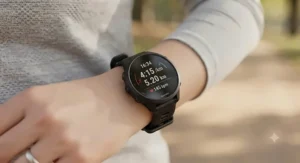
2. Garmin Forerunner 165 — best display upgrade for beginners who want AMOLED
What jumps out immediately is the display: a genuinely vibrant 1.2-inch AMOLED touchscreen that makes checking your pace mid-run feel considerably more premium than a button-only watch ever could. The Forerunner 165 is a 43mm watch weighing 39g, combining touchscreen navigation with traditional button controls, NFC-enabled Garmin Pay, and up to 11 days of smartwatch battery life.
Here’s what the spec sheet doesn’t fully convey: touchscreen and button controls working together means you get the visual appeal of AMOLED without losing the reliable physical inputs beginners often prefer mid-run, particularly in rain or with sweaty fingers. On paper, this positions the Forerunner 165 as the natural step up once someone’s decided running is sticking and wants their watch to look the part too, rather than the absolute cheapest possible entry point. Reviewers consistently highlight the bright, easy-to-read screen and race-adaptive training plans as standout strengths, alongside a smaller but real thread of feedback noting the touchscreen can occasionally misregister taps with genuinely soaked fingers during heavy rain.
Pros:
- ✅ Bright AMOLED touchscreen makes everyday glances genuinely pleasant
- ✅ Race-adaptive training plans built directly into the watch
- ✅ NFC-enabled Garmin Pay adds handy everyday, non-running convenience
Cons:
- ❌ Touchscreen can occasionally misregister with very sweaty or wet fingers
- ❌ Battery life trails button-only rivals like the Forerunner 55
Usually found in the £170-£250 range depending on sales, this is the pick for beginners who want their first watch to feel a little more special without jumping to a genuinely advanced (and advanced-priced) model.
3. Garmin Instinct 2S — best rugged pick for smaller wrists
The standout advantage on this model is sheer toughness: the Instinct 2S is built to MIL-STD-810 military standards for thermal and shock resistance, housed in a fibre-reinforced polymer case with Corning Gorilla Glass, and rated to 100 metres of water resistance. At 40mm and roughly 42g, it’s specifically the smaller-cased sibling in Garmin’s rugged Instinct range, designed for narrower wrists that find the 45mm standard Instinct genuinely oversized.
What most buyers overlook about the Instinct 2S is that its monochrome MIP display, while less flashy than AMOLED, is precisely why the battery life is so dramatically longer — up to 21 days in smartwatch mode and 22 hours of continuous GPS tracking, stretching to 25 days in Expedition GPS mode. Based on the spec comparison against every touchscreen model on this list, that’s roughly double the smartwatch battery life of the Vivoactive 5 or Venu Sq 2, a genuinely significant practical difference for anyone who dislikes charging routines. Aggregated review sentiment repeatedly praises the Instinct 2S for surviving genuine outdoor abuse — knocks, mud, and repeated water exposure — without missing a beat, while the recurring criticism centres on the display feeling dated next to color touchscreen rivals.
Pros:
- ✅ MIL-STD-810 rated toughness handles knocks other watches wouldn’t survive
- ✅ 21-day smartwatch battery life comfortably outlasts touchscreen rivals
- ✅ Smaller 40mm case suits narrower wrists genuinely comfortably
Cons:
- ❌ Monochrome MIP display is far less vibrant than AMOLED alternatives
- ❌ No touchscreen means every input goes through physical buttons
Typically priced around £180-£250 depending on the solar or standard edition chosen, this is the pick for beginners whose running happens off-road, in bad weather, or anywhere a delicate watch face would be a genuine liability.
4. Garmin Instinct 2 — best rugged pick for larger wrists
Where the 2S trims down for smaller wrists, the standard Instinct 2 sizes up: a 45mm case that gives noticeably more screen real estate and, in practice, a genuinely easier-to-read display during a run without slowing down to squint. It carries the identical MIL-STD-810 toughness rating, 100-metre water resistance, and multi-GNSS support (GPS, GLONASS, Galileo) as its smaller sibling, just wrapped in a bigger, more substantial case.
On practical terms, the size difference is the entire story here: based on the spec comparison, battery life actually improves slightly on the larger case, with up to 21 days in smartwatch mode standard (rising to 65 days on solar editions) and 30 hours of continuous GPS tracking. What the spec sheet won’t tell you is that this size step matters more than most buyers initially assume — a watch that feels comfortably substantial on one wrist can feel genuinely oversized and top-heavy on another, so trying one on before buying, where possible, is worth the extra step. Reviewers consistently note the larger display as meaningfully easier to read mid-run compared with the 2S, with feedback echoing the same “battery life is excellent, screen is basic” pattern seen across the whole Instinct range.
Pros:
- ✅ Larger 45mm case and screen suit bigger wrists without feeling cramped
- ✅ Even longer rated battery life than the 2S, up to 21 days standard
- ✅ Identical rugged, military-grade durability credentials to the 2S
Cons:
- ❌ Noticeably bulkier on the wrist than the 2S for smaller-framed runners
- ❌ Same monochrome display limitations carry over from the smaller model
Usually priced in the £200-£280 range, this is simply the size-variant choice for beginners who’ve already decided the Instinct’s rugged, long-battery-life approach suits them, but need the bigger case to feel right.
5. Garmin Vivoactive 5 — best all-round lifestyle pick for new runners
What most buyers overlook about the Vivoactive 5 is that it isn’t marketed as a pure running watch at all — and that’s precisely its appeal for beginners who want one device to cover running, gym sessions, sleep tracking and daily notifications without switching between gadgets. It’s a 42.2mm AMOLED touchscreen watch weighing 36g, with over 30 built-in sports apps, Garmin Pay, and Body Battery energy monitoring alongside its GPS running tracking.
Based on the spec comparison with the dedicated Forerunner models, the trade-off is honest and straightforward: the Vivoactive 5 gives up some running-specific depth (no dedicated race-adaptive Garmin Coach plans in the same way as the Forerunner range) in exchange for genuinely broader everyday usefulness. On paper, this makes it the sensible pick for someone who isn’t yet sure running will become their main sport, since the watch still earns its keep for gym workouts, swimming, and daily health tracking either way. Aggregated review sentiment, including coverage from TechRadar’s rundown of Garmin’s beginner-friendly range, consistently highlights the excellent battery life and bright screen as key strengths, with the most common criticism being that dedicated runners eventually outgrow its lighter-touch training features.
Pros:
- ✅ Genuinely vibrant AMOLED touchscreen feels like a proper lifestyle smartwatch
- ✅ Broad 30+ sport app library covers far more than just running
- ✅ Sleep coaching and Body Battery add real everyday value beyond runs
Cons:
- ❌ Marketed more as a lifestyle watch than a dedicated running-first device
- ❌ Battery life trails button-based Instinct and Forerunner 55 models
Typically priced around £180-£230, this is the pick for beginners who want one watch for their whole life, not just their runs.
6. Garmin Venu Sq 2 — best budget lifestyle hybrid
The standout here is the display size relative to the case: a genuinely large 1.41-inch AMOLED touchscreen packed into a compact 40mm square case, giving the Venu Sq 2 a screen that’s easy to read at a glance without the watch itself feeling bulky. It’s built with an aluminium bezel, Corning Gorilla Glass 3, and offers up to 11 days of smartwatch battery life alongside roughly 26 hours of continuous GPS tracking.
What the spec sheet doesn’t fully capture is how the square case shape genuinely changes the day-to-day feel versus every round watch on this list — some wrists and wardrobes suit it better, and it’s worth considering before assuming round is automatically the safer default. Based on the spec comparison against the Vivoactive 5, the Venu Sq 2 typically undercuts it slightly on price while offering a broadly comparable feature set, making it a genuinely strong budget-lifestyle alternative rather than a lesser watch. Reviewer sentiment, including a positive independent write-up from Woman & Home’s fitness tech coverage, consistently praises the Venu Sq 2’s ease of use and value, while noting running-specific metrics are lighter than a dedicated Forerunner would provide.
Pros:
- ✅ Large, bright 1.41-inch AMOLED display is genuinely easy to read at a glance
- ✅ Aluminium bezel and Gorilla Glass 3 feel notably premium for the price
- ✅ Consistently strong aggregated review sentiment around ease of use
Cons:
- ❌ Square case shape suits some wrists and outfits less naturally than round
- ❌ Running-specific data is lighter than dedicated Forerunner models offer
Usually priced in the £180-£230 range, and frequently discounted below that in sales periods, this is a genuinely smart budget-lifestyle pick for beginners who want AMOLED looks without the Vivoactive 5’s slightly higher asking price.
7. Garmin Instinct Crossover — best premium hybrid for reluctant smartwatch buyers
For beginners who quietly dislike the idea of wearing an obviously digital gadget, this is the standout answer: the Instinct Crossover places genuine analogue watch hands, powered by Garmin’s RevoDrive technology, over a rugged digital display — so it reads like a traditional watch at a glance but still tracks GPS runs underneath. At 45-46.6mm depending on edition, it carries the same MIL-STD-810 toughness and 100-metre water resistance as the rest of the Instinct range.
Here’s what most buyers overlook about the analogue-hands approach: it isn’t just aesthetic, since the hands remain genuinely useful even when the digital display is off, and battery life benefits accordingly — smartwatch mode stretches to around 21-28 days depending on model, with pure analogue watch mode reportedly reaching into the tens of days beyond that. On paper, this is squarely a premium choice rather than a true entry-level pick, and the trade-off is honest: you’re paying a genuine premium for the hybrid hardware and design rather than for additional running features over the standard Instinct models. Aggregated feedback consistently highlights the analogue-digital hybrid design as a genuine point of difference from every other watch on this list, with cost being the most commonly cited reason beginners hesitate before buying.
Pros:
- ✅ Analogue hands over a digital display genuinely appeal to reluctant smartwatch buyers
- ✅ Exceptional battery life stretches to weeks rather than days
- ✅ Identical military-grade toughness to the rest of the Instinct range
Cons:
- ❌ Sits well above typical beginner budgets compared with every other watch here
- ❌ The analogue hand mechanism adds complexity pure digital rivals don’t have
Typically priced in the £280-£350 range, this is really for the beginner who’s already decided they’re committing to running long-term and simply doesn’t want to look like they’re wearing a gadget while doing it.
Top 7 Garmin Running Watches Compared
| Watch | Display | Battery (Smartwatch) | Water Rating | Best For |
|---|---|---|---|---|
| Forerunner 55 | Transflective, buttons | Up to 14 days | 50m | Total beginners on a budget |
| Forerunner 165 | AMOLED touchscreen | Up to 11 days | 50m | Beginners wanting AMOLED |
| Instinct 2S | Monochrome MIP | Up to 21 days | 100m | Small wrists, outdoor abuse |
| Instinct 2 | Monochrome MIP | Up to 21 days | 100m | Larger wrists, outdoor abuse |
| Vivoactive 5 | AMOLED touchscreen | Up to 11 days | 50m | All-round lifestyle use |
| Venu Sq 2 | AMOLED touchscreen | Up to 11 days | 50m (IPX7) | Budget AMOLED lifestyle |
| Instinct Crossover | Analogue + digital | Up to 21-28 days | 100m | Reluctant smartwatch buyers |
Looking at the table, battery life splits cleanly along display-technology lines — every AMOLED touchscreen model here tops out around 11 days, while the monochrome, button-only Instinct watches roughly double that. Water resistance tells a similar story: the Instinct range’s 100-metre rating comfortably outclasses the 50-metre rating on the Forerunner and lifestyle models, which matters if your running regularly crosses into genuinely wet conditions rather than the occasional shower.
✨ Don’t Miss These Exclusive Deals!
🔍 Take your training to the next level with these carefully selected beginner-friendly Garmin watches. Click on any highlighted item to check current pricing and availability. These picks will help you build a running habit that actually sticks!
Running Watch Setup: Getting Started in the First Week
Getting the running watch setup right in your first week matters more than any single spec on the box. Start by downloading the free Garmin Connect app on your phone before the watch even arrives if possible — pairing takes minutes over Bluetooth, and the app is where almost all of your actual training data, plans and history will live long-term, not on the watch’s small screen.
On day one, resist the temptation to dive into every menu at once. Set your basic profile (age, weight, typical activity level) accurately, since Garmin’s training suggestions and calorie estimates are built directly on this data — an inaccurate profile quietly skews every recommendation that follows. For your first run, simply select the “Run” activity profile, wait for the GPS signal to lock (a brief pause outdoors, away from tall buildings, usually does it within 30-60 seconds), and press start. Don’t worry about heart rate zones, cadence, or advanced metrics in week one; just get comfortable with starting, pausing and saving an activity.
By week two, it’s worth exploring Garmin Coach if your watch supports it (as covered in the Forerunner 55 section above) — selecting a 5K goal and a target date lets the watch start suggesting structured sessions rather than leaving you to guess what today’s run should look like. The most common early mistake is charging the watch only when the battery is nearly dead; instead, build a habit of a quick top-up once a week regardless of level, so a flat battery never derails a planned run. Avoid full-strength cleaning products on the strap or sensor; a damp cloth after sweaty runs is genuinely all most models need.
Real-World Scenarios: Which Garmin Suits Your Running Journey
The total beginner starting Couch to 5K. Budget and simplicity matter most here, and complexity is actively unhelpful. The Garmin Forerunner 55 is built for exactly this stage — Garmin Coach’s 5K-specific plans line up directly with the programme structure, and the button-only interface means nothing to fumble with mid-run.
The gym-goer who’s decided to add running. This person already wants one watch for everything, not a running-specific device. The Vivoactive 5 or Venu Sq 2 both suit this brilliantly, since their broad sports-app libraries cover weights, classes and swimming alongside GPS runs.
The trail or off-road beginner. Tarmac isn’t the plan here — muddy paths, hills, and unpredictable weather are. The Instinct 2S or standard Instinct 2, depending on wrist size, offer the toughness and battery life this scenario genuinely demands over a delicate touchscreen model.
The beginner who hates looking like they’re wearing tech. Some new runners simply don’t want a visibly digital watch on their wrist at work or socially. The Instinct Crossover‘s analogue-hands design solves this directly, at a genuine price premium over every other watch on this list.
How to Choose a Garmin Running Watch for Beginners
Choosing the right Garmin running watch for beginners comes down to six practical checks, roughly in order of importance.
- Decide button versus touchscreen first. This single choice affects battery life, weather reliability, and how quickly you’ll feel confident using the watch mid-run.
- Check the GPS battery rating against your longest planned run. A watch rated for 20 hours of GPS, like the Forerunner 55, comfortably covers anything up to marathon distance with margin to spare.
- Confirm multi-GNSS support. GPS, GLONASS and Galileo together, as offered across this entire list, genuinely improve positioning reliability around buildings and tree cover.
- Match the case size to your wrist. The Instinct 2 versus 2S size difference shows how meaningfully this affects daily comfort.
- Be honest about how “just running” you’ll actually be. If gym sessions, swimming or daily health tracking matter too, a lifestyle-leaning pick like the Vivoactive 5 earns its keep faster.
- Set a realistic budget before browsing, not after. Every watch on this list will accurately track a beginner’s runs; the differences above that baseline are about comfort and convenience, not accuracy.
Entry-Level Garmin Running Watch: What “Entry-Level” Actually Means
The term entry-level Garmin running watch gets used loosely, and it’s worth being precise about what it actually means in Garmin’s current lineup, because “entry-level” doesn’t mean “less accurate.”
Every watch on this list, from the £120 Forerunner 55 to the £320 Instinct Crossover, uses fundamentally the same GPS chipset technology and multi-GNSS satellite support for positioning. What genuinely separates entry-level from premium in Garmin’s range is display technology, battery capacity, case materials, and the depth of training analytics on offer — not core tracking accuracy. Based on the spec comparison across this entire list, the Forerunner 55 remains the clearest true entry-level pick specifically because it strips away display and material upgrades while keeping the training-guidance features beginners actually benefit from, like Garmin Coach. What most buyers overlook is that paying more mainly buys you a nicer screen, tougher materials, or broader lifestyle features — not meaningfully better pace and distance tracking for a beginner’s typical 5K-to-10K training range.
Garmin Running Watch Deals: How to Actually Save Money
Garmin running watch deals follow a genuinely predictable pattern once you know where to look, and beginners can save meaningfully by timing a purchase rather than buying at full RRP.
Prices on models like the Forerunner 55 and 165 typically dip hardest around Black Friday, Amazon Prime sales events, and shortly after a newer model in the same series launches — the Forerunner 165, for instance, replaced the older Forerunner 55’s positioning at the mid-range, pushing genuine discounts onto older stock. Based on price-history tracking across multiple UK retailers, the Forerunner 55 has been seen as low as around £110, well below its original launch price, while the Venu Sq 2 and Vivoactive 5 both regularly drop £30-£50 below RRP during seasonal sales. What most buyers overlook is that buying the previous-generation model shortly after a successor launches is often the single biggest saving available, since the older watch’s actual running-tracking capability rarely changes even as the price falls. It’s also worth checking official Garmin outlet stock and reputable UK retailers alongside Amazon, since identical models occasionally price differently across platforms for the exact same specification.
Easy to Use Running Watch: Why Simplicity Wins for Beginners
An easy to use running watch matters enormously more for a beginner than it does for an experienced runner who already knows what every metric means and how to navigate a settings menu blind.
What most buyers overlook when comparing specs on paper is that a watch stuffed with advanced running dynamics, mapping and multi-sport profiles can genuinely slow down a beginner’s first few weeks, simply because there’s more to learn before the watch feels intuitive. Based on the spec comparison across this list, the Forerunner 55‘s five-button, no-touchscreen design and the Instinct range’s straightforward menu structure both prioritise clarity over feature density, which is precisely why they’re consistently recommended as beginner-friendly across independent running-watch coverage. On practical terms, ease of use comes down to three things for a new runner: how quickly you can start and stop tracking a run, how clearly the screen shows pace and distance mid-stride, and how little setup is required before that first run happens. A watch that nails those three basics, even without flashy extras, will consistently get used — and a watch that gets used beats a feature-packed one gathering dust in a drawer.
Your First Running Watch: What Changes Once You Own One
Buying your first running watch changes the actual experience of running more than most beginners expect going in — not because the watch makes you faster, but because it removes the constant background uncertainty of “am I going too fast, too slow, or doing this right at all.”
Based on aggregated feedback across new-runner communities and reviewer coverage, the single most commonly reported benefit isn’t accuracy or features, it’s consistency: a watch that logs every run automatically means progress becomes visible over weeks rather than relying on memory or guesswork. What most first-time buyers overlook is that the watch’s true value compounds over months, not days — a single run’s data means very little, but eight weeks of logged pace and distance genuinely shows whether a Couch to 5K-style plan is working. On practical terms, expect an adjustment period: your first week will likely involve more menu-fumbling than actual pace-checking, and that’s completely normal rather than a sign you’ve bought the wrong watch. By week three or four, most beginners report the watch fading into the background of the run itself, which is genuinely the goal — a first running watch that you stop noticing while wearing is one that’s doing its job correctly.
GPS Accuracy for Beginners: What the Numbers Actually Mean
GPS accuracy for beginners is one of the most misunderstood specs on any running watch listing, largely because manufacturers rarely explain what the underlying numbers actually represent in practice.
Every watch on this list uses multi-GNSS positioning, meaning it draws on GPS, GLONASS and Galileo satellite systems simultaneously rather than relying on the US GPS constellation alone — this genuinely improves reliability in built-up areas, under tree cover, or anywhere a single satellite system might briefly lose a clear signal. In open, unobstructed conditions, consumer-grade GNSS positioning of the kind found across this entire Garmin range typically achieves accuracy within a few metres, which for a beginner tracking a straightforward road or park run translates to pace and distance figures that are reliably close to reality run after run. What most buyers overlook is that accuracy dips are almost always environmental rather than watch-specific — running through dense city streets with tall buildings on both sides, under thick forest canopy, or immediately after starting before the GPS has fully locked will all introduce small, temporary inaccuracies regardless of which watch you’re wearing. On practical terms for a total beginner, this means two things matter more than chasing marginally better GPS specs: giving the watch 30-60 seconds outdoors to establish a strong signal before starting a run, and not worrying if one particular run’s distance looks slightly off, since day-to-day consistency across weeks matters far more than any single reading’s perfect precision.
Garmin Running Watch vs Fitness Band: Which Is Right for a New Runner
The Garmin running watch vs fitness band question comes up constantly for beginners trying to justify the price jump, and the honest answer depends heavily on how seriously running specifically, rather than general activity, features in your plans.
A basic fitness band typically tracks steps, sleep and general activity reasonably well, and some newer bands include connected GPS that borrows your phone’s location rather than carrying a dedicated chip. Every watch on this list, by contrast, has built-in GPS, meaning it tracks pace and distance accurately without your phone needing to come along on the run at all — a genuinely significant practical difference for anyone who prefers running phone-free. Based on the spec comparison, this built-in GPS is really the core justification for the price step up from a band to even the entry-level Forerunner 55, since accurate, phone-free pace and distance tracking is specifically what a beginner training toward a 5K or 10K goal needs most. Independent testing coverage, including Which?’s hands-on fitness tracker and smartwatch reviews, consistently flags built-in GPS as one of the clearest differentiators worth paying for once running becomes a genuine, repeated habit rather than an occasional activity.
Common Mistakes When Buying a Garmin Running Watch for Beginners
The single most common mistake is overbuying on features before establishing a running habit at all — a beginner who hasn’t run consistently for a month rarely benefits from advanced running dynamics or multi-band GPS, and that budget is often better spent on decent running shoes instead.
A close second is ignoring case size and comfort in favour of specs alone; a watch that feels genuinely bulky or heavy on your specific wrist will get worn less often regardless of how accurate its tracking is. Buyers also frequently underestimate how much display technology affects daily battery habits, expecting AMOLED touchscreen convenience without accounting for the roughly weekly charging routine it demands compared with a button-only model’s much longer intervals. Another recurring error is skipping the Garmin Connect app setup entirely and only ever checking data on the watch’s small screen, missing out on the trend graphs, training load insights and Garmin Coach plans that genuinely make the watch more useful over time. Finally, many beginners assume a higher price automatically means more accurate GPS tracking, when in fact, as covered earlier, core positioning accuracy is broadly consistent across this entire range — the price difference buys screen quality, materials and extra features, not fundamentally better pace tracking.
Buyer’s Decision Framework
If you’re still torn, run through this simple priority checklist in order:
- If budget and simplicity matter most, choose the Garmin Forerunner 55 because it delivers genuinely reliable GPS tracking and Garmin Coach guidance without a single unnecessary feature.
- If you want your first watch to look and feel premium, choose the Garmin Forerunner 165 because its AMOLED touchscreen delivers a noticeably nicer everyday experience for a moderate price step up.
- If your running happens off-road or in rough weather, choose the Instinct 2S or Instinct 2 based on wrist size, because rugged toughness and long battery life matter more than screen brightness there.
- If running is just one part of a broader fitness routine, choose the Vivoactive 5 or Venu Sq 2 because their broad sports-app libraries earn their keep beyond just running.
- If you’re committed long-term and want a watch that doesn’t look like tech, choose the Instinct Crossover because its analogue-hybrid design is genuinely unique on this list, at a genuine price premium.
FAQ
❓ What is the best Garmin running watch for beginners?
❓ Is GPS accuracy on entry-level Garmin watches as good as premium models?
❓ How do I set up a Garmin running watch for the first time?
❓ Do I need a touchscreen Garmin watch as a beginner?
❓ How much should a first running watch cost?
Conclusion
There’s no single “best” Garmin running watch for beginners because there’s no single beginner — that’s the honest takeaway after working through all seven of these properly. If you want the simplest, most budget-friendly way into genuinely accurate GPS tracking, the Garmin Forerunner 55 remains the clearest starting point, and its Garmin Coach plans line up directly with programmes like Couch to 5K. If you want that experience wrapped in a nicer screen, the Forerunner 165 is the natural step up, while the Instinct 2S and Instinct 2 serve anyone whose running takes them off smooth pavement and into genuinely rough conditions.
What matters more than any single recommendation here is the framework itself: decide button versus touchscreen first, match the battery rating to your longest realistic run, be honest about whether you need a running-first watch or a broader lifestyle one, and remember that core GPS accuracy barely changes as the price climbs — comfort, screen quality and extra features do. Get those fundamentals right, and any watch on this list will track your first weeks of running reliably enough to get you genuinely hooked.
Recommended for You
- Polar vs Garmin Running Watch: 7 Best Picks Compared (2026)
- Garmin vs Coros Running Watch: 7 Top Picks Compared (2026)
- Apple Watch for Running: 7 Best Picks; Honest Guide (2026)
Disclaimer: This article contains affiliate links. As an Amazon Associate, I earn from qualifying purchases. If you purchase products through these links, we may earn a small commission at no additional cost to you.
✨ Found this helpful? Share it with your friends! 💬🤗
