

In This Article
There’s a particular kind of dread that comes with watching a battery icon flash red at mile 60 of a race you’ve spent a year training for. It’s the reason so many endurance athletes end up switching allegiances to Coros. A Coros running watch is a GPS sports watch built primarily around three things: multi-day battery endurance, dependable satellite accuracy, and deep training analytics delivered without a subscription fee — a formula that’s quietly won over runners who got fed up charging their watch every single night.
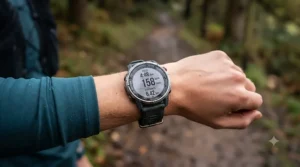
Coros isn’t the flashiest name on the shelf. It doesn’t have Garmin’s decades of brand recognition or Apple’s ecosystem pull, and the screens on several models still use a duller memory-in-pixel display rather than a vivid AMOLED. What it does have is a habit of solving the one problem that actually ruins long runs: running out of juice halfway round. Whether you’re chasing a first 10k PB on the towpath or working towards the NHS’s recommended 150 minutes of weekly activity, or planning a multi-day fastpacking trip through the Cairngorms, there’s a model in the current line-up built with your specific mileage in mind.
This guide walks through seven real Coros watches on sale in the UK right now, from the featherlight budget option through to the titanium flagship, with honest analysis of who each one actually suits — not just a spec sheet dump.
Quick Comparison Table
| Watch | Best For | GPS Battery (approx.) | Display | Price Range |
|---|---|---|---|---|
| Coros Pace 4 | Best overall value | up to 41 hrs | AMOLED | around £220-£240 |
| Coros Nomad | Backcountry & fastpacking | up to 50 hrs | MIP | around £310-£330 |
| Coros Apex 4 | Serious mountain training | up to 65 hrs | MIP | around £420-£480 |
| Coros Vertix 2S | Multi-day ultrarunning | up to 118 hrs | MIP | around £590-£650 |
A pattern emerges fast here: within the Coros range, battery life and price climb together, but so does ruggedness rather than raw accuracy. Even the cheapest model on this shortlist, the Coros Pace 4, tested with genuinely accurate dual-frequency GPS, so the jump in cost as you go up the table buys you longer endurance and tougher materials rather than a meaningfully better GPS chip. That’s an important distinction for anyone assuming premium always means more accurate.
💬 Just one click — help others make better buying decisions too!😊
Top 7 Coros Running Watches: Expert Analysis
1. Coros Pace 4 — best all-round value with an AMOLED upgrade
The standout thing about the Coros Pace 4 is what it doesn’t sacrifice to hit its price point: colour, brightness, and battery life all improved on the previous generation at once, which is rare in this market. It runs a 1.2-inch AMOLED touchscreen with dual-frequency GNSS, weighs roughly 32g with the nylon strap, and independent testing measured GPS battery life stretching from the low 30s up to around 40 hours in max accuracy mode, depending on always-on display settings. For context, most AMOLED watches under £250 top out at half that.
Based on the spec comparison against rivals like the Garmin Forerunner 165, the Pace 4’s real advantage isn’t any single number — it’s that Coros didn’t have to trade brightness for stamina the way most budget AMOLED watches do. This is the watch for runners who’ve outgrown a basic fitness band but don’t yet need offline mapping or a titanium bezel; new club runners, half-marathon trainers, and anyone who wants their training data taken seriously without spending Garmin flagship money. What most buyers overlook about this model is the lack of contactless payment and music streaming, which genuinely won’t bother most runners but will frustrate anyone coming from a smartwatch.
Reviewers consistently report that heart rate tracking is solid for steady running but occasionally lags during sharp interval changes, a known trade-off of wrist-based optical sensors generally rather than a Pace 4-specific flaw. Aggregated feedback also flags the plastic case as feeling a little basic next to metal-bezel rivals, though nobody disputes the accuracy underneath it.
Pros:
- ✅ Dual-frequency GPS in a genuinely budget watch
- ✅ Bright AMOLED screen with strong outdoor visibility
- ✅ Longest battery life of any AMOLED watch this price
Cons:
- ❌ No offline topographic maps, breadcrumb only
- ❌ Optical heart rate can lag on sharp effort changes
Typically found around £220-£240 in the UK, at the time of research the Coros Pace 4 represents the strongest pound-for-pound value in the current line-up — prices may vary by retailer, so it’s worth checking current pricing before buying.
2. Coros Pace 3 — best budget pick for simple, honest training
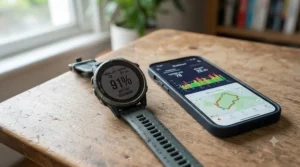
The Coros Pace 3 earns its keep by doing less, better. It swaps the AMOLED panel for a simpler memory-in-pixel screen, and reviewers who’ve put it through structured 8-week testing periods consistently rate its dual-frequency GPS tracking as reliable across road, track, and moderate trail terrain, even if the display itself looks dated next to newer siblings.
Here’s what to weigh: the 240 x 240 resolution screen is noticeably less crisp than the Pace 4’s, and the interface hasn’t been refreshed in a while, giving it a slightly clunky, last-generation feel. On paper this means you’re trading visual polish for a lower price and, counterintuitively, similar core GPS performance to the newer models. That’s an unusual trade in consumer tech, where newer almost always means better across the board — with Coros, “older” mostly just means duller-looking.
Aggregated review sentiment is remarkably consistent: testers repeatedly single out the sub-40g weight and the 38-hour GPS battery ceiling as the reasons to buy, while the “cheap plastic” feel of the crown button is the most commonly repeated criticism. For a first-time GPS watch buyer, or a marathon runner who wants Coros’s training analytics without paying for a screen upgrade they don’t care about, the Pace 3 remains a genuinely sound purchase in 2026, even as a legacy model.
Pros:
- ✅ Excellent battery life for its low price point
- ✅ Featherlight build, comfortable for all-day wear
- ✅ Accurate dual-frequency tracking on road and trail
Cons:
- ❌ Dimmer, lower-resolution screen than newer siblings
- ❌ Interface feels a generation behind current Coros models
At the time of research, the Coros Pace 3 typically sits in the £190-£220 range, making it one of the cheapest genuinely accurate GPS watches on amazon.co.uk.
3. Coros Pace Pro — best mid-range pick if you want maps without the mountain price
The Coros Pace Pro slots in as the AMOLED, mapped-out sibling of the Pace range. Reviewers note it packs a 1.3-inch AMOLED display, offline TOPO maps, an ECG sensor, and a noticeably faster processor than the Pace 3, wrapped into a case that’s a touch larger and heavier as a result.
What the spec sheet won’t tell you, but reviewer consensus does, is that the Pace Pro’s price positioning has been a point of friction. Several testers have flagged that at its RRP it edges close to rival watches from Garmin and Polar that offer a more polished app ecosystem for similar money, which slightly dents its value case against its own cheaper Pace 3 sibling. Based on the spec comparison, the genuine upgrade here is the offline mapping and 32GB of onboard storage, both of which the Pace 3 and Pace 4 lack entirely.
Who should care: runners training for their first ultramarathon or multi-day trail event who want basic route navigation without stepping up to the bulkier Apex or Vertix ranges. If you only ever run routes you already know, the Pace Pro’s mapping is arguably wasted, and the cheaper Pace 4 makes more financial sense.
Pros:
- ✅ Offline TOPO maps not available on cheaper Pace models
- ✅ Bright, large AMOLED screen with strong readability
- ✅ ECG sensor and 32GB of onboard storage
Cons:
- ❌ Noticeably pricier than the Pace 3 for a similar core experience
- ❌ Heavier and bulkier than both other Pace models
At the time of research, the Coros Pace Pro is generally listed in the £330-£360 range on amazon.co.uk — check current pricing, as Coros rarely runs deep discounts on newer models.
4. Coros Nomad — best crossover pick for trail runners who also hike
The Coros Nomad is a slightly unusual entry: it’s marketed as an adventure watch first and a running watch second, but its GPS accuracy and battery figures make it a genuinely strong pick for anyone whose training blends road, trail, and multi-day hiking. Testers consistently rate its 47.8mm case and always-on MIP screen as comfortable for extended wear, and its GPS battery life — reported at around 50 hours in all-systems mode, dropping to roughly 34 hours with dual-frequency active — sits comfortably between the Pace and Apex ranges.
Here’s what most buyers overlook: the Nomad includes full offline colour mapping and turn-by-turn navigation as standard, a feature that costs extra complexity (or isn’t available at all) on the cheaper Pace watches. Reviewers who’ve taken it on multi-day trips report that battery drain during actual GPS recording sits comfortably under 5% per hour, which lines up with Coros’s own daily-use claims of roughly three weeks between charges under lighter use.
Aggregated sentiment does flag two recurring gripes: the aesthetic reads as more “budget outdoor” than its price suggests, and the turn-by-turn navigation screen can block the zoom function right when you need it most, at a junction. Neither is a dealbreaker for most trail runners, but they’re worth knowing before you buy.
Pros:
- ✅ Full offline colour mapping at a mid-range price
- ✅ Excellent multi-day battery life for backcountry trips
- ✅ Built-in voice recording for route notes and journaling
Cons:
- ❌ Design looks less premium than the price implies
- ❌ Navigation zoom can be fiddly at busy junctions
At the time of research, the Coros Nomad is typically priced in the £300-£330 range, undercutting comparable adventure watches from Garmin by a meaningful margin.
5. Coros Apex 2 Pro — best titanium all-rounder now available at a lower price
Originally launched at a premium price point, the Coros Apex 2 Pro has matured into one of the better-value titanium sports watches on the market simply because it’s been on sale a while and pricing has softened considerably. It pairs a sapphire glass lens with a titanium bezel, dual-frequency GPS, an ECG sensor, and Coros’s EvoLab training system, all in a 46.5mm case that reviewers repeatedly describe as rugged without feeling unwieldy on the wrist.
Based on the spec comparison against the newer Apex 4, the Apex 2 Pro gives up some battery ceiling — reviewers measured around 66 hours in full GPS mode versus the Apex 4’s 65-plus hours in its lower-power Endurance setting — but the actual day-to-day training experience is very similar, since both run the same EvoLab engine underneath. The spec sheet won’t tell you this, but user reports suggest the touchscreen digital dial takes a session or two to get used to, particularly with gloves on.
Who it’s for: mountain athletes, trail racers, and anyone who wants Coros’s most rugged materials without paying current flagship pricing. If you don’t need the very latest processor or offline mapping refinements the Apex 4 introduced, the Apex 2 Pro remains a genuinely competitive buy.
Pros:
- ✅ Titanium bezel and sapphire glass at a reduced price
- ✅ Deep EvoLab training and recovery analytics
- ✅ Strong multi-day battery life for ultramarathon training
Cons:
- ❌ Touchscreen dial has a learning curve with gloves
- ❌ Superseded by the Apex 4’s newer processor and mapping
At the time of research, the Coros Apex 2 Pro can often be found in the £300-£400 range depending on retailer and colourway, well down on its original launch pricing.
6. Coros Apex 4 — best premium pick for serious mountain training
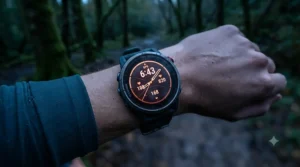
The Coros Apex 4 is, by most independent testers’ accounts, the current sweet spot in Coros’s mountain-focused range. Reviewers who’ve worn it for weeks on trails and daily commutes alike praise its combination of titanium bezel, sapphire glass, and genuinely useful offline topographic mapping, delivered with battery life that testing repeatedly clocked at 63-65 hours in continuous GPS mode for the 46mm version.
Here’s what stands out on the spec sheet: the Apex 4 comes in both 42mm and 46mm cases, with the smaller version trading some battery ceiling — roughly 41 hours in its top accuracy mode — for a noticeably lighter 64g-ish build. Based on the spec comparison, this makes the 42mm variant the better choice for runners with smaller wrists who still want the full mapping and titanium build, while the 46mm suits those prioritising maximum battery over minimal weight.
Reviewers consistently note that the MIP display, while excellent in direct sunlight, looks noticeably dimmer than AMOLED rivals indoors or at dusk — a deliberate trade-off Coros has made across its entire outdoor-focused range in exchange for the battery numbers. Aggregated sentiment on the ECG sensor and built-in speaker for phone calls is broadly positive, with testers flagging them as pleasant extras rather than must-haves.
Pros:
- ✅ Offline topographic mapping with excellent battery ceiling
- ✅ Titanium bezel and sapphire glass build quality
- ✅ Two sizes available to suit different wrist sizes
Cons:
- ❌ MIP display noticeably dimmer than AMOLED alternatives
- ❌ No contactless payment or major music streaming support
At the time of research, the 46mm Coros Apex 4 is generally listed in the £420-£480 range, with the 42mm version typically £30-£50 cheaper.
7. Coros Vertix 2S — best for ultrarunning training and multi-day expeditions
If battery anxiety is the single biggest reason you’re reading this article, the Coros Vertix 2S is very likely the answer. Independent lab testing recorded GPS battery life north of 110 hours in continuous tracking mode, with Coros’s own claims stretching to 118 hours, and everyday smartwatch battery life reported at up to 40 days. For context, that’s roughly three to four times what most premium rivals from Garmin manage in the same category.
What most buyers overlook about the Vertix 2S is that its accuracy upgrade over the original Vertix 2 was arguably a bigger deal than the battery headline suggests. Reviewers who tested both side by side reported meaningfully tighter GPS tracks in tricky terrain — slot canyons, dense tree cover, steep switchbacks — where earlier Coros models occasionally drifted. On paper this means the Vertix 2S isn’t just the longest-lasting Coros watch, it’s also arguably the most accurate one, which is an unusual and valuable combination for anyone racing serious mileage off-road.
The honest trade-offs are real, though. At 50.3mm across and around 70-88g depending on strap choice, aggregated reviewer sentiment is unanimous that this is a genuinely large watch, and the transflective MIP screen — while excellent for battery life — reads as noticeably duller than AMOLED competitors when you’re not in direct sunlight. Testers also consistently flag the lack of ANT+ connectivity as a frustration for anyone who wants to pair external power meters or older sensors. A detailed UKClimbing gear review covering months of use in the British hills backs up this pattern of strengths and trade-offs in detail.
Pros:
- ✅ Best-in-class battery life across the entire watch category
- ✅ Highly accurate multi-band GPS, even in tricky terrain
- ✅ Sapphire glass, 10 ATM water resistance, genuinely rugged build
Cons:
- ❌ Large, heavy case won’t suit smaller wrists
- ❌ No ANT+ connectivity for some external sensors
At the time of research, the Coros Vertix 2S typically retails in the £590-£650 range, positioning it well below rival titanium flagships from Garmin and Apple while matching or beating their battery figures outright.
Setting Up a New Coros Watch: Your First 30 Days
Getting the most from a Coros running watch starts before your first run. Pair the watch with the Coros app immediately, sign in, and let the firmware update fully before recording any activity — early firmware on a fresh-out-the-box unit is often a version or two behind, and Coros pushes meaningful GPS accuracy improvements through these updates regularly. Skipping this step is the single most common reason new owners report disappointing GPS tracks in week one.
Set your GPS mode deliberately rather than leaving it on the default. For road running and track sessions, “All Systems” mode balances accuracy and battery well; save dual-frequency “Max” mode for races or technical trail runs where every metre of accuracy matters, since it drains the battery noticeably faster. In your first week, run a lap of a known distance — a certified parkrun course works well — to sanity-check pace and distance accuracy against a known benchmark before you trust the watch for structured training paces.
A common mistake in the first month is ignoring EvoLab’s onboarding period. Coros’s training load and recovery metrics need roughly two to three weeks of consistent data before they become genuinely useful rather than generic. Resist the urge to judge your Training Load or Recovery Time estimates too harshly in week one; the algorithm is still calibrating to your individual fitness baseline. Finally, set a charging routine early — even Coros’s best battery life eventually runs out, and a fixed weekly charge day (Sunday evenings work well for most runners) prevents the classic mistake of discovering a flat watch the morning of a long run.
Which Coros Watch Suits Your Running Life? Three Real-World Scenarios
The couch-to-10k beginner: budget around £220-£240, moderate weekly mileage, mostly road and park running, no interest in offline maps. The Coros Pace 4 or Coros Pace 3 both fit comfortably here — the Pace 4 if a brighter screen matters to you, the Pace 3 if you’d rather save the difference. Either watch will comfortably last a full week of training between charges.
The weekend trail runner training for their first ultramarathon: longer runs into unfamiliar terrain, a genuine need for offline navigation, and races that might run 6-12 hours. This is where the Coros Nomad or Coros Apex 2 Pro earn their keep — both offer offline mapping and enough battery ceiling to cover a genuine ultra distance without a mid-race charge, at a noticeably lower cost than the flagship Vertix.
The committed ultrarunner tackling 100-mile events or multi-day fastpacking: this is squarely ultrarunning training territory, where a race can run 24-40+ hours and a dead watch mid-event isn’t just inconvenient, it can be a genuine safety issue if you’re relying on it for navigation. The Coros Vertix 2S is the only watch on this list built with that scenario specifically in mind, and its 110+ hour GPS battery ceiling reflects that. The Coros Apex 4 is a credible, lighter alternative if you want mapping without quite that much bulk on your wrist.
How to Choose a Coros Running Watch
- Work out your longest realistic GPS session. If your longest run is under four hours, almost every watch here covers you comfortably; ultramarathon distances push you toward the Apex or Vertix range specifically for their extended battery ceilings.
- Decide whether offline mapping actually matters to you. Road and track runners rarely need it; trail and mountain runners who venture off familiar routes will get genuine, repeated value from it.
- Be honest about screen preference. AMOLED (Pace 4, Pace Pro) looks sharper indoors and at dusk; MIP (Pace 3, Apex range, Nomad, Vertix 2S) sacrifices some vibrancy for meaningfully longer battery life.
- Factor in wrist size and comfort. The Vertix 2S and 46mm Apex 4 are genuinely large watches; smaller-wristed runners often prefer the Pace range or the 42mm Apex 4.
- Check what training metrics you’ll actually use. EvoLab’s training load tracking, recovery time, and race predictor tools are consistent across the range, so don’t overpay for a feature tier you won’t touch.
- Set a realistic budget band and stick close to it. The jump from Pace to Apex to Vertix buys battery life and ruggedness more than it buys core GPS accuracy, so spending more doesn’t automatically mean a better-tracking watch.
- Read aggregated review sentiment, not just spec sheets. Real-world battery figures often land below the marketing headline number; independent lab tests consistently give a more realistic picture of day-to-day performance.
Coros Running Watch Battery Life Explained
Battery life is arguably the single biggest reason runners choose Coros over rival brands, and the numbers genuinely hold up under independent scrutiny. Across the range, GPS battery life spans from around 31-41 hours on the entry-level Pace 4 up to a genuinely remarkable 110+ hours on the Vertix 2S, with smartwatch (non-GPS) battery life stretching from roughly 19 days to a claimed 40 days at the top of the range.
What the marketing numbers don’t always make clear is that GPS mode choice matters enormously. Every Coros watch offers multiple GPS accuracy tiers — typically an “Endurance” or “efficient” mode, a standard “All Systems” mode, and a maximum-accuracy dual-frequency mode — and the difference between the lowest and highest power settings can roughly double or even triple your available tracking time. Reviewers consistently note that most runners default to the highest accuracy setting without realising it’s costing them battery life they don’t actually need for a routine training run; reserving dual-frequency mode for races or genuinely technical terrain is a simple habit that meaningfully extends real-world battery life.
Temperature also plays a role that spec sheets rarely mention: lithium batteries lose capacity in cold weather, so a watch rated for 65 hours in a lab at room temperature may deliver noticeably less on a winter fell run. If you’re training through a British winter, it’s worth budgeting a buffer below the claimed figure rather than cutting it fine on a long route.
GPS Accuracy: What Dual-Frequency Really Means
Every current-generation Coros watch on this list uses dual-frequency (L1+L5) GNSS reception, connecting to up to five satellite systems — GPS, GLONASS, Galileo, Beidou and QZSS — rather than relying on a single frequency band. In practical terms, dual-frequency reception means the watch can cross-reference two separate signal bands to correct for the kind of ionospheric interference and signal bounce that causes single-band GPS watches to drift, particularly under tree cover or between tall buildings.
Independent testing backs this up in the real world, not just in theory: reviewers running Coros watches side by side with rival brands in dense forest and urban canyon conditions have repeatedly found the multi-band signal holds a tighter, more consistent track than older single-frequency hardware. That matters more than most buyers assume, because a GPS watch that drifts by even 2-3% over a marathon distance can meaningfully distort your recorded pace data and throw off your training log.
It’s worth noting that dual-frequency accuracy isn’t unique to Coros — Garmin and Suunto now offer comparable technology on their higher-end models — but Coros has consistently been praised for offering it further down its price range than most rivals, making genuinely accurate tracking accessible without paying flagship prices.
Coros Watch for Trail Running vs Road Running
A Coros watch for trail running and one built primarily for road running share the same GPS chipset and training engine underneath, but the practical differences in daily use are significant. Trail-focused features worth having include offline topographic or colour mapping (Nomad, Pace Pro, Apex range, Vertix 2S), a rugged sapphire or hardened glass lens to resist rock strikes, and climb-specific tools like Coros’s Hill Alerts and Pace Strategy features, which adjust pacing guidance for elevation gain in real time.
Road running rarely needs any of that. A road-focused runner is generally better served prioritising screen brightness, weight, and comfort over mapping and ruggedness — which is exactly why the AMOLED Pace 4 and Pace Pro make more sense for that audience than the bulkier Apex or Vertix models. Reviewers consistently note that runners who buy a rugged mountain watch purely for road training often end up carrying unused weight and battery capacity they never draw on.
The honest middle ground, and the scenario most UK runners actually fall into, is mixed training: road sessions midweek, trail long runs at the weekend. For that pattern, the Coros Nomad or Coros Apex 2 Pro tend to offer the best balance, giving you offline navigation for the unfamiliar trail routes without the largest, heaviest case in the range.
Training Load Tracking and EvoLab: Turning Data Into Better Racing
Every current Coros watch runs on the brand’s EvoLab sports science engine, which underpins training load tracking, recovery time estimates, VO2 max calculation, and race time predictions across the entire range — including the budget Pace 3. This is a genuinely important point for value-conscious buyers: you are not paying extra for better training software as you move up the range, only for better hardware to house it in.
Training load tracking works by combining heart rate data, pace, and session intensity into a rolling seven-day load figure, which EvoLab then compares against your recent training history to flag whether you’re undertraining, in a productive zone, or approaching overreaching territory. Reviewers who’ve used the system across multiple training blocks generally rate it as comparably rigorous to Garmin’s Training Status feature, without requiring a paid subscription to unlock the full picture — a genuine point of difference in this market.
Based on the spec comparison across the range, the practical advice here is straightforward: don’t assume a pricier Coros watch will give you smarter training guidance. If EvoLab’s training load tracking, recovery advice, and race predictions are the features you actually value, the Coros Pace 3 delivers essentially the same underlying analysis as the Coros Vertix 2S — you’re paying the price difference for battery life, materials, and mapping, not for smarter software.
Common Mistakes When Buying a Coros Running Watch
The most frequent mistake is buying more battery and ruggedness than your actual training demands. If your longest run rarely exceeds three hours, the Vertix 2S’s 110-hour GPS ceiling is solving a problem you don’t have, and that budget is better spent elsewhere or simply saved. Conversely, ultrarunners training for 100-mile events sometimes underspend on a Pace-series watch and discover mid-race that its battery genuinely can’t cover the distance — checking your target event’s expected finish time against a watch’s realistic GPS battery ceiling, with a sensible safety margin, avoids this entirely.
A second common error is assuming a higher price automatically means better GPS accuracy. As covered above, every current-generation Coros watch on this list uses comparable dual-frequency GNSS hardware; the price climbs primarily for battery capacity, display technology, and materials, not for a meaningfully better satellite chip. Buyers chasing “the most accurate Coros watch” specifically are often better served by simply choosing based on battery need and screen preference instead. For a broader look at how UK reviewers rank GPS running watches across brands, Tom’s Guide’s tested running watch rankings are a useful independent reference point.
Finally, many first-time buyers underestimate how different a MIP display looks compared to a smartphone or AMOLED smartwatch screen. If you’ve never worn one, it’s worth viewing one in person before committing to a premium MIP watch like the Apex 4 or Vertix 2S, since screen preference is genuinely subjective and returns on watches can be more involved than returning a smaller accessory.
✨ Don’t Miss These Exclusive Deals!
🔍 Take your Coros running watch shortlist to the next level — click through on any model above to check current UK pricing and availability before stock or promotions shift.
Long-Term Cost & Maintenance
A Coros watch is a one-off hardware purchase with no ongoing training-software subscription, which is a meaningful long-term cost advantage over rivals that gate advanced training metrics behind a paid tier. Over a three-to-five-year ownership period, that alone can offset a genuine chunk of the higher upfront price of a premium model like the Vertix 2S compared to a subscription-based competitor.
Battery degradation is the main long-term consideration: like all lithium-ion batteries, a Coros watch’s maximum capacity will gradually decline over years of daily charge cycles, and reviewers generally report noticeable capacity loss becoming apparent somewhere around the two-to-three-year mark of regular use, faster if the watch is frequently run flat before recharging. Keeping the battery topped up regularly, rather than habitually draining it to empty, is the simplest way to preserve long-term capacity.
Replacement straps, chest strap heart rate monitors, and screen protectors are widely available as accessories rather than proprietary parts, keeping running costs low across the ownership period. Total cost of ownership, then, tends to favour Coros over subscription-gated rivals for anyone planning to keep and use their watch for several years rather than upgrading annually.
Features That Actually Matter (And Those That Don’t)
Genuinely useful across the range: dual-frequency GPS accuracy, EvoLab training load and recovery tracking, and long GPS battery life all deliver real, repeated value on every single run. Offline mapping matters enormously for trail and mountain runners but is close to irrelevant for road-only training, so don’t pay a premium for it if you’ll never leave familiar routes.
Marketing hype worth filtering out: contactless payment and music streaming are absent from the entire Coros range, and while that reads as a negative on a spec sheet next to Garmin’s music-enabled models, aggregated reviewer sentiment suggests most serious runners barely miss either feature once they’re used to running with a phone or leaving both at home. The ECG sensor on premium models is a pleasant extra for general health tracking but isn’t something most runners will check regularly enough to justify paying for it alone.
FAQ
❓ Is a Coros running watch as accurate as Garmin?
❓ Which Coros watch has the longest battery life?
❓ Do Coros watches need a monthly subscription?
❓ Can a Coros running watch be used for trail running and hiking?
❓ Is the cheaper Coros Pace 3 still worth buying in 2026?
Conclusion
Choosing the right Coros running watch really comes down to being honest about your longest realistic training session and how much you actually value offline mapping over screen brightness. Budget-conscious road runners and beginners are well served by the Coros Pace 4 or Coros Pace 3, both delivering genuinely accurate tracking without excess spend. Runners splitting their week between road and trail should look closely at the Coros Nomad or Coros Apex 2 Pro, while anyone training seriously for ultramarathon distances will get the most out of the Coros Apex 4 or the battery-dominant Coros Vertix 2S.
What ties the entire range together, and what genuinely sets Coros apart from pricier rivals, is that every single model — from the cheapest to the flagship — runs the same EvoLab training engine, with no subscription wall between you and useful data. That’s a rare thing in this market, and it’s a big part of why so many serious runners end up recommending the brand once they’ve made the switch.
Whichever model fits your training and budget, check current UK pricing and availability before buying, since Coros stock and promotions shift regularly across retailers. For further independent testing and long-term wear reports on the flagship model, The Great Outdoors magazine’s Vertix 2S review is worth a read.
Recommended for You
- Lightweight Running Gloves for Spring: 7 Best Picks (2026)
- Touchscreen Running Gloves: 7 Best Picks That Actually Work (2026)
- Winter Running Gloves Under £20: 7 Best Buys for 2026
Disclaimer: This article contains affiliate links. As an Amazon Associate, I earn from qualifying purchases. If you purchase products through these links, we may earn a small commission at no additional cost to you.
✨ Found this helpful? Share it with your friends! 💬🤗
