
In This Article
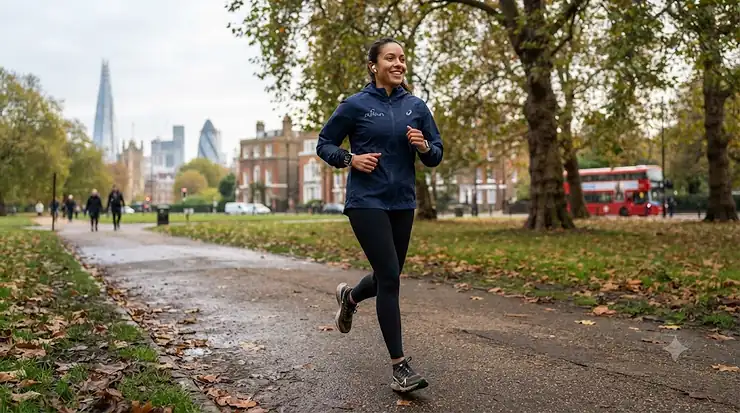
Lace up, glance at your wrist, go. That’s the promise of using an Apple Watch for running, and for the most part it delivers — provided you pick the right model for the miles you actually run. An Apple Watch for running is Apple’s wrist-worn fitness computer, combining GPS, an optical and electrical heart sensor, and watchOS running tools (Pacer, Race Route, custom workouts) to track pace, distance, heart rate zones and recovery in real time, all synced automatically to the Health app on your iPhone.
Here’s the honest bit, though: not every Apple Watch is built the same way for runners. A 5km jogger and a hundred-mile ultra racer have wildly different needs, and Apple’s own lineup — freshly expanded this month with the Apple Watch Series 12 and Apple Watch Ultra 4 — spans a genuinely wide range of battery life, ruggedness and price. We’ve dug through official specs, aggregated review sentiment, and real-world running data to work out which model (and which accessories) actually earn a place on your wrist this year.
This guide walks through seven real products worth considering, three comparison tables to speed up your decision, and a set of practical, research-backed sections on battery life, GPS accuracy, running apps and how Apple’s watch stacks up against dedicated running watches from Garmin, Coros and Polar. Regular movement matters more than any gadget, of course — the NHS recommends adults aim for at least 150 minutes of moderate activity a week, and a watch is only as useful as the habit it supports.
Quick Comparison Table
| Model | Battery (typical use) | Standout Running Feature | Price Range | Best For |
|---|---|---|---|---|
| Apple Watch Series 12 | Up to 24 hrs | Continuous background heart rate + Readiness score | £369-£750 range | Best all-rounder for road running |
| Apple Watch Ultra 4 | Up to 50 hrs | Satellite SOS + dual-frequency GPS | Around £749 and up | Ultra-distance and trail runners |
| Apple Watch SE 3 | Up to 18 hrs | Full running metrics at entry price | £219-£300 range | Budget-conscious beginners |
| Apple Watch Series 11 | Up to 24 hrs | Same core running tools, now discounted | £270-£330 range | Value hunters after last year’s flagship |
| Polar H10 | Up to 400 hrs | ECG-grade chest strap accuracy | £70-£90 range | Runners chasing precise heart data |
| Wahoo TICKR Fit | Up to 30 hrs | Chest-strap-free optical armband | £60-£80 range | Anyone who hates chest straps |
| Anker MagGo Power Bank | 10,000mAh capacity | On-the-go magnetic top-ups | Around £70 | Ultra-marathoners extending battery life |
Looking at the table, the split is pretty clear: if you want the newest sensors without paying flagship money, the discounted Apple Watch Series 11 or the fresh Apple Watch Series 12 cover almost everyone. Runners tackling multi-hour trail sessions or races where GPS drift genuinely matters should look past the mainline models entirely and go straight to the Apple Watch Ultra 4, whose battery ceiling isn’t just a bigger number — it’s the difference between finishing a 50-miler with a working watch and staring at a blank wrist at mile 30.
💬 Just one click — help others make better buying decisions too!😊
Top 7 Apple Watches (and Accessories) for Running: Expert Analysis
1. Apple Watch Series 12 — best all-round running companion for 2026
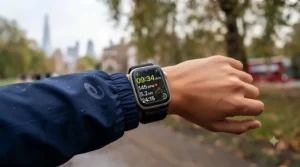
Announced on 9 September 2026 and landing in shops on 18 September, the Apple Watch Series 12 is the newest mainstream Apple Watch, and its headline running feature is the redesigned Health Sensing System. Rather than sampling heart rate every few minutes, it now checks in roughly every five seconds in the background and calculates heart rate variability as often as every five minutes, feeding a new daily Readiness score that’s genuinely useful for deciding whether today is a hard-interval day or an easy jog. Based on the spec comparison with last year’s model, the S11 chip and Ceramic Shield 2 front glass are the quieter but equally real upgrades — the glass is Apple’s toughest yet on a mainstream model, which matters if you’ve ever clipped a wrist on a gate during a trail loop. Running-wise, it keeps the full suite runners actually use: custom interval workouts, Training Load, Heart Rate Zones, Race Route, Pacer, and automatic track detection for anyone doing repeats. Early hands-on coverage from tech press has been positive about the sensor upgrade, though as a brand-new launch, broad aggregated customer-review sentiment isn’t yet available — we’ll update this section as verified owner feedback accumulates.
Pros:
- ✅ New five-second background heart rate tracking
- ✅ Readiness score genuinely aids training decisions
- ✅ Ceramic Shield 2 improves everyday scratch resistance
Cons:
- ❌ Battery life unchanged at roughly 24 hours normal use
- ❌ Titanium and ceramic cases push the price well past entry level
Prices start around £369 for the 42mm aluminium GPS model, climbing into the £700+ range for titanium or ceramic — a solid mid-range value pick if you want 2026’s newest sensors without going full Ultra.
2. Apple Watch Ultra 4 — best for ultra-distance and trail runners
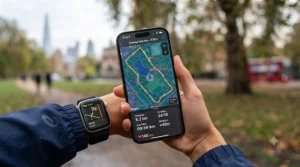
If your idea of a “quick run” involves a mountain, the Apple Watch Ultra 4 is the one built for you. Its headline number is battery life: up to 50 hours of normal use, stretching to 84 hours in Low Power Mode, which is roughly double what the mainline Series 12 offers. What that means in practice is you can start a 100km ultra on Friday night and still have a working GPS watch on Sunday morning without hunting for a charger mid-race. The dual-frequency GPS is the other genuinely practical upgrade for trail runners — it resists the signal bounce you get in tree cover or narrow canyons far better than single-frequency GPS, so your recorded route hugs the actual trail instead of cutting corners through the woods. Reviewers of the previous Ultra generation consistently praised its titanium durability and brightness, while noting battery life, though class-leading, still isn’t quite multi-day for full always-on use — a pattern that’s likely to persist even with Ultra 4’s improved numbers until real-world testing confirms it.
Pros:
- ✅ Up to 50 hours of battery life, 84 in Low Power Mode
- ✅ Dual-frequency GPS for accurate trail and canyon tracking
- ✅ Satellite SOS works even with no phone signal
Cons:
- ❌ Significant price jump over the standard Series 12
- ❌ 49mm case is noticeably bulkier on smaller wrists
At around £749 and up, the value case rests entirely on whether you actually run long enough to need the extra battery — for anything under half-marathon distance, you’re paying for headroom you won’t use.
3. Apple Watch SE 3 — best budget entry point for new runners
Not every runner needs hypertension alerts or an ECG app, and that’s exactly the gap the Apple Watch SE 3 fills. What most buyers overlook about this model is that it still runs the identical S10-era running software stack as pricier Apple Watches — Pacer, Race Route, heart rate zones and automatic workout detection are all present — it’s the extra medical-adjacent sensors that get trimmed to hit the lower price. Battery life sits at up to 18 hours of normal use, which comfortably covers a morning run plus a full day of notifications, though it’s noticeably behind the Series 12’s 24 hours if you’re a heavy all-day wearer. Hands-on impressions from tech reviewers this year have been notably warm, several calling it the best-value Apple Watch to date, while flagging so-so all-day battery stamina as the trade-off for the lower price.
Pros:
- ✅ Full running feature set at the lowest Apple Watch price
- ✅ Same S10-generation chip speed as pricier models
- ✅ Sleep apnea notifications included despite budget position
Cons:
- ❌ No ECG app or hypertension notifications
- ❌ 18-hour battery is the shortest in the current lineup
Starting from around £219 for GPS-only, stretching to roughly £300 with cellular, this is the sensible pick for anyone testing whether they’ll actually stick with structured running before spending flagship money.
4. Apple Watch Series 11 — best value pick now it’s been superseded
Here’s what the spec sheet won’t tell you outright: the Apple Watch Series 11 hasn’t gotten worse overnight just because the Series 12 exists — it’s simply gotten cheaper. UK retail listings already show it discounted from its £369-£399 launch pricing down toward the £270-£330 range, while running the same S10 chip, the same Pacer and Race Route tools, and the same 24-hour battery rating as when it launched. For runners who don’t need the very newest five-second background heart rate sampling, this is arguably the sharpest value in Apple’s entire watch range right now — you’re getting last year’s flagship running experience at a meaningful discount. Aggregated reviewer sentiment on the Series 11 at launch was solidly positive, with praise for its display brightness and running accuracy, and only mild criticism around the lack of a bigger battery leap generation-on-generation.
Pros:
- ✅ Full running feature parity with the current Series 12
- ✅ Already discounted following the Series 12 launch
- ✅ 24-hour battery matches the newest mainline model
Cons:
- ❌ Lacks the Series 12’s five-second background heart sensing
- ❌ Stock may thin out as retailers clear remaining units
With prices typically in the £270-£330 range depending on size and finish, this is the pick for runners who want strong value over bragging rights about owning the newest chip.
5. Polar H10 Heart Rate Chest Strap — best accuracy upgrade for serious training
Wrist-based optical sensors, including Apple’s, are good — but a chest strap using ECG-style electrical sensing is still the gold standard for beat-to-beat accuracy, and the Polar H10 is widely regarded as the benchmark in that category. Reviewers pairing it with an Apple Watch consistently report seamless Bluetooth connection with no dropouts, even through the Watch Ultra and older Series models, since the strap simply broadcasts standard Bluetooth heart rate data that watchOS reads natively. What most runners overlook is that the H10 can hold two simultaneous Bluetooth connections plus ANT+, meaning it can feed your Apple Watch and a bike computer or gym machine at the same time — genuinely useful for anyone who cross-trains. Aggregated user sentiment across cycling and running review sites is close to unanimous: comfortable fit, dependable pairing, and accuracy that consistently matches clinical-grade references during interval sessions where wrist sensors often lag behind sudden heart rate spikes.
Pros:
- ✅ ECG-grade accuracy beats wrist sensors during intervals
- ✅ Two simultaneous Bluetooth connections plus ANT+
- ✅ Roughly 400 hours of battery from a replaceable coin cell
Cons:
- ❌ Chest straps aren’t comfortable for every runner
- ❌ Requires occasional strap washing to maintain skin contact
Typically priced in the £70-£90 range, it’s a genuinely worthwhile add-on rather than a replacement for your Apple Watch — think of it as the accuracy layer serious interval and race-pace training benefits from most.
6. Wahoo TICKR Fit Armband — best chest-strap-free alternative
For runners who’ve tried a chest strap and hated it, the Wahoo TICKR Fit solves the comfort problem by moving optical heart rate sensing to the upper arm instead of the wrist or chest. Based on the spec comparison with wrist sensors, arm placement tends to pick up steadier blood-flow signals than the wrist during high cadence running, where arm swing can otherwise introduce noise into wrist-based readings. It pairs over Bluetooth and ANT+ simultaneously, connects cleanly to an Apple Watch’s workout app, and its 30-hour rechargeable battery comfortably outlasts several long training weeks between charges. Independent testers comparing it directly against the Polar H10 found the TICKR Fit’s readings tracked closely with ECG-based chest strap data throughout a session, a meaningful vote of confidence for an armband-style sensor that skips the chest entirely.
Pros:
- ✅ Comparable accuracy to chest straps in independent testing
- ✅ 30-hour rechargeable battery life
- ✅ Two adjustable strap sizes included in the box
Cons:
- ❌ Optical sensors can still lag during sudden sprint efforts
- ❌ Needs occasional recharging unlike coin-cell chest straps
Pricing generally sits in the £60-£80 range in the UK, making it a sensible middle ground between relying on wrist-only heart data and committing to a full chest strap.
7. Anker MagGo Power Bank for Apple Watch — best for extending battery on long runs
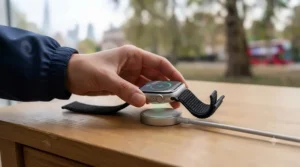
Even the Apple Watch Ultra 4‘s 50-hour battery eventually runs dry, and that’s where a dedicated top-up accessory like the Anker MagGo Power Bank earns its place in a serious runner’s kit bag. It’s a 10,000mAh portable battery with a built-in magnetic Apple Watch charging puck alongside a USB-C cable, meaning a single pocketable unit can revive both your watch and your phone mid-ultra without carrying two separate chargers. What most buyers overlook about magnetic Apple Watch chargers generally is that fast-charge speeds vary a lot by watch generation — Apple’s own guidance notes that SE models and pre-Series 7 watches don’t support fast charging, so pairing this with a Series 11, Series 12 or Ultra 4 gets you noticeably quicker top-ups than on older or budget hardware. A hands-on reviewer summed it up as a genuinely useful two-in-one charging dock for frequent travellers, with the main gripe being that it commands a premium price versus generic alternatives.
Pros:
- ✅ Charges Apple Watch and iPhone from one power bank
- ✅ 10,000mAh capacity covers multiple watch top-ups
- ✅ Built-in USB-C cable means one less thing to pack
Cons:
- ❌ Premium pricing compared with generic magnetic chargers
- ❌ Adds bulk versus a simple charging cable for shorter runs
Priced around £70 in the UK, it’s a niche but genuinely valuable purchase specifically for multi-day events, long-distance travel races, or anyone who’s ever bonked not physically but electronically, mid-run, at 4%.
Setting Up Your Apple Watch for Running Success
Getting a new watch out of the box is the easy part; setting it up so it actually helps your running is where most people leave value on the table. Start by opening the Watch app on your iPhone and building a custom Outdoor Run workout view that surfaces pace, heart rate and distance together — the default view buries some of this behind swipes, which is the last thing you want mid-interval. Next, calibrate your stride: run a known 1-mile loop with GPS on, and watchOS quietly improves its distance accuracy for treadmill and indoor sessions afterwards, since it partially relies on accelerometer-derived stride length data rather than GPS alone indoors. In your first 30 days, the single most common mistake new owners make is leaving Water Lock or Theatre Mode accidentally enabled after a swim or a film, which then silences workout alerts without any obvious warning — check Control Centre before every run if pace notifications suddenly stop appearing. Finally, set up Heart Rate Zones manually using a recent max-effort session rather than trusting the age-based default formula, since it can be off by ten beats per minute or more for well-trained runners, skewing your Zone 2 training without you ever noticing.
Real-World Scenarios: Which Apple Watch Actually Fits Your Running Life
Picture three very different runners. First, a 24-year-old training for her first 10K three mornings a week around city streets — for her, the discounted Apple Watch Series 11 or the entry Apple Watch SE 3 both make sense, since neither ultra-long battery life nor satellite SOS solves a problem she actually has; her money is better spent on decent trainers. Second, a 41-year-old marathon-in-training dad squeezing in early runs before the school run, wanting heart rate zone accuracy for structured tempo work without breaking the household budget — the Apple Watch Series 12 paired with a Polar H10 chest strap for key sessions gives him lab-grade heart data on race-pace days while keeping the everyday watch experience intact. Third, a weekend ultra-trail racer tackling 50-mile mountain routes with patchy phone signal — for him, the Apple Watch Ultra 4 isn’t a luxury flex, it’s the only watch in this list whose battery genuinely survives his longest days out, and the satellite SOS could matter far more than any running metric if things go wrong on an exposed ridge.
How to Choose an Apple Watch for Running
Picking between seven products gets easier once you break the decision into a short checklist rather than comparing every spec side by side.
- Work out your longest realistic run. If nothing you do exceeds three or four hours, the standard battery models cover you comfortably; only ultra-distance changes the answer.
- Decide if you actually need cellular. Running without your phone is genuinely liberating, but it adds real monthly cost — skip it if you always run with your phone anyway.
- Check your typical running environment. Dense tree cover, canyons or mountain terrain reward the Ultra 4’s dual-frequency GPS; open roads and parks don’t need it.
- Be honest about heart rate precision needs. Casual runners are well served by wrist sensing alone; interval and race-pace training benefits meaningfully from a chest strap or armband.
- Factor in case size and wrist comfort. The 49mm Ultra case is genuinely large — try one on before assuming bigger battery is worth the extra bulk on your wrist.
- Set a realistic total budget, including accessories. A £219 SE 3 plus a £70 Polar H10 can outperform a base Series watch for structured training at a similar combined price.
- Consider resale and software longevity. Apple typically supports watchOS updates for five-plus years, so buying one generation back, like the Series 11, rarely means missing out for long.
Apple Watch Running Features That Actually Matter (And Those That Don’t)
Marketing copy loves to list every sensor a watch has, but not every feature changes your actual training. Automatic workout detection and Race Route genuinely matter — the former means a forgotten tap to start tracking doesn’t ruin your data, and the latter lets you retrace a course you’ve run before with live pace comparisons against your past self, which is quietly one of the most motivating tools in watchOS. Training Load and Heart Rate Zones matter too, provided you’ve set your zones from a real effort test rather than the default formula, because otherwise you’re training against numbers that don’t reflect your actual fitness. On the other hand, features like the barometric altimeter matter enormously for hill or trail runners tracking elevation gain, but are close to irrelevant if your longest incline is a motorway overpass. An independent validation study of wrist-worn optical heart sensors found that accuracy during steady, continuous activity is generally strong, but tends to drift more during rapid changes in intensity, which is a useful reminder that even Apple’s improved Series 12 sensor should be treated as a strong guide rather than a clinical instrument during hard interval efforts.
Apple Watch Battery Life for Running: What to Really Expect
Apple’s quoted battery figures — 24 hours for the Series 12, 18 for the SE 3, and 50 for the Ultra 4 — are measured under a specific mixed-use test involving time checks, notifications and one hour of workout tracking, not continuous GPS running. In practice, an always-on display plus continuous GPS tracking during a run drains the battery meaningfully faster than that headline figure suggests, which is why a 24-hour-rated watch might realistically deliver six to eight hours of continuous outdoor GPS tracking before needing a charge — still generous for anything short of an ultramarathon. Here’s what the spec sheet won’t tell you, but real usage patterns suggest: Low Power Mode, which disables the always-on display and background heart tracking, roughly doubles battery endurance and is worth switching on manually before any run expected to exceed a couple of hours. For anyone regularly pushing past that window, pairing a mainline watch with an Anker MagGo Power Bank for a mid-run top-up is a more cost-effective solution than jumping straight to the pricier Ultra 4 just for the extra battery ceiling.
Apple Watch vs Dedicated Running Watch: Which Should You Choose?
| Factor | Apple Watch | Dedicated Running Watch |
|---|---|---|
| Battery life (GPS running) | 6-50 hours depending on model | Often 20-140+ hours |
| Smartwatch features | Full app ecosystem, calls, messages | Minimal to none |
| Training analytics depth | Solid, iPhone-dependent for deep data | Often deeper, standalone analytics |
| Best For | Runners who want one device for everything | Runners prioritising pure endurance and battery |
The trade-off here isn’t close to as simple as “which is better” — it’s about what you’re optimising for. Dedicated GPS running watches from brands like Garmin and Coros routinely deliver multi-day battery life and training-load analytics built specifically for endurance athletes, and independent testers’ running watch roundups have named devices such as the Garmin Forerunner 970 among the most complete pure running watches available, while separately singling out Apple’s own lineup as the best choice specifically for runners who want a full smartwatch experience rather than a running-only device. If you live inside Apple’s ecosystem already — iPhone, AirPods, Apple Pay — the convenience of one device handling notifications, contactless payment and music alongside your run is genuinely hard to give up, even if a dedicated watch would technically out-battery it. Runners training for ultra-distance events where battery margin is a safety issue, not just a convenience one, are the clearest case where a dedicated watch, or the Apple Watch Ultra 4 specifically, makes more sense than a standard Apple Watch.
Why the Apple Smartwatch Ecosystem Matters for Runners
Buying into the Apple smartwatch ecosystem isn’t just about the watch on your wrist — it’s about everything that talks to it. Workout data flows automatically into the Health app, which then feeds Trends, sleep tracking and recovery insights that build a fuller picture of readiness than any single run’s numbers could show alone. What most buyers overlook is how much this ecosystem effect compounds over time: a year of consistent Health app data makes trend analysis genuinely meaningful, in a way that switching platforms every year or two undermines completely. Family Setup also lets a runner monitor a child’s or older relative’s activity without them owning an iPhone, which is a quietly useful feature for households managing more than one runner’s training. The trade-off is lock-in — once your run history, achievements and Activity rings live inside Apple’s ecosystem, migrating to a different smartwatch brand later means starting your long-term data trends from scratch.
iPhone Integration: The Hidden Running Advantage
An Apple Watch is, fundamentally, designed as an iPhone companion first and a standalone device second, and for runners that shapes the experience more than any spec sheet line. Live Activities on the iPhone lock screen mean a running partner or family member can watch your pace and distance update in real time during a race without needing to install a separate tracking app. On-device Siri processing, now standard across the current lineup, means voice commands to start a workout or log a split work reliably even in patchy signal areas where cloud-based assistants would stall. The honest trade-off is platform exclusivity: Apple Watch cannot be paired with an Android phone at all, so Android users are locked out of this entire category regardless of budget, which is worth flagging clearly before anyone assumes cross-platform flexibility exists here.
Best Running Apps for Apple Watch in 2026
The built-in Workout app covers the fundamentals well, but third-party running apps add genuinely useful layers on top. Strava remains the most widely used option for runners who want route-based social features and detailed segment comparisons, syncing automatically once a workout finishes on watchOS. Nike Run Club continues to offer structured coached runs with audio guidance, a format that reviewers have noted works particularly well for beginners who want motivation baked into the experience rather than raw data alone. For structured training plans built around heart rate zones and periodisation, apps like Runna have gained strong aggregated user sentiment for translating a training block into daily Apple Watch workouts automatically, removing the guesswork of manually building each session. Whichever app you choose, the practical tip most new users miss is enabling background app refresh for it specifically in iPhone settings — without it, Health app syncing can lag by hours, which quietly undermines the same-day training insights these apps are built to provide.
Common Mistakes When Buying an Apple Watch for Running
The most expensive mistake runners make is buying based on the newest chip alone rather than the battery ceiling their actual training demands — plenty of buyers upgrade to an Apple Watch Ultra 4 for the bragging rights, then never come close to using more than a quarter of its battery capacity on their usual routes. The second common slip is skipping cellular consideration entirely, either paying for it and never leaving the house without a phone anyway, or skipping it and later regretting it after an injury scare on a solo trail run with no phone signal-carrying option. A third mistake is ignoring case size on smaller wrists; the 49mm Ultra case looks striking in product photos but can genuinely catch on jacket sleeves or gloves during winter training, something reviewers rarely mention until you’re actually wearing one on a cold morning run. Finally, many buyers assume every accessory works with every Apple Watch generation — fast magnetic charging in particular varies by model, so checking compatibility before ordering a power bank or dock avoids a frustrating surprise on delivery day.
Frequently Asked Questions
❓ Is the Apple Watch accurate enough for GPS running?
❓ Do I need cellular on an Apple Watch for running?
❓ How long does Apple Watch battery last during a run?
❓ Can I use a chest strap with my Apple Watch while running?
❓ Is Apple Watch or Garmin better for running?
Conclusion
There’s no single “best” Apple Watch for running — there’s only the best one for the running you actually do. Casual and beginner runners get outstanding value from the Apple Watch SE 3 or the newly discounted Apple Watch Series 11, both of which run the full running software suite without the premium price tag. Runners who want 2026’s newest sensor tech and don’t mind paying mid-range money should look at the Apple Watch Series 12, while anyone racing genuine ultra-distance events, particularly off-road, will get real, safety-relevant value from the Apple Watch Ultra 4‘s battery ceiling and satellite SOS. Layer in a Polar H10 or Wahoo TICKR Fit if heart rate precision matters to your training, and consider an Anker MagGo Power Bank if your runs regularly outlast your watch’s charge. Whichever you choose, remember the watch supports the habit — it doesn’t replace it, and the NHS still recommends spreading that activity across four to five days a week or more for the most consistent benefit. For the fuller picture on this year’s launches, Macworld’s rolling coverage of the Apple Watch Series 12 and Ultra 4 launch is worth a read before you buy.
Recommended for You
- Suunto Running Watch: 7 Best Picks for UK Runners (2026)
- Coros Running Watch: 7 Best Picks for UK Runners in 2026
- Lightweight Running Gloves for Spring: 7 Best Picks (2026)
Disclaimer: This article contains affiliate links. As an Amazon Associate, I earn from qualifying purchases. If you purchase products through these links, we may earn a small commission at no additional cost to you.
✨ Found this helpful? Share it with your friends! 💬🤗
