
In This Article
There’s a particular kind of dread that sets in around late October, when the clocks go back and suddenly your usual 6pm run happens in pitch darkness on roads you swear got busier overnight. They didn’t — you just became a lot harder to see. That single fact is the entire reason hi-vis running gear exists, and it’s worth taking seriously: drivers using headlights can spot reflective materials up to three times further away than non-reflective clothing, a distance that translates directly into extra reaction time on a wet, dark road.

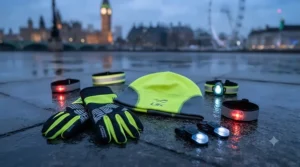
This guide walks through seven real, currently available products spanning full hi-vis running jackets, dedicated reflective vests and compact LED accessories, all chosen because they solve slightly different problems rather than duplicating each other. We’ll dig into what genuinely separates a hi-vis running jacket for winter from a bright top with a couple of reflective flashes stitched on, weigh up reflective vest vs LED armband for running (spoiler: it’s not really an either/or), round up the hi-vis accessories for runners actually worth owning, and cover winter visibility, road safety and layering for low light in enough depth that you’ll know exactly what to buy and why, not just which product ranks first on a list.
Quick Comparison Table
| Product | Type | Key Feature | Weight/Bulk | Best For |
|---|---|---|---|---|
| Proviz REFLECT360 Running Jacket | Full jacket | 100% reflective outer shell | Very light (~170g) | All-round winter running visibility |
| BTR Hi Vis Reflective Jacket | Hybrid jacket | Fluorescent colour + reflective panels | Light | Daylight and dusk running |
| Ronhill Hi Viz Bib Vest | Reflective vest | Two reflective strips, elasticated fit | Ultra-light | Layering over any top |
| flintronic Rechargeable LED Armband | LED accessory | 3 lighting modes, rechargeable | Minimal | Adding active light to existing kit |
| Simket LED Reflective Vest | LED + reflective vest | USB-rechargeable LED threads | Light | Unlit rural roads and trails |
| Proviz LED360 Chest Light | LED accessory | 500-lumen front/rear light | Minimal | Running on unlit paths |
| flintronic Reflective Sash Belt | Reflective accessory | Adjustable, worn over any clothing | Minimal | Quick add-on visibility layer |
Looking at the spread here, the two full jackets — Proviz REFLECT360 and BTR Hi Vis — sit at opposite ends of the visibility spectrum: one relies entirely on passive reflectivity that needs an external light source to activate, while the other combines fluorescent colour for daylight with reflective panels for after dark. The flintronic and Simket entries fill a different gap entirely, adding active LED light rather than passive reflection, which matters more than it might first sound — a point we’ll unpack properly in the section on reflective vest vs LED armband for running below.
💬 Just one click — help others make better buying decisions too!😊
Top 7 Hi-Vis Running Gear Picks: Expert Analysis
1. Proviz REFLECT360 Running Jacket — best 100% reflective outer shell
The Proviz REFLECT360 Running Jacket takes an unusual approach compared with most hi-vis gear: rather than adding reflective strips to an otherwise ordinary jacket, the entire outer shell is reflective. In daylight it reads as a modest, unremarkable grey; the moment a car’s headlights hit it at night, the whole jacket lights up rather than just a few narrow panels.
What that means in practice is a dramatic difference in how early a driver clocks you. Reflective strips catch a headlight beam only when angled correctly and only across a limited surface area; a fully reflective shell has a far higher chance of catching light from almost any angle, which genuinely matters on winding rural roads or at junctions where a driver’s headlights sweep across you rather than hitting you square-on. The fabric carries CE EN 20471 certification, the European standard for high-visibility clothing, which is worth checking for on any jacket you’re considering rather than assuming “hi-vis” on the label means it’s actually been tested to a recognised standard.
At a genuinely featherweight 170g, this doesn’t feel like the bulky, crinkly hi-vis you might associate with roadside workwear. Aggregated customer reviews consistently praise the visibility and fit, with several UK reviewers specifically flagging it as excellent for early morning dog walks and commutes as much as structured runs — a sign the reflectivity performs as claimed rather than just looking dramatic in product photography.
Pros:
- ✅ 100% reflective shell catches light from more angles than strips
- ✅ CE EN 20471 certified to a recognised visibility standard
- ✅ Featherweight build doesn’t feel like typical hi-vis workwear
Cons:
- ❌ Grey daytime colour offers little fluorescent daylight visibility
- ❌ Premium pricing compared with basic reflective vests
Typically priced in the £40-£50 range, this sits at the upper end of the budget for this guide, but the certified, full-shell reflectivity genuinely justifies it for anyone running regularly on unlit or poorly lit roads through winter.
2. BTR Hi Vis Reflective Jacket — best combined colour-plus-reflective hybrid
Where the Proviz jacket goes all-in on reflectivity, the BTR Hi Vis Reflective Jacket takes a hybrid approach, combining bright fluorescent colour with reflective panels rather than relying on one or the other. BTR markets this specifically as solving the “buy two jackets” problem — one bright jacket for visibility in daylight and dusk, one reflective jacket for full darkness — by folding both properties into a single garment.
The practical logic here holds up: fluorescent colour genuinely does very little for you once true darkness falls and there’s no ambient light to make the fluorescence pop, while reflective material does very little for you in flat daylight conditions when there’s no strong directional light source (like headlights) to bounce off. A hybrid jacket covers the gap between those two conditions — the grey, drizzly 4pm scenario that a lot of runners specifically struggle to dress for, as raised repeatedly in UK running forums and parenting boards alike.
The four-pocket layout is a small but genuinely useful practical detail: two zipped side pockets, an external zipped chest pocket for a phone or keys, and a mesh internal chest pocket, meaning you’re not stuck deciding between visibility and somewhere to actually carry your things on a run.
Pros:
- ✅ Combines fluorescent colour and reflective panels in one jacket
- ✅ Four pockets cover phone, keys and valuables separately
- ✅ Fits both men and women per the unisex sizing
Cons:
- ❌ Less “invisible by day” than a pure grey reflective shell
- ❌ Reviewers note fit runs closer to true-to-size than relaxed
Priced in the low-to-mid £30s typically, this is a strong middle-ground pick if you run across a genuine mix of daylight, dusk and darkness rather than sticking to one lighting condition.
3. Ronhill Hi Viz Bib Vest — best lightweight layering piece
The Ronhill Hi Viz Bib Vest strips things back to the essentials: a lightweight, breathable mesh bib with two reflective strips front and back and an elasticated side body for a snug, non-restrictive fit. Ronhill is a well-established UK running brand, and this bib specifically solves a different problem than the two jackets above — rather than replacing your existing running top, it layers over whatever you’re already wearing.
That layering flexibility is genuinely the point. On a mild autumn evening you might not want or need a full jacket, but you still want to be visible — the bib lets you wear a lightweight base layer and add reflective visibility on top without overheating, which matters more than it sounds once you’re a few miles into a run and generating real heat. The elasticated sides keep it snug enough that it doesn’t flap or bounce, a common complaint with looser hi-vis tabards borrowed from workwear use.
Because it’s explicitly LED-compatible in Ronhill’s own product design, this bib pairs naturally with an LED armband or clip light for anyone wanting to combine passive reflectivity with active illumination — precisely the combination we’ll discuss properly in the reflective-vest-versus-LED-armband section further down.
Pros:
- ✅ Layers over any top without adding bulk or heat
- ✅ Reflective strips front and back for two-way visibility
- ✅ LED-compatible design for pairing with lights
Cons:
- ❌ Provides no wind or rain protection on its own
- ❌ One size fits most, less tailored than a full jacket
At around £15-£20, this is one of the more affordable entries in this guide and a sensible first purchase if you’re building a hi-vis kit from scratch rather than replacing an entire wardrobe of running tops.
4. flintronic Rechargeable LED Armband — best active light accessory
The flintronic Rechargeable LED Armband shifts the conversation from passive reflection to active light. Rather than relying on an external light source (a car’s headlights, a streetlamp) to bounce light back, this armband generates its own glow via a rechargeable LED strip, with three lighting modes to choose from depending on how much attention you want to draw.
The distinction matters more than it might initially seem. Reflective material is invisible in genuinely unlit conditions — no light in, no light out — which is a real limitation on rural roads or paths without streetlighting. An active LED light, by contrast, is visible regardless of ambient lighting conditions, because it’s generating its own. flintronic’s own listing highlights the waterproof, skin-friendly material and lightweight build, and the rechargeable design (USB cable included) avoids the ongoing cost and waste of disposable batteries that older slap-band style lights relied on.
Aggregated review sentiment across flintronic’s range is consistently positive on build quality and battery life, with the brand appearing repeatedly across multiple reflective-gear categories on Amazon UK — a reasonable proxy for consistent manufacturing quality across their product line rather than a one-off hit.
Pros:
- ✅ Active LED light works even with zero ambient lighting
- ✅ Rechargeable via USB, no disposable batteries needed
- ✅ Three modes suit different visibility needs
Cons:
- ❌ Covers a smaller surface area than a full vest or jacket
- ❌ Needs remembering to charge before longer runs
Typically priced under £15, this is one of the most affordable ways to add genuine active visibility to an existing running wardrobe without buying new outerwear.
5. Simket LED Reflective Vest — best combined reflective-plus-LED vest
The Simket LED Reflective Vest goes a step further than either a pure reflective vest or a standalone LED accessory, integrating rechargeable LED threads directly into a reflective vest structure. The result is a garment that works on both fronts simultaneously: reflective material for when a car’s headlights sweep across you, and active LED illumination for genuinely unlit stretches where reflection alone has nothing to bounce off.
This combination approach directly answers one of the more common questions runners have when comparing reflective vest vs LED armband for running — rather than treating it as a choice between the two technologies, a hybrid product like this sidesteps the decision entirely by offering both in a single, adjustable garment. The waist and shoulder adjustment straps mean it fits over a range of body types and clothing thicknesses, useful specifically for winter layering where you might be wearing considerably more underneath in January than in September.
Customer feedback on Simket’s reflective and LED gear range consistently flags ease of adjustment and visibility as strong points, with the vest’s foldability and lightweight build making it genuinely easy to keep in a running bag or coat pocket as a just-in-case addition even on runs where you don’t expect to need it.
Pros:
- ✅ Combines passive reflection and active LED light in one garment
- ✅ Adjustable waist and shoulder straps fit over winter layers
- ✅ USB rechargeable, avoiding disposable battery costs
Cons:
- ❌ Bulkier under a jacket than a slim reflective bib alone
- ❌ LED element adds a component that eventually needs replacing
Priced around £15-£20, this represents strong value specifically because it removes the need to buy a separate reflective vest and LED accessory — one purchase covers both visibility mechanisms.

6. Proviz LED360 Chest Light — best dedicated running light for unlit paths
The Proviz LED360 Chest Light takes a more focused approach: rather than a wearable vest or jacket, it’s a dedicated 500-lumen chest-mounted light with both front and rear elements, designed to genuinely illuminate the path ahead rather than just make you visible to others. This distinction matters for anyone running on unlit canal towpaths, park routes or rural lanes where the concern isn’t just “can drivers see me” but “can I see the pothole three metres ahead.”
Because it mounts on the chest rather than the head, it avoids the bobbing light-beam effect that head torches can produce with each stride, and Proviz specifically pairs this in their own product range with the REFLECT360 jacket line — buying them together via Amazon’s “frequently bought together” prompts suggests the brand itself sees these as complementary rather than competing purchases, one for illuminating your path and one for maximising how visible you are to others.
Genuinely useful for anyone whose running routes include stretches without any streetlighting at all, this earns its place less as a “hi-vis” product in the traditional reflective sense and more as a practical winter running safety tool that happens to double as a visibility aid, since a runner carrying a bright forward-facing light is also, inherently, easier for oncoming traffic to spot.
Pros:
- ✅ 500 lumens genuinely lights the path, not just decorative
- ✅ Front and rear elements cover both directions
- ✅ Chest mount avoids head-torch bobbing effect
Cons:
- ❌ Doesn’t replace reflective or fluorescent clothing entirely
- ❌ Needs charging management alongside other rechargeable gear
At around £25-£35, this is a worthwhile addition specifically for runners on genuinely dark, unlit routes rather than a first purchase for someone running mostly on streetlit roads.
7. flintronic Reflective Sash Belt — best grab-and-go visibility layer
Rounding out the list, the flintronic Reflective Sash Belt is about as simple as hi-vis accessories for runners get: an adjustable sash worn diagonally across the body over whatever clothing you’re already in, with a reflective and fluorescent finish designed to catch light from multiple angles. It requires zero commitment — no charging, no specific base layer to buy, no fitting considerations beyond the adjustable strap.
The genuine value here is in the “grab and go” use case. If you’re heading out for what you expect to be a daylight run but might end up finishing as dusk falls, tossing a sash into a running bag or clipping it around your waist takes seconds and adds a meaningful layer of visibility without requiring you to have planned your entire outfit around hi-vis in advance. It’s also a sensible option for anyone who runs with others occasionally and wants a spare visibility layer to lend out rather than assuming everyone in the group already owns dedicated gear.
Review sentiment across flintronic’s reflective accessory range consistently highlights ease of adjustment and durability of the reflective coating, with the fluorescent green and yellow options rated as noticeably brighter in daylight than plain reflective-only alternatives.
Pros:
- ✅ Fits over any existing running clothing instantly
- ✅ Combines fluorescent colour with reflective finish
- ✅ No charging or maintenance required
Cons:
- ❌ Covers less surface area than a full vest
- ❌ Less structured fit can shift slightly during a run
At under £10, this is the cheapest entry in this guide and a sensible “always in the bag” backup rather than a primary visibility solution on its own.
Practical Usage Guide: Getting Your Hi-Vis Kit Right From Day One
Buying the gear is the easy part — using it properly is where most of the actual safety benefit gets won or lost. Start with placement: reflective and LED elements work best when they’re visible from multiple angles and positioned where a driver’s eye naturally scans, which means ankles and wrists (where movement itself draws attention) matter just as much as chest-level placement. This is exactly why combining a jacket with an armband, rather than relying on jacket reflectivity alone, tends to outperform either worn in isolation.
In the first few weeks of building a hi-vis routine, get into the habit of charging LED accessories the night before a planned early or evening run rather than assuming they’ll have charge when you grab them — a flat armband is a common and entirely avoidable failure point. For rechargeable vests and armbands like the flintronic and Simket options above, a quick top-up charge takes minutes and easily lasts several runs, so building it into your kit-prep routine alongside checking the weather removes the guesswork.
Maintenance is minimal but not zero. Reflective coatings on jackets and vests can degrade slightly with repeated washing, so check garment care labels — most, including the Proviz REFLECT360, recommend gentle washing to preserve the reflective finish rather than high-heat tumble drying. LED components on rechargeable accessories generally don’t need any maintenance beyond periodic charging, though it’s worth wiping down waterproof seals occasionally if you run in genuinely wet conditions often, since grit and salt from winter roads can accumulate around charging ports.
A common early mistake is treating hi-vis purchases as a one-and-done decision rather than building a layered system. A single reflective jacket is a good start, but pairing it with even one small active-light accessory, as covered in the next section, closes the gap that reflective-only gear leaves on genuinely unlit routes.
Real-World Scenario: Which Combination Suits Your Running Life?
The dark-morning commuter runner. You run before work, often before sunrise, on a mix of streetlit and unlit residential roads. The Proviz REFLECT360 Running Jacket paired with the flintronic Rechargeable LED Armband covers both bases — full-shell reflectivity for streetlit stretches, active light for the darker patches in between, without needing to think about it once you’re dressed.
The occasional dusk runner who mostly trains by day. Your schedule is flexible enough that most runs happen in daylight, but you occasionally get caught out as afternoons shorten in autumn and winter. The flintronic Reflective Sash Belt kept permanently in your running bag is the sensible low-effort solution — zero planning required, just clip it on if you’re still out as light starts to fade.
The rural or unlit-path runner. Your regular routes include stretches with no streetlighting at all — towpaths, farm roads, unlit parks. Here, the Proviz LED360 Chest Light genuinely matters as much as any reflective clothing, because the core problem isn’t just “can drivers see me,” it’s “can I see the ground,” and combining it with the Simket LED Reflective Vest covers both illuminating your path and maximising your visibility to anyone who is around.
Problem → Solution: Fixing Common Hi-Vis Frustrations
Problem: reflective gear seems to do nothing on unlit country roads. This isn’t a faulty product — it’s physics. Reflective material needs an external light source to bounce light back; without headlights, streetlights or any other light hitting it, there’s nothing to reflect. Solution: add an active LED element, like the flintronic Rechargeable LED Armband or a chest light such as the Proviz LED360, which generates its own visible light regardless of ambient conditions.
Problem: hi-vis jacket feels too warm once you’re a mile into a run. Solution: prioritise lightweight, breathable options like the Proviz REFLECT360 at 170g over bulkier workwear-style hi-vis, and consider a layering piece like the Ronhill Hi Viz Bib Vest over a breathable base layer instead of a fully enclosed jacket on milder evenings.
Problem: forgetting to charge LED accessories before a run. Solution: build charging into your kit-prep routine the night before, and consider keeping a dedicated charging cable near your running shoes so it becomes part of the same mental checklist as tying your laces.
Problem: uncertainty over whether gear is actually effective, not just “look bright in the shop.” Solution: check for CE EN 20471 certification specifically — a recognised European standard for high-visibility clothing — rather than assuming a product marketed as “hi-vis” has necessarily been tested against it. The Proviz REFLECT360 carries this certification explicitly.
Problem: reflective vest slides or bunches up mid-run. Solution: look for elasticated sides and adjustable straps, both features built into the Ronhill Hi Viz Bib Vest and Simket LED Reflective Vest specifically to prevent movement and bounce over the course of a run.
What Is Hi-Vis Running Gear?
Hi-vis running gear is clothing and accessories designed specifically to make runners more visible to drivers, cyclists and other road users, using two distinct mechanisms: fluorescent colour, which is visible in daylight and poor-light conditions, and reflective material, which bounces light from external sources like headlights back toward their origin, making the wearer visible from further away after dark.
The two mechanisms solve different problems and aren’t interchangeable — a purely fluorescent garment offers little benefit once true darkness falls, while purely reflective material does nothing in flat daylight without a strong directional light source to bounce off. According to the official Highway Code guidance on being seen, reflective materials can be seen by drivers using headlights up to three times as far away as non-reflective materials, which is precisely why genuinely effective hi-vis running gear increasingly combines both properties, as seen in hybrid products like the BTR Hi Vis Reflective Jacket covered earlier in this guide.
Hi-Vis Running Jacket for Winter: What to Actually Look For
A hi-vis running jacket for winter needs to do considerably more than a summer visibility layer — it’s working simultaneously as weather protection, temperature regulation and safety equipment, and compromising on any one of those three undermines the other two. Waterproofing rated to at least 5,000mm, as offered on the Proviz REFLECT360, genuinely matters through a British winter where a “light shower” forecast frequently turns into sustained rain for the back half of a run.
Ventilation is the second, often overlooked, criterion. A jacket sealed tightly enough to keep out driving rain can just as easily trap the heat and sweat you generate mid-run, and several jackets in this category, including both Proviz and BTR models, build in mesh panelling or vents specifically to let that heat escape without compromising the outer shell’s weatherproofing. Reviewers who skip this consideration often end up with a jacket that’s technically dry inside but uncomfortably damp from sweat rather than rain — a distinction that matters for comfort even if it doesn’t affect visibility.
Finally, colour choice deserves more thought than it usually gets. A jacket that reads as fully reflective, like the Proviz range, will appear a flat grey in daylight, which some runners find aesthetically underwhelming compared with a bright fluorescent option like the BTR hybrid. Neither is objectively wrong — it comes down to whether you’re prioritising maximum after-dark reflectivity or a balance across all lighting conditions, a trade-off worth deciding on deliberately rather than by accident.
Reflective Vest vs LED Armband for Running: Which Do You Actually Need?
This is one of the most common points of confusion for runners building a hi-vis kit, and the honest answer is that it’s rarely a straight either/or choice — the two technologies solve genuinely different problems and work best in combination rather than as substitutes.
A reflective vest, like the Ronhill Hi Viz Bib Vest, works passively: it contains no power source and does nothing on its own. Its entire function depends on an external light source — typically a car’s headlights — hitting the reflective material and bouncing back toward the source, which is precisely why reflective gear performs brilliantly on streetlit roads with regular traffic and considerably less well on genuinely dark, unlit rural paths where there’s simply no light to reflect. The upside is reliability: there’s no battery to run flat, nothing to charge, and the reflective coating typically lasts the lifetime of the garment with reasonable care.
An LED armband, like the flintronic Rechargeable LED Armband, works actively: it generates its own visible light via an internal battery, meaning it remains genuinely visible in complete darkness regardless of whether any external light source is nearby. This makes it the stronger choice specifically for unlit routes, but it introduces a dependency reflective gear doesn’t have — the light only works if it’s charged, and charge depletes over multiple uses, meaning it requires active maintenance that reflective material simply doesn’t.
The practical answer for most runners covering mixed routes and conditions is both, worn together — reflective material for its zero-maintenance reliability on lit roads, active LED light for the unlit gaps in between. Hybrid products like the Simket LED Reflective Vest effectively make this decision for you by building both mechanisms into a single garment, which is worth considering if you’d rather not manage two separate pieces of kit.
How to Choose Hi-Vis Running Gear: 6 Criteria That Actually Matter
- Match the gear to your actual route lighting, not a generic “hi-vis” label. Streetlit roads favour reflective-heavy gear; unlit paths need active LED light layered in, as covered in the reflective-vest-versus-armband comparison above.
- Check for recognised certification. CE EN 20471, present on the Proviz REFLECT360, indicates the reflective performance has actually been tested against a standard rather than just marketed as “high visibility.”
- Prioritise breathability alongside visibility. A hi-vis jacket for winter that traps sweat undermines comfort even if the visibility performance is excellent — mesh panelling and vents matter as much as the reflective spec sheet.
- Build in redundancy across garment layers. A single reflective jacket is good; a jacket plus an armband plus, ideally, a rear light covers more angles and more lighting conditions than any single item alone.
- Consider maintenance realistically. Rechargeable LED accessories need charging discipline; passive reflective gear needs almost none. Choosing predominantly one or the other should match how reliably you’ll actually manage the upkeep.
- Don’t neglect the accessories that are easy to forget. Ankle and wrist visibility, via a simple armband or reflective strip, catches a driver’s eye through movement in a way that static chest-level reflectivity alone doesn’t.
Common Mistakes When Buying Hi-Vis Running Gear
The most common mistake is assuming any bright-coloured running top counts as adequate hi-vis gear. Fluorescent colour genuinely helps in daylight and dusk, but offers essentially nothing once it’s properly dark, which is precisely the gap that catches out runners who assume “bright” and “reflective” mean the same thing.
Confusing a bright colour with genuine certified visibility performance is a related trap — Business Companion’s guide to CE/UKCA marking explains what a recognised conformity mark actually confirms about a product, worth a skim before assuming any “hi-vis” label alone guarantees tested performance. A second frequent misstep is buying a single item and assuming it’s sufficient across all conditions. As covered throughout this guide, reflective and active-light technologies solve different problems, and relying on just one — particularly reflective-only gear on unlit routes — leaves a meaningful visibility gap precisely when it matters most.
Underestimating winter-specific needs is a third common issue. Summer hi-vis gear, often just a thin reflective vest, doesn’t hold up to genuine winter conditions the way a properly waterproofed hi-vis running jacket for winter does, and runners who try to make do with lightweight summer kit through a wet British winter often end up cold, damp and less inclined to run consistently — which arguably undermines the safety benefit if it means fewer people are out running with proper visibility gear at all.
Finally, ignoring charge levels on active LED accessories is a mistake that’s entirely avoidable but catches people out repeatedly — heading out for a dark run assuming an armband has charge, only to discover it’s dead, defeats the entire purpose of owning the accessory in the first place.
Reflective Running Gear vs Standard Running Kit
| Factor | Hi-Vis / Reflective Running Gear | Standard Running Kit |
|---|---|---|
| Daylight visibility | High if fluorescent-coloured | Depends entirely on colour choice |
| Darkness visibility | High if reflective or LED-equipped | Minimal to none |
| Driver reaction distance | Up to 3x further with reflective materials | Standard, unenhanced distance |
| Weight/comfort trade-off | Slight added weight for certified fabrics | Generally lighter, no added technology |
| Best For | Winter, dawn/dusk, unlit or rural routes | Daylight running on quiet, well-known routes |
The comparison here isn’t really about which is “better” in the abstract — standard running kit is perfectly adequate for a lunchtime run on a familiar, well-lit route in summer. The gap opens specifically around conditions: as soon as low light, darkness, unfamiliar roads or genuine traffic exposure enter the picture, the driver-reaction-distance advantage that reflective materials offer stops being a nice-to-have and starts being a meaningful safety margin, one that’s difficult to replicate through standard kit alone regardless of colour choice.
Winter Visibility: Why the Season Changes the Equation
Winter fundamentally shifts the visibility maths for runners, and not just because it gets dark earlier. Reduced daylight hours mean a far higher proportion of typical training runs — commute-time morning sessions, after-work evening runs — now happen in genuine darkness rather than daylight or dusk, compressing the window where standard kit is adequate down to a fraction of what it was in summer.
Weather compounds the visibility problem independently of light levels. Rain, fog and low winter sun create their own reduced-visibility conditions even during daylight hours, meaning a runner who’s perfectly visible on a clear October afternoon can become considerably harder to spot in December drizzle at the exact same time of day. This is a genuine reason to treat hi-vis gear as a year-round consideration that intensifies in winter, rather than a purely seasonal purchase you retire once the clocks change back.
It’s also worth noting that winter visibility challenges cut both ways — reduced driver visibility affects how well they can see you, but it also affects how well you can see hazards on your own route, from black ice to unexpected obstacles. This is precisely why active lighting, like the Proviz LED360 Chest Light covered earlier, earns its place in a winter kit specifically, addressing both directions of the visibility problem at once rather than just the “can drivers see me” half of it.
Road Safety for Runners: What the Highway Code Actually Says
Road safety for runners isn’t a matter of personal preference dressed up as advice — there’s official UK guidance directly addressing it. The Highway Code’s rules for pedestrians specifically recommend wearing or carrying something light-coloured, bright or fluorescent in poor daylight conditions, and using reflective materials such as armbands, sashes, waistcoats, jackets or footwear once it’s dark, precisely because reflective materials can be seen by drivers using headlights up to three times as far away as non-reflective alternatives.
This isn’t a minor technicality. According to RoSPA’s pedestrian safety research, thousands of pedestrians are killed or seriously injured on Britain’s roads annually, and visibility — particularly in low-light and poor-weather conditions — is a consistently identified contributing factor across road safety research. None of that means running itself is unusually dangerous; it means the margin between a driver seeing you with several seconds to react versus seeing you at the last moment is genuinely influenced by what you’re wearing, which is precisely the gap hi-vis running gear is designed to close.
Beyond clothing, the same official guidance recommends practical route choices that complement hi-vis gear rather than relying on visibility clothing alone: crossing near street lighting where possible, and remaining aware that even highly visible clothing doesn’t guarantee a driver has actually seen and registered you before you cross or run alongside a road. For the full official wording, gov.uk’s Highway Code rules for pedestrians sets out the complete guidance in more detail than fits into a single gear review.
Layering for Low Light: Building a System, Not Buying One Item
Layering for low light is less about staying warm — though that matters too — and more about combining visibility mechanisms so that no single point of failure leaves you invisible. The core logic, built throughout this guide, is straightforward: fluorescent colour for daylight and dusk, reflective material for when external light sources like headlights are present, and active LED light for genuinely unlit stretches where nothing else has anything to reflect.
A sensible winter layering system starts with a base layer chosen for warmth and moisture management rather than visibility, since it’s rarely seen directly. Over that, a mid layer or jacket carries the bulk of the visibility responsibility — this is where a hi-vis running jacket for winter like the Proviz REFLECT360 or BTR Hi Vis Reflective Jacket earns its place, doing double duty as both insulation and the primary reflective or fluorescent surface. Finally, accessories — an armband, a reflective sash, a chest light — add redundancy at extremities and fill the gaps a single jacket can’t cover alone, particularly around wrists and ankles where movement itself helps catch a driver’s eye.
The mistake to avoid is treating layering purely as a temperature decision and forgetting visibility needs to be layered too. A perfectly warm outfit that happens to be entirely dark-coloured underneath a barely-visible outer layer defeats the purpose just as thoroughly as underdressing for the cold — both undermine the run in different ways, and a properly considered system, built from the pieces covered throughout this guide, solves both problems simultaneously rather than trading one off against the other.
Hi-Vis Running Gear for Different Types of Runner
Beginners building a first winter kit are usually best served starting with the cheapest, most flexible items — a reflective sash like the flintronic Reflective Sash Belt and a basic bib vest like the Ronhill Hi Viz Bib Vest — before investing in a dedicated jacket, since these layer over existing running clothes without requiring a full wardrobe rebuild.
Regular winter trainers covering the same routes several times a week benefit most from investing in a proper hi-vis running jacket for winter, since the cost-per-wear drops quickly and the combined weatherproofing-plus-visibility functionality replaces what would otherwise be two separate purchases.
Rural and trail runners on genuinely unlit routes should prioritise active lighting over passive reflectivity alone — the Proviz LED360 Chest Light and Simket LED Reflective Vest matter more here than they would for someone running exclusively on streetlit urban roads.
Runners training in groups should note that the same Highway Code guidance covering individual pedestrians extends to organised groups, recommending look-outs positioned front and back wearing appropriate fluorescent or reflective clothing depending on conditions — worth bearing in mind for running clubs training together after dark.
Long-Term Cost & Maintenance of Hi-Vis Kit
Total cost of ownership varies significantly depending on how much of your kit relies on active electronics versus passive reflective material. Passive gear — reflective vests, jackets, sashes — has essentially no ongoing cost beyond normal garment wear and occasional replacement as reflective coatings gradually degrade with repeated washing over years of use.
Active LED accessories introduce a small ongoing cost and maintenance requirement: rechargeable batteries in products like the flintronic Rechargeable LED Armband and Simket LED Reflective Vest will eventually degrade in capacity after hundreds of charge cycles, though this typically takes years of regular use rather than months. The upfront cost of rechargeable LED gear tends to be modest enough — often under £20 — that even a multi-year replacement cycle represents strong value against the visibility benefit provided.
Comparing cost-per-use across the seven products in this guide, the reflective-only options — Ronhill’s bib vest and the flintronic sash — offer the lowest long-term cost precisely because there’s no battery to eventually replace. The jackets represent a larger upfront investment but double as genuine winter running kit beyond just visibility, spreading their cost across both functions rather than being a single-purpose safety purchase.
Frequently Asked Questions
❓ Do I legally need to wear hi-vis gear when running?
❓ Is a reflective vest or an LED armband better for running?
❓ What colour is best for hi-vis running gear?
❓ How often should I replace reflective running gear?
❓ Can I wear hi-vis running gear in summer, or is it just for winter?
Conclusion
Choosing hi-vis running gear really comes down to matching the right combination of fluorescent colour, passive reflectivity and active LED light to your actual running routes and conditions, rather than assuming any single “hi-vis” labelled product covers every scenario. If you run mostly on streetlit roads through winter darkness, the Proviz REFLECT360 Running Jacket or BTR Hi Vis Reflective Jacket will do most of the heavy lifting. If your routes include genuinely unlit stretches, layering in active light via the flintronic Rechargeable LED Armband, Proviz LED360 Chest Light or a hybrid piece like the Simket LED Reflective Vest closes the gap that reflective material alone can’t.
What all seven products genuinely share is a foundation in real, tested visibility mechanisms rather than a “bright colour and a logo” approach to hi-vis marketing — CE EN 20471 certification, rechargeable active lighting, and construction specifically built for running rather than borrowed from roadside workwear. None of it requires an enormous outlay, and building a layered system across a couple of these items will do considerably more for your visibility than spending the same budget on a single premium item.
Whichever combination you land on, the road safety fundamentals covered throughout this guide — reflective material needing external light to work, active LED covering the gaps it leaves, and layering visibility alongside warmth rather than as an afterthought — matter more than any individual spec sheet. Prices for all products change regularly, so check current pricing and availability on amazon.co.uk before deciding, and treat building a proper hi-vis kit as an investment in staying out running through the darker months rather than a reluctant seasonal chore.
Recommended for You
- Running Headtorch Under £30: 7 Best Picks for 2026 (UK)
- 7 Best Reflective Vest Under £15 in 2026 (UK Night Running Guide)
- Running Sunglasses for Prescription Wearers: 7 Best Picks 2026
Disclaimer: This article contains affiliate links. As an Amazon Associate, I earn from qualifying purchases. If you purchase products through these links, we may earn a small commission at no additional cost to you.
✨ Found this helpful? Share it with your friends! 💬🤗
